Guest Blogger: Sheridan on Dubai Between Oil and Consumerism
Irish blogger Gavin Sheridan was moved by the recent death of Dubai emir Sheikh Maktoum to comment on the situation of the emirate, which he visits often.
Gavin kindly writes:
" 'History Rising' says the massive billboard as you ride along in a taxi on Sheikh Zayed Road in the small Emirate city of Dubai. It is quite an apt description not just of the building project it describes, but of the entire Emirate itself.
Dubai, more so than any other of the Emirates in the United Arab Emirates, has undergone a dramatic transformation. And the pace of change appears to be increasing - in my visits to Dubai in the last 4 years I have seen the construction and completion of immense building projects – and the biggest have yet to be finished.
If I was to imagine a democratic, wealthy and successful Iraq, I would look at some of what Dubai has achieved and replicate it. Dubai does have issues, most of them related to democratic freedoms and censorship, and in many ways it is a place of contradictions – on the face of it a Western-style economy, tourism, oil exports, Western-style architecture and lifestyle, shopping malls and water-parks. But on the other side a less than free press, a king, a censored Internet, some exceptionally strict laws and punishments and ill-treatment of immigrant workers.
But if Iraq were to replicate some of what Dubai has done, it would be a highly successful and dynamic economy within a few decades – with its oil wealth being used to achieve a vibrant and open economy.
Reading a list of projects currently underway in Dubai is somewhat mind boggling, but it serves to show the appetite there for development and status.
The Burj Dubai (Dubai Tower) is currently under construction and is expected to be completed in 2008. Looking at it in December it seemed to be a good 30 floors up, out of the planned 124 floors. The figure for its exact height will not be released until completion but it is thought to be about 2,300 feet - making it the tallest structure in the world. But the Burj Dubai is not being built in isolation. Surrounding will be a multitude of other developments known as the Business Bay, where half a dozen skyscrapers are already completed. Some others are planned with interesting designs.
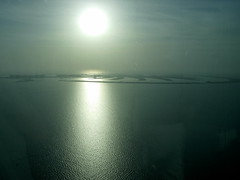
The other major developments are the artificial islands being built off the coast of Dubai. These are exceptionally large developments – increasing the length of Dubai's coastline by a number of factors.
There are currently 4 major islands being built, Palm Island Jumeirah is the most advanced in construction, with Palm Island Jebel Ali, Palm Island Deira and 'The World' also under construction. All are shaped like palm trees, while the World is a network of islands designed to look like the world.
All of the property on these islands has sold, or will be up for sale – for premium prices as one might expect.
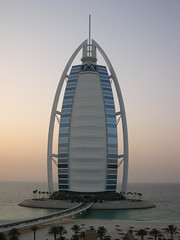
The iconic Burj al-Arab has become the icon of Dubai, and is often the symbol used on number plates for cars (many expensive ones like this). It is thought to be one of the tallest and most expensive hotels in the world.
Dubai Marina is, to me at least, a prime example of just what happens in Dubai. When I visited Dubai for the first time in December 2001, Dubai Marina was nothing more than a piece of desert. I found it odd to find, along the road to Abu Dhabi, a lone restaurant – a Hard Rock Café - entirely alone in the desert. 4 years later and it is surrounded by up to 25 completed gleaming skyscrapers – housing tens of thousands of people. It is testament to the work regime imposed on the immigrant workers – mostly from the sub-continent.
The average construction worker is either Pakistani or Indian, works 12 hours a day in up to 50 degrees Celsius (122 Fahrenheit), 6 days a week. He is paid about $150 a month for his effort.
Westerners - usually British, Irish, South African or Australian - work in the skilled sectors: engineers, surveyors, teachers or managers. And there are plenty of Western companies based there, among them Microsoft, Oracle, HP, IBM, Compaq, Dell, Siemens, Canon, Logica, Sony Ericsson and Cisco.
Dubai, as an Emirate in itself, will run out of oil within two decades (the rest of the UAE has an estimated 100 years left), and because of that it is gearing itself for tourism. Last year it made more money from tourism than it did from oil – thanks to it's weather, its liberal attitude to alcohol consumption, fine restaurants, luxury hotels and massive shopping malls. The recently opened Mall of the Emirates boasts what it claims to be the largest mall outside of North America, and the third largest in the world – and includes the only artificial ski resort in the Middle East. These malls include most designer names that one could think of – other shopping malls compete with it, but while smaller remain impressive – City Center, Mercato, Burjuman and more. DubaiLand , a theme park, is also planned, not far from the site of the Burj Dubai.
Dubai is a city that changes at an incredible rate, in one area alone I counted over 100 construction cranes, in 14 months since I last visited there, over a dozen skyscrapers have appeared out of nowhere, while more than further 40 are under construction.
But can it last?"


|
8 Comments:
Dubai seems to be the modern version of 1950's Cuba.
Gavin Sheridan seems to have the same view of "all" westerners on how should be a modern day third world country – a pity for an Irishman – or maybe he has it because that's what Ireland managed to achieve lately (without the glitter of Dubai) with the European Structural Funds and U.S. Multinationals.
Iraq – irrespective of politics – prior to the two wars had a vibrant economy with on top a proper education system and a proper infrastructure. In other worlds you build a country and sustain it with scientists and an industry not relatively cheaply paid subcontinent (in the case of Dubai) immigrants to entertain the western tourists.
Lebanon or indeed Cuba once again !
Sounds like they're trying to become to the ME what Hong Kong was to China before 1997.
Tom Friedman thinks Dubai the model for Gaza. Or he used to.
Tom thinks too much
A 20005 Zogby poll indicated that more Iraqis selected Dubai as a model than any other single country. It beat the UK, the US, and France. Dubai's affluence and cosmopolitan Muslim culture might well appeal to many Middle Easterners. Latin Americans are also impressed by what they hear about Disneyworld. Orlando has a significant community of immigrants who, visa or no, have opted to stay and work there. But do Dubai or the Magic Kingdom represent any sort of replicable model? Would an avenue of gleaming hotels, shopping malls, yacht harbors, and bank towers really change life for most Iraqis?
Islet, oasis, or theme park mini-states are difficult to compare to large nations. Singapore may have something to teach Asia, but its unique circumstances mean it cannot be a model for rural India. Miami is not a template for Peru. Atlantic City is not even a model for Atlantic City. Dubai may qualify as a Geneva cum Disneyworld for the Middle East, but tells little about how Egypt should raise revenue or create jobs.
Rxpatriate workers in Dubai are surely glad to have jobs, and they are better off than at home, but I wonder if this sort of model means anything outside of the UAE or similarly situated enclaves.
Oil wealth creates some distortions and hazards too. It can subsidize many things, but makes others uncompetitive and can concentrate economic and political power.
I wish Dubai and its people all the best. However, I hope it no offense that, were I to visit that party of the world, I think I might learn more by stops in Cairo, Damascus, Isfahan, or Istanbul. Add Baghdad, too, once (inshallah) Iraq is in peace. No need for palatial hotels with marble, onyx, Moghul arches, or lavish fountains. Tidy two or three star accomodations would suffice.
You said it.
Gav makes no mention of perhaps its most characteristic feature: rampant corruption and economic criminality.
As I read Gavin Sheridan's article, I couldn't help but be reminded of another piece written by Mike Davis recently on the exact same subject ... a piece entitled "Sinister Paradise".
If anything, the situation in Dubai sounds a whole lot like what the U.S. may be headed for ... rule by the corporations and the elites, while the rest of us are forced to suck it up in silence and subsist on their meager leavings. Somehow I can't bring myself to wish that upon Iraq ...
I have lived in the UAE as a Western expatriate the past 5 years. Gavin Sheridan paints a rather accurate picture of what Dubai is like. But I agree with some of the other posters here. I think it unlikely Dubai could serve as a model for any other place. It has a unique combination of circumstances that allows for an unprecedented amount of development to happen within a short period of time.
Looking at the building boom here alone, it is New York circa 1920-30 and Hong Kong circa 1960-70 all over again. If anything Mr. Sheridan's account understates the real extent of the development. It isn't just buildings, but also highways, trains, tunnels, bridges, rivers, lakes, islands--it is New York City cum Orlando cum Miami Beach all being re-created 21st century style.
Despite the apparent superficiality of it all, I think Dubai will succeed because it is tapping into the new global economy--which consists of a lot of wealthy, highly mobile people. It is no coincidence that the development of tourism and the Dubai national arline, Emirates, is at the center of the current growth. Within only a few years Dubai increased tourist and transit volume at its airport from less than a million to over 5 millon. The present airport is being expanded to handle up to 20 million visitors per year and construction of a new airport has been started which when complete will handle double that number.
There are less than two million people in the emirate--a third of them underpaid laborers and other low wage workers--yet government and private firms are constructing hundreds of thousands of luxury accommodations. One plan envisions a new city built on artificial islands and along the banks of an inland river, also to be constructed, to house up to 1 milllion people.
In the new global economy there are at least a few million millionaires and 10's of millions of middle class citizens around the world, some of whom can be tempted by the tax-free, laises faire lifestyle which is what Dubai is offering. Visas? Buy a residence and you get a residence visa. There's little red-tape or beauracracy. At present, British are buying up properties in the thousands. This is only the start as other Europeans and Americans will see the same benefits the British see, to be followed by wealthy and middle class Indians, Chinese and Japanese.
Is it possible that a couple hundred-thousand millionaires will come to Dubai and buy property within the next 10 years, I say yes. And another million or two middle-class retirees, vactioners and others with good incomes and savings? Why not?
It may seem far-fetched now, but those who already know Dubai are attracted to the low tax, low crime and soon to be ultra-modern environment. As more people discover that, they too will be take an interest.
For Publication
With oil trading at near record highs and no hurricane in sight, there can be little doubt a panic mentality is taking hold of the oil commodity markets. People should realize there is no shortage of oil anywhere in the world.
In the USA stocks of oil are plentiful, near their highest level. Neither China nor India are using enough oil to cause a shortage. World demand for oil is not driving up the price, so what is.
Iran is the main reason the oil price is trading high. However, it seems it is the intent of the Iranian leader to drive the price of oil to $100 a barrel.
What better way than telling the world they are going to build nuclear power plants. Israel has declared they will not allow that to happen, so there is no risk of an Iranian nuclear weapon.
Israel will bomb Iranian nuclear power plants if they continue their inept rhetoric. Since the leaders of Iran know that, it appears they are playing a bluffing game, as did Saddam Hussein, with his so-called weapons of mass destruction, which he never really had. He skillfully implied information into the system that was not true, but that backed-fired on him because Mr. Bush called his bluff.
An important point to note is Iran needs the revenue from oil to finance their counties requirement, so there is little chance of them cutting supplies for any extended period of time.
If the western world chooses to help the leader of Iran gets his wish with $100 a barrel oil then they will keep allowing the speculators to dictate the price that is traded on the oil exchanges. The more the media oil "experts" focus on $100 mark, the closer it get to becoming a reality.
A sky-high price when supply is plentiful goes against every economic law of supply and demand. It seems a plan of diabolical cleverness, from of a few powerful, scheming people, are using peoples speculative greed and fear psyche, as a weapon against America, in the same way they used USA aircraft to blow up the Trade center on 9/11...It seems to be working.
A panic driven mentality will hold the world at ransom with high oil prices until common sense returns to the mercantile futures exchange. A few greedy speculators will profit from everyone else's distress and the Iranian leaders will be laughing all the way their oil platforms.
They say you can fool all the people some of the time and some of the people all the time....I guess its time to stop fooling around and wise up to the fiendish plot of leaders who want to harm the Western economies.
The best way to defeat this enemy is to get the price of oil back to fair value of $35.00 a barrel. Market forces will return one day when people wake up to real supply and demand economics ... Until then, the enemy at this poker table has the upper hand.
Michael Levy. Author - Joys of Live Alchemy,
http://www.pointoflife.com/
P O Box 7 3032 East Commercial Blvd.
Fort Lauderdale
Florida 33303
USA
Post a Comment
<< Home