
James Aronson Award for Social Justice Journalism 2005
I kept meaning to blog the nice award ceremony held April 12 in New York at Hunter College, at which the 2005 James Aronson Awards for Social Justice Journalism were handed out.
The unsinkable Molly Ivins was given a lifetime achievement award. She couldn’t be there in person, but sent a wonderful videotape in which she warned against the corruption of news by the info-tainment industry and the demand of big corporations that news make a 15% profit for them. (This level of profit cannot be generated by real news, thus the rush to substitute scripted soap operas.)
Anthony Lewis, author and longtime columnist for the New York Times, also received a lifetime achievement award. He was there in person and it was a great honor to meet him.
Freelance cartoonist Kirk Anderson
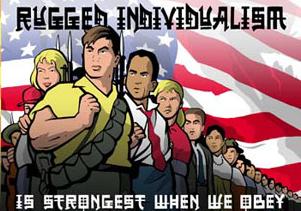
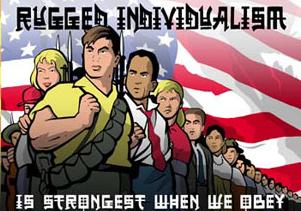
received the award for his politica cartooning. You must check out his illustrations of Bush administration policies in the style of Maoist social realism. My favorite is, “Rugged individualism is strongest when we obey.” Some publisher should get him to do a whole book!
Gary Fields of the Wall Street Journal (yes!) received an award for his courageous reporting on a bloated prison system collapsing under its own weight.
Kevin Fagan and Bryant Ward were recognized for making the homeless in San Francisco (15,000 strong) a “beat,” reporting on them for the past 3 years. Fagan and Ward have explored innovative solutions to the problems of the homeless, about half of whom are families fallen on hard times and another third of whom have mental problems. They got the ear of Mayor Gavin Newsome and some of their suggestions have been implemented in SF, with already noticeable good results. My heroes.
Tracie McMillan of City Lights was honored for her reporting on the “disconnected,” young adults who are “not in school, not working and not looking for work,” and for her work on the working poor and the “new safety net.”
For the first time, an award was given in the category of social justice blogging journalism, and Informed Comment was the recipient.
The “Notes on the Winners” says here:
Blogging at its Best: Juan Cole, Informed Comment.
‘ Blogging represents a significant new form of communication–sometimes merely scurrilous, sometimes a vital extension of public debate–and of journalism. “Informed Comment,” Cole’s Iraq War web log, shows the form reaching its highest social value. Cole, a professor of history at the University of Michigan, brings his scholarly expertise to the analysis of daily events. He speaks Arabic, Persian and Urdu and has lived for long periods in various places in the Middle East. As a blogger, he becomes a sort of hybrid scholar/journalist as he gathers links to US and international news, then draws from his professorial expertise to provide running commentary on the insurgency, the American military response, and nuances of Middle Eastern politics and religion. His easy, humorous style recalls I. F. Stone’s Vietnam-era newsletters and makes his dispatches an indispensable tool for understanding the social justice implications of this complex conflict. ‘
My thanks to Peter Parisi and the other members of the award committee. I am humbled and honored to be in this company, and want to acknowledge that I couldn’t do what I do without depending heavily on a legion of brave and perspicacious journalists and on courageous and principled progressive bloggers, many of whom will no doubt be winning this award over the years. And, of course, I get absolutely indispensable help and support from my wife, Shahin M. Cole. Thanks so much to the award committee for being so far-sighted as to include the blogging category!
——–
PS Just to remind everyone of my current project, to get Thomas Jefferson, Ben Franklin, and others translated and published in Arabic. Help is most appreciated, and we are well on our way!


 © 2024 All Rights Reserved