
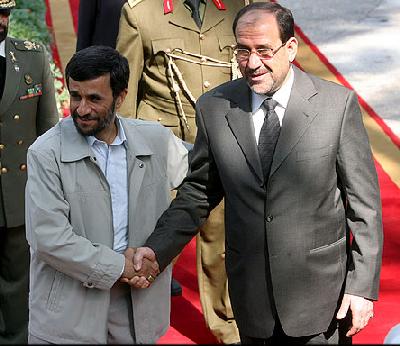
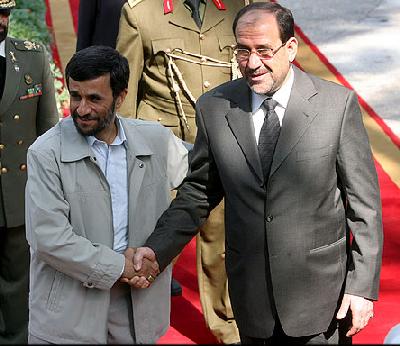
Maliki in Tehran for Oil Deal
60 Bodies found; 24 Dead in Bombings
A bombing Wednesday morning killed 3, and 60 bodies were found in various parts of Baghdad the previous 24 hours.
Courtesy of Mehr.
Iraqi Prime Minister Nuri al-Maliki and Iranian President Mahmud Ahmadinejad had something of a lovefest at their press conference on Tuesday. Ahmadinejad expressed his complete support for the Iraqi parliament, political process and government. The Iranians always sound just like the Bush administration when they talk about political progress in Iraq. Ahmadinejad also offered help with security affairs.
Al-Maliki declined to associate himself with American charges that Iran is fomenting turmoil in Iraq, saying that there were no obstacles to security cooperation between the two countries.
Iran and Iraq will cooperate in pumping petroleum from oil fields traversed by their common border, and in its refining. One such project could be online within a year. These fields are far from the Sunni Arab areas, and Iran would help with security, so that they could help the government escape the economic blockade the guerrilla movement has placed on the northern Kirkuk fields, which generally cannot export through Turkey because of pipeline sabotage.
AP reports that a member of Maliki's Da`wa Party in the Iraqi parliament, Haidar al-Obadi, maintain that radical Sunni fundamentalists did infiltrate Iraq via Iran, though he admitted that it was probably without Iranian government knowledge and support. Iran is three times the size of France and its border with Iraq is hundreds of miles long, running through rugged mountainous regions. (It is actually more likely that most radicals coming to Iraq infiltrate from Saudi Arabia, Jordan and Syria. And there aren't very many such foreign fighters in Iraq anyway, and nor are they the main source of violence.) It is ridiculous to think that Iran is supporting or supplying radical or neo-Baathist Sunnis to blow up Iraqi Shiites, more especially their clients, the Supreme Council for Islamic Revolution in Iraq and its Badr Corps paramilitary, which was trained by the Iranian Revolutionary Guards Corps.
AP reports that 24 were killed in civil war violence in Iraq, including bombings in Baghdad and elsewhere and a rash of assassinations. AP also reports an effort in parliament to get a resolution going calling for the withdrawal of US troops.
'A group of lawmakers tried Tuesday to take advantage of the unpopularity of U.S. troops among many Shiite and Sunni legislators to seek approval of a resolution setting a timetable for the withdrawal of foreign troops _ something the Shiite-dominated government has refused to do.
Sponsored by supporters of radical Shiite cleric Muqtada al-Sadr and some Sunni Arabs, the resolution managed to gather 104 signatures in the 275-member parliament before it was effectively shelved by being sent to a committee for review.
That committee will need at least six months to examine the resolution and present its findings to parliament. If it were to be approved, such a resolution would be binding on the government.
"We do not want another kitchen in which decisions are cooked away from the representatives of the people and away from the hearing of the Iraqi people," complained Falah al-Mishaal, the Shiite legislator who presented the resolution. '
102 signatures was enough to get the resolution broached if it is reported back out of committee. Typically a good 80 MPs haven't actually been coming to the sessions, so it is possible that the resolution gained the support of over 50 percent of the members present on the floor. That is, if it had not been sent to committee for review, the resolution could well have just passed on Tuesday. The Iraqi government would be bound by such a majority vote. Apparently the Maliki government has found a parliamentary maneuver allowing it to postpone the resolution for at least 6 months.
Reuters has more details on the violence.
The Iraqi government estimates that 40,000 internally displaced persons have recnetly returned home to districts such as Kadhimiyah, after 170,000 had been displaced by sectarian violence after the Samarra shrine bombing in late February. There are still districts too dangerous to go back to, such as the Sunni al-Jadidah quarter and the Shiite slum of Sadr City in east Baghdad, to which Sunnis are not moving back.
The top Marine commander denies that his forces have lost al-Anbar province. He admits, however, that their mission is not to defeat the insurgency and that all they are doing is "stifling" it. He said that the war would be won politically, when services and goods are provided in sufficient numbers to woo away the Sunni Arabs from the insurgency.
The problem with this set of statements is that they don't contradict the intelligence report that said that al-Anbar had been lost politically. It wasn't being alleged that the Marines couldn't go on "stifling" the insurgency. The allegation is that there are no functioning government institutions in the Sunni Arab areas. The allegation is that hearts and minds have been decisively lost. What the American commanders either don't understand or don't dare say is that the process of stifling has driven more and more and more Sunni Arabs into opposition to the US presence and the new government. In summer of 2004, when David Petraeus was running Mosul, Ninevah province was relatively quiet. Now there are bombs, killings, trouble. Mosul became a problem with the Fallujah assault, and it has never since stopped being a problem. Samarra is a problem. Tikrit is a problem. Baqubah is a problem. Kirkuk is a problem. Ramadi is a problem. If you just keep a lid on the problems, "stifling" them and driving ever more people into opposition, someday you will wake up and find that you really have lost, and not just politically.
The reason, moreover, that the Marines have not "won" is because they cannot. If winning means doing to Ramadi what they did to Fallujah, well that would just drive even more Sunnis to insurgency and further radicalize everyone from Ramadi, wherever they scatter. You could de-urbanize the whole Sunni Arab heartland, but then you'd have large numbers of mobile angry refugees, another Palestinian problem that would last decades and be destabilizing. There is no military solution.
Stifling is very bad. If that is all they can do, they should leave. Who cares who the mayor of Ramadi is? And, if they organize to try to overthrow the Maliki government, well, then they can be fought when they begin to march. They would not get very far if the US air force did not want them to.
Tom Engelhardt on the real link between 9/11 and Iraq.
My reconsideration of the significance of 9/11 for Foreign Policy is reprinted here.

|
Facebook


13 Comments:
In November, 2005, General Casey, commander of US forces in Iraq, convened a meeting with the leaders of the insurgency in the vicinity of ar-Ramadi. He asked what it would take for them to stop attacking our forces. They told him they were ready to take control of their own cities, and take responsibility for securing their own communities, and please allow them to return to a normal life.
Sensing he was about to pull off a dramatic political victory, he said there was just one condition to keep up appearances that the central government in Baghdad was really in charge, these Sunnis would have to accept that forces of the Iraqi Army or Police from the Ministry of the Interior would take over security responsibilities in their communities. These forces are dominated by Kurds and Shia Iraqis.
This was unacceptable to the people of ar-Ramadi. These other ethnic groups would be just as brutal if not more so than the US occupying troops.
General Casey cursed them, threatening that their city would get the Faloojah treatment.
Professor, I know who cares about who is the mayor of ar-Ramadi. Dexter Filkins cares, because he wrote up an admiring portrait of the quisling appointed to that post by the US commander. A Mayor who cannot leave the US military compound in ar-Ramadi, who cannot visit his constituents or hear their concerns. General Casey cares, because of his spite for those Sunni leaders who demanded Democracy for the city last November. President Bush cares, because, at this point, authentic democracy in Sunni Iraq feels to him like a defeat, just as it signaled defeat in the Palestinian territories, Iran, and Lebanon.
Heres a dilemma: if President Bush sends another division into the al-Anbar to fight the enemies of democracy, well have the US Army fighting the USMC.
Heres a partial solution: lets stop ordering our soldiers and marines to oppose freedom fighters, and instead work with these communities to help them get control and start fixing the place themselves. Why does it always have to be about US ?
And to think, when we started this war, we thought we were fighting FOR freedom and democracy. Now, the President fears Iraqi freedom and democracy as a threat. I guess the bigger question is: a threat to what ? Certainly not to US national security.
Actually, David Petraeus's division left, in stages, between January and March 2004.
Moreover, Mosul was literally the safest city in Iraq before he took charge, with no night curfews, insurgency, or crime.
The troops were also welcome, walking in town without weapons and using local shops regularly.
By the time he left, car bombs, mortars, and big gun fights were widespread, and so were F16 and helicopter bombings of civilian areas.
His biggest crime was, however, establishing "turban democracy". He created the first Provincial Councils in Iraq, in both Mosul and Kirkuk, out of US friendly Turbans, arguning that this is democracy since the Turbans distribution was ethnically and religiously fair. This set the scene for Turban power and secterianism with the horrific consequences we all know.
David Petraeus is a great PR man but a bad leader and person who cost the Iraqis and Americans a lot of lives.
Stifling is very bad. If that is all they can do, they should leave. Who cares who the mayor of Ramadi is? And, if they organize to try to overthrow the Maliki government, well, then they can be fought when they begin to march. They would not get very far if the US air force did not want them to.
I get the chills everytime I read you writing this. Isn't that the identical, fallacious reliance on air power that led the Israelis to "stifle" Lebanon? That led the Israelis to fire more then a million cluster bombs into Lebanon during the last days of the their latest war there?
I'm afraid that the US Air Force's penchant for bombing civilians, standard procedure since WWII really, simultaneously makes it militarily the most ineffective and terrifying organization in the world. Yet it is so well integrated into the fiber of our nation, into our panoply of terror against terror, that even you, an otherwise transcendently wise commentator, are ever ready to call in the Air Force.
How many innocent Iraqis has the US Air Force already killed? Tens, or hundreds, of thousands? How many cluster bombs have they already delivered to Iraq, how many already lie in wait for Iraqi children to pick them up?
The US Air Force is the most remorseless, the most brutal killing machine of them all. Its targets are primarily civilians. Its kind of "stifling" is no more needed in Iraq than is the Israeli "stifling" of Lebanon and Gaza.
Anbar Province appears to be a lost cause, mainly because the Sunnis who inhabit it refuse to stop fighting against the foreign occupying power (that would be US). Since surrender to US forces would automatically mean disarmament, leaving the Sunnis defenseless against the well-armed Shiite militias, they are essentially fighting for their very survival. So they fight on, using the tactics available to them (IEDs, ambushes, car bombs, suicide bombers, etc), and with some small number of foreign fighters - estimated at 3 to 10% of the total.
It is a mistake to place emphasis on the 'Al Qaida in Iraq' aspect. Yes, Zarqawi was a member of Al Qaida, and yes, both the insurgents in Iraq and the main Al Qaida group in Afghanistan/Pakistan claim a relationship, which certainly is there. The mistake is in considering the insurgency in Anbar Province to be a 'pure terrorist operation'. IT IS NOT. Like Hezbollah in Lebanon, the Sunni insurgency in Anbar Province is the sub-nationalist voice of the Sunni people, fighting against oppression, invasion and occupation. And, as in Lebanon, mis-labeling has caused our side to fight the wrong war, because we do NOT understand the enemy.
Let's make no mistake about this: if we do not accurately identify our enemy, and understand his motives, capabilities, strategy, tactics, strengths and weaknesses, we probably cannot defeat him. We found this out in Vietnam, where we failed to understand Ho Chi Minh and the North right from the start. Bottom line: you cannot make your enemy what you want him to be, no matter how hard you try. We are learning this lesson again, the hard way, in Anbar Province, where we insist that we are fighting 'terrorists', so we chase them around and around, when in fact we are fighting against a popular uprising. So we are bound to lose.
As to troop strength, it is critical to know that a month or so ago, a Stryker Brigade was moved from Anbar Province to Baghdad. This left the commander of US troops in Anbar unexpectedly short about 10% of his fighting force. When you are already losing the war, this is NOT a good thing.
Once again, we probably DO have enough troops in Anbar to fight against a 'terrorist group', but, as I pointed out above, that is NOT what we are up against. So our refusal to recognize the true nature of our enemy is once again causing us to lose a war. Brilliant!
The ultimate irony of our war with the Sunni insurgency is that, once we kill enough of them to degrade their fighting capability, they won't have enough left to stand up to the Shiites, which will make it easier for Iraq to complete its transition into a fundamentalist Islamic republic - what President Bush loudly and repeatedly calls 'Islamic fascism'. So our troops are dying in Anbar to make Iraq safe to become an enemy. Absolutely brilliant!
"War Is Not The Answer" - the Quaker's saying.
And they will also state that War Is NEVER The Answer - no matter how much some people love the idea of war for other people to be subjected to.
The Quakers were right about slavery and they are right about war.
According to the LA Times, that Marine commander is quoted as concuring with the report's analysis.
I thought we have elected such highly intellectual people to lead the country? Are they leading us to the better or to the worst?
http://www.chicagori.com
Air Force chief: Test weapons on testy U.S. mobs
WASHINGTON (AP) -- Nonlethal weapons such as high-power microwave devices should be used on American citizens in crowd-control situations before being used on the battlefield, the Air Force secretary said Tuesday.
I'm not making this up.
Maybe cluster bombs too, huh?
... one little counterintuitive correction to Bob's post, which is otherwise on target:
At this point, reducing the maneuver forces available to the commander of Multi-National Forces - West, the coalition command responsible for subjugating and oppressing the people of the al-Anbar, might actually be a good thing. It's the worn clichι about trying the smart approach when every other alternative has been exhausted.
If that commander is forced by a shortage of soldiers to look for civilized political solutions to fundamentally political challenges, and rely less on the force of arms, he will have to perpetrate (as in, crime against the neocon orthodoxy") the very first display of official US respect for the culture, values and dignity of the Iraqi Sunni population.
And whenever that event occurs, it will be the shot not fired but heard around the world.
That, my friends, will be the beginning of American success in Iraq. And the beginning of the "as they stand up, we stand down" drawdown of troops. And the beginning of Iraqi sovereignty. I pray that the day that American values start to inform American actions in Iraq comes soon.
Christianity in combat
I recently discovered, crusaders do exist - and theyre serving in the 523rd Fighter Squadron of our Air Force. The airmen of 523rd Fighter Squadron, based at Cannon Air Force Base, N.M., not only have invoked the term "Crusaders" to describe their unit, they use blatantly sectarian religious symbolism on the patches they affix to their uniforms and the official logo of their unit... The "Crusaders" patch prominently features a large cross - an unmistakable emblem of Christianity - as well as other accouterments of the historically dressed crusaders: a broadsword and armored helmet.
There is no hidden meaning here, no effort to disguise the reference to Christian religion. This Air Force F-16 combat squadron has taken the horrifying step of disregarding the Constitution, which, as servicemen and women, they should proudly uphold under the oath they all took to do so.
As we continue to engage in a war on terrorism against religious fundamentalists, we must take a moment to consider the sick irony of allowing Air Force combat personnel to dress in clothes displaying religious emblems.
The US Air Force is a hotbed of Xtianity and the racism that is attendant upon all forms of religious fundamentalism.
No doubt it is easier to drop cluster bombs on areas where they are sure to kill civilians, including children, when you "know" that god wants you to.
I'm kind of an obsessive optimist. I like to think there is always hope, even if we can't logically prove it or see it. The human capacity for hope is amazing and may be our signature trait. The fact that is, the human race continues to hope against hope, despite all evidence to the contrary. What makes villagers return to South Lebanon and rebuild their homes and businesses in the face of continued conflict? If any one has reason for despair, it's the citizens of Iraq. After surviving decades of war and dictatorship they find the fire far hotter than the frying pan. Still they will cling to the smallest threads of hope as shown by the quote below.
http://www.alertnet.org/thenews/newsdesk/IRIN/a09b71586562008ef22a08cdaa413c31.htm
"An increased security presence has given many displaced people the confidence to believe that the killings will soon be reduced. Increased patrolling and more checkpoints in sensitive areas are restoring hope to the country's war-weary citizens"
All this has been predictable, but none of this was inevitable. It's almost as if the colossally stupid policies of the last three years were designed to produce the resulting catastrophe. I still like to think there is some way out of this morass. That does remain to be seen.
Very much worth re-reading:
------------------------------------
Address of Michael C. Ruppert
To the Commonwealth Club San Francisco
Tuesday August 31, 2004
Thank you for that gracious introduction. Let me begin by thanking Pat Lamken for inviting me to be here today and for her efforts to arrange what is certainly for me a historic landmark in my 26 years of work to bring to light information vitally important, life and death, information which has been virtually ignored by the mainstream media. This information has also remained completely unaddressed or even publicly acknowledged by those elites in both America and the world that determine and shape public policy and direct the course of human events.
I say this with the full and complete awareness that I am tonight standing partially in the midst of those elites and that those elites are listening.
I have long been aware of the stature and prestige of the Commonwealth Club, for its ability to attract some of the world's most influential speakers; also for its reputation for bipartisanship; and perhaps most importantly for its willingness to present conflicting or opposing viewpoints. My appearance here tonight no doubt marks a departure for the club even from that inspiring record.
With today's remarks I intend to establish a whole new definition of "conflicting viewpoint."
I applaud the club's record and am mindful that, had it not been for the dangerous and epochal historical events taking place around us, I would never have been afforded such an opportunity as this. Because clearly, my writing and public speaking have demonstrated that where we are today is exactly where I said we would be if something fundamental was not changed about how we both view the world, and how we interact with it.
Before preparing this speech, of course, I did some research to see who had spoken here before.
I was happy to see that I follow on the heels of such notables as former CIA Director James Woolsey and two members of the Kean Commission on 9/11: Slade Gorton and Richard BenVeniste. These are not people who I would call "kindred spirits." I also saw the name of homeland security Secretary Tom Ridge and former Treasury Secretary Robert Rubin. These are also leaders of whom I have been sharply critical in the past and will be sharply critical of in the future.
I also saw names like John Kerry, John Edwards, Dennis Kucinich, Joe Lieberman and Madeleine Albright. My record as a journalist and lecturer shows that I have not embraced, and have indeed been fiercely critical of, most of these opinion makers. While I am more inclined to find kinship with Dennis Kucinich, I also state categorically that no political leader who does not address the real causes of the problems facing us will ever be considered by me as a true kindred soul or as a political champion for the future.
Such praise and endorsement I offer only to the likes of my good friend, the Honorable Cynthia McKinney of Georgia, and to former Assistant Secretary of Housing Catherine Austin Fitts. I heartily recommend them to the club as potential speakers for future events.
I also saw the names of spiritual leaders and independent or international voices like Al Franken, Jane Goodall, Arianna Huffington, the Rabbi Michael Lerner, Norman Mailer, Ted Turner, Hans Blix and King Abudullah II.
In looking at this long list of prestigious speakers I was very aware that the life's work of Michael Ruppert did not place me in any category that fit with these people. For the most part, I have long considered them to be part of a serious problem rather than pathfinders to its solution.
That realization brought to mind what was perhaps the single most memorable line from the 1992 vice-presidential debates in which Ross Perot's running mate, retired Navy Admiral James Stockdale a medal of honor winner and Vietnam POW asked, "Who am I?" and "Why am I here?"
I am not prone to over-analyzing such opportunities. I have always said that, if given the chance, I would walk into the lion's den or the devil's bedroom to make my case and that is what I intend to do today. This is as close as I have come thus far to either. For here, I can see tonight parts of the elite whose consciousness and attitudes must be changed if humanity is to even partially meet the challenges that are "in our faces."
For any of you who might be either lions or devils I hope that you have had a good meal recently and also that you have checked your pitchforks at the door. I also implore that your ears be open and your minds accessible.
For those of you who realize that a global crisis is casting its shadow across the entire planet, and who wish better to understand its dynamics, I am here to offer some of my experience and learning as a "mapmaker" who has no allegiance to partisan politics or any desire except to tell you the truth, no matter how disquieting it may be, or how divergent it may be from whatever cherished beliefs you may hold; from whatever cosmological principles you may believe in; or from whatever economic or other personal interests you may have.
A spiritual teacher once told me that my problem was not that I thought highly of myself; not that I thought lowly of myself; but that I thought constantly of myself. In that vein, let us all tonight try to think of issues larger than ourselves, our personal interests, our wants, or our fears.
Viewed from almost any perspective be it geopolitics, economics, climate, spreading warfare that threatens to unleash a global orgy of bloodletting, rising energy prices, documented energy shortages, fresh water shortages, biological warfare, the repression of civil liberties at home and abroad, or any of a dozen other issues planet earth and all of its inhabitants are in great danger. This is not a time to think of national security. It is a time to think of planetary security indeed, of planetary survival.
And I must recognize also that I would never have been afforded this incredible opportunity to speak to you today, had it not been for the consistent support and generosity, the research and activism, the courage and disenfranchisement, and above all the loyalty of all those people who have helped my newsletter, "From the Wilderness," grow in just six years from 68 to more than 15,000 monthly readers worldwide. Today our web site at www.fromthewilderness.com averages more than 12,000 visitors a day.
These include members of Congress, business and economic leaders, professors at more than 30 universities, respected journalists, and political leaders in many countries.
If anything had an impact on my thinking as I prepared these remarks it was my awareness that these loyal supporters are the people on whose behalf I presume to speak. It is their voice and their commitment which has given rise to my voice. I could not and would not be here were it not for them.
But I also, if I may be that bold, presume to speak for all mankind, regardless of religion, ethnicity, nationality, gender, sexual preference, bank account or any other artificial distinction.
This is no time to be shy. This is not a time when men and women of good conscience can afford to be politically correct or be guided by anything except a willingness to discard every "cherished" belief or opinion which stands in the way of an accurate and fearless appraisal of the world around us.
As I have said so many times in the last three years while delivering more than 40 lectures on the truth and lies of 9/11 and peak oil, in eight countries: the events in the five years following the attacks of September 11th will determine the course of human history for the next 500 years or more.
I can only assume that the record of my lectures and writings, wherein I have come to be known as a man who backs up everything he says and presents it to his audiences for verification, had something to do with how the Board of Governors reached its decision to extend this invitation. For many years now not a single fact, citation or piece of evidence, presented in my lectures, or in my best-selling video, "The Truth and Lies of 9/11," has been proved inaccurate. I am known as a man who does not expect people to take his word on faith but who asks and even expects people to challenge his research, evaluate it, and reach their own conclusions.
Operating under the assumption that the past credibility of my research has produced a record which got me in the door at the Commonwealth Club, I am today, in the interest of time and for maximum impact, going to dispense with my customary slide presentation. I fully expect that anyone who challenges or disagrees with my assertions will go out and do some checking for him- or herself.
Almost everything I present to you today will be fully documented by means of approximately 1,000 endnotes in my soon to be released book, Crossing the Rubicon: the Decline of the American Empire at the End of the Age of Oil. The book, published by New Society Publishers, should be available for sale from the FTW web site within 2-3 weeks and it will go on sale nationally, through all major outlets, by mid-October.
September 11th
Both here in the United States and around the world I am not alone in believing that the attacks of September 11th were facilitated, orchestrated and executed by the United States government. However, there is a great deal of misunderstanding and conclusion-jumping about these assessments that is not supported by the evidence. I was trained as a police officer and detective, and for many years now I have been an effective investigative journalist because I have adhered to strict evidentiary and investigative standards.
The 9/11 attacks were the result of deliberate planning and orchestrated efforts by identifiable leaders within the U.S. Government, and the energy and financial sectors, to see a Pearl-Harbor-like attack which would provide the American empire with a pretext for war, invasion and the sequential confiscation of oil and natural gas reserves, or the key transportation routes through which they pass. 9-11 was a premeditated murder and in my book, and here tonight, I will name some of the suspects who committed the crime. In my book I will show you overwhelming evidence of their guilt which I would be proud and confident to place either before a district attorney or a jury.
Historically, the assertion that the United States government would orchestrate an attack upon American interests has ample precedent. Former National Security Advisor Zbigniew Brzezinski described the need for such an event in several places in his 1997 book The Grand Chessboard." It was I who first brought this book to world attention in late 2001. The Project for a New American Century made reference to the need for such an attack in its 2000 report Rebuilding America's Defenses. Declassified top secret documents disclosed, by author James Bamford in his book Body of Secrets, tell us that in 1962 the Joint Chiefs had approved a plan called "Operation Northwoods" which was a covert operation that would shoot down American aircraft and stage attacks on American military facilities with the intent of blaming those attacks on Fidel Castro and prompting the subsequent US invasion and occupation of Cuba. The declassified Northwoods documents can be seen and downloaded from the FTW web site. But once viewed, they cannot be ignored.
Therefore it cannot be said that such a thing has never been conceived of or carried out by American political leaders. From the sinking of the battleship Maine, to the Gulf of Tonkin, and indeed, even to Pearl Harbor itself, history today provides us with abundant documentation of US government complicity in varying degrees in similar attacks. The book Day of Deceit and other records from the national archives have shown us that the Roosevelt administration had broken the Japanese codes well before December 7th, and that a conscious decision was made to allow the attack on Pearl Harbor to take place. This was intended to provide the necessary impetus for US entry into the Second World War at a time when Great Britain was buckling under the military blitzkrieg, aerial bombing and U-boat warfare of the Third Reich.
Crossing the Rubicon is a detective story that gets to the innermost core of the 9/11 attacks. It places 9/11 at the center of a desperate new America, created by specific, named individuals in preparation for peak oil: an economic crisis like nothing the world has ever seen. Simply defined, peak oil is that moment in time when global oil and natural gas production begins an irreversible and permanent decline which will not yield or give way regardless of how much money and effort is spent trying to change it.
With demand still accelerating rapidly in both the US and the industrialized and developing world, the arrival of peak oil literally describes a point of overshoot in which economic and ecological stasis let alone growth becomes unsustainable. Over the course of the last three years, From the Wilderness has pioneered the investigation and documentation of this crisis. With the invaluable research and writing of FTW's energy editor Dale Allen Pfeiffer, a geologist, and through my own travels and research in the US, France and Germany, we have drawn upon the expertise of those with decades of experience in the oil industry (many of whom have left it), independent scientists and academics having no connection to the energy industry, business and financial leaders, international bodies such as the International Energy Agency, and actual world events to draw attention to what is the single most serious threat facing mankind in its entire history.
It is my belief, as I speak to you tonight, that planet earth is plus or minus one year at the all-time peak of hydrocarbon energy production. Simply put, we have used half of all the oil god placed on this planet, and every drop, every barrel extracted from the ground from now on will become progressively more expensive, of lesser quality, and much harder to obtain. We have picked the low-hanging fruit. As all experts agree, peak is something we will only know of a certainty as we view it in our rear view mirrors.
The attacks of September 11th, 2001 were the pretext for the American, and to a lesser extent, the British and Israeli empires to begin seizing, by force, those energy supplies needed to sustain their power, hegemony (whether regional or global) and their teetering economies.
The attacks of 9/11 were accomplished through an amazing orchestration of logistics and personnel. Former national security aide and counter-terror advisor Richard Clarke has postulated that such a conspiracy could never be kept a secret. Too many people would have been involved, he said.
On this point I disagree with Clarke completely and point to the fact that the Manhattan Project, which developed the atom bomb, and the Stealth Fighter Project were both successfully kept secrets. The numbers of people involved in both of those projects far exceeded the numbers of people within the United States government required to execute 9/11.
However, I must express a deep debt of gratitude to Clarke. For in his book Against all Enemies, he left a compelling trail of bread crumbs, contradictions to the sworn testimony of our highest leaders, and hard evidence which provided me with much of the information needed to say that not only can I name some of the US government officials who perpetrated those attacks, I can also identify the prime suspect or Mr. Big who played the command role in executing them. Mr. Clarke is not a stupid man, and I can only conclude that he left those crumbs for others to find.
All of this of course stands in stark contrast to the report of the so-called independent commission which investigated those attacks. Before I start naming names, let me first take a look at why absolutely nothing presented by the Kean Commission can, or should, be accepted without challenge.
The Kean Commission
A recent story in the Minneapolis Star Tribune reported on how one US senator, Mark Dayton of Minnesota, found some egregious inconsistencies in the final report of the Kean Commission. The story said that during a recent hearing evaluating the Kean report:
"Dayton told leaders of the Sept. 11 Commission that, based on the Commission's report, a NORAD chronology made public a week after the attacks was grossly misleading. The chronology said the FAA notified the military's emergency air command of three of the hijackings while those jetliners were still airborne. Dayton cited Commission findings that the FAA failed to inform NORAD about three of the planes until after they had crashed.
"And, he said, a squadron of NORAD fighter planes that was scrambled was sent east over the Atlantic Ocean and was 150 miles from Washington, D.C., when the third plane struck the Pentagon 'farther than they were before they took off. '
"Dayton said NORAD officials 'lied to the American people, they lied to Congress and they lied to your 9/11 Commission to create a false impression of competence, communication and protection of the American people.' He told Kean and Hamilton that, if the Commission's report is correct, President Bush 'should fire whoever at FAA, at NORAD .. betrayed their public trust by not telling us the truth.'"
What Senator Dayton did not fully focus on was that, just a few short weeks before releasing its final report, the Kean Commission unilaterally changed the times of certain key events, negating and overruling testimony and evidence presented under oath, without having received a single new piece of evidence either formally or informally that contradicted or changed the evidence already received.
I'm sure that there are some attorneys in the room tonight. I wonder how many of you would acquiesce to the judge in a criminal trial submitting and ruling on evidence that neither the defense nor prosecution had presented during trial, but which the judge had somehow produced, without explanation, from his or her chambers. How would you react if the judge then ruled on the basis of that evidence, making no attempt to reconcile the evidence presented by either side? What would you say to the jury?
While Senator Dayton was astute enough to note some glaring inconsistencies and contradictions in a highly manipulated and frequently altered evidentiary record, he missed, or chose to ignore other elephants sitting comfortably in the living room of one of the most shameless pieces of dishonest public accounting in American history. These include the fact that the Commission inexplicably introduced, at the last minute, a completely new timeline of events surrounding the responses of the FAA, NORAD and the Pentagon on 9/11 in direct contradiction to previously sworn testimony and exhibits from these commands. In most cases this evidence was presented by the same men who actually made key decisions that day. Why?
In its mere constitution, the Kean Commission's members would never have been allowed to even approach the bar of judicial impartiality in an American courtroom to decide such an important case. They every one of them, including your two recent speakers would and should have been immediately disqualified from providing, as was mandated by law, "a full accounting" of the events of September 11th.
In describing to you some of these conflicts of interest, I would like to express my thanks to independent journalist JIm Rarey who did a magnificent job of cataloguing the histories of the wolves and the foxes who managed the hen house of September 11th's historical record. The following is only a partial description of some of the more obvious conflicts within the Kean Commission.
Thomas Kean, Chairman
Thomas Kean is a director (and shareholder) of Amerada Hess Corporation, which is involved in the Hess-Delta joint venture with Delta Oil of Saudi Arabia, owned by the [Khalid] bin Mahfouz and Al-Amoudi clans. This company was involved in the initial planning for a trans-Afghan oil pipeline just prior to September 11th. Khalid bin Mahfouz, once a senior executive with the legendary organized crime bank BCCI, is Saudi Arabia's largest banker, and his clients include both the Saudi royal family and the Saudi bin Ladin group of companies.
Coincidentally, the former Governor of New Jersey is also a member of the Council on Foreign Relations, together with another prominent member of the board of directors of Amerada Hess, former Secretary of the Treasury Nicholas Brady.
It is also worth mentioning that Thomas Kean also sits as co-chairman of the Homeland Security Project (HSP) under the auspices of the Century Foundation. In this capacity, Kean has played a key role in the draft recommendations of the Century Foundation, which partially laid the groundwork of the Department of Homeland Security legislation.
Journalist Wayne Madsen has shown with ample documentation that George W. Bush also had business relations with Khalid bin Mahfouz, when he was in the Texas oil business. Both George W. Bush and Khalid bin Mahfouz were also implicated in the BCCI scandal closely tied to the Iran-Contra and savings and loan scandals.
Other links between Bush and Mahfouz can be found through investments in the Carlyle Group, an American investment firm managed by a board on which former President George H. W. Bush himself once sat. The younger Bush personally held shares in one of Carlyle's owned companies, Caterair, between 1990-94.
Lee Hamilton, Vice Chair
In 1987, House speaker Jim Wright (who later resigned in disgrace) appointed Hamilton to chair a committee investigating the Iran/Contra affair.
When a question was raised about CIA/Contra drug smuggling, the response was release by Hamilton of a cursory review that concluded there was no truth to the charges. The CIA released a report in October of 1998 (volume ii of the CIA Inspector General's report on Iran-Contra drug trafficking), that received almost no publicity, yet admitted the drug connection and direct CIA involvement in the transshipment of thousands of kilos of cocaine.
Hamilton played a key role in the so-called October Surprise of 1980-81 in which it was charged that the Reagan-Bush campaign team was reported to have secretly negotiated with Iran's revolutionary government to delay release of the American hostages held at the US embassy in Tehran. The deal was that the hostages would be released after the presidential election so that Jimmy Carter could not benefit from their emancipation during the campaign. In this progenitor of the Iran-Contra scandal, military weapons were promised to the Iranian government in exchange for its cooperation. The evidence was serious enough to warrant Congressional hearings which were ultimately chaired by then Congressman Hamilton. As most of us who are old enough recall, the hostages were not released until the very day of Ronald Reagan's first inauguration in January of 1981. This was one of history's great coincidences.
For more than four decades, veteran Washington journalist Sarah McLendon was the grand dame of the White House press corps. Until her January 2003 death (at 92) she was a revered and active journalist known for her feisty confrontations with presidents and the powerful dating to the Truman administration. In her later years she had a great habit of appearing to be asleep in her wheelchair until the moment when she would wake up and pounce on her prey with incisive questions that revealed she hadn't missed a word of what had been said. Once, on national television and in the middle of a live White House press conference, she even dared to question President Bill Clinton about the abundantly documented record of CIA and Arkansas state government involvement in drug smuggling operations at Arkansas' Mena Regional Intermountain Airport during the 1980s.
In 1994 and 1995, while living in Washington, I was a regular attendee at McLendon's weekly study group at the National Press Club and later at her residence on Connecticut Avenue. After she passed, the National Press Club renamed one of its conference rooms as "The McLendon Room." In 1992 McLendon offered her observations on Hamilton's behavior as the chief "fact-finder" and chair of the October Surprise and Iran-Contra committees.
"I declined to withdraw the report I made that Congressman Hyde elicited and obtained a promise from chairman Lee Hamilton, D. Ind., of the House Task Force on October Surprise, that the group would clear President George Bush of going to Paris to cinch a deal of weapons for Iran in exchange for retaining American hostages to be delivered to President Ronald Reagan and not to outgoing President Jimmy Carter. Hyde says he made no such a deal and I must remember that Hamilton is a Democrat. That makes no difference. Hamilton held a press conference to clear Bush before the investigation into the deal between the Reagan-Bush candidates for presidential office and the Iranians had even started. Hamilton then admitted he had not interrogated witnesses or talked with his special attorney hired to investigate the matter."
Iran-contra, in all its horrific corruption, was effectively "managed" by Lee Hamilton in the House and John Kerry (among others) in the Senate throughout the late 1980s to conceal the greatest crimes of the era crimes committed by a litany of well-known government operatives. At the time, Hamilton was the chairman of the House Permanent Select Committee on Intelligence.
While many activists regard 2004 Democratic presidential candidate Kerry as something of a hero for bringing many details of Iran-Contra drug activities to light (and into the public record), others, more deeply versed in the evidentiary record, suspect that he also did a masterful job of keeping some of the most damaging Iran-Contra secrets especially records of CIA proprietary company operations hidden. I am among the latter group.
Many figures who came under criminal and investigative scrutiny in Iran-Contra, like John Poindexter, Elliot Abrams, Richard Armitage, Dick Cheney, Otto Reich, Colin Powell and John Negroponte, returned (with little or no congressional opposition) to serve in the current Bush administration after the 2000 (so-called) election.
Veteran AP journalist Bob Parry, who broke the first major story linking drug smuggling to Contra support activities, only to later lose his job, offered some additional observations on Lee Hamilton in his independent web newsletter consortium news.
"One of the key congressional Republicans fighting this rear-guard action was Rep. Dick Cheney of Wyoming, who became the ranking House Republican on the Iran-Contra investigation. Cheney already enjoyed a favorable reputation in Washington as a steady conservative hand. Cheney smartly exploited his relationship with Rep. Lee Hamilton, D-Ind., who was chairman of the Iran-Contra panel. Hamilton cared deeply about his reputation for bipartisanship and the Republicans quickly exploited this fact."
Not only did Hamilton fail to find any wrongdoing by top officials in either investigation, he was even "satisfied" with the performance of Marine Lieutenant Colonel Oliver North in the Iran-Contra hearings. As one commentator connected to the national security archives observed:
"North appears before the House Select Committee on Intelligence to answer questions about his role in a Contra resupply operation. He lies convincingly: he has "not in any way, at any time violate[d] the principles or legal requirements of the Boland Amendment," which bans federal support for the Nicaraguan counter-revolutionaries. Committee Chairman Lee Hamilton, D-Ind., pronounces himself satisfied with North's "good faith." When North's superior, John Poindexter, is told of his successful deception of Congress, Poindexter emails Ollie: well done. '"
Philip Zelikow, Executive Director
Perhaps no more glaring conflict of interest attracted opposition from victim families and 9/11 activists than that of the Commission's Executive Director Philip Zelikow. Concerns were raised when it was disclosed that only two Commission members and Zelikow might be allowed to see certain classified presidential records, including the much ballyhooed and publicly debated Presidential Daily Briefing (PDB) of August 6, 2001.
Personally, I viewed the August 6th PDB as a red herring and a hubristic pretext over which the Commission could make a show of "battling" the White House for information. The PDB, titled, "bin Laden determined to strike in US" was eventually released in a one-and-a-half page version that was presented to the world as "complete."
Nothing could have been further from the truth. The respected German paper Die Zeit published a story in October of 2002, well before the PDB became an issue, stating that the PDB was actually eleven-and-one-half pages long. Since I had documented so many other clear, direct and credible and apparently more detailed warnings of the 9/11 attacks, the Aug 6 PDB was a non-issue for me. In Crossing the Rubicon I will document more than a dozen specific warnings which foretold hijacked airliners being crashed into the World Trade Center during the week of September 9th. Other warnings, such as massive insider trading on financial markets from Hong Kong to Tokyo, to Chicago, to New York, to London and Berlin, told those who were watching that the airlines involved would be United and American. The insider trading, acknowledged and documented by the likes of CBS News, Bloomberg, and respected financial commentators was given the complete brush-off by the Kean Commission in its final report. All it said was that Osama bin Laden and Al Qaeda did not make the trades. In my book I will give you an idea of who did.
The controversy arising from the public debate over Zelikow forced even the New York Times to comment on some of his more obvious conflicts of interest.
"Advocates for the families said they were alarmed by the Commission's disclosure on Thursday that only one of the 10 Commissioners would have access to a wide range of the briefings, and that the only person from the Commission with similar access would be its staff Director, Philip Zelikow, who has close ties to Condoleezza Rice and other senior officials in the Bush administration.
"The Commission has previously rejected a request from victims' families to limit Mr. Zelikows responsibilities sharply in light of potential conflict of interests involving the White House.
"The families' advocates said the decision to have Mr. Zelikow be one of only two Commission officials with wide access to the highly classified documents the other is Jamie S. Gorelick, a Democratic Commission member who was Deputy Attorney General in the Clinton administration raised new questions about the investigation's impartiality
"Mr. Zelikow, who wrote a book with Ms. Rice in 1995, was on the Bush administration's transition team for the National Security Council and has acknowledged having contacts earlier this year with Karl Rove, President Bush's chief political adviser, about Mr. Zelikow's scholarly work at the University of Virginia.
What's more, Zelikow had been serving as a member of President Bush's Foreign Intelligence Advisory Board (PFIAB) since 2001 and he also made a September 2002 public statement saying that US military action against Iraq would be based upon a desire to protect Israeli interests rather than any real threat from Iraq.
Perhaps the worst conflict of interest was the fact that Zelikow had advised the incoming Bush administration on terror-related intelligence matters and had several discussions about bin Laden and Al Qaeda in 2000-2001 with Richard Clarke. By rights, he should have been a witness testifying under oath before the Commission instead of its Executive Director. When many of the victim families learned of this they were justifiably outraged at an arrangement that would have never been permitted in a court of law.
In spite of all the controversy, and calls from many for his resignation, Zelikow remains securely in place at the Kean Commission to this day.
Jamie Gorelick
Freelance journalist Jim Rarey writes:
"Considered one of the fifty most powerful women in the country, CFR member Jamie Gorelick is currently vice-chair of the giant mortgage lender and insurer Fannie Mae. From March 1994 until she joined Fannie Mae in May 1997 she was Deputy Attorney General, the number two spot in Janet Reno's Department of Justice.
"In May 1995, the intelligence community Law Enforcement Policy Board was established to meet quarterly and discuss mutual concerns of the Attorney General and Director of Central Intelligence. The board was co-chaired by Gorelick and DCI George Tenet. Other members included all of the law enforcement agencies, the Assistant Secretary of State for Intelligence and Research and the Defense Department General Counsel.
"This is the same time frame (spring of 1995) in which the Philippine government apprised the FBI, CIA and State Department of Project Bojinka, an Islamic terrorist plot which included hijacking commercial airliners and flying them into the Pentagon, World Trade Center towers, and several other buildings.
"The BCCI scandal involved a number of powerful individuals. Clark Clifford and Robert Altman were the top two officers in First American, the new name given Financial General Bankshares when it was taken over by BCCI (known as the Bank of Crooks and Criminals International in the corridors of Washington) with the help of the Jackson Stephens / Lippo Worthen Bank and the Rose law firm.
"First American is said to have been using the notorious PROMIS software.
I will have a great deal to say about this legendary "spyware" in Crossing the Rubicon. Back to Jim Rarey:
"When BCCI and First American were exposed, the legal defense team for Clark Clifford and Robert Altman attracted a bevy of well-known names, including Robert Fiske (later the first "independent counsel" investigating Whitewater and Vince Foster's "suicide"), Robert Bennett (later attorney for Bill Clinton), and Jamie Gorelick
"In 1998, while at Fannie Mae, Gorelick served on Clinton's Central Intelligence National Security Advisory panel as well as the President's review of intelligence."
At one point in the Kean Commission hearings, a brief stir was caused when Republican partisans charged that Gorelick bore some personal blame for the attacks by virtue of having created an "intelligence wall" between the FBI and the CIA.
There was no wall. A 2001 Rand Corporation study, which I quote in my book, offered great praise for the working relationships between the FBI and the CIA. It documents a number of instances where successful cooperation and information sharing between the Bureau and the CIA actually prevented a number of Al Qaeda and other terrorist attacks against US interests.
There is also no wall between the Kean Commission and the government it has been charged with investigating.
Gorelick also has oil connections. Mrs. Gorelick sat on the board of the world's premier oil drilling firm, Schlumberger. Gorelick was one of four Commission members allowed to review presidential intelligence records and make notes before reporting to the Commission. It appears that the White House had very little to worry about.
Let's take a look at your recent guests who came here promoting the final 9/11 report. Jim Rarey tells us:
Richard BenVeniste
BenVeniste is a high-visibility Washington attorney and Democratic power broker. He was Democrat Counsel to the Senate Whitewater investigation where he blocked inquiries about Webster Hubbell's hiring by the Lippo group and others administered by Truman Arnold.
According to investigative journalist Daniel Hopsicker, BenVeniste then turned around and defended Arnold (the man he was supposed to be investigating) before Ken Starr's Whitewater grand jury, for which he was roundly criticized.
Hopsicker also reveals that Arnold had furnished a $2 million airplane to his friend Wally Hilliard for $1. Hilliard, Hopsicker says, owned the flight school in Venice, Florida where (according to official accounts) four of the Islamic terrorist pilots were trained that flew the suicide missions on 9/11.
Another of BenVeniste's clients was Barry Seal, the drug running CIA asset of Iran/Contra and Mena, Arkansas notoriety. In fact, Hopsicker relates BenVeniste told the Wall Street Journal, I did my part by launching him (Seal) into the arms of Vice President Bush who embraced him as an undercover operative."
Slade Gorton
Slade Gorton is a former Senator from the state of Washington. After he lost his reelection bid in 2000, he joined the Seattle law firm of Preston, Gates & Ellis, which specializes in environmental issues. If jury selection rules were being used, Gorton would probably be dismissed from consideration for the Commission for cause [a technical term for conflict of interest]. Two days after the 9/11 attacks he told a public-television audience there was nothing government intelligence officials could have done to thwart the attack, according to the Seattle Times. The Times quotes Gorton as saying, I doubt we can expect to get too much inside information no matter what we do."
Gorton served two years on the Senate Intelligence Committee. He says that experience and his personal friendship with Trent Lott were responsible for his appointment by Lott.
Every commission member has deep conflicts of interest with respect to 9/11 and its investigation of the government agencies charged with protecting the American people that day. I will discuss all of them in my book. One, apparently, who did not, is former Georgia Senator Max Cleland, who at one point called the Commission a sham. Cleland resigned from the Commission before its investigation was complete.
What happened on 9/11?
While these attacks were arguably one of the most serious homicides ever committed, the investigation and "prosecution" of that case, by means other than Dick Cheney's "war that will not end in our lifetimes," has never even approached the legal and logical standards governing all such investigations. No real case has ever been made that would pass first muster of even a junior assistant district attorney.
Without such a court process, we are forced to employ analogies and metaphors. But there remains to us the most successful, fundamental strategy for the prosecution of criminal behavior: demonstrating that a suspect (or suspects) did, or did not, possess the means, motive, and opportunity to commit the crime.
To date, the case that 9/11 was perpetrated solely by Osama bin Laden and Al Qaeda has never been proved, even to the most rudimentary standards. In fact, some 35 months after the attacks there has not been a single successful 9/11 prosecution anywhere in the world. The only conviction that had been secured, a German prosecution against Mounir el Motassadeq, charged with aiding the so-called Hamburg cell of Mohammed Atta, was overturned in 2004 because the US government refused to produce key witnesses such as Khalid Shaikh Muhammad or Ramzi bin Al Shibh and other evidence relevant to the charges. Every defendant in a western criminal case has the right to examine the evidence used against him and to cross-examine witnesses.
To the general public as well as to the 9/11 research community, the mysterious and inexplicable failure of the nation's air defenses that day remains the most glaring and gaping hole in the Kean Commission's account and in the government's version of events. Scrambling fighter aircraft was a routine occurrence for years before 9/11. The Associated Press has told us that fighter aircraft were scrambled and flying beside errant commercial and private air traffic within minutes of the slightest deviation some 67 times in the calendar year preceding June 1, 2001. This is one of many areas where the Kean Commission not only failed to look but actually altered evidence in the preparation of its final report.
For me, the pivotal evidence absolutely demonstrating direct government complicity in, and management of, the attacks was found in a number of undisputed, yet virtually unaddressed wargames that I will show were being conducted, coordinated and/or controlled by Vice President Dick Cheney or his immediate staff on the morning of September 11th. The names of those wargames are known to include: Vigilant Guardian, Vigilant Warrior, Northern Guardian, Northern Vigilance, and Tripod II. All have been reported on by major press organizations relying on undisputed quotes from participating military personnel. They have also been confirmed by NORAD press releases. All, except for Northern Vigilance and Tripod II, had to do with hijacked airliners inside the continental United States, specifically within the Northeast Air Defense Sector where all four 9/11 hijackings occurred.
According to a clear record, some of these exercises involved commercial airline hijackings. In some cases, false blips were deliberately inserted onto FAA and military radar screens and they were present during (at least) the first attacks. This effectively paralyzed fighter response because, with only eight fighters available in the region, there were as many as 22 possible hijackings taking place. Other exercises, specifically Northern Vigilance, had pulled significant fighter resources away from the northeast U.S. just before 9/11 into northern Canada and Alaska. In addition, a close reading of key news stories published in the spring of 2004 revealed for the first time that some of these drills were "live-fly" exercises where actual aircraft, likely flown by remote control were simulating the behavior of hijacked airliners in real life. All of this as the real attacks began. The fact that these exercises had never been systematically and thoroughly explored in the mainstream press, or publicly by Congress, or at least publicly in any detail by the so-called independent 9/11 Commission, made me think that they might be the holy grail of 9/11.
That's exactly what they turned out to be. Only one wargame exercise, Vigilant Guardian, was mentioned in a footnote to the Kean Commission report and then it was deliberately mislabeled as an exercise intended to intercept Russian bombers instead of a hijack exercise in the northeast sector. Even then, a deliberate lie was told to the American people as NORAD commander Ralph Eberhart testified to the Commission that the exercise actually expedited US air force response during the attacks.
When Michael Kane, a brilliant young New York activist and budding investigative reporter, approached General Eberhart on an FTW assignment at the conclusion of the Commission's last public hearing and asked for information on the other exercises, Eberhart's only response was, "No comment."
And an additional nonmilitary biowarfare exercise called Tripod II, being "set up" in Manhattan on September 11th was under the direct coordination of FEMA and by White House directive the immediate control of the Vice President. The setup for that exercise conveniently placed a fully staffed FEMA, New York City and Department of Justice command post on Manhattan's Pier 29 in time for it to be conveniently used as the command post after the Twin Towers had collapsed.
There are many, many areas where the official account and the findings of the Kean Commission are contradicted by hard evidence, official records, mainstream news investigations and even sworn testimony. Both the Los Angeles Times and the New York Times have noted some of the lesser, but no less glaring, inconsistencies. In my book I will provide you with many more.
In my book I will make several key points:
1. I will name Richard Cheney as the prime suspect in the mass murders of 9/11 and will establish that, not only was he a planner in the attacks, but also that on the day of the attacks he was running a completely separate command, control and communications system which was superceding any orders being issued by the NMCC, or the White House Situation Room. To accomplish that end he relied on a redundant and superior communications system maintained by the US Secret Service in or near the presidential Emergency Operations Center the bunker to which he and National Security Advisor Condoleezza Rice were reportedly "rushed" after flight 175 struck the WTC's south tower. I will demonstrate that the Secret Service possessed radar screens which gave them, and the Vice President, whose side they never left, with real-time information as good as or better than that available to the Pentagon.
2. I will demonstrate that, in what are called national special security events, the US Secret Service is the supreme US agency for operational control with complete authority over the military and all civilian agencies.
3. I will establish conclusively that in May of 2001, by presidential order, Richard Cheney was put in direct command and control of all wargame and field exercise training and scheduling through several agencies, especially FEMA. This also extended to all of the conflicting and overlapping NORAD drills on that day.
4. I will also demonstrate that the Tripod II exercise being set up on Sept. 10th in Manhattan was directly connected to Cheney's role in number 3 above.
5. I will also prove conclusively that a number of public officials, at the national and New York City levels, including then-Mayor Rudolph Giuliani, were aware that flight 175 was en route to lower Manhattan for 20 minutes and did nothing absolutely nothing to order the evacuation of or warn the occupants of the World Trade Center. One military officer was forced to leave his post in the middle of the attacks and place a private call to his brother who worked at the WTC warning him to get out. That was apparently an act of desperation because no other part of the system was taking action.
6. I will also show that the Israeli and British governments acted as partners with the highest levels of the American government to help in the preparation and, very possibly, the actual execution of the attacks.
Israel
I must now digress to say a few words about Israel.
Israel is a country. Judaism is a religion. It is no more proper to say that the actions of the Israeli government are above criticism than it is to say that criticism of the American government is a criticism of all Americans.
There are many direct connections between Israeli intelligence activities and the events of 9/11, including a report from the Drug Enforcement Administration, showing that more than 100 Israeli covert operatives were functioning inside the United States just before and during the attacks. Some of these operatives were placed in extremely close proximity to four of the 9/11 hijackers in south Florida and San Diego. Israeli companies such as Amdocs, Comverse and Odigo had direct connections to the events of 9/ 11. A "former" Israeli anti-terror operative was on board American flight 11. To say that Israel played a criminal role in the attacks is not the same thing as saying that Israel perpetrated the attacks. A key question asked by any homicide investigator is Cui bono? Who benefits? And on this account we can find only three countries, the US, Britain and Israel that have never wavered in their support of everything that has happened since 9/11.
Tonight, even as I speak, an Israeli spy scandal is spreading through the highest levels of the Pentagon, and revelations from breaking news stories strongly suggest that the information being provided to the Israeli government carried with it the sanction of some of the same people I have charged in Crossing the Rubicon with perpetrating the attacks of September 11th. Tonight I predict that the current scandal will overlap and connect with the recent arrest by South African authorities of Sir Mark Thatcher, son of former British Prime Minister Margaret Thatcher, for his role in sponsoring an aborted coup in the West African nation of Equatorial Guinea. The motive: British commercial acquisition of oil rights in a region that as I have been writing for two years now is destined to become the next regional zone of confrontation.
West African nations from sub-Saharan Africa, to Nigeria, to Sierra Leone, to Sao Tome and Principe, to Chad, to Cameroon, to Angola, are all feverish oil-rush boom towns where nations, money, military might, covert operations and intrigue are converging with lightning speed to control oil reserves. Although much smaller than the reserves of the Middle East, these African reserves are critical swing and lesser suppliers of oil in a world where as we too well know the removal of just a million barrels a day from global supply can wreak economic havoc. Africa's priceless energy takes only about two weeks to reach an American gas tank, as opposed to the six-week journey required for oil from the Middle East.
Last spring, just after the US occupation of Iraq, it was disclosed that the Israeli government had entered negotiations with US representatives to explore the possibility of rebuilding a demolished pipeline from northern Iraq to the Israeli port of Haifa.
To level a charge of anti-Semitism at me or anyone else who dares to criticize Israeli government actions is to argue that Israel and all of Judaism is a monolithic structure, sharing only one viewpoint. It is to say that being a Jew means being a Likudnik. It is to overlook the enormous dissent within Israel of groups like Women in Black, Not in Our Names, and the almost 700 commissioned and noncommissioned officers from the Israeli defense forces who have refused to serve in the occupied territories. It is to ignore the fact that the nephew of Benjamin Netanyahu has refused compulsory military service and risks jail for that decision.
I look in the back of the room and I see my dear friend, agent and publicist Ken Levine. Last spring I was privileged to participate in a Seder at the home of his incredible 92 year-old mother. I stop and give thanks for Jamey Hecht, Ph.D., a poet, English literature professor, great friend and American Jew who edited Crossing the Rubicon.
In the same breath I also think of and thank my dear friend, Dr. Faiz Khan, a Muslim Imam and emergency room physician who left his post at Jewish Hospital in Brooklyn and rushed to the World Trade Center to render aid on September 11th. He was one of the first doctors on the scene and he was one of the last to leave.
There is no room for stereotypical thinking in a time of crisis. As Faiz Khan said to me once, a paradigm is what you think about something before you think about it. It is these traps which we must all avoid.
I will say one more thing before leaving the subject of 9/11 tonight. I, like many Americans and many people around the world, have serious lingering questions about the collapse of the Twin Towers, what it was that actually struck the Pentagon and what in the name of god it was that caused the collapse of WTC-7, a building that had not even been struck during the attacks.
Unfortunately, the physical evidence was quickly destroyed and scientific analysis is not available to us to answer these important questions. In order to make the strongest legal case possible, I have avoided discussions of physical evidence open to acrimonious debate and scientific challenge and chosen to do what any good police officer must do: keep my eye on the suspects. It does not take a scientist to prove that George Bush, Dick Cheney, Donald Rumsfeld, Condi Rice, General Ralph Eberhart, General Richard Myers, FBI Director Robert Mueller, John Ashcroft and George Tenet lied to the American people.
There is a record that proves this and that is the record I will present to you in Crossing the Rubicon.
But on the subject of WTC-7 I will, in my book, explain why that particular building had to be destroyed. And although I cannot prove to you how the Twin Towers were collapsed, I will show you who performed the requisite studies that would have been essential to pull off that feat.
Peak oil
I turn now to the motive for the murders. Peak oil is no secret. Its chief opponent is something called denial which is not a river in Egypt.
Dick Cheney knew about it. I will show you that in my book. His national energy policy development group you know, the one that refused to release its records, sparking a constitutional crisis and a Supreme Court ruling knew about it. I will show you that in my book too.
Oil and natural gas are indispensable to our way of life. The world consumes ten calories of hydro-carbon energy for every calorie of food that is eaten. All commercial fertilizers are made from natural gas. All pesticides are made from petroleum. All irrigation, plowing, harvesting and transport is accomplished by either oil-powered machinery or oil-or natural-gas-generated electricity.
There are between 600 and 700 million internal-combustion-powered vehicles on the planet and the demand for them is exploding exponentially, especially in China where GM's sales rose 300% in one year alone. According to the National Geographic this last June, there are seven gallons of oil in every tire. Want to suddenly build 600 million new vehicles that run on something else, hydrogen perhaps? How much oil will be required to do that? To mine and melt the ore? To transport it to factories that don't exist, using electricity that isn't there? To make the paints, solvents and all of the plastic needed? All plastic is made from oil.
Hydrogen is a cruel joke that creates false hope. A recent study from EV Magazine reported that the average life expectancy of a very expensive fuel cell engine was just 200 hours. Commercial hydrogen is now made from natural gas. We're nearly out of that too.
China's economic growth has seen it replace Japan as the world's second largest importer of oil and China is now coming into direct economic and political competition with the US for what oil remains.
I have attended two international conferences on the subject of peak oil and its implications for civilization, one in Paris in 2003 and one in Berlin this year. For almost the entire year between the Paris and Berlin conferences, the icons of the mainstream press the ones known and employed to mold public and business perception have been acknowledging peak oil's reality, sometimes reluctantly, sometimes less than directly, but also sometimes very boldly. CNN, the BBC, the New York Times, The Economist; dozens of media giants had begun to respond, like a giant ship turning slowly in the water. The ship has clearly changed course, but was it enough? Was it in time? I have saved close to 200 of these stories.
Looking at just a few of them makes the point well enough.
o "The End Of Cheap Oil" National Geographic (cover story), June 2004.
o "What To Use When The Oil Runs Out" BBC, April 22, 2004
o "Adios Cheap Oil" Interpress News Agency, April 27, 2004
o "G7: Oil Price Threatens World Economy" Moscow Times, 4/26/04
o "World Oil Crisis Looms" Jane's, 4/21/04
o "US Procuring The World's Oil" Foreign Policy in Focus, January 2004
o "Are We Running Out Of Oil? Scientist Warns Of Looming Crisis" ABCnews.com, 2/11/04
o "Blood, Money, And Oil" US News, 8/18/03
o "Soaring Global Demand For Oil Strains Production Capacity" Wall Street Journal, 3/22/04.
o "Check That Oil" Washington Post, 11/14/03
o "China's Demand For Foreign Oil Rises At Breakneck Pace Knight Ridder,1/26/04
o World Oil And Gas Running Out CNN, 10/02/03
o "Debate Rages On Oil Output By Saudis In Future" New York Times, 2/25/04
o "Fossil-Fuel Dependency: Do Oil Reserves Foretell Bleak Future?" San Francisco Chronicle, 4/02/04
o "The End Of The Oil Age: Ways To Break The Tyranny Of Oil Are Coming Into View. Governments Need To Promote Them" The Economist, 10/23/03
The subject of peak oil is one which requires a little study to get your brain around. It does not, however, require much science except for basic arithmetic. Discoveries of large oil deposits have been in steep decline since 1962. Demand, on the other hand, has been soaring.
To quote my energy editor Dale Allen Pfeiffer, a geologist: it appears that the year 2007 will be important. A new study published in Petroleum Review suggests that production might not be able to keep up with demand by 2007. The study is a survey of mega projects (those with reserves of over 500 million barrels) and the potential to produce over 100,000 barrels per day of oil). Mega projects are important not only because they provide the bulk of world oil production, but also because they have a better net energy profile than smaller projects, and they provide a more substantial profit than smaller projects.
Bear in mind that the planet consumes a billion barrels of oil (or two mega fields) every eleven-and-one-half days.
The discovery rate for mega projects has dwindled to almost nothing. This can be seen in the data for the last few years. In 2000, there were 16 discoveries of over 500 mb; in 2001 there were only 8 new discoveries, and in 2002 there were only 3 such discoveries. From first discovery to first production generally takes about 6 years. If the new project can make use of existing infrastructure, then the start-up time might be cut to 4 years.
In 2003 seven new mega projects were brought on stream. 2004 expects to see another 11 projects start producing. 2005 will be the peak year for bringing new projects on stream, with 18 new projects expected to be brought on stream in that year. In 2006, the pace drops back to 11 new projects. But in 2007 there are only 3 new projects scheduled to begin production, followed by 3 more in 2008. There are no new projects on track for 2009 or 2010. And any new mega project sanctioned now could not possibly come on stream any sooner than 2008.
The study points out that currently about a third of the world's oil production comes from declining fields, with a likely overall decline rate of about 4%. As a result, global production capacity is contracting by over 1 million barrels per day every year. New production is the only thing offsetting this decline.
Of course, recent events have clearly demonstrated the fragility of a global production system that is operating at full tilt. Sabotage an Iraqi pipeline one day the price goes up. Announce that Vladimir Putin is easing up on Russian oil giant Yukos and the price drops. Announce that Putin is moving to sell off its assets and confiscate its cash, the price soars. Worry that Hugo Chavez of Venezuela might be ousted in a violent coup and the price jumps. Watch Chavez who is despised by the Bush administration win his seventh election in as many years and the price drops.
By the way, that is seven more elections than George Bush has won.
In spite of repeated assurances from the Saudi government that they can and are increasing production, the evidence is growing that they cannot. FTW was the first to report, a year before the New York Times did, that Saudi Arabia may have actually peaked. New studies are reporting that Saudi wells in the mother of all oil fields, Ghawar, are showing 55% water cut. That means that 55% of what is pumped out every day is the same seawater that was pumped in to push the oil up. Experience has shown that when the water cut gets to between 70 and 80% the field collapses.
The rush to produce more oil is hastening the destruction of fields that could last longer otherwise.
Events then seem to confirm these worries about Saudi Arabia. Saudi reassurances are now being chuckled at by major financial commentators, and Saudi pledges to increase production are having less and less effect on the markets.
Ghawar, the super giant of all fields was discovered more than 60 years ago. It had estimated reserves of almost 100 billion barrels of oil. Professor Michael Klare has told us that, in order to keep pace with accelerating oil demand, the world will have to discover three new Ghawars in the next 10 to 15 years just to meet demand. There was only one Ghawar. There hasn't been another one since.
So when we look at the paltry and rapidly diminishing rate of discovery for the so-called mega fields, the prospects become just a bit more chilling. In the year 2003, for the first time since the 1920s according to a leading petroleum consulting firm, not a single so-called mega field 500 million barrels or more was discovered.
By 2007, production capacity will have declined by 3-4mn b/d. Yet this decline will be offset by 8mn b/d of new capacity drawn from the many new projects expected to come on stream over the next few years. This leaves a surplus of 4mn b/d in spare capacity. Yet global demand is growing by over 1 mbpd each year. So 3 years of demand growth will reduce our spare capacity to 1mn b/d by the start of 2007. As very little new capacity is set to come on stream in 2007, that remaining 1 mbpd spare capacity will likely disappear before 2008.
In the short term oil prices are governed by market forces rather than geology, which will tell us, as opposed to investment and economics, how much oil we can ultimately extract. The irony is that, when three new mega fields come online all at once, the prices may actually drop. That will not change the outcome. Speculation at present is not a big a factor as it could be. I wholeheartedly agree with investment banker Matthew Simmons that a margin requirement of 50% should be placed on all oil futures trading worldwide.
The upshot of all this is that the oil supply appears sustainable, barring major wars or destruction on infrastructure, until 2007. With so much new production coming on stream, there may even be periods of price weakness. However, it is likely that we will begin suffering oil shortages after 2007, especially if anything happens to disrupt a portion of the production. If new projects are not found, and online by 2008, then by the end of that year we are certain to see severe shortages without any cause other than rising demand.
But there is another factor to this oil calculus. So many complaints are being voiced that a major part of the problem with current oil prices has to do with a lack of refineries. People point out that there are 18 different grades of gasoline in this country matching various state laws. Why, they demand, are no more refineries being built?
The answer is simple and it is a direct and irrefutable confirmation of peak oil. The return on investment as Matthew Simmons says is uncertain. According to Simmons it takes 5-7 years and about $150 million to bring a complex refinery online. The cost of the refinery is paid for by the sale of the oil. The refineries are not being built and massive expensive exploration projects are not being undertaken because the oil companies understand that there is very little oil left to find.
Finding 10 new North Sea fields somewhere
By 2015, global oil demand is expected to increase by over two-thirds, that is 60 mbpd beyond current global consumption of between 75 and 80 mbpd. To meet that demand we will have to find the equivalent of 10 new North Sea oil fields within a decade. In the meantime Britain's North Sea, just like Alaska's North Slope did a decade ago, is running dry. Rigs are shutting down and employees are being laid off. Yet we are hard pressed now to discover even another mega-sized field. To quote former British environmental minister Michael Meacher, we are facing "the sharpest and perhaps the most violent dislocation (of society) in recent history."
I should add that Meacher, along with former German cabinet minister and former Parliamentary Secretary Andreas von Buelow, has stated publicly and in writing that the attacks of September 11th were perpetrated by the US government.
There are many out there who just refuse to believe that oil and natural gas are running out. Some insist that oil is created automatically and infinitely by the earth's core, disputing all known science showing otherwise. There are those who insist that alternative energies can be snapped into place immediately to allow for infinite economic and population growth.
Aside from looking at the events since 9/11 and seeing that they match a world of diminishing energy let's take a look at some recent developments around the world and see what they tell us.
Britain's largest electricity provider has announced that prices will soar as much as 40% next year. Wholesale energy prices have doubled in the last year as Bloomberg has announced that the decline in North Sea production is creating a trade gap which is now threatening to cause widespread unemployment.
In March Reuters reported that Argentina, facing its worst energy crisis in 15 years, is becoming unstable to the point of threatening the security of the entire region. It has cut its natural gas exports to Chile by 15%, which is threatening Chilean power generation. Argentina is now moving into the world oil market in search of oil for power generation and transportation as its own domestic supplies have dwindled.
The BBC reported recently that high oil prices are threatening many Asian economies.
Just two weeks ago the Australian government ordered an emergency fuel review in anticipation of future crises. In June it conducted a test to see how the government and country would respond to a "disruption" in oil supplies.
On August 25th it was reported that Brazil was opening negotiations with Ecuador to replace diminishing oil supplies.
China, in the midst of rapidly diminishing harvests, a growing economy and expanding population, is fearing a major food crisis. This, even as Hong Kong, Hangzhou, and Shanghai are facing mandatory blackouts which are disrupting manufacturing, trade and retail activity. Chinese oil imports have increased by 15% in just the first quarter of 2004 alone. In anticipation of pending military conflict in the region, China has decided to build a pipeline through Burma to the Indian Ocean so that tankers supplying China's growing thirst will not have to travel through a region that is becoming increasingly dangerous.
Germany has moved to institute home energy passports, and undertaken serious and well-planned efforts to reduce energy consumption. Chancellor Schroeder, in the wake of recent revelations that Shell which downwardly revised its reserve estimates four times in one year called upon the G8 nations to move to mandate total and verifiable transparency in all oil reserve figures.
India, whose oil imports jumped 23% in one month, has moved to create a strategic petroleum reserve.
Indonesia, a member of OPEC, has announced that its oil production will drop significantly by 2008.
Japan, ignoring stiff opposition from Washington, has signed a major oil contract with Iran, at the same time that it is feuding with China, Vietnam and the Philippines over relatively small oil and gas deposits in the Spratly Islands of the South China Sea. Three bills have been introduced in the Japanese parliament that would suspend its nonviolent constitution and permit a full-scale rearmament.
Russia, having recently admitted that its oil reserves were finite and that production might start to decline sharply within the next five years, has announced that it will build a pipeline from its Siberian fields to the Pacific ports of Vladivostok and Sakhalin, thus agreeing to sell its oil to Japan, Korea and the Philippines. Russia's other choice was to have the pipeline terminate in central China.
This Week in Petroleum, an industry journal, has reported that non-OECD countries have begun to hoard petroleum and are buying all they can even at what some analysts call "inflated" prices.
In Thailand, mandatory evening curfews have been imposed two nights a week, requiring all businesses to shut down in order to conserve energy.
On August 24th Britain's Oil Depletion Analysis Center confirmed, citing data from Petroleum Review, that daily oil depletion is now exceeding one million barrels per day. In other words, every day, the world is producing 1.14 million barrels per day less than it did the day before. By analyzing data from the 18 largest oil producing nations, Petroleum Review calculated that production from these countries peaked in 1997 at 24.7 million barrels per day and that by 2003 it had fallen to 22.1 million barrels per day.
On August 21 the Houston Chronicle posed a great question. If oil prices are soaring and there's insatiable demand, why isn't there a boom in hiring and corporate expansion? The Chronicle, paying due heed to the financial markets, offered the dubious explanation that the oil companies just didn't want to overdo things and look greedy. In fact, all over the world oil companies are downsizing, selling off assets, laying off employees and merging. Just last week it was announced that French giant Total was considering a tender offer to purchase Royal Dutch Shell.
And here in the United States, rising oil prices have forced major airlines like United to consider raiding corporate pension funds in order to offset rising oil costs as an alternative to bankruptcy.
In the meantime, in the West African country of Liberia, there are reports of 10 year old mercenaries being recruited to fight in guerilla conflicts in neighboring countries and there is no shortage of recruits. I wonder if Senator Chuck Hagel of Nebraska will see any of them. He just left on an energy "safari" to scout West African prospects, just about a year after NATO announced it was shifting its focus to West Africa and the US delivered six obsolete warships to the Nigerian navy.
This, ladies and gentlemen, is just the beginning. And neither presidential candidate has even remotely addressed the real issues or dared to tell the American people the worst. The one overriding concern I have seen expressed everywhere is Oh, no. We can't do that. It will crash the markets."
Is that the sum total of human expression and achievement? The markets?
To close this presentation tonight, I would like to offer you quotes from two distinguished gentlemen whose names might carry a bit more weight in this room than Michael Ruppert.
The first is from Sir Charles Galton Darwin who in 1952, just one year after I was born, wrote:
"The fifth revolution will come when we have spent the stores of coal and oil that have been accumulating in the earth during hundreds of millions of years. . . . It is to be hoped that before then other sources of energy will have been developed . . . But without considering the detail [here] it is obvious that there will be a very great difference in ways of life. . . . Whether a convenient substitute for the present fuels is found or not, there can be no doubt that there will have to be a great change in ways of life. This change may justly be called a revolution, but it differs from all the preceding ones in that there is no likelihood of its leading to increases of population, but even perhaps to the reverse."
I have insisted for many years now that any fundamental change in the current human paradigm, a change that will really make a difference, is impossible until we, collectively and as a species, change the way money works.
In Crossing the Rubicon, I will explain just how and why the world's current economic system is hastening and worsening a calamity of unimagined proportions. This all began for me some 27 years ago when, as a young policeman, I discovered that the CIA was deeply involved in the drug trade. The purpose of that involvement led me to discover, and prove using US Senate hearing records and documents from the CIA itself, that an essential ingredient perhaps the essential ingredient in US economic supremacy was the maintenance of a flow of as much as $600 billion a year in drug profits through US financial markets and institutions.
What we are witnessing now is a collision: a collision of a financial system relying on fractional reserve banking, debt-financed growth, and a fiat currency system with a planet and energy resources that are finite, limited, and running out. Infinite growth is battling with finite energy. One is not possible without the other and I have absolutely no doubt as to which side will win.
In November 2002 James Kenneth Galbraith wrote an article titled "The Unbearable Costs of Empire":
None of these problems will be cured so long as war remains our dominant political theme. But serious though they are, they pale in comparison with the larger problem of the international trade-and-financial order under conditions of permanent war. It is a straightforward fact that if global oil production starts to decline but U.S. consumption does not, everyone else will be required to cut purchases and uses of oil. But how can oil prices be held stable for Americans yet be made to rise for everyone else? Only by a policy of continuing depreciation in everyone else's currency. Such a policy of dollar hegemony amid worldwide financial instability, of crushing debt burdens and deflation throughout the developing world, is perverse. It will make our trading partners' exports cheap, render their imports dear and keep their real wages low. It will price American goods out of world markets and lead to unsustainable dependence on foreign capital. It will be a policy, in short, of beggar-all-of-our-neighbors while we live alone, in increasing idleness and inside the dollar bubble.
This is the policy that Bush and Cheney are actually imposing on the rest of the world. But they cannot make it last. It will make lives miserable elsewhere, generating ever more resistance, terrorism and military engagement. Meanwhile, we will not experience even gradual exposure to the changing energy balance; we will therefore never make the investments required to adjust, even eventually, to a world of scarce and expensive oil. In the end, therefore, that world will arrive much more abruptly than it otherwise would, shaking the fragile edifice of our oil economy to its foundations. And we will someday face a double explosion: of anger against our arrogance and of actual shortage and collapsing living standards, when the confidence of investors in the dollar finally gives way.
Compared with this future, a new commitment to collective security, to a new world financial structure, to a rational energy and transportation policy, and to spending to meet our actual domestic needs would be a bargain. At the end of the Constitutional Convention, Benjamin Franklin was asked what type of government the framers had given our new country. He famously replied, "A republic, if you can keep it."
In 49 BC Julius Caesar, fresh from a battlefield victory in central Italy ordered his legions to cross a small creek called the Rubicon. Under the laws of the Roman Republic, the army was not allowed to enter the capital city.
As Julius Caesar crossed the Rubicon, the Roman Republic died and the Roman Empire was born.
Our task, if we and much of human civilization are to survive, is not to keep our republic, but to take it back.
Thank you
Sam,
I read about one third of your exceedingly long cut and paste operation and quit. They call it the world wide web because of hypertext. You could have linked to this very wordy article instead of posting it on Juan Cole's dime.
Bandwidth costs money and I'll bet you not one in ten people reads this logorrheic flow, although Juan Cole will have to pay everytime this page is delivered to another non-reader.
I know you mean well, but that's loooong man.
Post a Comment
<< Home
