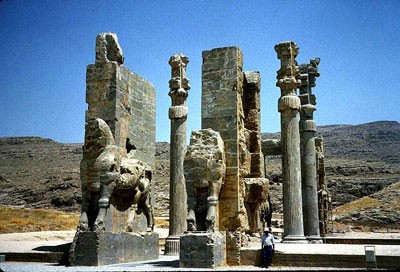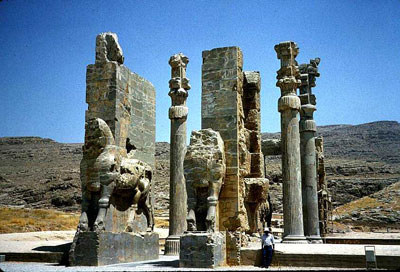
Archeologists Discover Workers' Town near Persepolis
Persepolis was the magnificent capital of ancient Iran, when that country ruled most of the civilized world, from Egypt to Central Asia and from Greece to Northern India. (Yes, some of the later pharaohs were vassals of Iran!)
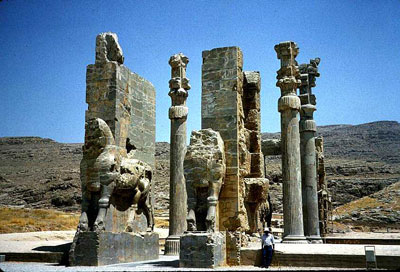
Now comes exciting news that a joint Italian and Iranian archeological team has found Parsa, the gritty working-class district that lay outside the palace walls, where the artisans lived. The Iranian director, Alireza Askari, said:
" two trial trenches brought to light important evidence which suggests that in the Achaemenid and post-Achaemenid periods the area was dedicated to craft activities. In fact, one of the trial trenches yielded a kiln for pottery making, while the other was characterized by the presence of a large number of successive dump pits extremely rich in pottery shards, bricks, charcoal, and bones. Also for this area, the very promising results of the trial trenches suggest that extensive excavations will be carried out in the next season. Being one of the few stratigraphic excavations to have been carried out in the area of Persepolis for the historic period, this activity will allow a comprehensive and fundamental study of the pottery as well as of the other classes of materials recovered for the historic period from the Achaemenid through the Islamic periods, and thus bring a relevant contribution to the knowledge of everyday life in ancient Fars . . .” '
For a sense of the magnificence of the original, see Persepolis Recreated:

|
5 Comments:
You may be interested in the blog of the Persepolis Fortification Archive Project
http://persepolistablets.blogspot.com/
which is working in Chicago and elsewhere to document and publish the administrative archive excavated at Persepolis.
For Matt Stolper's essay "What are the Persepolis Forti?cation Tablets?", see:
http://persepolistablets.blogspot.com/2007/01/what-are-persepolis-fortication.html
You make me nostalgic for the days when I was young and all of mankind seemed my progenitors.
Now we're sliced and diced into bloody hunks by the few twisted tatters of humanity "on top", snapping at the tail of power with jaws of money, adding nausea and dizziness to the litany of maladies they've let out of the box.
Extensive excavations during 2005 in Darreh-ye Bolaghi (not far from Pasargadae) have uncovered settlements in the area that have been dated to the Bakun period (5th - early 4th millennium BC), as can be read about here:
Darreh-ye Bolaghi (Bolaghi Valley), German Archaeological Institute.
A very good source of information concerning Iran's cultural heritage is Cultural Heritage News Agency. By searching for, e.g., "Bolaghi", one is presented with 52 entries (at the time of writing this Comment) concerning articles related to Darreh-ye Bolaghi and Tangeh-ye Bolaghi (Bolaghi Gorge): Bolaghi. Two of the entries are the following:
Looking for the extent of wine production in Bolaghi Gorge
September 30, 2006.
Wine production structures in Bolaghi Gorge are in danger
March 12, 2007.
Incidentally, Spenta Productions has produced a documentary concerning Cyrus the Great, a short part of which can be viewed here (10 minutes): In Search of Cyrus the Great. In this video frequent reference is made to Xenophon's Cyropaedia, the English translation of which can be read here: Cyropaedia of Xenophon; The Life of Cyrus the Great (the full text can also be downloaded from Project Gutenberg); the translation is due to Henry Graham Dakyns.
I close this Comment by inviting the lovers of fine arts to watch the following documentary which concerns "Khosrow and Shirin" (Khosrow va Shirin) from "The Five Treasures" (Panj Ganj, aka Khamseh) of Nezami Ganjavi (1141-1209):
Khosrow and Shirin from Nezami's Five Treasures
The quality of this video is excellent, however the spoken text is in German (the video is originally a French production). Please make sure that you view the video in the large-screen mode.
BF.
I finished reading Tom Holland's Persian Fire recently, an interesting popular history that aimed to re-tell the Persian Wars more from the Persian than the Greek perspective with Athens and Sparta as barbaric outlier "terrorist states" and illuminate the continuity in human behavior.
Persia has never ruled North India, except during Mughal times.
The early vedic and aryan history is full of wars between aryans and the persians (the battle of the 4 kings etc). The zoraster religion was opposite and diverged from aryan religion, in that Indra (for example) was considered a demon by the ancient Persians and not a god (as in the Vedas).
Ancient North India insofar being "India" is *defined* as the territory of the various aryan kingdoms, never the persian ones.
Post a Comment
<< Home