

The FT says that at least two suicide bombers struck at the shrine of medieval Sufi master Datta Ganj Bakhsh (Sayyid Ali Hujwiri), the patron saint of Lahore, on Thursday evening, killing at least 42 and wounding 175. (The death toll will rise since many of the injured are in critical condition). Pakistan’s The News has more details.
A panic spread in Lahore at other shrines, and the Pakistani government increased security at religious buildings.
One Panjabi to whom I spoke predicted that there would be an enormous backlash in Lahore against the Taliban as a result.
Pakistani intelligence officials blamed the Taliban, against whom the Pakistani army has fought extended campaigns in Bajaur, Swat and South Waziristan in the past two years. The FT quotes a security official who said, “They [the Taliban] seem to be telling us they have the means and the will to disrupt Pakistan’s urban areas if we keep on battling them.”
It is true that such bombings in the eastern, Panjabi city of Lahore, are meant to retaliate for the army’s pushback against Pashtun, Taliban fighters in the northwest. The aim is to spread fear and destabilize the capital of Pakistan’s largest, most influential province.
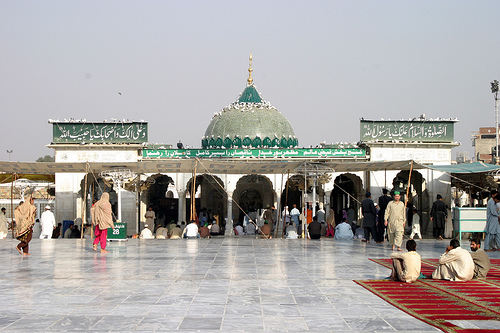
In addition, however, the Taliban have been using terrorism to mark a theological terrain. Most Panjabis and Sindhis in Pakistan practice a form of Islam deeply influenced by Sufism, and many visit shrines to obtain the blessings of God through their mediation. In Lahore, malangs or itinerant Sufis, attend melas or religious festivals at shrines like the one attacked. There, qawwali or Muslim spirituals, are sung to the accompaniment of drums.
In late December and again in February, the Taliban bombed Shiite Muslim religious processions. In May they struck at a mosque belonging to the Ahmadi sect. And on Thursday they attacked a Sufi shrine. Each of these forms of Islam is considered heretical and even to have departed from Islam by the Taliban, who adhere to a radical branch of the Deobandi movement that has been deeply influenced by the Wahhabism of Saudi Arabia. Wahhabism forbids music and attendance at saints’ shrines.
Deobandis, named after the town in which a reformist seminary or madrasah arose in the 19th century, stressed studying and emulating the sayings and doings of the Prophet Muhammad and his early companions. This approach was their way of trying to achieve a purer form of Islam in the Indian subcontinent under British colonial rule, where many Muslims were influenced by Hindu ideas and practices or by British ones. But Deobandi leaders were in the nineteenth and twentieth century themselves adherents of Islamic mysticism or Sufism, a form of Islam that stressed the quest of the believer for union with the divine beloved, God.
When Deobandi seminaries came to form the front line of the anti-Soviet struggle in northwest Pakistan in the 1980s, they attracted funding from Saudi Arabia and came under the influence of the Saudi national sect of Islam, Wahhabism. Begun in the 18th century by Muhammad ibn Abdul Wahhab, Wahhabism was from the beginning highly hostile to Shiism and to Sufism, both of which it considered heretical. Wahhabis are the militant Protestants of Islam. The sect predominates in Saudi Arabia, and has few adherents elsewhere in the Muslim world, though Saudi oil money allows the kingdom to spread it elsewhere. Among the targets of Saudi missionaries and officials are Sufi shrines, and they attempt to convince other Muslim governments to close them down. It would be sort of like Calvinist Protestants from Geneva gaining influence over religious policy in Mexico and trying to stop people from visiting the shrines of saints. Note that there are only about 22 million Saudis, by no means all of whom are Wahhabis (12 percent are Shiites). There are 1.5 billion Muslims. So the Saudi form of Islam is very much a minority taste among Muslims. And note that although Wahhabism tends to be practiced in a narrow-minded way and has often disadvantaged Shiites and others, there is no evidence for Wahhabis being more often terrorists than adherents of other forms of Islam.
The targeting of religious buildings and processions by the Taliban in Pakistan during the past more than six months, then, signals not only a determination to destabilize the country but also a conviction that Pakistan has departed from the true, pure Islam and that its heretics deserve condign punishment. These Taliban are underlining their faithfulness to the rigid theological ideas of the Wahhabis as the neo-Deobandis interpret them–though contemporary Wahhabi clerical authorities in Saudi Arabia forbid such suicide bombings.
The shrine of Datta Ganj Bakhsh is that of the medieval Sufi master Sayyid Ali al-Hujwiri (d. 1072), who traveled widely in Iraq, Iran, Afghanistan and what is now Pakistan, settling in Lahore.
Fans of Sayyid Ali Hujwiri put up a facebook page for him here.
An amateur translation of Hujwiri’s major treatise, “The Unveiling of the Mysteries,” written in Persian, is available in pdf form on the Web in pdf format. I cannot for the life of me understand why R. A. Nicholson’s 1911 translation hasn’t been scanned and put up– it is the most scholarly and long out of copyright. (Thanks to alert readers who pointed out that the Nicholson text is available here.)

0 Retweet 0 Share 23 StumbleUpon 0 Printer Friendly Send via email
Posted in Pakistan | 12 Comments | Print
It would be sort of like Calvinist Protestants from Geneva gaining influence over religious policy in Mexico and trying to stop people from visiting the shrines of saints.
What about another example : like the US evangelical churches sending missionnaries in Maghreb in order to convert Muslims to Christianism ? Ooops.. this may look an absurdity, but it’s a real fact too. The French colonizers in the 19th century on the other hand strickly forbided proselytism and any effort to convert Muslims to Christianism.
Enlightening — thank you.
Just a short note the French Press Agency is saying that the Turkish and Israeli Foreign Ministers have had a secret meeting in Geneva to try to repair damaged ties between the two countries. (I think that they really mean governments.)
[...] Additional Analysis and Background from Professor Juan Cole [...]
Sorry, wrong link. Here it is:
Taliban can lie. TTP destroyed shrine of Baba Rahman in Swat.
Professor Cole, one hopes that there is a backlash against the Taliban in the Punjab. However, Punjabi society has changed a lot. The influence of Wahabism is deep now. Even if you don’t agree with the militants or with the Jamaat i Islami on political points, they have won a good deal of cultural ground. Hence, you don’t say “Khuda Hafiz”, you say “Allah Hafiz”; and you don’t blame Muslims for these acts, much less imagine that a muslim could have done it, you blame the US, India, and Israel. If there is no serious backlash as a result of this, then it says much about the shift in moral judgement that is reflective of the ethics and politics in the largest province and center of power in Pakistan. “Commanding the right” in this case could be simply viewed passively by the majority as a virtue and not murder, a judgement that would be unthinkable 30 years ago.
The link for Nicholson’s translation of Kashf ul Mahjub.
link to archive.org
The attack in Lahore is absolutely shocking.
Ali Al-Hajveri better known as ‘Data Ganj Bakhsh’ preceded Rumi by 200 years and his book ‘Kashf Al-Mahjoob’ (Revelation of the Mystery) (available at Amazon.com)
is the first known treatise on Sufism. The book is absolutely amazing as it traces origins of Sufism going back to Prophet Mohammad’s time and beyond.
It boggles the mind that some people committed such acts of terror in the name of religion by the graveside of such a revered saint and a beacon of knowledge. Such terrorists have no place in society and those who brain washed them into committing suicide bombings should be locked up for ever.
The famous Sufi Saint Khawaja Moeen uddin Chishti (another famous Sufi saint buried at Ajmer in India) spent several days at Ali Al-Hajveri’s shrine and said this about him:
“Ganj Bakhsh is the manifestation of divine light and bounty for all
For lesser mortals, he is the perfect guide and for the perfect, a divine leader”
The attack in Lahore is absolutely shocking.
Ali Al-Hajveri better known as ‘Data Ganj Bakhsh’ preceded Rumi by 200 years and his book ‘Kashf Al-Mahjoob’ (Revelation of the Mystery) (available at Amazon.com) is the first known treatise on Sufism. The book is absolutely amazing as it traces origins of Sufism going back to Prophet Mohammad’s time and beyond.
It boggles the mind that some people committed such acts of terror in the name of religion by the graveside of such a revered saint and a beacon of knowledge. Such terrorists have no place in society and those who brain washed them into committing suicide bombings should be locked up for ever.
The famous Sufi Saint Khawaja Moeen uddin Chishti (another famous Sufi saint buried at Ajmer in India) spent several days at Ali Al-Hajveri’s shrine and said this about him:
“Ganj Bakhsh is the manifestation of divine light and bounty for all
For lesser mortals, he is the perfect guide and for the perfect, a divine leader”
from the nicholson translation:
“he who
says that he finds no pleasure in sounds and melodies and
music is either a liar and a hypocrite or he is not in his right
senses, and is outside of the category of men and beasts. Those
who prohibit music do so in order that they may keep the
Divine commandment, but theologians are agreed that it is
permissible to hear musical instruments if they are not used for
diversion, and if the mind is not led to wickedness through
hearing them. Many traditions are cited in support of this
view. Thus, it is related that A isha said : ” A slave-girl was
singing in my house when Umar asked leave to enter. As
soon as she heard his step she ran away. He came in and the
Apostle smiled. O Apostle of God, cried Umar, what hath
made thee smile ? The Apostle answered, A slave-girl was
singing here, but she ran away as soon as she heard thy step.
I will not depart, said Umar, until I hear what the Apostle
heard. So the Apostle called the girl back and she began to
sing, the Apostle listening to her.” Many of the Companions
have related similar traditions, which Abu ( Abd al- Rahman
al-Sulami has collected in his Kitdb al-Samd 2 ; and he has
pronounced such audition to be permissible. In practising
audition, however, the Sufi Shaykhs desire, not permissibility as
the vulgar do, but spiritual advantages. Licence is proper for
beasts, but men who are subject to the obligations of religion
ought to seek spiritual benefit from their actions. Once, when
I was at Merv, one of the leaders of the Ahl-i hadith* and the
most celebrated of them all said to me : “I have composed
a work on the permissibility of audition.” I replied : ” It is
a great calamity to religion that the Imam should have made
lawful an amusement which is the root of all immorality.” ” If
you do not hold it to be lawful,” said he, ” why do you practise
it ? ” I answered : ” Its lawfulness depends on circumstances
and cannot be asserted absolutely : if audition produces a lawful
effect on the mind, then it is lawful ; it is unlawful if the effect
is unlawful, and permissible if the effect is permissible.”
Chapter on the Principles of Audition.
You must know that the principles of audition vary with the
variety of temperaments, just as there are different desires in
various hearts, and it is tyranny to lay down one law for all.
Auditors (mustami anjmay be divided into two classes: (i) those
who hear the spiritual meaning, (2) those who hear the material
sound. There are good and evil results in each case. Listening
to sweet sounds produces an effervescence (jrhalaydri) of the
substance moulded in Man : true (Jwqq) if the substance be
true, false (bdtil) if the substance be false. When the stuff of
a man s temperament is evil, that which he hears will be evil
too. The whole of this topic is illustrated by the story of
David, whom God made His vicegerent and gave him a sweet
voice and caused his throat to be a melodious pipe, so that
wild beasts and birds came from mountain and plain to hear
him, and the water ceased to flow and the birds fell from the
air. It is related that during a month s space the people who
were gathered round him in the desert ate no food, and the
children neither wept nor asked for milk ; and whenever the
folk departed it was found that many had died of the rapture
that seized them as they listened to his voice : one time, it is
said, the tale of the dead amounted to seven hundred maidens
and twelve thousand old men. Then God, wishing to separate
those who listened to the voice and followed their temperament
from the followers of the truth (ahl-i haqq) who listened to the
spiritual reality, permitted Iblis to work his will and display
his wiles. Iblis fashioned a mandoline and a flute and took
up a station opposite to the place where David was singing.
AUDITION. 403
David s audience became divided into two parties : the blest and
the damned. Those who were destined to damnation lent ear
to the music of Iblis, while those who were destined to felicity
remained listening to the voice of David. The spiritualists
(ahl-i mctnf) were conscious of nothing except David s voice,
for they saw God alone ; if they heard the Devil s music, they
regarded it as a temptation proceeding from God, and if they
heard David s voice, they recognized it as being a direction from
God ; wherefore they abandoned all things that are merely
subsidiary and saw both right and wrong as they really are.
When a man has audition of this kind, whatever he hears is
lawful to him. Some impostors, however, say that their audition
is contrary to the reality. This is absurd, for the perfection of
saintship consists in seeing everything as it really is, that the
vision may be right ; if you see otherwise, the vision is wrong.
The Apostle said : ” O God, let us see things as they are.”
Similarly, right audition consists in hearing everything as it is
in quality and predicament. The reason why men are seduced
and their passions excited by musical instruments is that they
hear unreally : if their audition corresponded with the reality,
they would escape from all evil consequences. The people of
error heard the word of God, and their error waxed greater
than before. Some of them quoted ” The eyes attain not unto
Him” (Kor. vi, 103) as a demonstration that there shall be no
vision of God ; some cited ” Then He settled Himself on the
throne” (Kor. vii, 52) to prove that position and direction may
be affirmed of Him ; and some argued that God actually
“comes”, since He has said, “And thy Lord shall come and
the angels rank by rank” (Kor. Ixxxix, 23). Inasmuch as error
was implanted in their minds, it profited them nothing to hear
the Word of God. The Unitarian, on the other hand, when
he peruses a poem, regards the Creator of the poet s nature
and the Disposer of his thoughts, and drawing an admonition
therefrom, sees in the act an evidence of the Agent. Thus he
finds the right way even in falsehood, while those whom we have
mentioned above lose the way in the midst of truth.”
[...] drones the example of nonviolence might settle on the Afghanistan-Pakistan theatre. In Pakistan, as Juan Cole notes, there is a nonviolent Islamic culture, which attracted recent suicide attacks on attendees at the [...]
