
9 Marines among 31 Killed in Iraq
The news from Iraq on the last Saturday before the US elections was truly horrible, with an orgy of death and explosions. More US troops were killed in one day than at any time since last May. The Iraqi national guards behaved in a way that demonstrates they are nowhere near ready to take over security themselves.
The shakiness of the US coalition in Iraq was underlined when tens of thousands of Italians demonstrated in downtown Rome against the Iraq war and the support Italy has given to it. Although the rightwing government of Silvio Berlusconi can easily ignore even such a large demonstration, it seems clear that Berlusconi's government ever fell, the Italians would be out in a flash.
Associated Press reports 31 deaths in Iraq from major violence, including the killing of 9 US Marines.
Near Fallujah, guerrillas used a car bomb to kill 8 Marines. A further Marine combat death was later reported. The car bomb had also wounded 8 Marines.
Guerrillas in Baghdad targeted the Arabic satellite channel, al-Arabiyah, with a car bomb, killing 7 persons and injuring 19.
Near Latifiyah south of Baghdad, guerrillas attacked a US convoy. Iraqi national guards then showed up, furious, and began firing wildly and throwing hand grenades. They hit several civilian vehicles, killing at least 14 persons. It seemed clear that there was a lot of what the US Pentagon calls "collateral damage." The national guards in that region have faced a lot of attacks.
Guerrillas at Fallujah subjected Marine positions outside the city to the strongest artillery barrage seen in recent weeks. The US military responded by bombing Fallujah, attempting to hit a guerrilla mortar emplacement.
Ramadi saw further fighting on Saturday, with clashes between US troops and the guerrillas there. The fighting left two policement dead and 4 Iraqis injured. Al-Jazeerah is reporting early Sunday morning Baghdad time that 3 US Marines have been wounded.
Sunday, October 31, 2004
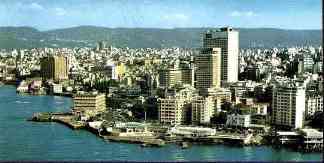
Towers of Beirut
Readers have asked me to what Bin Laden was referring when he said he first conceived the idea of attacking US skyscrapers when the Israelis destroyed the "towers" of Beirut.
Beirut had been among the more advanced cities in the Arab world. I saw it in 1968 and 1974 before the civil war when it was called the Geneva of the Middle East. Although there was fighting in Beirut 1975-1981 by local militias, in fact by the early 1980s the situation had calmed down substantially and the economy was roaring back.
Then Ariel Sharon took it into his head to invade Lebanon in 1982. Sharon always has plots within plots. He wanted to install a far-rightwing government of his liking in Beirut and reshape the Eastern Mediterranean. And he wanted to murder the Palestinian leadership in Beirut, just bomb them all or otherwise rub them out. Although the Palestine Liberation Organization was an annoyance to Israel, it had been substantially defeated by the Syrians in the late 1970s and was extremely weak in 1982. In a way, Sharon's attack was made possible by the Camp David Accords, in which Egypt made a separate peace. Sharon took advantage of the neutralization of Egypt to launch an aggressive war on Lebanon. Egyptians were boiling mad as a result.
The horrible Israeli siege of Beirut in summer of 1982, which lasted for weeks, involved the brutal and indiscriminate bombing of the city. Many of the "towers" that were destroyed contained hundreds of innocent Beirutis. Sharon's proposed puppet ruler, Bashir Gemayyel, used to keep posters of Hitler in his locker at college. He was promptly assassinated and the whole scheme fell apart.
The invasion killed some 18,000 persons, half of them innocent civilians. During this period Sharon turned the task of guarding the disarmed and helpless Sabra and Shatila Palestinian refugee camps over to his allies, the fascist Phalangist paramilitary. The latter promptly murdered hundreds of defenseless Palestinians.
One of the 9/11 hijackers, Ziad Jarrah, was a Lebanese Sunni who was 8 when the Israelis invaded his country and wrought so much destruction. He obviously was deeply traumatized by the experience.
The Israeli invasion of Lebanon in 1982 was a wanton act of aggression and destruction that ended up radicalizing the Lebanese Shiites and leading them to develop the technique of suicide bombing. A majority of Israelis was disgusted with the war, and in the aftermath Sharon was politically marginalized for two decades. Somehow he has managed to rehabilitate himself and now pursues his agenda of killing without any let or hindrance.

Beirut's "towers"

Beirut under Israeli bombardment.
The US has since the late 1970s coddled the Likud Party about its aggression, whether in the Occupied Territories or in Lebanon (part of which it occupied for 20 years!), which has helped to generate anger among Arabs at the United States. A whole generation of Arab politicians and intellectuals was marked by humiliation and helplessness in the face of Sharon's Lebanon war.
None of this justifies the monstrous attack on the US of September 11. As Gandhi pointed out, an eye for an eye makes the whole world blind.
But it is in the interests of all Americans for our government to find a way for Israelis and Arabs to live in peace and justice with one another. In a world where small numbers of terrorists have enormous power because of new technologies, it is dangerous to let such situations fester.
When Dwight Eisenhower perceived the 1956 war launched against Egypt by France, the UK and Israel to be a threat to US security, he knocked some heads together and made it stop. He ordered the Israelis summarily out of Sinai, and cursed out Anthony Eden "like an old soldier." He also threatened the French with an end to US loans if they didn't settle the Algerian crisis because he was afraid the Algerians would go Communist if it festered along. We need someone in the White House who will do more than ignore Arafat and kiss Ariel Sharon's enormous backside. We need an Eisenhower to reshape the political realities in the region in a positive way. Right now we don't have an Eisenhower in the White House.
(By the way, it is highly unlikely that Bin Laden started thinking about hitting the US in 1982. But once the idea was proposed by Khalid Shaikh Muhammad in 1996, he may well have flashed back to those scenes of Sharon's siege of Beirut.)
The full transcript of Usamah's diatribe is at al-Jazeera.
Saturday, October 30, 2004
Elections and Religious Tensions in Iraq
Al-Hayat reports that Shaikh Sadr al-Din Qubanji, a Friday mosque preacher for the Supreme Council for Islamic Revolution in Iraq, criticized "religious figures who doubt" everything and "threaten" to boycott the elections, which will "make manifest the rights of the Shiites." He asked the doubters if they wanted "the Shiites to be killed and cut off yet again?" He said, "it is necessary to give the Shiites and the Sunnis their respective rights, in accordance with what they deserve. A If the Shiites rule in accordance with the elections, that is their right. For they are the majority and they have rights that will be made manifest via this election."
The SCIRI leader was probably referring to Muqtada al-Sadr and the Sadrists, who had earlier threatened to boycott the election. When the Shiites in Bahrain boycotted the last election, it threw parliament into the hands of Sunni fundamentalists, and al-Qubanji knows this very well.
At the same time, Shaikh Mahdi al-Sumaid'i of the Association of Muslim Scholars preached before hundreds of worshippers at the Ibn Taimiyah Mosque in Baghdad. He said, "The Assocation of Muslim Scholars and the Consultative Council of the Sunni Community have issued a general call to the members of the group, to specify their position on the elections. With regard to the US attack on Fallujah, he said that a meeting would be called to address the "marginalization of the Sunnis" and the crushing of their personality. He said that during the Najaf crisis they had stood as a single man. He wants the Sunnis to show equal solidarity today.
Dennis Gray of the Associated Press reports that voter registration via food ration cards will begin Monday in Iraq.
Six weeks will be spent registering voters and political parties.
Authorities have used a Saddam-era database for food rationing to create an initial voter roll. Heads of households collect their 2005 ration cards from 548 distribution centers around the country starting Monday, and voter registration clerks will be waiting with fact sheets on each family. If there are mistakes, the voter roll will be corrected.
Combining voter registration with the popular food rationing system is expected to lessen the chances of attacks by insurgents, and it also provides a cover for Iraqis who wish to sign up to vote but might fear being targeted by those seeking to disrupt the election.
U.S. military units like the 3rd Brigade are responsible for protecting the election process, but they also must keep enough distance to counter charges that Iraqi organizers and participants are merely puppets on America's strings.
In Baqubah they are finding that a third of the population is illiterate and 70 percent know nothing about the election. It is likely that the US military will have to preside over the elections, despite the officers' desire to stay in the background.
The Other Shoe Drops: Bin Laden Weighs in
It is interesting that Usamah Bin Laden explicitly said that it doesn't matter to al-Qaeda whether Bush or Kerry is president. Only the degree to which the US gives "liberty" to the Muslim world matters to al-Qaeda, he says. [I'll have things to say about this diction below, but it is bizarre that a mass murderer who helped run the Taliban state is talking about "liberty."]
Does the appearance of the video help or hurt Bush? It is a double-edged sword. On the one hand, it is a painful reminder that Bush dropped the ball, left the fight against al-Qaeda half-finished, and ran off to the Iraq quagmire, so that Bin Laden is still at large 3 years after he killed 3000 Americans and hit the Pentagon itself. That can't be good for Bush. On the other hand, because so many Americans confuse Bush's swagger and aggressive instincts with being "strong on terrorism," any big reminder that al-Qaeda is out there could actually help W. It shouldn't, but it may well.
He begins by addressing the US public directly [this passage is translated by J. Cole]:
On the reason for the war, addressing the US public, Bin Laden says, "I say to you that security is an important pillar of human life, and that free persons do not neglect their own security, contrary to the allegations of Bush that we despise liberty. He should let us know why we did not strike at Sweden, for instance [if that were true]. It is well know that those who despise liberty do not possess lofty-minded souls like the 19, God bless them. We only waged battle with you because we are free persons, and we cannot sleep knowing that injustice is being done. We want to regain freedom for our nation. As you damage our security, we will damage yours."
Some of the rest of the statement is given by The Associated Press:
He said he was first inspired to attack the United States by the 1982 Israeli invasion of Lebanon in which towers and buildings in Beirut were destroyed in the siege of the capital.
``While I was looking at these destroyed towers in Lebanon, it sparked in my mind that the tyrant should be punished with the same and that we should destroy towers in America, so that it tastes what we taste and would be deterred from killing our children and women,'' he said.
``God knows that it had not occurred to our mind to attack the towers, but after our patience ran out and we saw the injustice and inflexibility of the American-Israeli alliance toward our people in Palestine and Lebanon, this came to my mind,'' he said.
Bin Laden suggested Bush was slow to react to the Sept. 11 attacks, giving the hijackers more time than they expected. At the time of the attacks, the president was listening to schoolchildren in Florida reading a book.
``It never occurred to us that the commander-in-chief of the American armed forces would leave 50,000 of his citizens in the two towers to face these horrors alone,'' he said, referring to the number of people who worked at the World Trade Center.
``It appeared to him (Bush) that a little girl's talk about her goat and its butting was more important than the planes and their butting of the skyscrapers. That gave us three times the required time to carry out the operations, thank God,'' he said.
In planning the attacks, bin Laden said he told Mohammed Atta, one of the hijackers, that the strikes had to be carried out "within 20 minutes before Bush and his administration noticed."
Bin Laden has repeatedly said that one of the reasons he hit the US was over the Israeli attacks on the Palestinians. Bin Laden has cared deeply about Palestine since his youth. His partner in Peshawar at the Office of Services for 6 years when he was funding the Mujahidin was Abdullah Azzam, a prominent Palestinian Muslim fundamentalist. When he came back to Jiddah from Pakistan after the Soviets withdrew, Bin Laden gave a guest sermon at the local mosque in which he bitterly criticized Israeli actions during the first Intifadah. He declared war on the Zionists and the Crusaders, and has constantly complained about the Occupation of the Three Holy Cities, which are Mecca, Medinah and Jerusalem. Because he did not use traditional Palestianian nationalist language, it has been possible for some to miss his commitment to the Palestine issue. The 9/11 report notes that he wanted to move the attack up from September to April of 2001 to punish the Israelis for actions against Palestinians. He thought of himself as attacking the US for backing Israel and Israeli aggression and seems to be annoyed at the success of the Bush administration in painting him as a nihilist.
The talk about being "free persons" (ahrar) and fighting for "liberty" (hurriyyah) for the Muslim "nation" (ummah) seems to me a departure. The word "hurriyyah" or freedom has no classical Arabic or Koranic resonances and I don't think it has played a big role in his previous statements.
I wonder if Bin Laden has heard from the field that his association with the authoritarian Taliban has damaged recruitment in the Arab world and Iraq, where most people want an end to dictatorship and do not want to replace their secular despots with a religious one. The elections in Pakistan (fall 2002) and Afghanistan went better than he would have wanted, and may have put pressure on him. He may now be reconfiguring the rhetoric of al-Qaeda, at least, to represent it as on the side of political liberty. I am not saying this is sincere or might succeed; both seem to me highly unlikely. I am saying that it is interesting that Bin Laden now seems to feel the need to appeal to this language. In a way, it may be one of the few victories American neo-Wilsonianism has won, to push Bin Laden to use this kind of language. I doubt it amounts to much.
Friday, October 29, 2004
Pentagon Briefing on Missing Explosives
I just watched the Larry DiRita host a Pentagon briefing on the issue of the missing explosives at al-Qaqaa.
I was disgusted by the political spin DiRita was putting out. The Pentagon should be serving the military needs of the whole United States, not of the Bush administration.
DiRita kept talking about RDX plastic explosives, when the real issue is what happened to the HMX, which is the stuff that can be used to detonate an atomic bomb. At one point DiRita insisted that the Pentagon refers to it all as RDX and doesn't distinguish HMX (!) He brought a poor US army major, Austin Pearson, out to talk about how his unit had destroyed over 200 tons Iraqi munitions, including tons of stuff from al-Qaqaa.
But if DiRita thought that this officer would clear the whole thing up, he was clearly disappointed. The major said explicitly that he had not seen any seals of the International Atomic Energy Commission, which means that he cannot testify that his unit destroyed the HMX. Then he was asked if insurgents could have carried off 150 tons of that stuff in a short period of time as a practical matter. He replied that it seems like a lot, but in fact it could be done really quickly.
Then he let it slip that his unit was at al-Qaqaa on April 13, before the KSTP video was shot of US soldiers examining HMX there. So Pearson's unit could not have removed all the HMX at that time. Since he didn't see IAEA seals, it seems likely that his unit didn't remove any HMX.
No one doubts that the US military has blown up enormous amounts of Iraqi ordnance. The point is that they have also not blown up enormous amounts of Iraqi ordnance, and that the country's 80 major arms depots have gone on being looted throughout the US occupation because the military was not given enough troops by Bush to guard the depots.
Conclusion: The DiRita performance today was embarrassing to Bush. His Pentagon spokesman doesn't know the difference between RDX and HMX and he hasn't debriefed his chief witness, Maj. Pearson, so as to avoid being blindsided when the major says he never saw IAEA seals, that looters could have carted off tons of HMX quickly and easily, and that his unit was at al-Qaqaa before the date of the damning KSTP video!
US Has Killed 100,000 in Iraq: The Lancet
The Lancet, a respected British medical journal, reports that the US and coalition forces (but mainly the US Air Force) has killed 100,000 Iraqi civilians since the fall of Saddam on April 9, 2003. Previous estimates for civilian deaths since the beginning of the war ranged up to 16,000, with the number of Iraqi troops killed during the war itself put at about 6,000.
The troubling thing about these results is that they suggest that the US may soon catch up with Saddam Hussein in the number of civilians killed. How many deaths to blame on Saddam is controverial. He did after all start both the Iran-Iraq War and the Gulf War. But he also started suing for peace in the Iran-Iraq war after only a couple of years, and it was Khomeini who dragged the war out until 1988. But if we exclude deaths of soldiers, it is often alleged that Saddam killed 300,000 civilians. This allegation seems increasingly suspect. So far only 5000 or so persons have been found in mass graves. But if Roberts and Burnham are right, the US has already killed a third as many Iraqi civilians in 18 months as Saddam killed in 24 years.
The report is based on extensive household survey research in Iraq in September of 2004. Les Roberts and Gilbert Burnham found that the vast majority of the deaths were the result of US aerial bombardment of Iraqi cities, which they found especially hard on "women and children." After excluding the Fallujah data (because Fallujah has seen such violence that it might skew the nationwide averages), they found that Iraqis were about 1.5 times more likely to die of violence during the past 18 months than they were in the year and a half before the war. Before the war, the death rate was 5 per thousand per year, and afterwards it was 7.9 per thousand per year (excluding Fallujah). My own figuring is that, given a population of 25 million, that yields 72,500 excess deaths per year, or at least 100,000 for the whole period since April 9, 2003.
The methodology of this study is very tight, but it does involve extrapolating from a small number and so could easily be substantially incorrect. But the methodology also is standard in such situations and was used in Bosnia and Kosovo.
I think the results are probably an exaggeration. But they can't be so radically far off that the 16,000 deaths previously estimated can still be viewed as valid. I'd say we have to now revise the number up to at least many tens of thousand--which anyway makes sense. The 16,000 estimate comes from counting all deaths reported in the Western press, which everyone always knew was only a fraction of the true total. (I see deaths reported in al-Zaman every day that don't show up in the Western wire services).
The most important finding from my point of view is not the magnitude of civilian deaths, but the method of them. Roberts and Burnham find that US aerial bombardments are killing far more Iraqi civilians than had previously been suspected. This finding is also not a surprise to me. I can remember how, on a single day (August 12), US warplanes bombed the southern Shiite city of Kut, killing 84 persons, mainly civilians, in an attempt to get at Mahdi Army militiamen. These deaths were not widely reported in the US press, especially television. Kut is a small place and has been relatively quiet except when the US has been attacking Muqtada al-Sadr, who is popular among some segments of the population there. The toll in Sadr City or the Shiite slums of East Baghdad, or Najaf, or in al-Anbar province, must be enormous.
I personally believe that these aerial bombardments of civilian city quarters by a military occupier that has already conquered the country are a gross violation of the Fourth Geneva Convention of 1949, governing the treatment of populations of occupied territories.
Spencer Ackerman at TNR's online blog on Iraq has a long interview with Burnham about the study, in which Burnham is quite humble about it not being definitive.
Missing HMX: It Really is Missing
The evidence accumulates hourly that deadly HMX explosives were at the al-Qaqaa facility on April 18 of 2003 and subsequently disappeared.
The allegation that the material was moved by the Saddam regime between March 16 and April 9 does not seem to me to get Bush off the hook. First, it is probably groundless. Josh Marshall points out that the photos released by the Pentagon of trucks at al-Qaqaaa are of a different part of the huge facility than where the HMX was stored.
Second, it wouldn't account for all the material that disappeared, since a substantial amount was certainly looted after the US conquest, as television video from embedded reporters demonstrating that the material was there on April 18, suggests. Third, the US had complete control of the skies over Iraq and had al-Qaqaa under surveillance. If they did not want Saddam moving HMX around, all they had to do was take out some trucks that came up to al-Qaqaa, as a warning.
Secretary of Defense Donald Rumsfeld ran away from a lower-level bureaucrat's crackpot conspiracy theory, of Russians moving the stuff to Syria, so fast that he could have been auditioning for a Nike commercial. The Russians rather exasperatedly denied the story. (The Russians haven't been militarily involved in Iraq since the 1980s when they were part of the Soviet Union).
A new low was reached in the Republican Party, out of panic at this story, by Rudi Giuliani, who blamed our troops for the al-Qaqaa catastrophe, saying, ''No matter how you try to blame it on the president, the actual responsibility for it really would be for the troops that were there. Did they search carefully enough? Didn't they search carefully enough?" So let's get this straight. Bush sends only 100,000 US troops to Iraq, when 500,000 are needed to secure the country. Then when the troops don't have te personpower to do their jobs properly, you blame them? The refreshing thing about Giuliani's remark is its honesty. Surely a lot of fatcat Republicans who are always draping themselves in the flag and exploiting the heroism of US troops actually view them as little more than kitchen help, who can be blamed if the banquet doesn't come off as brilliantly as hoped. Remember the images of Bush in white tie toasting his "base" among the super-wealthy, in Fahrenheit 9/11? It is not the corporals in the US army whom he was toasting.
The Star Ledger reports:
ABC said experts who have studied the images say the barrels seen in the video contain the high explosive HMX, and U.N. markings on the sealed containers were clear.
"I talked to a former inspector who's a colleague of mine. He confirms that, indeed, these pictures look just like what he remembers seeing inside those bunkers," David Albright, a former U.N. weapons inspector in Iraq told the network.
ABC said the barrels seen in the video were found inside locked bunkers that had been sealed by inspectors from the U.N.'s International Atomic Energy Agency just before the war began.
"The seal's critical. The fact that there's a photo of what looks like an IAEA seal means that what's behind those doors is HMX," Albright said.
The soldiers were not ordered to secure the facility, ABC reported.
The Pentagon yesterday released an aerial photograph taken two days before the Iraq war of two trucks at the site where nearly 400 tons of high explosives went missing, but it was unable to say they had anything to do with the disappearance.
The image of a small portion of the sprawling al Qaqaa arms storage site, taken on March 17, 2003, showed a large tractor-trailer loaded with white containers with a smaller truck parked behind it, the Pentagon said.
Chief Pentagon spokesman Lawrence Di Rita acknowledged that he could not say that the trucks were hauling away the explosives, or had anything to so with the disappearance of the material.
Earlier yesterday, the U.N. nuclear agency said U.S. officials had been warned about the vulnerability of explosives stored at al Qaqaa after another facility -- the country's main nuclear complex -- was looted in April 2003.
The IAEA cautioned American officials directly about what was kept at al Qaqaa, the main storage facility in Iraq for so-called high explosives, spokeswoman Melissa Fleming said in Vienna.
And here is what weapons inspector David Kay had to say about the ABC News video from al-Qaqaa in April, 2003:
BROWN: I don't know how better to do this than to show you some pictures, have you explain to me what they are or are not, OK? First, I'll just call it the seal and tell me if this is an IAEA seal on that bunker at that munitions dump.
KAY: Aaron, as about as certain as I can be looking at a picture, not physically holding it, which obviously I would have preferred to have been there, that's an IAEA seal. I've never seen anything else in Iraq in about 15 years of being in Iraq and around Iraq that was other than an IAEA seal of that shape.
BROWN: And was there anything else at the facility that would have been under IAEA seal?
KAY: Absolutely nothing. It was he HMX, RDX, the two high explosives.
BROWN: OK. Now, I want to take a look at the barrels here for a second and you can tell me what they tell you. They obviously to us just show us a bunch of barrels. You'll see it somewhat differently.
KAY: Well, it's interesting. There were three foreign suppliers to Iraq of this explosive in the 1980s. One of them used barrels like this and inside the barrel is a bag. HMX is in powdered form because you actually use it to shape a spherical lens that is used to create the triggering device for nuclear weapons.
And, particularly on the videotape, which is actually better than the still photos, as the soldier dips into it that's either HMX or RDX. I don't know of anything else in al Qa Qaa that was in that form.
BROWN: Let me ask you then, David, the question I asked Jamie. In regard to the dispute about whether that stuff was there when the Americans arrived, is it game, set, match? Is that part of the argument now over?
KAY: Well, at least with regard to this one bunker and the film shows one seal, one bunker, one group of soldiers going through and there were others there that were sealed, with this one, I think it is game, set and match.
There was HMX, RDX in there. The seal was broken and quite frankly to me the most frightening thing is not only is the seal broken and the lock broken but the soldiers left after opening it up. I mean to rephrase the so-called (UNINTELLIGIBLE) rule if you open an arms bunker, you own it. You have to provide security.
BROWN: That raises a number of questions. Let me throw out one. It suggests that maybe they just didn't know what they had.
KAY: I think quite likely they didn't know they had HMX, which speaks to the lack of intelligence given troops moving through that area but they certainly knew they had explosives.
And to put this in context, I think it's important this loss of 360 tons but Iraq is awash with tens of thousands of tons of explosives right now in the hands of insurgents because we did not provide the security when we took over the country.
BROWN: Could you -- I'm trying to stay out of the realm of politics.
KAY: So am I. BROWN: I'm not sure you can necessarily. I know. It's a little tricky here but is there any reason not to have anticipated the fact that there would be bunkers like this, explosives like this and a need to secure them?
KAY: Absolutely not. For example, al Qa Qaa was a site of (UNINTELLIGIBLE) super gun project. It was a team of mine that discovered the HMX originally in 1991. That was one of the most well documented explosive sites in all of Iraq. The other 80 or so major ammunition storage points were also well documented.
Iraq had, and it's a frightening number, two-thirds of the total conventional explosives that the U.S. has in its entire inventory. The country was an armed camp.
Laura Rozen has more.
2 US Troops, 15 Others killed
17 persons died in violent attacks in Iraq on Thursday, including two US troops.
Al-Hayat reports that Grand Ayatollah met with the Chaldean Patriarch. The grand ayatollah urged Christian Iraqis to vote, and condemned attacks on Christian churches by what he called "takfiri" forces. The practice of declaring some Muslims to actually be "kafirs" or infidels is controversial in mainstream Islam, since it is often felt that if someone claims to be a Muslim, the claim should be accepted. The militant, radical Muslim fundamentalists often declare other Muslims to be unbelievers. But this is the first time I have seen condemnation of takfiris in relation to non-Muslims. Sistani seems to be implying that it is even wrong for Muslim Iraqis to consider Christian Iraqis "infidels." Of course, mainstream Islam does accept the truth of Jesus as an envoy of God, and the Koran says that Christians are closest in love to Muslims. So perhaps the statement isn't surprising; but it struck me as distinctive.
Britain outlined the precise steps and stages envisaged in the movement of Iraq toward elections in January of 2005. This is the first time many of these steps have been spelled out publicly.
The FBI is investigating how Halliburton got its bids to work on Iraqi petroleum facilities.
Vice President Dick Cheney is the former CEO of Halliburton. The company is also being investigated concerning money that has gone missing.
Thursday, October 28, 2004
Breaking News: Film Crew May have Smoking Gun
A US film crew has footage of the explosives at al-Qaqaa that later went missing. This development may be the downside of embedding for the US military. It makes things hard to deny later on if you leave a filmed trail. For instance, the Russians can't have absconded with the explosives before the war if a US camera crew still sees them there in April of 2003.
Iraqi Officials Deny Early Disappearance of Explosives
Dr. Muhammad Sharaa who leads Iraq's science monitoring department, denies that the 380 tons of high explosives that has gone missing could have been moved in spring of 2003 before or during the war. AFP reports:
"It is impossible that these materials could have been taken from this site before the regime's fall," Mohammed al-Sharaa, who heads the Science Ministry's site monitoring department, said.
"The officials that were inside this facility (Al-Qaqaa) beforehand confirm that not even a shred of paper left it before the fall.
"I spoke to them about it and they even issued certified statements to this effect which the US-led coalition was aware of."
AP's timeline on the explosives shows that an inspection team from the International Atomic Energy Commission visited Iraq in mid-March, 2003 just before the war, and found the seals they had placed on the explosives containers in January untouched.
US military officers are now expressing confidence that the explosives couldn't have been removed in April-May 2003 because there were US vehicles all over the roads it would need to have travelled. But as Nathan Brown notes below, the signs of looting were far more extreme as reported in spring of 2004 than they had been earlier. So the evidence suggests that in fact lots of looting did go on under the nose of the US military. (Again, as John Kerry has pointed out, this wasn't their fault; they didn't have enough troops on the ground to secure the weapons sites). In fact, all the looting of all the weapons depots took place with US military driving all over the country. But they had no instructions to stop random trucks and that was not defined as their mission by the Bush administration.
After all, you wouldn't have thought that seven nuclear facilities in Iraq could have been looted at that time, either, with all the US troops around and US vehicles on the roads. Sorry, nice try but no cigar.
I think the evidence is that the explosives were still there and under seal in mid-March 2003. I find it difficult to believe they were moved during the war. What soldier would have been stupid enough to drive a truck full of that stuff through Iraq as the US was bombing the country? Despite the stability of these explosives under ordinary circumstances, such a truck driver would have been exposed to extreme danger from American fire, if anything sufficiently powerful hit the truck. Plus the Iraqi scientists now confirm that it wasn't moved.
Brown: 2004 Bremer Report on al-Qaqaa Looting
Professor Nathan Brown of George Washington University writes:
In the dispute between the Kerry campaign and the Bush administration over the disappearance of explosives at al-Qaqaa, the core of the Bush defense is that we don’t know when the explosives disappeared; it could have happened before American troops arrived. President Bush stated today: “Our military is now investigating a number of possible scenarios, including that the explosives may have been moved before our troops even arrived at the site. This investigation is important and it’s ongoing, and a political candidate who jumps to conclusions without knowing the facts is not a person you want as your commander in chief.”
I have to admit that I am unsure why this is a defense. If the investigation is so important, why is it still ongoing? One CPA document (discussed below) makes clear that the extent of looting has been known—not merely suspected but documented and evaluated—for some time. The reason we don’t know when the explosives disappeared is that we were not securing or monitoring the site. In other words, our lack of knowledge about the date of the disappearance is itself an indication that nobody was watching one of the most important military production sites in the country. Thus, to proclaim now that we don’t know what happened is not evidence of an open mind; it is evidence of an open barn door. Why did Bush wait until October 2004 to look into the matter? The 18 ˝-month gap is no more to Bush’s credit than the 18 ˝-minute gap was to Nixon’s. It is the absence of evidence that is the problem.
But the absence of evidence is not evidence of absent-mindedness. There were people who said a year and a half ago that this needed attention. In particular, the IAEA was trying to examine the site from the very end of the war. We barred them. In other words, the failure to monitor was not an oversight but a policy decision. It may have been partly based on the size of the American force, but it was also based on an ideological hostility to the United Nations.
Actually, we do know a little bit more than has been reported. But the little evidence we do have hardly supports the Bush case. What has been widely reported is that during and immediately after the war, some American military units and journalists briefly visited the site. What has not been reported is that on 15 April 2004—a year after the war—CPA head Paul Bremer issued a regulation transferring the employees of some military industries to various parts of the Iraqi government. I assume the point was to ensure that these critical people would get paid and not defect to the insurgents. That regulation can be viewed here.
Annex A to the regulation mentions al-Qaqaa (see p. 3 of the annex) and the extent of damage and looting there. 37% of the buildings were destroyed and fully 85% of its machines were destroyed or looted.
In other words, the place was very utterly trashed as of this past April, a year into the Iraqi occupation.
What does this have to do with the flap between Bush and Kerry? Well, it seems to me that if damage to equipment was so remarkably extensive—with the vast majority of the equipment ripped out or destroyed—any of the military units or journalists visiting in April 2003 should have noticed it even in a cursory examination. One of the accounts (by Fred Wellman, a former spokesman for the 101st Airborne Division’s 2nd Brigade) does indeed mention that looting was underway on April 9. This was roughly when the Iraqi regime disintegrated and the looting began, so the observation makes sense. Looting was not mentioned in the accounts of the first American visit to the site, the previous week. I do not know how long it takes to loot such a site so thoroughly (according the original NY Times story, the looting was still going on quite recently), but it seems that almost all of it occurred during the period of the American occupation. When the explosives were taken cannot be ascertained from this. But we seem to have evidence that virtually everything at the site—even the stuff that was nailed down—was taken while it was under our nominal control.
- Nathan Brown
Qazi tries to Forestall Sunni Boycott of Elections
Az-Zaman: United Nations special envoy to Iraq, Ashraf Jahangir Qazi, held talks on Wednesday with Shaikh Muhammad Bashar al-Faydi, a leader of the Association of Muslim Scholars. They discussed the AMS attitude toward the January elections as well as the situation in Fallujah, which continues to be bombed by the United States. Qazi said that the UN was willing to take a more active negotiating role in Iraq if it might avert a Sunni Arab boycott of the elections. (A Sunni boycott might produce a parliament that was 80% Shiite and 15% Kurdish, leaving the Sunni Arabs out altogether, even though they form 15 percent of the population and are the wealthiest and best educated Iraqis. This result would be a huge disaster, since the parliament would then write the constitution and the Sunni Arabs would not be represented in the process.) So far, AMS is urging a boycott, in contrast to the Iraqi Islamic Party, which wants Sunnis to come out in force.
It is a shame that Qazi has to play this role, with the Americans having no better policy toward the Sunni Arabs than to bomb the bejesus out of them. Why isn't Colin Powell talking to al-Faydi?
The US bombed Fallujah again on Wednesday, killing 3 persons.
President Ghazi al-Yawir (a Sunni) received a delegation from (Shiite) Karbala on Wednesday. He said a way must be found for Iraqis to prevent a US attack on Fallujah and other Iraqi cities.
Wednesday, October 27, 2004
Deadly Dual Use Explosives Missing: Part Deux
The politicization of news in the United States has reached such an embarrassing point that what Vice Presidential candidate Dick Cheney thinks about what was going on in Iraq in April of 2003 is being reported by the press in an article on the weapons' disappearance, even though he was not there and knows nothing about it and speaks in the subjunctive. The proper journalistic judgment on such a statement? Treat it on the op-ed page but keep it away from news sections unless the story is on Cheney's claims in his speeches.
Despite the new attempt to defend Bush from charges of incompetence over the disappearance of 380 tons of dual-use explosives (which can be used to detonate nuclear bombs) from the al-Qaqaa facility in Iraq, there is really no excuse. The Pentagon's attempt to maintain that the facility was inspected in early April by US troops has fallen apart. It has 1000 buildings, and the troops had no orders to search them exhaustively. Thus, the statement that they did not see the stickers of the International Atomic Energy Commission does not in fact suggest that the explosives were already gone. It indicates that they didn't have time to see much of the facility.
The gravity of the disappearance of these explosives cannot be underscored enough. Not only can they help in the detonation of a nuclear bomb, they are deadly in their own right. A pound can bring down a jetliner. There are 2000 pounds in a ton. Bush let enough high-power explosives disappear to bring down (God forbid) 760,000 airliners! What if this stuff leaks from Iraq to al-Qaeda?
Initial Bush administration responses to the scandal depended on NBC news reporting which, however, did not say what the administration said it said. The embedded NBC reporter has now clarified that the 101st Infantry did reach al-Qaqaa a week after the 3rd ID, but did not inspect the site. Its commander told CBS he would have needed 4 times as many troops as he had to do that job on top of everything else. Probably the entire US military needed 4 times as many troops as they had in Iraq.
The Bush administration's attempts to pull the wool over the eyes of the American public fails on several grounds. First, there is every indication that al-Qaqaa was not secured and could not have been secured. That is because Bush did not send enough troops to Iraq to do the job that needed to be done. It was Bush's decision, not Rumsfeld. At this late date surely Bush's tendency to farm out blame to his cabinet for his own decisions, and then to decline to hold his cabinet members responsible for mistakes, must be completely rejected. The buck stops with the president. Bush decided to send such a small army to Iraq that the place immediately fell apart in an orgy of uncontrollable looting. This development is not the fault of the Iraqis. The sudden removal of the structures of government regularly produces this result in history. There was looting when the electricity went out in New York in 1977. It is Bush's fault.
Second, although the disappearance of the RDX and HMX is frightening, it is only one of many such scandals. Dual-use equipment and even nuclear material was also looted (most of the nuclear material has thankfully been recovered, no thanks to Bush).
Third, this charade of looking around for lowly GIs to get the blame off Bush about al-Qaqaa is just public relations. The fact is that there are people in the Pentagon and the CIA who know exactly what happened there. This is because al-Qaqaa was certainly under US satellite surveillance in spring of 2003. The United States had extensive satellite surveillance of Iraqi weapons sites, some of the techniques of which Colin Powell revealed at the United Nations Security Council. Although the interpretation of the photos turns out to be more difficult than proponents of the technology admitted, some basic things can be seen. For instance, trucks moving 380 tons of explosives from a sensitive facility could certainly be spotted. An automobile typically weighs two tons, so this is like moving 190 automobiles. It is a big operation and would show up clearly in the aerial photographs. That information like this is still probably classified, even though the Saddam government is long gone and there is no compelling national security need to keep it secret, underlines how easy it is for governments with billions of dollars in high tech surveillance equipment to manipulate a democratic public. It is a shell game, with information being shifted around and then hidden.
And if all else fails, you just muddy the waters with some cock and bull story that you know the party faithful will swallow and which will create doubt in the minds of the independents.
We have seen the debasement of discourse reach the point where George W. Bush can actually deny that he let Bin Laden escape at Tora Bora, and then can use John Kerry's simple statement of that fact as a means of indicting John Kerry. Bush portrayed Kerry in one speech as cocky and too sure of himself for making the charge. Numerous eyewitnesses from among captured Taliban and al-Qaeda confirm Kerry's allegation. The way Bush gets away with this is that the journalists are not calling him on it.
The Bush administration is now using the same rhetorical strategy with regard to al-Qaqaa. You label a true charge false or hasty. And then you use your own lie to impugn the character of your opponent, who is now accused of being hasty in his judgment or of being dishonest or guilty of poor fact checking.
Secretary of Defense Donald Rumsfeld even tried to dismiss the missing explosives story by comparing to the story of the looting of the Baghdad Museum. He seems to want to say that the museum was not in fact looted. But of course it was. Indeed, as a historian of Iraq I weep every day that apparently the archives of the entire period of the constitutional monarchy (1922-1958) were burned or disappeared. That would be as though the US National Archives records for everything from the Roaring Twenties through the Depression, WW II, and the Eisenhower Administration had completely disappeared off the face of the earth. The rightwing revisionist story that the looting never happened is itself a myth. So Rumsfeld disproves a true charge by comparing it to another true charge that he has incorrectly labeled a myth, thereby discrediting both.
The presidential election of 2004 is a test of Lincoln's assertion that you can't fool all the people all the time. At the very least, if Bush is put back in it will demonstrate that you can fool enough of the people enough of the time.
Bush will ask for another $70 Billion
Allawi Slams Bush over Troop Massacre
The Bush administration will ask for another $70 billion for Iraq in another month or two if re-elected. Remember in the debates when Kerry said Iraq had cost $200 billion, and Bush corrected him that it was only $120 billion? Well, it turns out that Kerry was right, but Bush was being dishonest in postponing the further request until after the election. Another example of how the Bush administration is government by "representation" in the sense that Michel Foucault used the term rather than in the civics sense. Foucault said that people have a tendency to represent reality, and then to refer to the representation rather than to the reality. (This is also the way stereotypes and bigotry work.) So Bush represented the Iraq war as a $120 billion effort, and actually corrected Kerry with reference to this representation. But the representation was a falsehood, hidden by a clever fiscal delaying tactic. So Kerry is made to seem imprecise or as exaggerating, when in fact he was referring to the reality. Bush made representation trump reality.
Edward Said in his Orientalism shows the ways in which Western travelers and writers have often invented a representation of the Middle East that then gets substituted for Middle Eastern realities so powerfully that the realities can no longer even be seen by Westerners. Said cites travel accounts by eyewitnesses who report falsehoods that had already entered the literature. So these travelers let the representations over-rule what their own eyes saw.
In a sign that Iyad Allawi finally realizes he needs to distance himself from the Americans if he is to have any political future (or perhaps even just future) in Iraq, he blamed the US military for neglecting to arm and escort the recruits that were found massacred on Sunday. He accused the US military, and by extension the Bush administration, of "gross negligence."
Allawi was contradicted by his Defense Minister, Hazim Shaalan, who blamed the recruits for being too eager to get home after training, for leaving the base at midnight and without arms, and for taking an unprotected route.
The Bush administration is not forgiving about criticism from allies, so although Allawi will get points with the Iraqi public for finally speaking out about US incompetence in this regard, he may well find a long knife in his back if Bush gets back in. And, obviously, Shaalan is angling for Allawi's job by blaming the victims.
Tuesday, October 26, 2004
10 Killed in four bombings, Including US Soldier
Charges of Corruption In Halliburton Bids
AP reports that that on Monday, guerrillas bombed four coalition and Iraqi military convoys on Monday, killing 8. Among the dead was one American and one Estonian soldier.
Guerrillas detonated a roadside bomb in western Baghdad, killing 1 US soldier and wounding five other US troops.
On the outskirts of Baghdad, guerrillas detonated a roadside bomb as an Estonian patrol passed, killing one soldier and wounding 5 others.
Near the Australian embassy in Baghdad, guerrillas used a car bomb to attack Australian military vehicles. They eounded 3 Australian soldiers lightly, but killed 3 Iraqis and wounded 6 others.
In Mosul, one suicide car bomber detonated his payload at provincial government offices, killing 3 Iraqi government employees and wounding one. Another car bomber targeted an Iraqi military convoy in the city, wounding an Iraqi general, Mu`tazz al-Taqah.
AP says that guerrilla attacks are up 25 percent since the beginning of the holy fasting month of Ramadan.
Az-Zaman reports the assassination of Dhari Ali Dulaimi al-Ghariri, a tribal chieftain, in Mahmudiyah. He did not hold an official post other than heading up his tribe, and had not held high office under Saddam Hussein. Mahmudiyah is in a mixed Sunni and Shiite area where there has been violence between Sunnis and Shiites.
In Mosul, guerrillas assassinated Shaikh Sahir Khudeir, who chaired an association of tribal chieftains in the north.
Ash-Sharq al-Awsat says that hundreds of Kurds demonstrated in Kirkuk demanding that the city be incorporated into a new Kurdish superprovince. The Kirkuk issue remains unresolved, with thousands of Kurds coming back. It is among the issues that could throw Iraq into even worse turmoil
In Najaf, the Shiite clergy issued a joint condemnation of what they called the "massacre" of Iraqi military recruits, most of them poor Shiites from the south. The condemnation signals what a tough time the guerrillas have in building a national consensus, since the Shiite clergy see the victims as poor Shiites and do not see the perpetrators as Iraqi patriots.
Billions of dollars in no-bid contracts for Iraq were let to Halliburton subsidiary Kellog, Brown and Root, sometimes in violation of Pentagon rules. The chief civilian in charge of making sure such contracts are on the up and up says she was marginalized and ignored by military officers who ignored the rules.
Gee, I wonder how Halliburton got to be so powerful inside the Bush White House?
Helena Cobban at Just World News insightfully analyses last Friday's Shiite sermons in Iraq, showing the ways in which the clergy are threatening Shiites with hellfire if they don't vote.
I pretty much feel that way about Democrats who don't vote in 8 days.
Monday, October 25, 2004
Bush is Making us Safer?
The complete lack of interest of the Bush administration in actually securing dangerous materials connected to the old, abandoned Iraqi nuclear program has long belied Bush's stated concern with Iraq's alleged weapons as a pretext for the war.
James Glanz, William J. Broad and David E. Sanger with Khalid al-Ansary reveal in the New York Times today that the Bush administration allowed 380 tons of super-powerful explosives to disappear from al-Qaqaa, one of Iraq's sensitive military installations, after the war in spring of 2003. These are not ordinary bombs. This explosive material, HMX and RDX, can be used to detonate atomic bombs, collapse buildings, and form warheads for missiles. A pound of it brought down a passenger jet over Lockerbie, Scotland.
A lot of the roadside bombs that have killed hundreds of US troops and maimed thousands have been made of HMX and RDX, as suggested by how infrequently the guerrillas have blown themselves up in planting them. HMX and RDX are favored by terrorists because they are stable and will only explode via a blasting cap.
Incredibly, the International Atomic Energy Commission and European Union officials warned Bush before the war that these explosives needed to be safeguarded.
Josh Marshall is suspicious that this major screw-up has been known to the Bush administration for some time, and that it may have pressured the Iraqi government not to mention it.
If Bush cannot even protect our troops from explosives at a sensitive facility in a country he had conquered, how is he going to protect the American public from terrorists who have not even yet been identified?
The disappearance of these explosives is yet one more disaster caused by Secretary of Defense Donald Rumsfeld's mania to send a small military force into Iraq. Rumsfeld over-ruled the officers in the Pentagon, who wanted hundreds of thousands of troops and knew that many would be needed to secure the country after the war. Why hasn't Rumsfeld been fired? He ran Iraq for most of the last 18 months and it is beginning to be as cratered as the dark side of the moon.
Only two weeks ago, The International Atomic Energy Commission reported that not only had dual-use equipment been stripped from an old Iraq nuclear weapons facility, but even the buildings had been stripped and dismantled. Muhammad al-Baradei said that some of the nuclear material stolen from facilities in Iraq has already begun showing up in other countries. But the dual-use equipment, which has applications in nuclear weapons construction, has disappeared. (Hmm. I wonder which neighbor of Iraq might be desperately at work on a nuclear bomb and might be willing to pay top dollar for such equipment?) How bad a job Bush is doing is clear when we consider that we might well be relieved to know that this equipment went to Iran, since that means Bin Laden doesn't have it.
So let me ask this again. Bush is making us safer? The American public trusts him to fight terror more effectively than Kerry? On what record? Bush appears to have all but just called up Usamah and Khamenei and told them where Saddam's old stuff was in case they needed it for their programs. And he politely made sure that no pesky US troops would be around to impede their access.
Bush administration spokesmen are being careful to say that the hundreds of tons of explosives stolen from al-Qaqaa are not themselves useful as fissile material, i.e. they are not enriched uranium or plutonium.
But the fact is that one of the first such "missing deadly weapons" scandals to break in Iraq had to do with the disappearance of radioactive materials from Tuwaitha. This theft was known already in the summer of 2003, and worries were expressed that that material could be used to make a dirty bomb.
So Bush not only failed to have al-Qaqaa guarded against theft of HMX and RDX, not only failed to guard against theft of dual-use equipment from a long-defunct nuclear program site, but also failed to do the elementary work of ensuring that the notorious al-Tuwaitha facility was secured against the theft of radiocative materials!
Since Tuwaitha was the great bugaboo impelling the Iraq war in the first place, you would imagine that Bush would have sent out a unit to secure and search it immediately. But no, he politely let the looters have a look-around first, waiting in line.
I know someone is going to write me asking whether the existence of all this equipment and dangerous explosives doesn't prove that Saddam still had an active weapons program. The answer is a categorical "no." A lot of this stuff was left over from the 1980s when there had been such active programs, but which were abandoned after the Gulf War. Ironically, the bits and pieces Saddam still had were useless to a major state. But they could be stolen and cobbled together by a small band of terrorists to deadly effect.
I just don't feel any safer with Bush in the White House. Maybe it is just me.
Reuters has the main stories of mayhem in Iraq on Sunday. The big one is of the cold-blooded murder of nearly 50 Iraqi army recruits in Diyala province. They were killed mafia-style, a bullet in the back of the head. They were unarmed and being trucked back from their training. This was obviously an inside job, since the guerrillas knew where they were and that they were unarmed. Iraqi al-Qaeda claimed responsibility, which is plausible since Monotheism and Holy War does hate Shiites, and the troops were poor Shiites from the south.
I googled Ed Seitz, the State Department security official killed by a mortar shell on Sunday. The story of his death at the hands of nativist Iraqi guerrillas is even more complicated and poignant if it is true that he was a crusader against the anti-globalization movement who tried to keep Canadian anarchists out of the US and used to ask them where Bin Laden is. The contrast of the demand for open borders for corporate purposes and for closed borders with regard to ideas is striking. In some ways, Iraq is proving highly resistant to the distinction, and is if anything turning it on its head. Companies are being chased out of Iraq, but all sorts of ideas are swirling in from Iraq's nieghbors and from the United States and Europe.
IRI Suppresses Key Data
Muqtada as Popular as Allawi
In my posting on Sunday, I complained that the International Republican Institute rather unrealistically put a happy face on the results of its most recent poll in Iraq. It is worse. First, the poll is being greeted as a huge joke in Iraq, both because it is widely felt that its methodology was deeply flawed (even a local Baghdad IRI official admitted as much) and because its more positive findings are contradicted by local Iraqi polling. They left out any question about the country's most popular politician, Ibrahim Jaafari!
Second, they have actively suppressed at their web site slides Q27, which reveal the popularity and recognition ratings of major political figures. Here are some selected findings, arranged according to level of support. (Note, I just don't have time to type it all up, but am presenting all the top figures along with some others who are important but scored lower).
Support
Abdul Aziz al-Hakim 51.27%
Ayad Allawi 47.01
Muqtada al-Sadr 45.82
Muhammad Bahr al-Ulum 37.51
Hussein Hadi al-Sadr 35.70
Adnan Pachachi 33.09
Fuad Masoum 31.63
Masoud Barzani 31.06
Jalal Talabani 30.49
Salamah al-Khafaji 28.23
Hareth al-Dhari 25.26
Abdul Karim al-Muhammadawi 17.95
Ahmad Chalabi 15.07
Raja al-Khuzai 11.18
This list is remarkable for the number of clerics at the top. Abdul Aziz al-Hakim, Muqtada al-Sadr, Muhammad Bahr al-Ulum, and Hussein al-Sadr are all Shiite clergymen. The most popular Sunni aside from Adnan Pachachi on this list (why didn't they ask about President Ghazi al-Yawir? It is bizarre.) is Hareth al-Dhari, the Sunni cleri who leads the Association of Muslim Scholars. AMS is leading a boycott of the elections, though, otherwise al-Dhari is a shoo-in for a seat in parliament.
The other thing that is remarkable about the list is how it is split between anti-American and pro-American figures. Prime Minister Iyad Allawi and his arch nemesis radical cleric Muqtada al-Sadr are in a virtual tie for second place, behind al-Hakim. Although al-Hakim earlier cooperated with the Americans, he is increasingly bitter. He spoke out against the US attack on Tel Afar, and today al-Jazeerah reports that he is threatening to reveal the details of Iraqi government torture of prisoners. Al-Dhari is anti-American, as well, though Hussein al-Sadr had dinner with Colin Powell and is a moderate, and Bahr al-Ulum served on the Interim Governing Council.
Anyway, for Muqtada al-Sadr to have a higher recognition rate than Iyad Allawi, and to have about the same level of support, is surely highly embarrassing to the Bush administration. For so many Shiite clerics to be at the top of the list is, likewise. These results were reported in the press (Robin Wright of the Washington Post clearly got access to all the slides or at least to people who had seen them). But it is highly unprofessional that IRI did not post the slides about the relative ranking of politicians to its web site (or at least not to the obvious part of its web site).
Since I am a fan of Dr. Raja' al-Khuzai, I am sorry to see her numbers so low. Less than half of respondents recognized her name, and she did not place well (though perhaps well enough for a seat in parliament). These results are not surprising, since she led the charge last winter to stop the implementation of Islamic law in personal status matters in Iraq. Apparently that stand, though successful on the IGC, wasn't very popular. (She is an obstetrician and headed a women's hospital in Diwaniyah).
Defending Massad
Those who care anything for freedom of speech and academic integrity should please rise to the defense of Professor Joseph Massad at Columbia University. A concerted campaign has been gotten up against him by the American Likud, aimed at getting him fired.
We don't fire professors in the United States for their views when we are in our right minds. It happens when the US is seized with an irrational frenzy, as during the McCarthy period. A researcher at the University of Michigan was let go in the 1950s for "tending toward Scandinavian economics."
You know, we really need a Political Action Committee for professors. The American Association of University Professors is a wonderful organization, but has mainly moral authority (it can de-certify universities that behave egregiously). There are hundreds of thousands of teachers at community colleges, four-year colleges and universities in this country, and they just let themselves be walked all over by small single-issue constituencies who don't want them teaching this, that or the other thing.
Congress is increasingly a battleground on such matters, and elected representatives tend to cave to special interest groups if there is no money coming in on the other side.
We don't have to be sitting ducks and put up with this. There are lots of forces in US society that would support the researchers. The debate over attempts by creationists on the school board in Kansas to curtail the teaching of evolution has been informed by city council concerns that such moves may damage the city's biosciences initiative. It is increasingly clear to a lot of Americans that they can be ignorant and poor or they can cultivate science and get rich. Likewise, a lot of Americans realize that serious security thinking at the university level requires a free-for-all in which you can't put some subjects off limits for debate.
In the meantime, I urge academics and others to boycott the United States Institute for Peace this year, as long as extremist ideologue Daniel Pipes serves on it. Bush put him on it despite the Senate's refusal to confirm him. Pipes is leading the charge to have US academics censored for daring speak out against Ariel Sharon's odious predations in Palestine. Sharon's state terrorism and expansionism is endangering both Israel and the United States, and puts both Jewish Americans and other Americans at unnecessary risk. Those who attempt to stop criticism of Sharon are in essence giving aid and comfort to extremists of all stripes, who benefit from polarization. In parlous times like the post-9/11 environment, demagogues grow powerful and American values are endangered. Massad is the canary in the mine shaft of American democracy.