Cost of War Heading toward One Trillion Dollars
Some less ethical automobile salesmen will deploy a tactic called "low-balling." The young naive couple comes in and sees a coupe they like. They think it is beyond their means, maybe in the $30,000s. He'll quote them $26,000. There will be financing. They get excited. Maybe, just maybe, it can work. They can have their dream car. So the salesman says, let me talk to my boss. The couple sits in the car. They dream of driving it home. The salesman comes back glum, shuffling with embarrassment. My manager, he says, over-ruled me. We couldn't let it go for less than $32,000. So the couple is crushed. But they had already driven the car home in their minds. They liked the color of the floor model. They ran their fingers over the upholstery. They smelled the newness inside. O.K. They'll cut back on luxuries. No vacation for a few years. They sign up. It comes to $35,000 loaded.
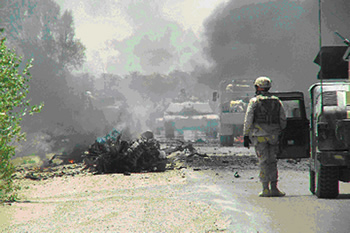
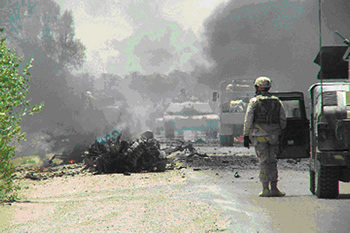
This item says that Bush administration officials told the American people that the Iraq War would cost $50 billion. A reader reminds me that the head of US AID actually put the cost at $1.7 billion. Paul Wolfowitz, that great economist now neoliberalizing the World Bank, even implied that Iraqi petroleum would pay for Iraq reconstruction. The cost of the war is rising toward a thousand billion dollars, i.e. a short-scale $1 trillion. Bush is still keeping this sum off the official budget (why?), and so it does not show up in the official figures for the budget deficit. But the money for the war is being borrowed, so that our grandchildren will still be debt slaves of Halliburton and Boeing. Folks, we've done been low-balled. The difference between us and that young couple with the coupe, though is at least they have a coupe. We've got rubble in the Middle East for our $1 trillion, on which we're paying interest every month. 
Meanwhile, at least somebody got something out of this miserable war. Millions in ill-gotten gains and jail time.

|
4 Comments:
Cost of War Heading toward One Trillion Dollars
Thanks for reminding us just how we got here. Very soon now it's going to be nearly impossible to find anyone who will admit to having voted for George Bush. None of us ever voted for Paul Wolfowitz, that's for sure!
When Americans collectively wake up and find themselves in the gutter because of the neocons' bender it will be possible to open the proceedings of The Anglo-American War Crimes Tribunal.
And then Paul Wolfowitz and Douglas Feith will rejoin their partners in crime Ronald Rumsfeld, Dick Cheney and poor George himself in the docket, as well they should.
Unlike after the Vietnam war, when Hollywood implanted the poor, spit-upon, noble-savage, murderer Rambo into kids' heads as the "victim" of that war, this time the truth must be hammered home. (See "Sir! No Sir!" for the real life antidote to Hollywood's propaganda)
Our country was the bad guy. Our country is a democracy. The actions our country takes are our responsibility.
If these mad dogs are not our responsibility then whose responsibility are they? Perhaps it's the fault of the French?
The one big difference is I didn't particularly like this war, and axked for the model that stopped Osama bin Laden instead. This wasn't low-balling. It was bait-and-switch.
$50 billion, hell.
Implied, hell.
A Bush administration official (USAID was created by executive order) told the American people the cost would be $1.7 billion. And he did not imply, he came right out and said that Iraqi oil (and other countries' spending) would cover the rest.
the one trillion was Stiglitz's figure who was Clinton's economic advistor, is a great economist and all that, but well you might want to read the full range of opinion:
http://www.economist.com/displaystory.cfm?story_id=E1_GSRSQPP
you'll need a bugmenot to get to the story. Kevin Murphy and them at the univ of c are argueing that the cost of containment (i.e. the cost we were paying to keep military in the region in order to keep Saddam Hussein from invading another country or gassing the kurds again) might have been more than the cost of actually occupying the country.
here's a link to Murphy and his collagues paper:
http://gsbwww.uchicago.edu/fac/steven.davis/research/War%20in%20Iraq%20versus%20Containment,%20Weighing%20the%20Costs%20(March%202003).pdf
as the economist points out Stiglitz's figure includes a lot of factors other economists didn't figure into the war such as the cost of providing health care for veterans etc. regardless it's going to cost more than originally thought. I'm assuming th Wolfolitz as economist angle is ironic, he's not an economist he has several degrees (chemistry, mathematics, and political science), but none in economics. You can find out more about Woloflitz's history in the bbc documentary the power of nightmares:
http://www.youtube.com/results?search=the+power+of+nightmares&search_type=search_videos&search=Search
Post a Comment
<< Home