
Informed Comment

Thoughts on the Middle East, History, and Religion

Juan Cole is President of the Global Americana Institute

Monday, May 01, 2006

Settling Iraq before it Blows Up

A renewed debate on the possible partition of Iraq is emerging.

Let's get one thing out of the way. As for letting a civil war rage, deliberately, I don't understand. Everyone is (rightly) complaining about world inaction on the genocide in the Sudan. But here you want to provoke a genocide (maybe a million dead and 5 million displaced) and have troops in the region and not intervene? Doesn't that make you worse than Khartoum? It is despicable. And, remember that such a war a) would not stay inside Iraq--it would become regional; and b) a full-scale war in the Persian Gulf region will lead to a big increase in your gasoline prices (as in, you ain't seen nuttin' yet).

Personally, I am against breaking up Iraq. I don't think it is more unworkable than Nigeria or Lebanon. And, the consequences are unforeseeable and potentially very, very dangerous.

I do, however, believe that the tendencies toward separatism must be recognized and managed.

I say that we make 5 superprovinces: Deep South, Middle Euphrates, Baghdad, Sunnistan, and Kurdistan, along with two smaller ethnic enclaves, of Turkomanistan and Chaldeanistan in the north. Bear with me.
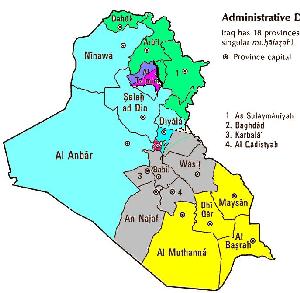


The Kurdistan Regional confederacy has already said that it will never disband its peshmerga militia, some 60,000 strong, and will never allow Federal troops on its soil. It is handing out visas and inviting in oil prospectors without asking Baghdad.
There is real danger of secession.

But the Kurdistan confederacy (the green in the north) has something that it wants from Iraq, and which other Iraqis want, which is the oil-rich Kirkuk (old name: Ta'mim) province. Kurdistan is waging a demographic war, via flooding Kirkuk with Kurdish immigrants and squatters (only some of whom used to live there), in its bid to annex oil-rich Kirkuk province to the Kurdistan Region (which now comprises Irbil, Dohuk and Sulaymaniyah). They want to hold a referendum on bringing the whole province into the Kurdistan confederacy in December 2007. They will win the referendum. And then the Northern Civil War will begin, because the Turkomans and the Arabs will never accept this outcome.

So here is what I would do if I were in charge. Mind you, this is not worked out to detail, but a general set of suggestions.

First, I would send the new Iraqi army into Kirkuk immediately to police it instead of having the peshmerga or heavily peshmerga-infiltrated Kirkuk police do it. Kirkuk is dangerous but it is not out of control, and this would be a good training wheel mission for the Iraqi army, supported by US forces from a distance. The neutrality of Kirkuk security forces has to be affirmed to begin with.

Then, I would partition Kirkuk province. It doesn't matter into how many parts. Let's say that the Kurds get a stan in the east contiguous with their confederacy, which can join it. (Note to the unimaginative: The map I gave here is completely notional, and I am not suggesting any actual boundaries of anything. Small ethnic groups should please keep your shirts on and not correct the map as though it represented something real.)

The Arab stan can hook up with largely Arab Ninevah province which will be part of Sunnistan, so that the Sunni Arabs would share in the special petroleum dividend, and that would help combat the insurgency. Likewise the small Turkoman and Chaldean stans might stretch across what is now Kirkuk and Ninevah/Mosul. They'll be on their own.

Kirkuk city would be a shared city, maybe for some of them a shared capital, on the model of Chandigarh in India (which is a multiple provincial capital).

The Coalition should dictate an oil profit sharing agreement before they go.

Of Kirkuk's petroleum profits, the central government gets 33 percent. The Kurdistan regional confederacy gets 33% if it stays in Iraq. If Kurdistan secedes, it gets nothing. The oil belongs to Iraq. This principle should be guaranteed by the Coalition.

Some formula would have to be worked out for apportioning the 33% among Turkomans, Chaldeans and Sunnistan. Sunnistan is much bigger but will have other sources of income. Whatever you do, they will scream, but that is what the new Iraqi army is there for. Send some of those Hungarian tanks with it. Besides, any percentage of the profits on 800,000 barrels a day is a hell of a lot better than the bupkes they have now. And, they'll share in some of the 33% that goes to the federal government, too, since that will be parcelled back out to provinces in services and programs.

A danger of ethnic stans is that they might want to secede. But I say that if they do, then their share of Kirkuk oil is cut off. So they can be rich Iraqis or poor stans. Their choice.

So that would be an incentive for the Kurds to remain at least nominally in Iraq, and to have good relations with Baghdad and with Turkoman, Chaldean and Arab neighbors. (Ethnic attacks would hold up oil payments). Partitioning Kirkuk province up front precludes it from blowing up into ethnic strife.

And here's the rest. The Rumaila oil field income is also split up. 20% goes to the federal government. 20% goes to Deep South Provincial Confederacy. 20% goes to Middle Euphrates Provincial Confederacy. 20% goes to Baghdad Province. And 20% goes to Sunni Arab Confederacy.

You will say, the Sunni Arab Confederacy is double dipping, getting shares from both Kirkuk and Rumaila. And I will say, bingo! They can go on blowing things up, or they can be Kuwaitis. Their choice.

You will say, how can the federal government live on these percentages of the oil money? I will say that it isn't good for the federal government to hog the oil income--it makes it too powerful and reinforces dictatorial tendencies. And I will say, if it needs money, it should put in an income tax like every other government.

Finally, the amount of petroleum profit sharing is not absolute. It assumes good behavior. Baghdad could make reductions for too many militias in a province, for instance. Bad behavior would be punished.

So that's my plan for keeping Iraq together as a federal state with substantial provincial sharing of oil income. I say, instead of just doing ad hoc policy and waiting for the blow-up, as Bush keeps doing, lets spend what political capital we have and make some forward-looking settlements right now. But lets make settlements that might produce social peace, not ones that lead to genocide and further inter-statelet wars.

39 Comments:

At 1:17 PM, Blogger EdoRiver said...

1) can the Kirkuk oilfields be made more secure against terrorist attack by agreements with the Kurds than similar negotiations for the areas of other oil fields? So that, this could become a reliable, high production source of income for driving the development of the region. And if so, what portections could be included in the negotiations to minimize revenues from being syphoned off into corruption by the Bagdad government?

2) Can the Bagdad government be trusted to gurantee some protection or support for this kind of regional unit, in negotiations with Turkey in exchange for oil? No security would mean no oil. and Further the Kurdish gov. would have to promice to cut off military aid to their neighboring Kurds in Turkey. However if the Turks again start up some modified version of ethnic cleansing of the Kurdish areas there would have to be some phrase of official Bagdad support for a protest to the Turkish gov. and Europeans could be brought in. So that if the Europeans want stable Iraq this includes the Kurdish region that overlapps the countries of Iraq and Turkey for starters. If Turkey domestic policy is a gross violation of human rights so that it disturbs the stability of Iraq then this is grounds for strong protests by the EU to Turkey.

If I were the Bush admin. I would seriously look at your proposal as a viable plan to provide enough stability so that the Pentagon could focus more of its attention and resources on Iran. The sooner Iraq is stabilize the sooner the pressure on Iran can be taken seriously by the Iranian government. Right now I suspect the hardline mullas are laughing at our President.

 
At 1:37 PM, Blogger johnMccutchen said...

Juan, I have long thought that all was too little, all too late. Color me cynical but truth-to-tell since about Fall 2003.

But now that we're at Mission Accomplished Anniversary 3

Preview of Coming Attractions

SULAIMANIYAH, Iraq (AFP) - Iranian forces shelled Kurdish rebel positions in Iraq for the second day, forcing dozens of Kurdish families to flee.


Families flee Iranian shelling on Kurdish rebels in Iraq

Some may be too young to recall, others too lost in Bushevik war reveries to remember or care, but there was a reason that Donald Rumsfeld shook hands with Saddam Hussein in the 1980's.

 
At 1:55 PM, Blogger johnMccutchen said...

Another thing too Juan.

As I've been reading Biden, Gelb, the WaPo piece on Sunday, Major Ike Wilson (West Point - "Let's do Civil War"), I keep thinking and like one of those bad tunes you can't get of your head, can't quite stop thinking

This is a sovereign state. Who are WE to decide anything for Iraq?

We've certainly come to a parlous and tragic pass.

 
At 2:08 PM, Blogger pop said...

Although laudable I don’t think your partition plan will work. I know of no weak central government like that in the world except for Switzerland. Everywhere else where there are very strong regions leads to break up. Look at Serbia and Montenegro. Look at the Basque country in Spain. Look at Quebec in Canada. Look at Indonesia.

Secondly Kurds everywhere have a very strong ethnic identity and they have been repressed everywhere. There is a low level intifada brewing in Turkey and I don’t think it will end until they get a State. Iran and Syria repress their Kurdish population. And yet that act of repression only serves in the long term to reinforce group identities. This builds up pressure that leads to a State.

On top of this people (often but not always) would rather be ruled by a dictator who is 'one of them' than a benevolent other. This is further complicated by the probability of incompetence corruption and attempted repression by the central government. What will stop it from using its power of the purse to increase its relative power? Not much. Even in countries with the rule of law show this problem (eg the USA). The Kurds understand this and will not want to diminish the relative power of their own province as compared with the central government.

Finally I must admit that I think the Kurds deserve a State of their own. The history of hitherto stateless groups getting a State unfortunately says they do not get it unless they are willing to resort to violence. Thus I fear that infiltrating Kirkuk is the only way they will achieve their objective.

I think it’s quite ironic that the whole of the Arab world is quick to go on about the injustice to the Palestinians (another group wanting their own State) and yet refuses to recognize the Kurds in their own back yard.

 
At 2:15 PM, Blogger SandSkeptic said...

Wheeee, Isn't This Fun?

In Iraq, even anti-imperialists get to be imperialists! Split this, join that, divvy out funds that aren't yours, walk all over nationalism and ethnic groups like they don't exist and pretend to be watching out for their interests on a higher plane.

Except for the high moral tone, even the neocons can probably get on board.

------

Um, wouldn't this require some sort of UN mandate? Or an invitation from the notional, perhaps-soon-to-
be-conjured-into-existence Iraqi "government?" They can't even agree on a set of ministers, how will they get on board for something like this?

What force is going to bring this about? A clueless, giga-humoungously-expensive US expeditionary force that becomes less effective by the month? Under whose feckless in-security regime the number of dead and wounded gets ever-larger and more gruesome? The dudes who can't even get Zarqawi now that they are finally notionally looking for him?

Get the troops out now. Call it a strategic re-deployment. Pretend it's a race; bet they could be out within a month.

Then the Iraqis could start to figure out what they want to do with their future.

------

Sorry to be so harsh. It's not a bad approach, if some international group wants to take it on, with the widespread agreement of Iraqis, probably in 3-5 years after an indecent and bloody interval. But not with US forces; they can't do this either.

-----

The real dismemberment plan everyone is looking at now is that for Iran:

Azeristan in the northwest, Arabistan in the southwest, with the oil, some Parsi-platelets in the middle, and some Sandy-stans in the east. Let your imagination run riot! Anyone can play!

The geopolitical argument, aside from notional nukes in a decade or three or five, is that the mayhem-ization of Iraq takes it out as a power factor in its region, leaving Iran relatively more powerful. (Slick move, W. and Co.!) With this sort of weak justification, we will be off to the races, the lesser ones, that is, the breeds without the Law.

The blood to be shed will be mostly that of non-English speakers, so you won't have to read many complaints. And of course some lucky American kids will get the chance to be heroes and die for their country. Dulci et decorum.

 
At 3:09 PM, Blogger Spin proof said...

I am sorry to spoil the fun, but the USA does not have the authority to divide Iraq, or any other country for that matter.

This may sound stupid, but the Iraqis understand Iraq better, and have the interest of their country at heart more than the Americans.

The 'exceptional' Americans in Iraq turned out to be exceptional at the wrong things: ignorance; arrogance; ineptitude; failed projects;lawlessness ..etc ..etc. I am all for free speech, but please do not take yourselves too seriously.

 
At 3:51 PM, Blogger ent lord said...

What are the Turks doing in the meantime? I have read some reports that Turkey has been threatening to send troops into Northern Iraq to seal the border because of border raid by Kurdish militia on Turkish towns. By Turkish reports,things are not as quiet in the Kurdish area as the Administration says.

 
At 3:59 PM, Blogger Christiane said...

Wow.. Your proposal leaves me speechless because of its quasi colonial approach. As soon as the new Iraqi government is elected, the coalition (aka the US) has nothing to say anymore. The Iraqis should be able to make their choices. There is no reason why the coalition (aka the US) should intervene; unless they receive an explicit Iraqi invitation they have no right to occupy it anymore, at least not second the last UN resolution.

That said,
1) Iraq is a country with a long tradition of central administration. The only reason why the Americans tried to break it up in different states is in order to weaken it and because oil firms hope it will be easier to get contracts from provincial governments. I'm not sure whether a working federal government can be imposed an a country with that level of centralization.
2) If the provinces are to be governed in a more decentralized way, I think it should be based on the existing geographical provinces, not on ethnic divisions as you propose, because that can only increase the rift between the different groups. This is even a sure receipt for the break up of Iraq, with or without the oil benefits redistribution (because each ethnic probably think she will get a bigger share if she fights). A real equitable plan of oil redistribution should keep half of its benefits for the central government and half for the provinces; each province should get a share proportional to their population. All the oil revenues should be shared in all the country, not these fields to these provinces and those fields to those province.
3) I think that sooner or later, the Kurdistan will become an independant region; they have already more or less taken their independancy and they won't go back. Whether with or without Kirkuk, that will depend on the issue of their independance war, or whether they get the support of the Americans for this(because I don't think it can be a peaceful separation if there are no external constraints).
4) IMO the Shiites/Kurdish alliance won't last. The Shiites will soon call for the withdrawal of the US troops and the Americans, who don't want to go, will thus make an alliance with the Kurds. So in the end, the Kurds will probably get their independant Kurdistan, but the price to pay would be the acceptation of US military bases; they won't hesitate to go along with the US if they are allowed to take Kirkuk, if not, they may be more reluctant.

 
At 4:29 PM, Blogger John Koch said...

You write: "First, I would send the new Iraqi army into Kirkuk immediately to police it instead of having the peshmerga or heavily peshmerga-infiltrated Kirkuk police do it."

Good luck.

Is there an effective "new Iraqi army"? Or is this still a "maybe some day" item on the to-do list? US officers try--vigorously and sincerely--to shepherd a new army, but perhaps it is beyond its means to disarm the peshmerga. That would entail a sub-occupation that would dilute the control of the Sunni insurgency.

Many press reports report of army actions without clarifying the sect or ethnicity of the unit or its target. If the press mentions an action at all, I suspect it was because a US officer guided the action and invited embedded coverage. What other units do (or don't do) is a good question.

It would be curious to see an article by an Arabic-fluent journalist about a pan-Iraqi army unit that pacifies and patrols a hostile town without heavy US oversight. I sort of suspect that it would be very dangerous to cover such a story, even incognito. Embedding is probably a pre-condition for journalists' security, but also constrains what they see.

Military reports emanating from official Iraqi sources are very murky. Consider today's allegation that Iranian troops crossed the border and shelled an Iraqi position. See:

http://www.nytimes.com/2006/05/01/world/middleeast/01iraq.html

It sort of reminds one of Hemingway's WWI observation that Italian conscripts would hear eachother in the dark, get scared, exchange fire, or even mutiny and shoot each other, and then file reports blaming Austrians.

All this fog is likely to obscure any evolving outcomes so long as enough US troops remain on hand to prevent wholesale collapse. After that ...

 
At 4:32 PM, Blogger Phoenix Woman said...

You'd think that Bush, Cheney, Rumsfeld and the other PNACers would be worried about this, instead of spending the past two years sending Special Forces troops into Iran to bait it into a military reaction: Bush has had US Special Forces troops in Iran since at least July of 2004, trying to bait the Iranians into giving Bush a pretext to invade:

http://news.bbc.co.uk/2/hi/americas/4180087.stm

 
At 4:51 PM, Blogger the actual rod said...

Prof. Cole,

Were something your plan to be implemented, do you believe that the Federal government would not have some significant troubles in levying an income tax? And are you certain that some the large-scale infrastructure (oil, transit, water, sanitation, and electricity, assuming that the security situation would improve) costs facing the federal gov't of Iraq could be addressed with such a diminished income? --Or better addressed by governments of the super-provinces? What would a federal government look like in such an Iraq? What would its responsibilities be? Who would be in charge of education? Given the crucial role of national education systems in creating/raising national consciousness in the Arab world, is control of education systems (by federal or confederate or provincial government) not a serious issue?

Most Iraqis (though probably not Sunnis) would understandably also have a problem with the Coalition working out the oil revenue allotment system, and many may choose not to recognize it as legitimate. Perhaps the Kurds would resent such an attempt and resist any deal that would tie their hands. In addition, the Kurdish population in Ninewah/Mosul province is not addressed by such a deal--a significant issue, though perhaps not as threatening as Kirkuk.

Is the current allotment deal not based on population? That would seem to be a workable deal, if the oil were flowing.

That said, it is admirable that you have tried to come up with a solution to what seems to be an unavoidable and bloody disaster, and of course it is necessary that every political avenue be pursued to the fullest extent.

 
At 5:17 PM, Blogger helena said...

Juan, I am really sad to see you thinking and writing like an imperialist who thinks it is the job of any US administration or US person to devise an outcome for the Iraqi people... "lets spend what political capital we have", etc etc.

What "we" are you talking about here? As a US citizen, I know for sure that the Bush administration has never taken my views into consideration in devising its militaristic policies of coercion in the Middle East, so I certainly don't feel a part of their "we".

(Do you?)

As a US citizen, I maintain that the best kind of relationship our citizenry can have with the 96% of humanity who constitute the rest of the world's people is to approach and deal with others around the world as complete equals to ourselves, entitled to their own rights in their own national territories... In other words, the US troops need to get the heck out of other people's countries, and neither the US government not any US citizens have any right to determine the shape of what the Iraqis choose to rebuild there... The most we can ask, really, is that they not shoot our troops as they leave and not treat our country in the future in the same arrogant, violent way that US troops and a US government have treated their country...

I think your map-drawing is arrogant and imperialistic.

As an analyst, I would say your pressimism about the possibility of coexistence among all Iraqis (with the quite likely exception of the Kurdfs) is decidedly overblown. But that is a discussion of a different nature.

 
At 7:27 PM, Blogger raf* said...

dear juan,

it is sad to see that your audience does not follow the INNER-iraqi debate on the federalism/regionalism issue. had they done so, they would not be up in arms about your proposal since you mirror PRECISELY the debate inside iraq and among iraqis.

kurdistan IS an autonomous region. the south (basra, muthanna, dhi qar) IS already setting up (for months now) a new "deep south" province. the idea of a "middle euphrates region" is also something that people in najaf & karbala are envisioning - even if the current preference for a name is "sumer". most groups also AGREE that baghdad should have some sort of special status as federal capital.

the one thorny issue is that of "sunni-stan" - but only because (a) many sunnis still don't want to face the demographic truth that they are a minority, (b) many don't want to accept the fact that 8 decades of sunni domination of iraq are over, and (c) they are afraid that they get cut off from the oil money. ensure that a significant amount of the oil $$$ will go to "sunni-stan" & there won't be a problem.

ditto for chaldeo-stan & turkoman-stan ...

this has nothing to do with "neo-colonialism/-imperialism" -- it is an IRAQI debate on how to organize the future of IRAQ.

and PLEASE everyone stop that crap about iraq having been a "historical nation". you don't have to go any further than the wiki article to understand that "iraq" was created in 1920 and is no more "historical" than, say, yugoslavia (created at the same time).

--raf*

www.aqoul.com

 
At 8:22 PM, Blogger copy editor said...

Chop it up. Bring the boys home. Rebuild the Army.

But, if Bush would not go for firing Rumsfeld -- one man -- what makes anyone think the chief executive will allow his Iraq to be split?

 
At 8:36 PM, Blogger CuriousHamster said...

This post, and the attached comments, are, I think, a reflection of the problem which the "coalition" now faces in Iraq.

Most people would like to see civil war averted but what legitimate influence can the coalition now exert? We're talking about a sovereign country and the US government cannot now decree a solution.

This was always the elephant in the room of the the democratisation project. In the absence of the slam dunk WMD, the rationale for the war now rests on the promotion of democracy. This has meant that the coalition's ability to influence events has become pretty much non-existent.

I'm increasingly of the view that a hot civil war and some form of partition are already inevitable. As things stand, I believe the only thing in doubt is the timing.

Even if Bush and Blair were to break the habit of a lifetime and actually start listening to people who could give them competant advice, it's probably too late for it to make any difference on the ground.

The Iraq project was fatally flawed from the start. For a long time, I thought radical corrective surgery to the coalition's policies might still save the Iraqi people from the worst consequences of this disasterous intervention. It pains me to say it but I no longer believe that's the case.

Unless the coalition troops are going to actively intervene in the coming civil war, and the US government shows no indication that it has the stomach for that, there's no point in them staying there any longer.

Of course, the small but vocal neo-con pro-war crowd will portray this position as typical of liberal defeatism rather than a reluctant acceptance of an unpleasant reality. An ability to accept reality has never been high on their list of essential qualities, it seems.

 
At 8:41 PM, Blogger Nabil said...

Although I suppose your approach to parceling up Iraq into super provinces is no worse than anyone else's, I am still struck by the casual privilege assumed by many in the international community -- especially Americans -- to other folks' sovereignty.

As a counter-example, in order to prevent the most aggressive nation-state in the world right now from threatening any more sovereign states, I propose the following partition of the US into more homogenous and viable super provinces:

1) New England: stretching from New Jersey to Maine.

2) Mid-Atlantic: stretching from Virginia to Delaware.

3) Dixie: Most of the CSA.

4) Gulf Coast: Southern Louisiana to Pensacola. Katrina relief could be self-funded within these borders.

5) Florida: excluding N. Florida.

6) Texico: Including all former Mexican provinces. A referendum to rejoin Mexico would be held within 5 years.

7) Midwest: stretching from Ohio to Wisconsin.

8) Appalachia: W. Virginia, Kentucky, and Tennessee.

9) Prairieland: Kansas to Utah.

10) Great Northwest: Oregon, Washington.

11) Alaska

12) Hawaii.

This plan would do more to help world peace than dividing Iraq would, and would more accurately reflect the ethnic and sectarian differences evident in American society.

 
At 8:44 PM, Blogger johnMccutchen said...

From TPMCafe...


MISSION NOT ACCOMPLISHED --- WHAT NEXT?


By Bruce W. Jentleson | Professor of Public Policy and Political Science at Duke University

Today marks the three-year "anniversary" of when President Bush so jauntily told us that the mission in Iraq was accomplished. It clearly hasn't. The critiques are well-established; the "what next" alternatives less so. The former without the latter only get us so far, both politically and in policy terms.

We're going to use our blog to address alternatives. Between now and May 15 we of the America Abroad contributors group will post on what next in Iraq (other topics, too, but this as a focus and thread). We invite bloggers in our AAbroad community to join in. While some analysis of how we got to where we are can be helpful, we'd really like to keep the focus on where we go from here. We'll then compose a paper, drawing on ideas conveyed, and pursue opportunities for dissemination and input (e.g., possibly the Baker-Hamilton Iraq Study Group).

Bruce Jentleson, on behalf of America Abroad contributors group

 
At 8:45 PM, Blogger pete, NY said...

Wow, ambitious prpoposal, Prof. Cole!

I can imagine this turning into is several years of haggling over how to split the oil revenues, during which time the status quo of halfway peace, halfway civil war, is more or less maintained, a situation that may be better than some alternatives.

Problem #1 is that foreign powers have incentive to sabotage the deal that distributes oil money amongst the ethnic groups, because they want the chance to buy the iraqi oil as soon as they can encourage an iraqi government to privatize it.

Problem #2, which is probably going to happen anyway, is that the process of negotiating the split creates a reason for all factions to stay armed in case the others try to cheat them of their fair share, actually incentive for military buildup for negotiating advantage. A sortof multi-sided iraqi cold war?

Come to think of it, Chalabi is running the oil now right? And its not getting produced as fast as it used to right? He may not be as dumb as it looks- from an investment point of view, with the price of oil going up, the best place for it is to stay in the ground until it becomes more precious.

So you raise the stakes as time goes on, and so the longer you wait the more reason other powers (saudi, iran, US, china??) have to get involved. maybe it turns into a big cold war!

 
At 10:15 PM, Blogger Charlesellison said...

This site has been so outstanding. Have you lost it completely? Time to break out the Vietnam hearings transcripts, the Fulbright books and the last chapter of Bob McNamara's book (that took 25 years too long to write).

I know that it is hazardous to draw too closely on historical parallels. Nonetheless, might I suggest that the best interests of the US are served by a policy that (a) removes US and related troops, (b) allocates US funds to credible international agencies to rebuild Iraq in conjunction with the Iraqi people, (c) identifies some international force to safeguard Iraq's borders, and (d) seeks to rebuild our relations with other nations?

Iraq is a self-defeating diversion from the effort to reduce or stop terrorism. It is part of a foreign policy that weakens the federal government in a fiscal sense and, thus, constitutes a roadblock to progressive domestic policies at home.

Bush has made Iraq a major issue for the US and the world. Our policy should be to return it to what it rightfully was and is. We owe the people of Iraq plenty, but it is not and should not be a major issue for the US or the world. The sooner we get there, the better off we will all be.

 
At 10:47 PM, Blogger Waveflux said...

Professor Cole:

I think you and Tony Cordesman need to have a long talk. Seriously: I think a debate on this issue between the two of you - sober analysts both - on these pages or elsewhere, would be instructive.

 
At 10:56 PM, Blogger Nicholas said...

Wow...Juan is the imperialist now? I don't even want to know what that makes me.

Juan's proposal is perfectly reasonable. Instead of having Kirkuk's oil be a source of war, have it be a source of unity. There is nothing imperialistic about it. But it must be great to have the moral authority hurl Marxist buzzwords at people who are trying to resolve conflict.

Did the US violate Hitler's sovereignty when it liberated Western Europe? Did we violate Milosevic's when we prevented his genocide of Bosnian Muslims? Saddam's when we kicked him out of Kuwait? I'm sure you all must have been thrilled when we didn't violate Rwanda's sovereignty in 1994.

Yes people, there are sometimes good reasons to get involved in the affairs of other "sovereign" nations. So get over yourselves. Maybe invading Iraq was a bad idea, but trying our best to unify the country isn't.

 
At 11:06 PM, Blogger marcwycliffe said...

For those looking to inform themselves about the historical context of the federalism debate in Iraq, and its relationship to various empires over the 20th c. I'd suggest this piece by Gareth Stansfield in Prospect magazine. It does not have Cole's cartographical detail but it raises good questions about feeling Iraqi, new oil and old oil, Peshmerga/National Army links and so forth.

http://www.prospect-magazine.co.uk/article_details.php?id=7437

 
At 12:21 AM, Blogger endee said...

Prof. Cole,

I do not know what prompted you to act as a latter day Durand ( or Balfour) -- perhaps you are a realist and presume that the blackshirts are going to do it anyway so why not play with the crayons.... Whoever does it, it is wrong!! It was wrong to invade Iraq, it is/was wrong to deplete them with depleted uranium, it is/was wrong to spend their wealth, financial and cultural, to enrich crooked officials and contractors, it is wrong to blame the Iraqis for opposing this literal and figurative rape of their country and, finally, it is wrong of you ( and some of your commentators) to even play act in this fashion. When sensible people act like twits, how can one blame those who are actually twits?
Kudos to John McCutchen and Nabil et al for their comments -- especially Nabil and his crayon!!

Tsk, Tsk Prof. Cole -- from a concerned Bangladeshi.

 
At 12:58 AM, Blogger lgonick said...

Has nobody noticed that the US govt may be crying crocodile tears over high oil prices? Surely they are much more damaging to India and China than to the United States. The only thing wrong with $3 gas, from the administration's point of view, is that it'll toss the Republicans out in November.

 
At 1:44 AM, Blogger Rusty said...

Per Pop's comment: "I know of no weak central government like that in the world except for Switzerland." I would ask, 'What about the United Arab Emirates?'. Granted these emirates don't have the ethnic tensions found in Iraq, but haven't they forged a sharing of revenues and governance?

 
At 1:45 AM, Blogger Rusty said...

er Pop's comment: "I know of no weak central government like that in the world except for Switzerland." I would ask, 'What about the United Arab Emirates?'. Granted these emirates don't have the ethnic tensions found in Iraq, but haven't they forged a sharing of revenues and governance?

 
At 2:29 AM, Blogger KingoftheDarbar said...

I agree with several of the posters who are against such heavy-handed intervention.

It is simply WRONG for westerners to not only unfairly attack/occupy a place but then to also set the policy before hightailing...

The Iraqi civil war will happen, but that's only because the US invaded and is now refusing to leave peacefully.

Tribal/feudal/ethnic rivalries are taking place all over the world and will never be cleaned up by western mopping.

This is the exact gung-ho attitude that got us into this quagmire in the first place and exactly why some people are not 100% pro-Cole (including me).

While I respect you Professor for standing up on a number of controversial issues no one else of any eminence wants to touch, you can't go about the Iraq fix up with this approach.

It will cause another 100 years of crap.

 
At 3:00 AM, Blogger Truth About Iraqis said...

Christiane, I love what you said, but finally, Juan Cole reveals his true colors.

Take, for example, this statement:

"You will say, the Sunni Arab Confederacy is double dipping, getting shares from both Kirkuk and Rumaila. And I will say, bingo! They can go on blowing things up, or they can be Kuwaitis. Their choice."

This is quite the racist comment, is it not? It leads one to believe that Sunni Arabs only blow things up.

And is that how the notable college prof has reduced the Iraqi resistance? Sunni Arabs blowing things up?

Bigoted, prejudiced, the list for this post and in particular the statement above is limitless.

Iraqis become Kuwaitis. Okay, fine, but only when America allows the national anthem to be sung in Spanish and all Californians, New Mexicans and Texans become ... heck, Mexicans!

This is your solution for Iraq?

How much was deposited into your bank account? Be honest.

 
At 4:03 AM, Blogger Nur-al-Cubicle said...

It's too late.

 
At 4:14 AM, Blogger gagiiberibimba said...

You can stop with "If I were in charge..."

Now, back up a step, and start out in reality.

"If anyone were in charge..."

 
At 4:48 AM, Blogger Fred in Vermont said...

"You will say, the Sunni Arab Confederacy is double dipping, getting shares from both Kirkuk and Rumaila. And I will say, bingo! They can go on blowing things up, or they can be Kuwaitis. Their choice."

This is quite the racist comment, is it not? It leads one to believe that Sunni Arabs only blow things up. And is that how the notable college prof has reduced the Iraqi resistance? Sunni Arabs blowing things up?


No I think that it is just a realistic way to put forward an uncomfortable fact that many want to walk away from: unless the constitution is changed so that the Sunni Arabs of the center get a share of oil revenue the insurgency will continue as a civil war. I suppose he could have said that "fairness demands that . . . ." and it would have sounded more professorial, but it is more correct to say that only an oil sharing agreement will prevent continued fighting. And characterizing that fighting as "blowing things up" is a good way to focus on just how difficult it would be for anyone to stop that sort of asymmetrical war.

But I fear that there is a problem with Professor's Cole's very well meaning and responsible suggestions. While I think that the complex of compromises that he describes might be stable and self-correcting if it could ever be put in place, I just don't see how we, or they on their own, get from here to there.

It seems to me that we are just too far down the road of setting up an elected constitutional government, and too much committed to starting to draw down our forces, to be in a position to move the permanent Iraqi government, when and if it forms, into such a difficult agreement however desirable it would be.

I think that the comments of SandSkeptic, though perhaps a bit more harsh than necessary, put the major problems well:

1. We look like imperialists if we put too much pressure on the Iraqi government to develop such a solution.

2. Since it is not clear that the government can even agree on a set of ministers, it is unlikely that new government will have the political capital needed to take up something like this as one of its first items of business (which it would almost have to be).

3. In view of our failed occupation policy and our already homeward-looking forces can we really do the arm twisting required to make such an agreement happen?

I think that someday either Iraq will fall apart or it will reach some sort of oil sharing agreement, but I don't see how we can somehow give such an agreement to Iraq as we are leaving in what amounts to defeat.

The only chance I can see for such a plan would be for us to announce we are on our way out and use that irrevocable fact get all the other stake holders in the area to come together and demand that Iraq use the 4 month window for constitutional amendment to reach a fair agreement on power and resource sharing.

Perhaps if the Arab League told them that they needed to sit down and make this happen it would. But the only way that can happen is that it has to be clear that we are not asking people to support our occupation but rather to themselves help put humpty dumpty together again because all our king's horses and all our king's men have failed and are on our way home.

I can understand the moral imperative that many true friends of the Iraqi people, like Prof. Cole, feel that we must not abandon a broken Iraq to a disastrous civil war, but we are just not in a position to prevent that and the only people who perhaps can prevent that will not be willing to become involved until we are clearly well on our way out. It seems to me that this is a risk we need to take, not just as an excuse to bug out, because it is the only real way to get the Iraqis to make the changes needed to avoid civil war.

 
At 5:27 AM, Blogger Moloch-Agonistes said...

Worrying about Cole's "imperialism" at this stage of the game seems a bit much. The American invasion is over, we've opposed it--with reasoning that proved quite sound--but for Americans, the charge of imperialism can't be avoided. We are, in fact, imperialists, and if I can agree with Bin Laden on nothing else it's that I am responsible for the actions of my government. So the question becomes: Quo vadis?

In that vein, it's not only reasonable to ask what the best outcome for Iraq might be at this point, it's positively valorous. Having caused death and destruction on a mass scale, it's our responsibility as Americans to advocate for the least destructive resolution. Unfortunately, our behavior to date -- combined with the degree of instability that our proconsuls have presided over --makes the chances of anyone adopting an American-inspired Partition Plan, no matter how rationally designed, minuscule. It probably is too late. But that doesn't mean we shouldn't think about it.

More importantly, maybe, it's also our responsibility as engaged members of the human race to envision
less destructive possible futures, in which more people can flourish.
Part of this involves thinking about the framework in which such proposals have to be executed. Maybe the U.N. would have to administer it, maybe some other body. In case anybody's forgotten, the track record of the U.N. with partition plans is not so hot. But that's just to say that the rough sketch Cole presented is missing a few important elements.

If thinking about and advocating more constructive political arrangements in other places is ipso facto imperialist then icons like Che Guevara, Karl Marx, even Jesus Christ all fall by the wayside. Imperialism is defined not by hopes or visions for the world outside one's own national borders, but by the use of force and coercion to get them realized. Allowing the fiasco of Bush's Middle East policy to make us shy away from the world outside our borders would compound tragedy with denial. That's not what "self-determination" ought to mean, and if it is, then no self-styled progressive should have anything to do with it.

 
At 6:41 AM, Blogger avid student said...

I like that the forum is discussing possible solutions. Maybe there should be some parameters:
1. Start small. I'm not aware of any of the large USAID contracts or the large CPA/IRMO contracts really accomplishing much of benefit to the Iraqi people.
2. Focus on what the US can or should do, rather than on what Iraqis should do.
3. For inspiration, and to understand the urgency, study the new strategy developed by USAID, DOD and State intended to undermine support for the insurgency. It is available at www.grants.gov. Find the RFA for FSSCI. The plan includes a sharp increase the level of violence. This is the strategy that integrates PRT, CERP, FSSCI and makes all reconstruction and development efforts joint with the military.

 
At 6:58 AM, Blogger Charlesellison said...

I will hazard one more post on this topic.

Forty years ago the US turned Vietnam into our most important foreign policy issue. Today, we recognize that we lost the war, the Vietnamese managed to create their own government, and the US abandoned plans for "democracy" in Vietnam. Vietnam has lived in peace more or less for years and it rightfully no longer occupies a central place in the give-and-take of international and military affairs.

For now, the Vietnam War was longer and more violent than the US war on and occupation of Iraq, though US policy in each case seems criminal enough.

While there are many ways in which the current situation seems more dangerous, I wonder: Could we be lucky enough that in forty years Iraq might be pretty much what Vietnam is today?

The Vietnam experience suggests that it is at least possible that an end to the US occupation and withdrawal of all troops might produce a not dissimilar result.

The US and Iraq could do a lot worse. One way to achieve this less desirable outcome might be to keep an occupation army in Iraq and try to "fix" its governmental apparatus.

 
At 4:41 PM, Blogger meo49 said...

"Anatomy of a civil war; a Lebanese perspective on Iraq." was written back in May of 2005 and show how the atmosphere for a civil war was created shortly after the invasion of Iraq and how a civil war evolves.
I was talking to congressman Christopher Shays about 3 weeks ago. I started the conversation by sayin, I told you so about Iraq way back in October of 2002. His reply was: "but they voted". How little our politicians understand Iraq and understand us. They discount the "hope" factor. What is left for a population on the brink of a civil war is hope and it is hope alone that brought the Iraqis to the voting booths, not their belief in democracy.
Anyway, I think the article is worth reading.
I was going to write a follow up article "How to survive a civil war". Surviving a civil war does not mean avoiding death; truely surviving a civil war means surviving with a clear conscience and being able to be a positive influence when the dust settles.
I did not write that article. What stopped me was the "hope" that Iraq would not plunge into a civil war.
Thanks for reading,
Maher Osseiran

 
At 12:46 AM, Blogger Murteza ali said...

To the guy called truth about Iraqis, How dare you say Juan cole is a racist? Face facts, the sunnis have been disenfranchised and are blowing things up. those things have, for the last 3 years, included shia children, shia women and shia mosques.

If, as i assume, you are a muslim then you have to take back your sly dig about Juan taking money. It is haram to throw accusations about without evidence. Dont fail me habibi.

All you idiots having the balls to call Juan cole an imperialists should crawl back under the rabid stones you came from.

This man has done more than ANY of you to hold the bu$h administration to account. Yes the situations fucked but sitting around crying wont do nothing to help Iraq.
To the concerned bangladshi, i hear you points but Iraq has already been invaded, has already been depleted, has already been raped and pillaged. Now we need to do what we can to find the best way out of this situation. Talking about the past doesnt actually get us any closer to getting the devils army out, nor does it help the Iraqis plan for a better future.

Our nation needs a solution and at least someone is trying to come up with something.

More than can be said for some of you self-loathing scum buckets.

 
At 7:36 AM, Blogger r. scott thompson said...

Perhaps its time the Kurds did have some greater stake in their traditional homeland.....Around 1914...."An independent Kurd-
istan in Anatolia would almost certainly have destabilized the British
hold on central Kurdistan and its vital oil deposits".....www.ciaonet.org/book/sir01/sir01_06.pdf

The sizable ehtnic enclaves(turkmen, etc.) within a 'redeveloped' Kurdistan could be structured similar to the autonomous region of Gaugazia in Moldova. After all, a robust petroluem sector in Kurdistan will benefit many. Even oilfileds in the US werent nationalized. But the supporting industries and services would emply a great many. This 'formal' establishment of Kurdistan could also spark additional foreign investment in the region.
"Sunnistan" or whatever the central region containing Baghdad is called, while itself oil deficient will have oil-rich neighbors to the north and south so one would think that imports wouldnt be a problem. Sadly Bagdhdad doent have a real harbor. How to develop central Iraq????

 
At 11:57 PM, Blogger no exit said...

Professor Cole,

Wonderful analysis and finally an informed, reasoned analysis & PLAN.

There are too many critics here who seem to be faulting you for presuming to put in your two cents about how to fix this problem. We broke Iraq. When do we start putting in place a coherent plan to fix it?

I love the idea of tying oil revenue to unity, it provides a positive incentive to work things out and protect the money. Sure it requires good government, but, are we to disqualify plans because they require good government. If so, then all IS lost.

Keep up the good work!

Hitchens is an ass and his influence is on the wane while yours will only grow (hopefully).

 
At 11:06 PM, Blogger Asif Sertturkmen said...

I do totally agree with what prof. Juan Cole had indicated regarding the demographical change of the Turkmen city of Kirkuk. Kirkuk’s demography has been changed twice since 1980.
In fact, large-scale violations in Kirkuk have occurred since April 2003. Turkmen lands and properties that were forcibly taken from the Turkmen by the former Iraqi regime during the Arabification scheme were distributed to the new Kurdish settlers.
It has been recorded that since April 9, 2003 more than 500,000 Kurds have entered Kirkuk from the Northern provinces of Iraq (Sulaimaniyah, Erbil and Dohuk) as well as from Iran and Syria. The freedom and dignity of the Turkmen in their regions were violated. Hundreds of Turkmen were detained and investigated without judicial decision. Moreover, the Turkmen detainees were mentally and physically tortured. The Kurdish migration to Kirkuk is unstoppable. The Kurd’s intention is to increase the Kurdish population in Kirkuk to gain majority in 2007 referendum. When the Turkmen demanded to repossess their confiscated land and properties, it was strongly rejected by Kirkuk Kurdish authorities.
Kirkuk should be a neutral city and should not be annexed to any region. This was indicated in Paragraph (c) of Article-53 of the Transitional Administration Law which gives Kirkuk and Baghdad a special status and opposes their annexation to any region. Canceling this paragraph in the Iraqi constitution is a clear indication that Kirkuk will be annexed to the northern Kurdish region, which the Turkmen and Arabs strongly opposed.
Kirkuk should be given a special status because it is considered as a multi-ethnic city representing all Iraqi segments. Despite the fact that the administrative, cultural and political rights of the Turkmen were said to be guaranteed, it is not possible to say that the law is satisfactory at these points.
It has been estimated that the Turkmen constitute around 13 per cent of the total population of Iraq, but higher percentages have also been proposed. The Turkmen are the third largest ethnic group in Iraq after the Arabs and the Kurds and their number is estimated at around three million people.
The Turkmen people of Iraq have waited patiently to see their legitimate rights in the new Iraq, but unfortunately more injustices and unfairness has been applied against them. They were stunned by the limited rights stated in the Iraqi constitution. Moreover they were deprived of basic human, political, social, cultural and economical rights.
As a conclusion, the Turkmen are very concerned about their future in Iraq. The issue of the Turkmen city of Kirkuk should be fairly solved and Kirkuk should stay within Iraq. Consequently, instability, hatred and more bloodshed will continue to occur in the region because the Turkmen and the Arabs will strongly oppose the eradication of Kirkuk from the body of Iraq.


Post a Comment

<< Home