
Reflections on Petraeus's Comments
On lack of Political Progress
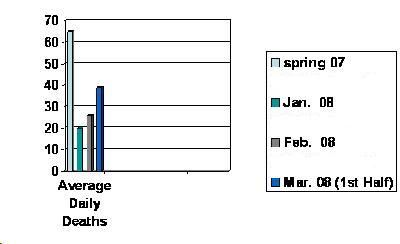
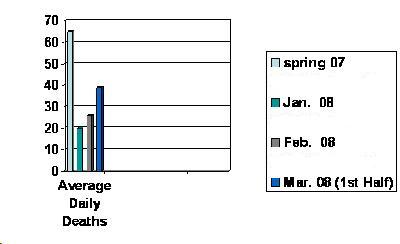
General David Petraeus is quoted in WaPo as saying that no one, American or Iraqi, thinks that there has been sufficient political progress in light of the reduction of civilian deaths since last fall. The US troop escalation, the strategy of paying Sunni guerrillas to join pro-US Awakening Councils, and the cease-fire with the Mahdi Army have brought down the grisly daily death toll from an average of 65 a day in the apocalypse that followed the February 2006 bombing of the Golden Dome in Samarra to between 20 and 40 a day more recently (it was 20 in January, 26 in February and 39 in the first half of March):
The first half of March has been disappointing with regard to casualties. There have been several big bombings in Baghdad, and over a dozen US troops have been killed in the past week. In fact a few weeks ago the Sunni Arab guerrillas blew up a meeting of the al-Anbar Awakening Council in Baghdad itself right under the nose of the US military. It is possible that the Sunni guerrillas had lain low during January, keeping their powder dry, with the intent of embarrassing Gen. Petraeus in his April congressional testimony. It is also possible that the various techniques the US military has deployed to reduce violence have reached their limit of effectiveness in the face of an ever-adapting enemy. And after all, the Sunni Arabs now have even more to avenge, since quite without meaning to the American surge somehow allowed a massive ethnic cleansing of Sunnis from Baghdad, with about a million of them now penniless and homeless in Damascus.
But despite these controversies about the military side, Gen. Petraeus has certainly had successes. And he is clearly frustrated that they have not been taken advantage of by the Iraqi political elite. And my strong suspicion is that the US officers in Iraq are also frustrated with the White House for not pushing the Iraqis harder on a political settlement. It is very hard to see what Bush's political strategy is in Iraq. The "surge" was never meant to be the objective but rather the means.
Gen. Petraeus isn't specific, but I can give some examples. The Sunni Arab Iraqi Accord Front withdrew from the al-Maliki 'national unity' government last summer. The IAF is a coalition of three parties. Two of them say they are uninterested in coming back into the government. The third, the Iraqi Islamic Party, led by vice president Tariq al-Hashimi, is said to be seriously considering returning. Nothing has happened so far. In other words, it is still the case that al-Maliki's government is less successful at reconciliation with the Sunnis now than it had been last year this time before the surge had made much of an impact.
Sunni Arab provinces such as Diyala, Salahuddin and Mosul are still violent, and even al-Anbar, which has settled down, is not paradise. The Awakening Council model does not seem to have been successful outside al-Anbar and some Baghdad neighborhoods, and there is always the danger that the US is creating a powerful Sunni militia that despises Prime Minister al-Maliki as Iran's cat's paw.
The Kurdish-Arab struggles in the north, the issue of Kirkuk, the terror activities of the Kurdish Workers Party (PKK)-- based in Iraq but hitting NATO Turkish troops in eastern Turkey-- and the Turkish incursions into and bombings of Iraqi Kurdistan, signal that the north is a powder keg. The unresolved issue of oil-rich Kirkuk and whether it will accede to the Kurdistan Regional Government is the other shoe in the Iraq crisis, which has not yet dropped but could at any moment. I have been told that Gen. Petraeus deeply disagreed with Bush's decision to share real time intelligence on the PKK with the Turkish government and to allow a major Turkish incursion into and bombing of northern Iraq.
Likewise, the Islamic Virtue Party (Fadhila) withdrew from the al-Maliki government last year. It controls the provincial administration of Basra. Its rival, the Islamic Supreme Council of Iraq, staged a 5000-strong demonstration against the provincial government last week. Having bad relations between the federal center and the province of Basra is not good for Iraq, because Basra is the country's biggest export route, including for petroleum, which generates 90% of government revenues.
So you could understand how Gen. Petraeus, having sacrificed so much to get some sort of social peace in Baghdad that would allow some major steps toward political reconciliation, is frustrated that no such major initiatives have been launched and that Iraqi politics just seems to be stuck.
It is worthwhile mentioning that what Gen. Petraeus said about the lack of political progress is the opposite of what John McCain has been saying. I am not saying that the contradiction is intended to be a political statement. But I am saying that Petraeus has just revealed himself again to be a straight shooter of a sort that has been all too rare in the Iraq misadventure.
===
On another topic, see Barnett Rubin on an integrated strategy for Afghanistan.

Labels: Iraq


19 Comments:
Thank you so much, but all I care about is leaving Iraq and Petraeus will have no such leaving.
We must leave Iraq, and Petraeus and this Administration are trying to prevent leaving even by the coming President.
General Petraeus is of course not competent to speak about Iraqi politics. That is the purview of the State Department and Ambassador Crocker.
The US Government long ago established eight key areas as pillars of US strategy in Iraq.
The Eight Pillars
---------------
1 Defeat terrorists, neutralize insurgents
2 Transition Iraq to Security self-reliance
3 Help Iraqis forge a compact for democratic governance
4 Help Iraq build government capacity and essential services
5 Help Iraq strengthen the economy
6 Help Iraq strengthen the rule of law
7 Increase international support for Iraq
8 Strengthen public understanding of coalition efforts and public isolation of the insurgents
Two military pillars, one economic, three political, one diplomatic and one propaganda, with four requiring "help."
How are we doing in the political and diplomatic spheres? According to the most recent US State Department Iraq Weekly Status Report on the Eight Pillars, under "political", are the following: "Charges against Ministry of Health Officials Dropped, U.S. Accepting More Iraqi Refugees, Iraqis Begin Processing Amnesty Applications and Execution of Chemical Ali Approved."
Under diplomatic: "Talabani to Visit Turkey, Proposal to Increase European Union Involvement in Iraq, Iranian President's Iraq Visit Ends with Seven MoUs and $1 Billion Loan, and BBC Prepares to Launch New Arabic-language News Channel."
http://www.state.gov/documents/organization/101940.pdf
The Eight Pillars, beyond the title, aren't even referenced in the report!
This useless information was obviously taken from wire service news reports. This inability of the US government to report to the American public what's actually going on in Iraq, specifically progress on the Eight Pillars, as advertised, leaves the door wide open for speculation by others. Obviously the intent of the Bush administration is to muddle through the next year, and the growing disinterest from the American public seems to be acquiescent.
Iraq is a complex situation-- no doubt beyond my ability to comprehend very well. Worse, it appears beyond the ability of the current administration to comprehend very well. I see Gen. Petraeus as something of a Westmoreland figure in this adventure-- perhaps a bit more candid, but still usually claiming progress based on favorable body counts. He claims that he is succeeding militarily, only the political part of it isn't coming together. But as I understand it, the political part is 90 percent of IT. Insurgency is principally a political movement, not a military one. Guerilla violence is aimed for political, not military, affect. [Blowing] "up a meeting of the al-Anbar Awakening Council in Baghdad itself right under the nose of the US military" is political, not military, theater and I imagine that event was much more significant to he Iraqi public than to us. US strategy has been taken right out of the British handbook-- invade, install a corrupt puppet regime with no political organization, withdraw leaving a skeleton force to prop up the puppet regime and live happily ever after. It didn't work all that well for the British.
Gen. Petraeus is very frustrated. It seems that he has now realized that he has been a fool to accept such a hopeless challenge.
His future rests on the trivial Maliki who has surrounded himself with 77 equally trivial advisers from his circle. What hope is there?
America's tactics rely on using a carrot and a stick. The trouble is the GreenZone Iraqis are incapable of delivering, regardless of the incentives. So it the whole thing has fallen apart.
The most immediate problem is the formation of the new cabinet. The Sadrists left in April 2007, and Maliki is still discussing options nearly a year on! The latest info is that they will propose few new ministers "to repair" the existing cabinet. They hope to release the names by the end of the month, to be voted on in April most likely after Gen. Petraeus has delivered his report.
He really wants to scare the Iraqis off with the report, but the Bush admin is sabotaging his efforts. It is very tough and always getting tougher still.
" And after all, the Sunni Arabs now have even more to avenge, since quite without meaning to the American surge somehow allowed a massive ethnic cleansing of Sunnis from Baghdad, with about a million of them now penniless and homeless in Damascus.
I think it was a tactical decision to do nothing about the Sunni diaspora ... to attempt to do something might well have led to serious urban warfare, and open civil warfare. What "we" (and the press did) was ignore it or make it sound "voluntary" (when much apparently resulted from death threats) -- because people were "tired."
As I understand it, this failure represents further violation of Geneva Convention Occupation Guidelines/Rules.
I suspect it was obvious to everyone early on that "our" priorities were to sector Baghdad as we sectored Fallujah. I recall in March/April of last year Maliki suddenly showed some spine and prohibited the Americans from building walls sectoring up Baghdad. There seemed to be some brief kerfuffle (which I watched with interest but couldn't decipher.) I suspected this was integral to Petraeus' plan. I listened and watched and these disputed walls were never mentioned again much until the Congressional Testimony when it appeared that Maliki had been ignored or overruled (unless other partitions replaced the walls he so strenuously objected to).
Tactically, to secure the peace, "ethnic cleansing" provides some short term benefits. The new Foreign Affairs cover article on ethnic strife internationally states in its summary that sectoring may be the least bad immediate solution - globally.
Depressing that. Unworkable that. Temporary "solution" at best that.
The 30,000 "surge" troops could never hope to make up for the missing 75,000 or 150,000 more necessary bodies that were not deployed at the outset -- estimated by Shinseki -- estimated pre-invasion, pre-things going to hell in a handbasket, pre-3+ years of badly managed occupation and the rise of the various insurgency factions.
This is unrelated but seems to have escaped notice. It was reported by Reuters. I have no idea if it is significant.
http://www.alertnet.org/thenews/newsdesk/L13822207.htm
"QANDIL MOUNTAINS - Iran shelled bases used by Kurdish separatist rebels in the Qandil Mountains in northeastern Iraq for about 90 minutes, said the spokesman for Kurdish security forces in northern Iraq, Jabbar Yawar. There were no reports of any casualties."
ref : “It is very hard to see what Bush's political strategy is in Iraq.”
Mr. Bush's political strategy is to sustain the Occupation of IRAQ, not end it ~ and by doing so sustain the War Powers apparent that enable a Unitary Executive to persist.
The tragedy is that it never was, and has not been to date, about Over There : about Weapons of Mass Destruction, or Al-Qaeda 9/11, or OIL, or Sunni- and Shi'ite- and Kurdish- Iraqi people. Foreign Occupation, itself, is a means to an end : it has no ‘end state’ in its intention, in its vision: "What is this place to become when there is no Occupation?" will always be a future tense; So long as this place remains occupied, The Occupation will remain an enemy of the future of this place.
IMHO The blood and treasure cost of the Administration's foreign policy is, for Mr. Bush, a necessary sacrifice for the nation to demonstrate their appreciation of his leadership.
IMHO The only way for anyone to "win" an 'Occupation' is to survive it; The only military strategy that leads to Victory is to end The Mission = Occupation; The only political strategy that will lead to the end The Occupation of IRAQ is to end the occupation of the White House by the American leader, Mr. Bush.
The Sunni- and Shi'ite- and Kurdish- Iraqi people have their own destiny to endure, and wondering what our political strategy is for them, is in my humble opinion unhelpful ~ and unnecessary for us to end our occupation of them.
Because if there are any real ‘Wise Men and Women’ remaining in Iraq, the lesson they have already learned from the Americans: is not to invade and occupy other peoples' places; And if you ever find your people being mis-led into doing so, for whatever reason: remove that President ~ by peaceful, Constitutional precedent ~ before ‘The People’, themselves become his people, and ‘The War’, itself becomes his sole Raison d'ętre, and you find your peoples' souls expendable. . . thus in history written, yet again.
"It is very hard to see what Bush's political strategy is in Iraq."
I do not agree. bush's strategy is to control the oil and keep military bases in the area - forever. He has no intention of ever ending the occupation of Iraq.
The route to doing this is to destroy the country of Iraq - which he has done - and end up with a puppet government that does what the US authorities says.... and they are only listening to the multi-national oil companies.
The US military is an extortion racket for the oil companies.
Time for Americans to wake up and put an end to this.
Great post it left me wondering: why Gen. Petraeus took this job? he must of known what he was getting himself into. I wonder if he would quit.
dancewater said: It is very hard to see what Bush's political strategy is in Iraq.
My theory is that he is playing out the clock of his presidency. His political strategy is an American one not an Iraqi one.
Gonzo -- Sounds like you've been channelling John McCain. We have to stay, just to prove we can't be made to leave.
Jaz -- You forgot one element of British strategy: Divide the native population into warring camps, dependent on the occupier for survival.
And as far as the Green Zone Iraqis are concerned, I think their only goal is to suck as much money out of us as they can for as long as they can. I suspect not one of them has any intention of living in Iraq after we leave.
Violence is creeping upwards again, and St. Petraeus sees the writing on the wall. The insurgency controls the course of events, not the US. Only one of any number of Shi'a or Sunni factions needs to see it in its interests to expose the lie of the surge, and the game is up. Petraeus is acting in the best Pentagon CYA tradition.
[A] General Petraeus is of course not competent to speak about Iraqi politics. That is the purview of the State Department.
Isn't it a bit silly to try to pin Dr. Gen. Petraeus of Princeton down to his place on the formal organization charts like that, when everybody remembers how George XLIII as good as handed the whole bushogenic quagmire over to his ol’ buddy ‘David’?
To act as if there is no such thing as kitchen cabinets is not going to make them go away. (Is it?)
Happy days.
Basically Petraeus and the US Gov were just using hard cash (and other things) to bribe the Sunni insurgents to shoot at so called "Al Queda" insurgents, instead of shooting at them. It was a short term fix born out of desperation, to make the "Surge" strategy look good. It was never going to last for long.
The 30,000 "surge" troops could never hope to make up for the missing 75,000 or 150,000 more necessary bodies that were not deployed at the outset--anonymous
Oh, right, the only crime is that the US didn't use more troops. `I don't think so. More troops = more resentment. More killings. More expense.
The invasion of Iraq was a crime. The occupation of Iraq is a crime. More criminals wouldn't have made it right. More killing and incarceration (now 24,000) of Iraqi citizens (Sunnis and Sadrists, mainly) in 2003 wouldn't have brought success.
The surge, with more military, has been a success, they say. But Iraq is a country in name only. So what leads some to believe that more military brings more success? It makes no sense.
As I wrote here, this just means we've missed yet another opportunity to get out. We've foolishly fought our way onto ground we can't hold in the long run
An Anwer to The Big Question:. I was woefully optimistic five years ago about the war in Iraq. I sought to make amends in the winter of 2007 with Charlie’s Secret Plan “C.” Here is the Table of Contents:
1. The George (The Spurge)
2. The Scourge
3. The Purge
4. The Verge
5. The Dirge
6. The Surge
7. The Urge
8. The Splurge
9. The Emerge
10. The Merge
I fear it will surely remain a total secret but nevertheless think it might work. Here is the short version: “It is about the Iraqi oil economy, Stupid.”
So with whom can I discuss this idea with any hope of getting a hearing from one of the Presidential Candidates?
Bush has no political strategy. His strategy ended with "Shock and Awe". When the Iraqis failed to lay a carpet of rose petals down for the invading troops, Bush, whose brain matter would not fill a thimble, was so taken aback, he has never recovered. He still has not figured out what happened. Meanwhile, a steady stream of incompetents, crooks, and war profiteers have made one blunder and plunder after another. Bush is already singing songs about returning to the ranch, and is biding time until he can dump his mess on the next chump. The plan is for Petraeus to hold the fort a bit longer, and allow the McCain to step into the trap .Being a fanatic about war, should McCain win, he will take the bait. What will stop this war is the economic collapse of the United States. With Bear Stearns as the canary in the mine, that may not be as far away as you think.
Actually the death rate per day was not 36 for the first half of March, it was 29. The 36 figure was published around March 10, the average has come down since then. Acc to AP tally, the same source which the other cited per day figures cone from, 441 Iraqis have been killed or found dead this month as of the 16th.
And despite the 12 soldiers killed in one week, US troop losses this month are still averaging less than one per day- slightly lower this month than last month. US troop losses so far this year have been the lowest per day since the war began- 1.1 per day vs. 2.7 per day in 2007.
I think it is likely that the recent spike (tho still less than half the 2006 violence levels) is in part due to the upcoming Petreaus testimony. Violence also spiked just before the last such tesimony in August 07 (with 500 killed in one attack), then plummeted immediately afterwards. And I expect it will temporarily spike again in October, as AQI attempts to prevent McCain's election.
Petraeus's surge is pure bull crap, not a policy.
The US's only leverage(i.e. something to scare Maliki with) is 24000 insurgents in US custody, which if released could tip the balance.
To prevent this Maliki sends his ally Al Sadr to Iran (they are the same).
So by allying himself with the Sons of Anbar, Petraeus 'makes' the US matter. After all how he could exactly release the 24000 to Al Qaida?
How long can the 'brilliant' Petraeus keep up this act? If he stops the act, the US has no leverage, so the act goes on and on.
It's your basic Mexican standoff, which alaways passes for stability in Republican circles.
Post a Comment
<< Home