Informed Comment

Thoughts on the Middle East, History, and Religion

Juan Cole is President of the Global Americana Institute

Monday, June 09, 2008

2 GIs Killed, 18 Wounded;
Al-Maliki Tries to Reassure Tehran;
Mudarrisi Denounces Security Accord

The guerrilla movement in Iraq struck with three strategic attacks and several lesser ones on Sunday. A suicide bomber targeted US troops at a patrol base in Rashad near the oil city of Kirkuk on Sunday, killing one US soldier and wounding 19 others. Two Iraqis were also wounded in the blast. On Saturday, guerrillas used a roadside bomb to kill another GI.

AFP says, "At least four civilians were killed and 23 wounded in the deadliest attack at a police centre in the Al Yarmuk district of western Baghdad. . ." The bombing struck at police recruits standing in line to join.

AFP also reports that guerrillas sent mortar or rocket fire on the Green Zone, killing 3 and wounding 7. The Green Zone is supposed to be safe and secure, and it contains foreign embassies as well as Iraqi government officies. The attacks may have been aimed at the Ministry of Defense, but fell short.

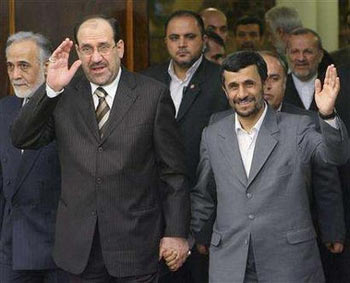
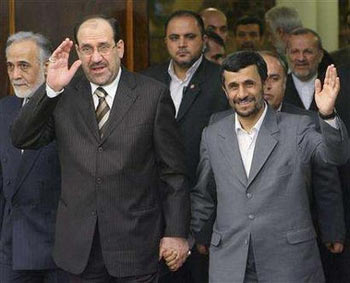
Prime Minister Nuri al-Maliki went to Iran this weekend to attempt to assuage that country's concerns about the security agreement he is negotiating with the United States. He met with President Mahmud Ahmadinejad, who said, "stronger relations between the two nations will help Iraq's development and stability."

Stock earlier photo courtesy Xinhuanet

Just before that consultation with Ahmadinejad, al-Maliki had met with Iranian Foreign Minister Manouchehr Mottaki, al-Maliki assured his host that he would not allow Iraq to be used as a base by a third party for an attack on Iran.

Aljazeera International reports on the visit:


Bush and Cheney are desperately afraid that the next administration will get out of Iraq, thus removing the mercantilist advantages they were trying to throw to US oil companies in developing Iraqi fields. They believe they can commit the US to a long-term military presence in Iraq by becoming the guarantor of Iraqi security at least in the medium term, and by locking in that role through a security agreement between Bush and Maliki. Iran's opposition is threatening to block this deal, and thus al-Maliki's visit.

Al-Maliki will also seek Iranian reconstruction help and provision of electricity.

Al-Hayat reports in Arabic that its sources say that Iranian FM Mottaki informed al-Maliki of Iran's opposition to the signing of a security agreement between Iraq and the US as long as Tehran does not receive guarantees that it will participate in a regional security order.

Al-Hayat says that the chief points al-Maliki made to Mottaki were:

  • Iraq wants to build a strategic relationship with Iran on the basis of mutual friendship and respect.

  • The US is a strategic parter for Iraq, and Iran is a dear friend.

  • Iraq is not an arena for the settling of scores between Washington and Tehran.

  • Iraq will not serve as a staging ground for any attack on Iran.

  • Iraqis want to build a democratic, not a sectarian, state.

    Al-Maliki wants an agreement with the US, but wants to confine US troops to their bases unless he authorizes an operation. He also wants private contractors to be subject to Iraqi law. His demands have thrown a wrench into the negotiations, since the Bush administration had assumed that the US military and its contractors could retain their current freedom of movement under a Status of Forces Agreement (SOFA).

    Note the supreme hypocrisy of the Republican Party. Bush and McCain are attacking Barack Obama for saying he would meet with Iranian officials. But they are perfectly o.k. with their man in Baghdad, Nuri al-Maliki, doing exactly the same thing. In fact, it may well come out eventually that Bush and Cheney sent private messages to Ahmadinejad via al-Maliki.

    Senior Ayatollah Muhammad Taqi Mudarrisi of Karbala denounced the provisions of the current draft of the security agreement, saying that they damage Iraq's sovereignty and are therefore harmful even to the US image. Mudarrisi is an old-time Shiite political activist who heads the Islamic Action Council. He was exiled from Iraq during the Baath period, and trained some activist clergy from Saudi Arabia and elsewhere.

    McClatchy reports political violence in Iraq on Sunday:
    ' Baghdad

    - Around 7am, a roadside bomb targeted a police patrol in the New Baghdad (east Baghdad).Four people were injured including 2 policemen.

    - Around 10 am, a roadside bomb targeted a police patrol near the medical department intersection in Waziriyah neighborhood (north Baghdad) .Five were injured including three civilians.

    - A roadside bomb targeted recruiters for police commandos at Nisoor square .Four recruiters were killed and 23 injured.

    - A mortar shell hit the ministry of planning building near Jamhouriya bridge downtown Baghdad .Three people were killed and seven others injured.

    - Around 1:30 pm, a roadside bomb targeted an American patrol at Baladiyat neighborhood. No casualties reported.

    - Gunmen threw a grenade on a civilian car whose passengers were two of the ministry of defense employees in Atifiyah neighborhood. The two passengers were injured.

    - Police found four dead bodies in the following neighborhoods in Baghdad: 2 were found in Risafa bank; 1 in Atifiyah and 1 in Ameen .While 2 were found in Karkh bank; 1 in Hurriyah and 1 in Shoala.

    Kirkuk

    - A suicide truck bomber targeted a combined base for Iraqi and American forces in Rashad area (west Kirkuk ).Ten Iraqi and American soldiers were killed, brigadier general Sarhan Qadir of Kirkuk police said. From their side the MNF-I said “ a suicide vehicle-borne improvised explosive device exploded near a patrol base in the Ta'Mim province, June 8, killing one Coalition force Soldier. During the attack, 18 CF Soldiers were wounded as well as two local national contractors.”'

    Labels:

  • 11 Comments:

    At 3:25 AM, Anonymous Anonymous said...

    The fallacy of Islamic 'national suicide'
    Not only is the neocon incantation wrong, it's also a dangerous idea that could be used to justify more preemptive wars.
    By George Bisharat

    June 9, 2008

    Anew buzzword is arising from the network of Israeli think tanks and security-oriented academic departments bent on instigating a U.S. attack on Iran: "national suicide." The term describes a supposed Arab Muslim tradition of politically motivated suicide at the national, not just individual, level. Arab Muslim regimes have purportedly launched ruinous wars they could not have reasonably hoped to win, condemning their nations to destruction.

    The notion of an "irrational" and thus untrustworthy Iranian regime has already been widely discussed in the U.S. It is regularly invoked by Sen. John McCain on the stump. The term "national suicide" advances the notion and gives it a patina of academic respectability.

    Israeli jurist and former Knesset member Amnon Rubinstein recently editorialized on "national suicide" in the Jerusalem Post. Citing Israeli army Lt. Col. Ari Bar Yossef, Rubinstein offered Saddam Hussein, Yasser Arafat and the Taliban in Afghanistan as exemplars of this new construct. Hussein could have avoided overthrow by giving U.N. arms inspectors free rein to search his country. Arafat, after the failure of the Camp David peace talks, could have continued negotiating but resorted to violence. Finally, the Taliban could have given up Osama bin Laden to the U.S. but instead invited self-destruction. All this because, per Rubinstein, these leaders prefer dying to "negotiating with infidels."

    "National suicide" will soon be an incantation by neoconservative and other pro-Israeli pundits and politicians on the "bomb Iran" bandwagon. Its strategic implications are clear: We can't trust irrational regimes because they are not deterred by threat of annihilation. Therefore, extraordinary actions -- such as preemptive attack -- may be not only justified but necessary. It further shifts moral responsibility to the victim. In the "national suicide" formulation, it is the martyr that chooses death, while the actual killers are merely the instrument by which the suicide -- or, as the case may be, the destruction of a country -- is carried out.

    Yet the idea of an Arab Muslim tendency toward self-destruction is wrongheaded and dangerous.

    "National suicide" is easier to believe in if you're willing to lump all Arabs and all Muslims into a single mind-set. For example, the Palestinian national movement under Arafat was staunchly secular; members of the non-Arab Taliban are Islamist extremists. The concept elides the enormous diversity within the Arab and Muslim worlds and ignores the local particularities of their multifarious -- and sometimes ideologically opposed -- political movements. A hint of these intra-regional tensions was displayed in Bin Laden's recent audiotape denouncing Hezbollah leader Sheik Hassan Nasrallah.

    What of the supposed examples of "national suicide"? In fact, Hussein allowed U.N. inspectors relatively unfettered access to his country -- belatedly, to be sure, and under pressure from the international community. But by then the neoconservative push for war had already reached inevitability -- the facts be damned.

    Arafat, for his part, continued negotiating after Camp David in Taba and never chose to ignite the second intifada. The uprising was sparked by Ariel Sharon's provocative visit to the Al Aqsa mosque and was fueled by Palestinians' sense of betrayal over a peace process that brought no peace but doubled the number of Israeli settlers on their land. The "Arafat chose violence" canard was rejected by the Mitchell report. Ami Ayalon, former head of Israel's Shin Bet security service, concluded: "Yasser Arafat neither prepared nor triggered the intifada."

    Finally, if members of the Taliban committed suicide, they are an uncommonly vigorous corpse. They are still hanging tough and continue to resist the U.S. on the battlefield.

    Iranian President Mahmoud Ahmadinejad is a convenient whipping boy. He has frequently predicted Israel's eventual demise, and yet -- accurately translated -- he has not threatened it with offensive attack. Nor does he command the country's armed forces.

    Israel, with an estimated 100 to 200 nuclear warheads, should fear no existential threat from Iran. But Iran is a source of inspiration and material support to Hezbollah and Hamas, two forces that harass Israel and impede its regional hegemony. Israel's local challenges are insufficient to justify a U.S. strike on Iran -- thus the need to gin up "national suicide" and the specter of nuclear Armageddon.

    Iran is a nation of 70 million people, many of them discontented with their government's performance. Nothing would unite and rally them around the current regime better than a foreign attack.

    We dearly need sobriety and responsible conduct in our relations with Iran and the broader Middle East. We do not need another reckless venture impelled by fanciful terms and politically motivated spin.

    George Bisharat is a professor at Hastings College of the Law in San Francisco and writes frequently on law and politics in the Middle East.

     
    At 3:54 AM, Anonymous Anonymous said...

    So how can Maliki stop the US from launching an attack on Iran from bases in Iraq? Does he heroically stand in the way of the troops as they advance?

    Maliki is a trivial man, just like the 70+ advisors he surrounds himself with, and has absolutely no chance of retaining his job in the general election. He is not in a position to influence things anymore, let alone be The Decider.

    Iran is calculating, correctly, that the US is on the way out and it is planning for a post-US era. Their previous plan was to replace the USA in Iraq, but the hotheads have lost out in Iran. The new plan is to help stabilize Iraq in order to kick the US out. They realize now that the US military is too weak to invade anyway and there is no need to tie it down in Iraq.

    The Gulf states also see a post-US post-Maliki non-secterian Iraq as a friendly link to Iran rather than a something to fight over. Trade and development is fast replacing proxy war as a solution.

     
    At 4:37 AM, Blogger massminuteman said...

    Hmm, I wonder how long it will take until the Iranian leadership decides it is no longer desirable to prop and rely on al-Maliki.

     
    At 9:55 AM, Anonymous Anonymous said...

    I note that Ron Paul seems to be in possession of far more detail on the SOFA draft agreement than I have seen anywhere else. He does not publish the draft, but he does summarize it by numbered sections. He denounces the colonial and emperial implications, and is particularly incensed that it will not be submitted to the Senate. He does not explain why he appears to know the agreement in such detail. The location is:
    http://www.dailypaul.com/node/48792

     
    At 10:40 AM, Anonymous Anonymous said...

    On the hoped for merchantilist advantage the administration wants, we should remember that Bush's desire to toppel Saddam played into the hands of Cheeney and co. who were concerned about the deals he was beginning to make with China and European parties for development of the oil fields after sanctions were lifted.

     
    At 10:45 AM, Blogger james_speaks said...

    "Al-Maliki wants an agreement with the US, but wants to confine US troops to their bases unless he authorizes an operation. He also wants private contractors to be subject to Iraqi law. His demands have thrown a wrench into the negotiations, since the Bush administration had assumed that the US military and its contractors could retain their current freedom of movement under a Status of Forces Agreement (SOFA)."

    Critics of the war said it was for control of the oil but Cheney, Rumsfeld and Bush said they were wrong. Yet, oil is the major concern of our nation at this time.

    Critics of the war it was to prevent Saddam Hussein from pricing Iraqi oil in Euros but Cheney, Rumsfeld and Bush said they were wrong. Yet, Iraqi oil is now increasingly priced in Euros, not dollars.

    Critics of the war said it was to appease Ariel Sharon but Cheney, Rumsfeld and Bush said they were wrong. Yet, a weakened Iraq enables Likudniks to promote war against Iran.

    Critics of the war said it's purpose was to establish permanent bases in Iraq but Cheney, Rumsfeld and Bush said they were wrong. Yet, .....

     
    At 11:15 AM, Blogger Syrian Nationalist Party said...

    “.........al-Maliki assured his host that he would not allow Iraq to be used as a base by a third party for an attack on Iran.............”
    Al Maliki has no power to stop and prosecute a janitor working for American Forces who shot his son under SOFA (Slaves of America). But Ahmadinejad is assuring Iranians that Al Maliki will not allow U.S. attack on Iran from Iraqi bases.

     
    At 12:18 PM, Anonymous Mark Konrad said...

    Note the supreme hypocrisy of the Republican Party. Bush and McCain are attacking Barack Obama for saying he would meet with Iranian officials.

    The U.S. political parties as well as U.S. governments throughout history have been nothing if not hypocritical and dishonest.

    The republicans are technically objecting to Obama meeting with Ahmadi Nezhad "without pre-conditions" which they claim is unacceptable. It's a minor debating point that doesn't mean much at all. Of course there are pre-arranged formats and schedules for discussions. Are the republicans suggesting that all parties agree not to bring firearms to the meeting? That would be a "pre-condition." No, what the republicans are insinuating is that for any meeting to take place Ahmadi Nezhad must agree to publicly genuflect before the state of israel and treat the United States with deference. Obama is (was?) willing to meet the Iranians without those requirements.

     
    At 3:46 PM, Blogger PEU Report/State of the Division said...

    Interesting piece on Arab country "national suicide". That kind of thinking could usher in the use of "unthinkable weapons" on those unthinking recalcitrant Arabs.

    Ironically, the NYT reports Pentagon Chief Robert Gates will talk to Air Force soldiers about "weak leadership". Those he's targeting for more "strength" include bases responsible for nuclear ballistic missiles and refuelers for jets carrying nuclear weapons.

    http://arisfreedomswitch.blogspot.com/

    From pre-emptive war to the pre-emptive use of nuclear weapons to prevent someone else from acquiring same. Bush compares himself to Harry Truman. Will he drop the bomb, like Harry? And will he stop at two?

     
    At 4:46 PM, Anonymous Anonymous said...

    STOP PRESS
    The Americans have made two new "concessions" with regards to the SOFA:

    1) Foriegn civilian contractors are liable under Iraqi law ... but only if the were hired by the Iraqis. Those working for any foriegn country have immunity, just like the US troops and any troops the US invites to Iraq (which does not require Iraqi approval by the way.)

    2) Iraqi aircrafts are permitted to use Iraqi airspace below 29,000 feet without seeking US permission

    What generosity! The Iraqi can't possibly refuse now.

     
    At 5:50 PM, Anonymous Anonymous said...

    With a wildly unsustainable energy policy, a go-it-alone attitude toward the rest of the world, and a decreasing manufacturing sector for basic human needs, the US under Bush is more firmly in the "national suicide" category than many other first world countries. Consumption under the guise of consumerism is now national policy. Consumption used to have a different meaning.


    Post a Comment

    << Home