
John McCain's Oil Scam
McCain is arguing for offshore drilling to lower US petroleum prices in the "short term."
It is all a big lie, and a dangerous one at that. Our marine environment and our fisheries are already at risk. And the devastation in Wisconsin, Iowa and Mississipi from extreme weather events like flooding is where the US, and the world is going if McCain wins this argument. And McCain has the gall to say he is worried about global warming!
The world uses on the order of 86 million barrels a day of petroleum. That figure is expected to veer sharply upward as China and India go in for automobiles and trucking in a big way.
The United States uses nearly 21 million barrels a day of petroleum and liquified hydrocarbon fuel, or nearly 25% of everything the world produces daily. The US has 5% of the world's population.
The US produces about 5 million barrels a day of petroleum and another 3 million barrels a day of liquefied fuel. That 8 million barrels a day is only about a third of what we use, so we import the rest. The lower 48 states produced about 4.4 million barrels of petroleum a day in 2006.
If all the known offshore fields were drilled and panned out, the lower 48's oil production would be increased by 7%. That would be 300,000 barrels a day.
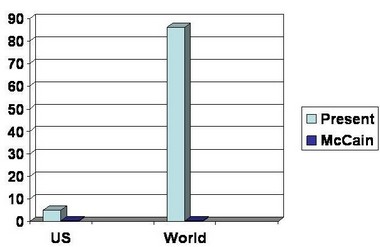
Millions of barrels of oil a day produced by US and by world, with McCain's proposed increase through offshore drilling.
0.3 million barrels a day would make very little difference whatsoever to current oil prices even if it could be brought online right now. It would be a matter of a few pennies. And, in fact, if there were to be any impact of all of offshore drilling on prices, it would not come until 2020 or even 2030.
You will note that the Saudis just offered to increase their production by 0.5 million barrels a day, and the oil futures market just yawned. And that is in the real world, right now, not in some decade or two-decades-out in the future drilling scheme.
Moreover, US consumption of petroleum is increasing over time, so the extra 300,000 barrels a day would quickly be used up and then some.
McCain is cynically wooing Big Oil in Texas in order to get campaign contributions, while lying to the American people about his offshore drilling plan having a quick impact on oil prices and their quality of life. Bringing the 300,000 barrels a day on line would make somebody a lot of money. It will do us no good with regard to energy prices, and in fact will harm our standard of living because drilling for the oil will endanger beaches and the environment more generally, and burning that extra oil will accelerate climate change.
An informed reader writes, "We can save more than 300,000 barrels a day by everyone in the US using just one sixth of a gallon less a day. The US did it in WW2, why not in the War on Oil?"
It isn't even a matter of just voluntarily using less. If the US depended more on trains and increased automobile and truck fuel efficiency, it could reduce its use of petroleum by millions of barrels a day, which would have a stupendous impact on oil prices compared to what could be achieved from offshore drilling. Rail is much more efficient at transporting goods than trucking. Trucking in the US receives very substantial hidden subsidies. Trucks tear up the highways in ways that passenger automobiles do not, so the hundreds of millions of dollars the government spends on road repair every year, which you pay for with your tax dollars, is effectively a vast subsidy to trucking companies. If that subsidy were cancelled, or given to the railroads, and trucking companies had to actually pay the cost in carbon production and road repair generated by their industry, the US would be light years closer to energy independence. It is Congress, which is bribed by campaign contributions from concrete and trucking concerns, that has set up this ridiculous system of hidden subsidies that harms us all. Moreover, Detroit's silly resistance to fuel efficient automobiles will bury the US car industry, as the world turns to vehicles produced by the Japanese or Europeans that are much cheaper to run. And Congress coddles them on all this.
"Redshift" notes below,
'To add to his new energy policy instanity, McCain is a longtime opponent of Amtrak. He's actually worse than Bush in this area. In the "differences" column of the recent NYT chart comparing Bush and McCain on policy, this is noted under "Federal spending":
"Mr. McCain has sought to emphasize his differences with Mr. Bush by portraying himself as a stronger opponent of pork-barrel projects and other wasteful spending. He says he would not sign any earmarked projects into law and would cut financing for ineffective programs, including Amtrak." '
McCain is not against Federal subsidies for commuter airlines, on which Arizonans depend.
It is estimated that Federal subsidies for highways annually amount to $500 an automobile, while subsidies for Amtrak amount to only $40 a passenger.
(Since rail is also more efficient in moving passengers than automobiles, and since automobiles account for a significant proportion of US petroleum use, opposing subsidies for Amtrak while spending billions in public money to build and repair roads for autos is suicidal.)
But I have a sinking feeling that the Democrats will have no effective answer to McCain's cynical offshore drilling ploy. Developing a Green rhetoric that is convincing to the public is the most essential political task of our generation, and of tremendously more import than terrorism or war.

|
20 Comments:
To add to his new energy policy instanity, McCain is a longtime opponent of Amtrak. He's actually worse than Bush in this area. In the "differences" column of the recent NYT chart comparing Bush and McCain on policy, this is noted under "Federal spending":
"Mr. McCain has sought to emphasize his differences with Mr. Bush by portraying himself as a stronger opponent of pork-barrel projects and other wasteful spending. He says he would not sign any earmarked projects into law and would cut financing for ineffective programs, including Amtrak."
This is great post, and I'm foursquare behind you on all the important judgments, but there's one factual discrepancy that's worth pointing out -- Europe is way ahead of the US on residential rail vs. cars, but the US is actually better when it comes to rail freight vs. trucks:
http://krugman.blogs.nytimes.com/2008/06/02/
Krugman links in the post to an academic paper with all the details.
It's news to me that the US auto companies haven't become wise to the reality and aren't aggressively pursuing fuel efficiency. I guess the ridiculously fast Chevy Volt launch schedule GM is shooting for is due to that same past mindset that will bury them.
First off, Redshift makes a good point. One of the most energy efficient modes of transportation is rail. I always envisioned a straight-through-the-Rockies railway tunnel linking the west coast and east coast, and make it in as straight a line as possible from LA to NYC, say. Something similar to the Gotthard Base Tunnel (here's the cache if the fan forum is down) being built through the Alps by the Swiss (of all people, by the way. It's a sad commentary on the state of civil engineering in the United States that Swiss engineers and tunnel builders have the funding and confidence to tackle an enormous project that the Americans do not have the will or maybe the capability to attempt.). A direct rail line between the west and east coasts would reduce the number of over the road tractor-trailers required to ship goods in the United States as well as provide a more efficient method of travel in both directions.
Second point, the United States burns approximately 7.5 Billion barrels of petroleum every year.
Approximately 4 Billion barrels of that is imported from outside the country.
6 Billion barrels of domestically produced cellulosic ethanol would replace all the oil we import. Cellulosic ethanol (CE) is produced from any organic biomass, even wood and organic trash. Food items such as corn kernels and sugar cane are not required. That 6 Billion figure includes one Billion extra barrels of CE to compensate for the energy required to desalinate the seawater required to perform the process.
Could the United States produce 6 Billion barrels of cellulosic ethanol every year? Yes, eventually, if the project were pursued with the same urgency as say the Apollo moon program or the war in Iraq.
There are hundreds of thousands of square miles of marginal and barren land west of the Rockies that does not support large scale food agriculture and never has throughout history. That land will however support many native species (oleander, sage, jojoba and mesquite just to name a few) that are perfectly suitable for cellulosic ethanol production. Much of that land belongs to the BLM (Bureau of Land Management). In other words it's owned by Uncle Sammy.
If the United States government was serious about transitioning from a petroleum-energy economy to a renewable fuel economy there would be a government directive to begin planting and creating biomass plantations on BLM land tomorrow. While the bureaucrats and politicians dither and wring their hands we could at least be establishing enormous fields of biomass crops on otherwise "useless" land. Then when the government apparatchiks finally make a decision to go ahead with industrial scale biofuel production the feedstock crops would already be in place and established. Installing and initially nurturing a plantation of bushes or trees is a time consuming and labor intensive process. But the U.S. government functionaries are not thinking far enough ahead to even take that fundamental first step.
Ref:
United States oil consumption
http://www.indexmundi.com/united_states/oil_consumption.html
United States oil imports
http://www.eia.doe.gov/basics/quickoil.html
Map of BLM holdings in the western USA
http://www.blm.gov/nhp/facts/index.htm
.
What percentage of that 25% of the world's use of petroleum is the Pentagon's? I think it would shock us all to find out. The Pentagon is Big Oil's exploration and discovery unit in 'hostile' territory. The Pentagon is the largest single consumer of petroleum in the US, in the world.
This is a game of diminishing returns. The Pentagon consumes the lion's share of the petroleum it 'discovers'.
Both McCain and Obama want to increase the size of the military. Both are on automatic pilot, watching the controls as the plane flies into the ground.
Four Western oil companies are in the final stages of negotiations this month on contracts that will return them to Iraq, 36 years after losing their oil concession to nationalization as Saddam Hussein rose to power.
Exxon Mobil, Shell, Total and British Petroleum — the original partners in the Iraq Petroleum Company — along with Chevron and a number of smaller oil companies, are in talks with Iraq’s Oil Ministry for no-bid contracts to service Iraq’s largest fields, according to ministry officials, oil company officials and an American diplomat.
http://www.nytimes.com/2008/06/19/world/middleeast/19iraq.html
see ???
now we do not have to worry about Peak Oil or any of that horseshit - just go murder a country full of non-white people and STEAL THEIR OIL !!!!
gd, that was easy !!!
HAPPY DAYS ARE HERE AGAIN !!!
Normally I'm a cynic about this kind of thing, but given the broadly negative reaction to the ridiculous "gas tax holiday," in spite of McCain and Clinton offering cover to one another... I'm not sure that "drill our way to prosperity" is a guaranteed winner, either. Especially with the popular sentiment towards oil companies' enormous profits. I generally felt that the congressional hearings on oil company profits were a waste of time, but if they manage to help dampen public enthusiasm for further profiteering adventures, they may serve a useful purpose in a roundabout way, after all.
(As for GM and the Chevy Volt... You mean the same GM which created the EV1, then worked relentlessly to eradicate any traces of it, leading directly to their current need for a "ridiculously fast launch schedule?" American automakers have kicked, screamed and dug in their heels against fuel efficiency for decades. Had they devoted one-tenth the energy which went into lobbying against CAFE standards, into solving problems instead of making excuses for them, they would not now be suffering from a public perception as behind the times.)
You say: "Rail is much more efficient at transporting goods than trucking. Trucking in the US receives very substantial hidden subsidies." This is true. But then you go on to equate "rail" with Amtrak. This is not so true. Amtrak carries passengers, not freight. The competition for Amtrak is airlines, not cars or buses, so highway subsidies have little to do with Amtrak's failure. Opposition to government subsidies of Amtrak (by McCain or anyone elese) has nothing to do with freight. So your argument goes one bridge too far.
Professor Cole,
Perhaps you could mention this on your blog. No one seems to be covering this story. Not even on Huffington Post and absolutely nothing in the MSM.
Type DESC and MCEL into Google Finance. these were both viable alternative energy companies working on wind turbine technology (DESC) (the ONLY American company LEFT IN THE WORLD doing this to compete with the growing 5 major European companies working on this technology) and hydrogen fuel cell technology (MCEL).
BOTH worked for seven years or more through the Oil Wars of the Bush Administration. BOTH went under in the last 30 days. Both are now being de-listed from NASDAQ.
The U.S. investment market has dried up for their efforts while European governments nurture these technologies for a future world of alternative energy technology systems that WILL COME and will eventually explode. 20% of the worlds future energy needs could come from decentralized wind turbine systems alone. These could be systems on shorelines that could create electricity from wind along the coasts of all nations to crack sea water into oxygen and hydrogen to move to the hydrogen economy of the future. Why is no one in our government studying this?
This is a possible headline: The LAST American Wind Turbine Technology company WENT UNDER this month while the U.S. spends $2 BILLION A MONTH on an Oil War that will ONLY secure a resource that will eventually RUN OUT.
What if we had just had invested $100 million of that A YEAR into buying products form a company like DESC to get on the new road?
This is a story that is NOT being covered by anyone. The MSM is sound asleep.
Maybe you could do a story on your Blog and the MSM would pick it up?
The facts are out there. Call someone from DESC and MCEL to write something to post here on your excellent blog.
First and most important, in his congressional testimony yesterday, T. Boone Pickens said we won't be getting more than the 85Mbpd we now get. Second, Matt Simmons, an early energy advisor to Bush, has been on CNBC umpteen times recently saying we have peaked, the current flow rate for light-sweet crude is maxed. Third, for at least the fourth week running, the US refinery utilization rate is under 90% and crude inventories lag at the bottom of the 5-year running average for this time of year (All from the EIA). The analysis and debate of these points at The Oil Drum reveals the truth to Pickens and Simmons assertions. Simmons latest presentation can be seen here, while video of Picken's testimony is here and his prewritten statement is here. We also face something more crucial, and that is a decline in net exports, especially from Mexico and Venezuela.
When it comes to discussing Peak Oil The Oil Drum and its satellite sites cannot be beat for articles and analysis and debate about the whole gamut of issues related to energy. And of course, Saudi Arabia is a main point of focus, as is the rest of the Middle East.
The dramatic effect that conservation can have on oil consumption can be seen from historical data. The energy conservation and CAFE standards of Presidents Ford and Carter were implemented in the late 1970s. Between a peak oil use in 1978 and 5 years of conservation efforts through 1983, US demand for oil dropped by over 20%, refinery utilization dropped to under 70%. (Note that the low utilization forced Big Oil to close EXISTING refineries. The Cheney argument that environmentalists are the reason no new refineries were built in those years is a Big Lie.)
Oil History
The lower demand lowered the price of oil and kept it low until demand came back up to 1978 levels in 2000. Unfortunately the lower oil prices led to lack of support for energy efficiency standards. Instead of embarking on a new round of CAFE and energy efficiency, we have done nothing and paid for it in higher oil prices.
A new round of CAFE and energy efficiency coupled with a higher price for oil to maintain support for efficiency would do much to address the current oil problem.
Excellent comments.
There are many reasons to greatly boost federal funding for rail.
Many people also do not know that while the government owns and maintains the roads, the railroads own and maintain their own rail -- and pay taxes on the property. This causes the freight companies to minimize investment in their property to keep their taxes low. We're now almost maxed out on our freight rail capacity. See
http://www.newsweek.com/id/139129
Part of Amtrak's problem is terrible on-time schedules outside of the Northeast corridor. And part of the reason for it is that freight trains are now longer than most bypass sidings, so it's the passenger train that has to stop on the siding to wait for the freight to pass. No train system in the world operates without a subsidy, so the insistence on Amtrak running a profit is ridiculous.
A solution to both problems is massive public investment in additional track and sidings so that we can increase rail freight (and lower the cost for rail freight) and also improve the on-time performance for Amtrak -- and any other passenger rail. In exchange for federal funding, the freight companies could give up some of their existing rights-of-way, particularly in the crowded northeast corridor where Amtrak is most heavily used and where Amtrak owns some track already.
Although ideally I'd prefer to see government take a larger portion of the rail network so that we can maintain a minimum interstate network, as we do with the highways and air traffic control system.
Illinois and other states have a partnership with Amtrak whereby Amtrak runs the trains and the state helps foot the bill. I think this will be the pattern for the redeployment of a rail network in the US.
Has anyone broken down the fuel costs of the Iraq War? the supply convoys, armored transport, aircraft, etc ---- then add the burning oil fields.
Make public the cost to date, with projections for upcoming years under various scenarios.
And for comparison, domestic auto use and home heating fuel costs. I suspect one Hummer alone uses in a week more fuel than I save in a year by lowering my thermostat and driving my Civic less frequently.
Seems to me that the reason I can't ride on Amtrak is that I can't take my car with me to the east coast from Denver.
Sure I can rent a car, but what about MY CAR. I have to leave it at a train stop, can't get out and stretch or see a view when I am in a railcar. Sure if point A to B were the only way to travel I would take a taxi everywhere. But we Americans like to sight see. Need the freedom of our car to do that.
The autos are one thing, rail is another, and air is a third... all of these need to work together, and right now, policy is written one arm at a time.
Much like reducing your blood pressure by taking out salt, but keeping jerky in your diet.
Biofuel is not Food stuffs: we have tons of acreage of brownfields to grow fuel on.
What you say about "green rhetoric" can be said about progressive rhetoric in general. The Democrats are bizarrely unable to mount effective rhetoric to support anything remotely progressive, even though progressive policies are in many or most cases inherently very sensible.
I think it's time for progressives to stop bemoaning the ineffectiveness of the Democrats and move beyond the limitations of a party that seems to have no principles or policies that it actually believes in.
I know it's late for this comment thread, and I should have included this in my previous comment. Regarding the US military's oil use, the comparisons I've seen rank it with Sweden, or about 350,000 bpd. Although from 2005, this item discusses the topic and links to the most recent US Government Annual Energy Review [Very large PDF] for 2006-07, wherein info can be found easily by using defense as a term to search the document. At $135/bbl, 350Kbpd is $47,250,000/day or $17,246,250,000/yr, and doesn't include refining or transportation costs or profit margins to providers. So the US military fuel budget would dwarf the entire military expenditures of most other countries. A very recent news item reports "Navies are facing a crises because of rising fuel costs. Last year, these costs went up fifty percent, and another 25 percent jump is expected this year," which is forcing them to remain in port.
So the answer to the often asked question, How much oil does the US Military use? is roughly the same as Sweden, or 350Kbpd, although I personally think some amounts used in combat operations aren't included in the total accounting based on other reports I've read.
350,000 bpd military consumption is less than 2% of total US consumption. Not as much as some folks would guess, I think.
The thing about ANWR and OCS oil fields is that it's very doubtful that they could even keep up with the depletion of the fields already being produced. That means no more US-produced barrels/day than we're getting now.
Damn it, Juan, this is not informed comment.
The crude oil that Saudi Arabia offered to the markets is sour and medium. Oil is not a homogenous commodity. The price that is quoted is WTI, which is a light sweet crude. So when Saudi Arabia offers more medium sour crude and the price of light sweet crude doesn't go down, that is something along the lines of you putting 500,000 gallons of extra 2% low fat milk on the market and noting that the price of heavy cream didn't go down.
There are a limited number of refineries that are capable of refining sour crudes. Even fewer that can refine medium and heavy crudes effectively. Saudi Arabia is trying to address this problem on some level by building two export refineries (about 800 kb/d capacity combined) which will be able to handle the sour crudes they have in surplus. This is also why, for example, Iran is putting their heavy crude production in storage in ships in the Persian Gulf instead of selling it--the price being offered is too low in their opinion. (And they believe that for heavy crudes, it's better to act as if the market is in contango ... which I imagine they have profited from.)
For crudes over all, elasticity of supply is calculated to be at -0.04. For sweet light crudes it is -0.02. If crudes found off FL added 300 kb/d were light sweet crudes, that would be about .5% addition to WORLD ALL CRUDES supply and much more for AMERICAN CRUDE SUPPLY and even more for AMERICAN LIGHT SWEET CRUDE SUPPLY. Do the math.
So, please, although I agree with nearly every prescription you make. Yes, up CAFE standards radically. Yes, reinstate 55 mph limits. Yes, get rid of subsidies for major gas guzzling vehicles. Yes, encourage the reshaping of American cities so that they are pro-pedestrian and mass transit and anti car. Drilling would help the supply situation and you simply do not know what you are talking about when it comes to oil.
i'm 33, with a phd from ivy league, don't have a driver's license and don't even know how to drive a care.
no regrets, ever. currently it's even sweet, pure Schadenfreude. as chickens are roosting, i'm ready to walk.
How much oil to the racing cars waste.. like NASCAR i heard they get about 5-8mpg, why does the poor man has to conserve, while those cars keep going round and round and round and round and round...
Post a Comment
<< Home