
Ann Arbor (Informed Comment) – A new $210 million facility is being built in Egypt to produce 4 gigwatts of solar components annually.
These numbers are not world shaking, but this development is. Egypt has enormous industrial potential. It has as many as 2.5 million workers in various sectors of the textile industry and 33 million over all, and the country’s literacy rate is now on the order of 75%. Literate workers are valuable because they are able to read and follow instructions.
If Egypt becomes a hub for producing solar cells, panels and arrays, it could be an engine for economic growth and also for the production of inexpensive energy in the country, which also acts as a fillip to economic growth.
Green Building Africa reports that “The $210 million Atum Solar project is being developed in the TEDA industrial zone in Sokhna and will have an annual production capacity of 2 GW of solar cells and 2 GW of solar modules.” The investors include JA Solar, a Chinese solar panel manufacturer, as well as concerns in the UAE, Bahrain and Egypt itself. The UAE and Bahrain have substantial investment capital lying about from oil sales, but small domestic populations and lack what economists call absorptive capacity. Egypt is a promising investment field for them as a fellow Arab country with a big workforce.
The plant will create over 800 direct jobs, and likely many more indirect ones.
The solar cells will be exported to the United States. Note that this facility is a way for JA Solar to sidestep the stiff US tariffs on Chinese solar cells, since the units will come from Egypt. The panels will be sold inside Egypt and also to other African countries.
The energy consultancy Ember reported last summer that there are now the first signs of large-scale African adoption of solar panels.
I commented about a year ago on a report that Sweden’s Sunshine Pro has partnered with Egyptian institutions to establish a solar panel manufacturing facility with a capacity to produce 1 gigawatt of solar panels annually.
Egypt is, of course, creating large solar farms for electricity generation, and so will have a use for these domestically produced panels. By the start of 2024, the Egyptians had installed 1.8 gigawatts of solar, most of it at the Benban Solar Park some 400 miles south of Cairo in the Aswan Governorate. It now, at the beginning of 2026, has about 2.8 gigawatts of solar capacity, with plans for a rapid build out the rest of this year. Cairo is hoping for 12 gigawatts of sustainables by the end of 2026.
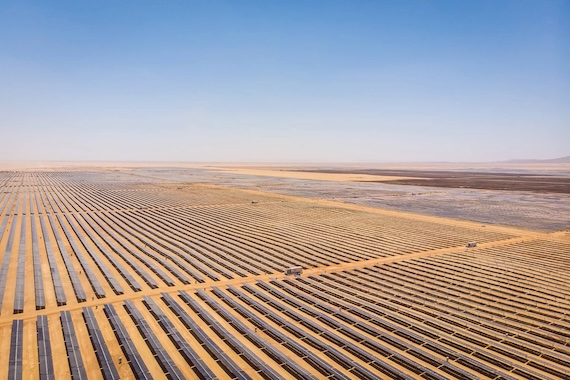
Benban Solar Farm, courtesy Ecohz
As Chinese labor costs have risen, Chinese companies have been moving to other countries for some manufacturing purposes, benefiting from their cheaper labor costs. It is even government policy, with the slogan “Go out!” attached to it. Since China is the preeminent leader in greentech, it is natural that some of the expansion of Chinese investments in factories abroad would be in sustainables.
One advantage for Chinese firms of investing in a facility abroad is that they can often lower their tariff costs. For instance, the African Union has low tariffs for member states, so a factory that is partially Chinese-owned established in an African country can export cheaply throughout the continent. That role seems to be envisioned for the panels produced at the Atum plant, while the solar cells (the basic component of the panels) will be sent to the US.
If Egyptians manage their affairs well, they could become the Vietnam of the Middle East with regard to solar panel production. Vietnam now produces 18 gigawatts of solar panels annually and is the fourth-largest panel exporter, having 12% of the world market, up from almost nothing a decade ago.


 © 2026 All Rights Reserved