
On March 27 President Trump spoke in Miami to a Saudi investment conference and touted the “rise of the Middle East,” echoing what he said last October to the Israeli Knesset about the “historic dawn of a new Middle East.”
Imperial wars falsely advertised as a means to peace and stability are not, however, “new” in this region of the globe, nor in any other. Since the early uncivilized behavior of rulers in ancient Mesopotamia and ancient Egypt it has been the same old story: war for the glory of whoever was the local god or goddess. Sargon of Akkad, served by the wind god Enlil, went with his army from southern Iraq all the way to the Mediterranean over four millennia ago, destroying cities, slaughtering enemies and enslaving those who survived. Three and a half millennia ago the Egyptian Pharaoh Thutmose III took control of Canaan at the Battle of Megiddo, the same location in what is now Israel that apocalyptic-minded Evangelical Christians think will take place between a returned Christ and the Devil’s last gasp at Armageddon.
The advent of the three major monotheisms did not prevent war in this region from being a constant. The Israelites, after wandering for forty years without a map in Sinai, were told by their Abrahamic God to drive out the Canaanites, in some cases slaughtering every man, woman and child (Joshua 8:24-25). The Babylonians and the Assyrians made life miserable for the descendants of Kings David and Solomon. It was Solomon who reminds us that there is nothing new under the sun (Ecclesiastes 1:9).
In the year 70 CE the Romans destroyed the Jewish Second Temple in Jerusalem. Almost six centuries later Arab armies under the banner of the new religion of Islam conquered Jerusalem from Christian Byzantine control and guaranteed religious protection for the Jews and Christians there.
At the end of the 11th century Medieval Christian crusaders conquered Jerusalem, slaughtering the Jews and Muslims there in the name of their Abrahamic God. Less than a century later the Ayyubid leader Saladin reconquered Jerusalem, allowing the Christian Crusaders there to leave in peace.
The Buddhist Mongols came close to capturing Jerusalem in the 13th century, but were defeated by the Egyptian Mamluks, who were in turn overcome by the Ottoman Turks in the early 16th century.
At the end of 18th century Napoleon led a massive French force that took over Egypt but failed to conquer Ottoman Palestine, thanks to the British, A century later the British assumed control of Egypt and its important Suez Canal.
The 20th century in the region was regularly punctuated by warfare. The first World War ended the Ottoman Empire and created a new map of what was transitioning from the Near East to the Middle East. The lines drawn by Europeans may have been new, but the problems created by the imposed borders brought up all kinds of old problems. The French denied Syria to the Hashemite Prince Faisal who helped Lawrence of Arabia defeat the Ottomans.
The British created space for two Hashemites hailing from Mecca to become kings in Jordan and Iraq. The French carved Lebanon out of Syria to create a Christian-majority country that Paris hoped would support their colonialism (in the 1940s the Christian Lebanese demanded independence along with everyone else in the country). The pre-oil Gulf States remained British Trucial States for the most part, and mostly desert Arabia was given to King Saud with his fanatical Wahhabi backers.
And, to top it all off, the Balfour Declaration of 1917 set policy for the British Mandate in Palestine, once it was conquered by British troops and awarded by the San Remo conference to London. The British commitment to flooding the Mandate with European Jews led to mounting violence within and outside Palestine. Then in 1948 the modern state of Israel was created, followed by major local wars the rest of that year and again in 1956, 1967 and 1973, along with almost constant tension and violence through the present. Today there is what many call genocide being committed by Israel’s right-wing government in Gaza, daily Israeli settler violence against Palestinians in the West Bank, the recent invasion of southern Lebanon and the now four-week old Iran war that is or is not being called a war.
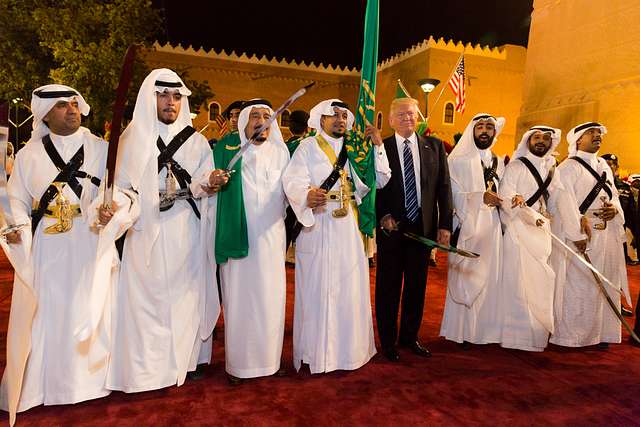
File photo, President Donald Trump poses for photos with ceremonial swordsmen on his arrival to Murabba Palace, as the guest of King Salman bin Abdulaziz Al Saud of Saudi Arabia, Saturday evening, May 20, 2017, in Riyadh, Saudi Arabia. (Official White House Photo by Shealah Craighead). Public Domain. Via Picryl.
There may indeed be a “newer” Middle East, certainly considering the state of the region a mere century ago, but both the present and future are clouded by non-stop war, revenge and imperial interference that are as old as recorded time itself. Poor patriarch Abraham, who spiritually fathered the three religious rivals in the land where he shepherded his sheep, must be rolling over in his grave. One of the most quoted parables of Jesus in the Gospels, those New Testament books that talk a lot about peace and not about war, is about putting new wine into old bottles. It is worth quoting from the old English King James Version so beloved by those who insist Jesus is yet again about to come down to earth:
- “And he spake also a parable unto them; No man putteth a piece of a new garment upon an old; if otherwise, then both the new maketh a rent, and the piece that was taken out of the new agreeth not with the old. And no man putteth new wine into old bottles; else the new wine will burst the bottles, and be spilled, and the bottles shall perish.” (Luke 5:36-38)
The rhetoric clothing war-talk as a prelude to peace can never cover the naked truth of the ongoing suffering of victims on all sides in the ongoing conflicts.
Yet another new wine justifying the horrors of war in a region that has known too much conflict only leads to more spilled blood.

 © 2026 All Rights Reserved