
Bush and the 7 Deadly Sins
The Washington Post reports a new poll that shows that the public’s approval of Bush in the realms of trust, honesty and values has declined even in his base:
“Bush’s approval ratings have been in decline for months, but on issues of personal trust, honesty and values, Bush has suffered some of his most notable declines. Moreover, Bush has always retained majority support on his handling of the U.S. campaign against terrorism — until now, when 51 percent have registered disapproval.
The CIA leak case has apparently contributed to a withering decline in how Americans view Bush personally. The survey found that 40 percent now view him as honest and trustworthy — a 13 percentage point drop in the past 18 months. Nearly 6 in 10 — 58 percent — said they have doubts about Bush’s honesty, the first time in his presidency that more than half the country has questioned his personal integrity.”
Bush’s presidential campaign in 2000 focused on restoring “values” to Washington, but ironically, with regard to the War on Terror and the Iraq War, the Bush administration has gradually committed all of the seven deadly sins. It had even been argued that Bush himself committed all 7, whereas below I will concentrate on the administration as a whole and on the Iraq issues.
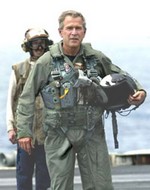
Pride. On May 2, 2003, Bush landed on an aircraft carrier in a flight suit to declare the end of major combat in Iraq. From the staged character of the event (the aircraft carrier was just offshore and there was no need to fly out to it), to the famous codpiece flight suit (which was intended to exude machismo), to the banner “Mission Accomplished,” the entire event was suffused with overweening pride.
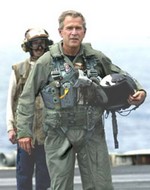
Major combat was, of course, not then over, and is not over in fall of 2005. Bush compounded his pridefulness with a speech on July 2, 2003, when he addressed the growing guerrilla movement in Iraq and said, “Bring’em on!”
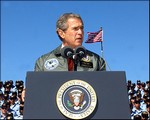
This unfortunate taunting of a deadly and determined enemy was the farthest thing possible from either statesmanship or the gravity with which a commander in chief must view the dangers encompassing his troops.
It was pride that led Bush, Cheney, Rumsfeld and Wolfowitz to believe that they could occupy Iraq with a relatively small military force, and could then transform the country without facing any significant opposition. It was pride that led them to disregard the advice of distinguished military men such as Gen. Eric Shinseki and Gen. Anthony Zinni.
Envy.
The Bush administration envied the old imperial powers such as the British Empire, and wanted to recreate that age. They could not, and the whole idea that they could was far-fetched to begin with.
Anger.
Bush and his team were angry at those who criticized their propaganda about Iraq’s alleged weapons of mass destruction.
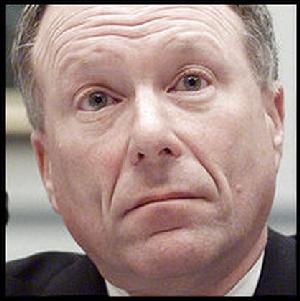
They investigated their critic, the former ambassador Joseph C. Wilson IV, and discovered that his wife, Valerie Plame Wilson, was an undercover operative in the CIA. Cheney told his then chief of staff, Irving Lewis Libby, about Plame Wilson’s identity. Libby shared the information with journalists, including Judith Miller of the New York Times.
It was anger that drove Cheney, Libby, Rove and the others involved in this outing of a serving undercover agent.
Laziness: Bush vacations relentlessly, and especially in August.
It was while on vacation that Bush declined to act early and forcefully in both the tsunami and in the Katrina catastrophe in New Orleans. If laziness or sloth is the absence of appropriate zeal, that absence has deeply marked his presidency.
Bush has still not brought Usamah Bin Laden and Ayman al-Zawahiri, who killed nearly 3,000 Americans and attacked both New York and the Pentagon, to justice.
Greed. The Bush administration is guilty of imperial overstretch with regard to Iraq.
Naomi Klein wrote that
“The honey theory of Iraqi reconstruction stems from the most cherished belief of the war’s ideological architects: that greed is good. Not good just for them and their friends but good for humanity, and certainly good for Iraqis. Greed creates profit, which creates growth, which creates jobs and products and services and everything else anyone could possibly need or want. The role of good government, then, is to create the optimal conditions for corporations to pursue their bottomless greed, so that they in turn can meet the needs of the society.”
Gluttony
Over-consumption of petroleum drives some significant part of the Bush administration”s Middle East policies.
Lust Lust can be for sex but also for power. A person who lusts have power wants more of it than is good for anyone.
Lust for power caused Bush to make many of his most important mistakes.


 © 2025 All Rights Reserved