
Informed Comment

Thoughts on the Middle East, History, and Religion

Juan Cole is President of the Global Americana Institute

Sunday, July 31, 2005

Constitution Unfinished as Deadline Looms
17 Dead in Violence Saturday


Sunni Arab members of the constitution drafting committee are still rejecting language that would make Iraq a "federal" republic. In practice, this language would formally acknowledge Kurdistan and perhaps Shiite federations of provinces in the south as having a good deal of autonomy and a claim on petroleum revenues from Kirkuk (the Kurds) and Rumaila (the Shiites). The Sunni Arabs do not have a developed petroleum or natural gas field and so would suffer from a federal arrangement that left some of the petroleum income in the provinces rather than having the central government take it all and redistribute it. It increasingly looks as though the only way the committee can meet its August 1 deadline for informing parliament that it will be done by August 15 would be to simply over-rule the minority Sunnis with an up and down vote. The bitterness this step would leave in Sunni mouths might make it inadvisable.

al-Hayat: Sunni parliamentarian Mishaan Jiburi, on a visit to Damascus, warned that for the Shiites and Kurds to run roughshod over the Sunni Arabs and their concerns would result in civil war. He said they would be driven in even greater numbers into opposition to the government and the foreign occupation. Among the points they most cared about, he said, were that Iranians must not be mentioned as a recognized Iraqi minority in the constitution. He said it was also important to distance the government from religion.

His concerns were echoed by five clan leaders from the Fallujah area meeting with US officers. They said a federal Iraq in which the Kurds got the oil of Kirkuk and the Shiites the oil of Rumaila in the south, would leave the Sunni Arabs with "the desert sands of Anbar."

Deputy speaker of the house and member of the Shiite United Iraqi Alliance, Hussein Shahristani, told al-Hayat on Saturday that some combination of southern, largely Shiite provinces may form a confederation within the framework of a federal Iraq. He said as many as ten provinces or as few as two could join this confederation (which would be analogous to the "Kurdistan" formed from northern provinces by the Kurds). He said most leading politicians had already agreed to this step, with the exception of a few who thought it might prove too much of a complication in Iraqi politics at the moment.

Shahristani also said that it was absolutely unacceptable for the Peshmerga paramilitary of the Kurdish parties to remain an armed force in Kurdistan. He said that defense would be the prerogative of the central government in Baghdad.

There seems little doubt that the permanent constitution will acknowledge a leading role for Islamic law in legislation. The question is whether it will be the source of legislation or one among several. Also, it will matter if the constitution puts Iraqis under their religious law for matters of personal status like marriage, divorce and so forth, and whether a special status is recognized for the grand ayatollahs in Najaf, as it was in a draft leaked last week to al-Sabah newspaper.

Newsday says, ' "Mouafak al-Rubaie, a national security adviser and a Shiite, met al-Sistani on Saturday and said the main concern of the Shiite religious leadership is to "preserve the Islamic identity of Iraq and its people, which means preserving a united Iraq and people as a state." '

Adnan Dulaimi maintains that he has been fired as head of the Sunni Pious Endowments Board by the Jaafari government because he was too outspoken a champion of Sunni causes.

Al-Hayat says that the Association of Muslim Scholars (Sunni) objected strongly to Dulaimi's firing, and the installation in his place of Shaikh Ahmad Abd al-Ghafur al-Samarra'i. They said the replacement was made by the government without any consultation with the Sunni Arab community.

On Sunday morning, guerrillas detonated a carbomb near Haswah, a half an hour's drive south of Baghdad, killing 5 civilians and wounding 10.

A roadside bomb targetting a British military convoy southwest of the city of Basra in Iraq's deep south on Saturday, killing 2 private security guards. A second bomb timed to hit rescuers instead killed two local children.

BAGHDAD - Guerrillas detonated a car bomb at a police checkpoint in the capital. They killed 7, wounded 25.

Reuters reports other casualties of Iraq's unconventional civil war:

Three employees of Baghdad International Airport, who had been kidnapped, turned up blindfolded and dead.

A roadside bomb aimed at a US military patrol in Dura instead killed an Iraqi civilian.

A member of the Sunni National Dialogue Council that is cooperating with the elected government in crafting a constitution narrowly missed being assassinated Saturday. His bodyguard was wounded.

Reuters adds:

"BAGHDAD - An Iraqi health ministry official, Eman Naji, was kidnapped by gunmen who stormed her home in the capital's upscale district of Mansour, police said."

In HIT, west of the capital, a suicide bomber hit a US military patrol, wounding 4 Marines.

In Mahmudiya just south of Baghdad, a roadside bomb killed one Iraqi civilian and wounded 3.

The US military has established a new base in the northwest of Iraq aimed at interdicting infiltration of foreign fighters into Iraq.

You're not allowed to blog about the Iraq War critically if you are an active duty serviceman over there. This is why we know so little about what is really going on. Few will risk reporting on the reality while Don Rumsfeld wants boosterism and cheerleading.

I reported a few days ago that a US military base near Fallujah had taken mortar fire. Aljazeerah even had film showing damage to a building as US troops standing around. I noted that the wire services and other reporters appeared to have ignored the story. I heard from a relative of someone serving in Fallujah, who said that all the bases around there take mortar fire so frequently that it has become a big yawn for the troops. Now, since march the US military has conducted a vigorous propaganda campaign proclaiming how nice post-invasion Fallujah is, how life has returned to normal, with bustling traffic and trade, and how it is the safest city in Iraq. While some quarters may in fact have gotten back to a semblance of normality, not all the city has, and the area isn't safe, just as Anbar province in general is not. The reason we don't know more about the real situation is that the troops are being forbidden to tell us about it. Most of what they could reveal would not in fact endanger the US military. But it would endanger the propaganda and black psy-ops campaigns being run on us by the civilians in the Department of Defense.
For "cont'd" postings, click here.

Submit to RedditSubmit to SlashdotStumble Upon Toolbar
Email to a Friend:

Saturday, July 30, 2005

London Bombings: State of Play

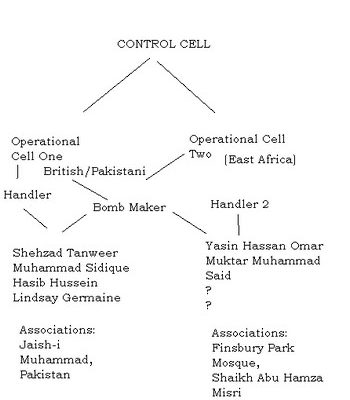
After the dramatic arrests on Friday in London and Rome, it appears that the foot soldiers of the July 21 bombing are all in custody. Whether the police have been able to go up the cell structure to find handlers, bomb makers and logisticians is unclear.

This is what we know, except that one of the question marks can be replaced with the name of Somalian-British Osman Hussein, captured in Rome. He was traced using his cell phone!


The use of two distinct ethnic networks for the two operational cells was an excellent way to throw the police off the trail and prepare the way for the July 21 bombings. The police would have been looking at British/Pakistani networks after the first bombing. The question of what ties the two networks together is the real question. It would only be necessary that the two operational cell leaders-- say Muhammad Sidique Khan and Yasin Hassan Omar-- knew a third person. Or that they each had a handler who knew the third person.
For "cont'd" postings, click here.

Submit to RedditSubmit to SlashdotStumble Upon Toolbar
Email to a Friend:

Sunnis Demonstrate in Baghdad
As Bombings Kill 28, wound 46, with 3 US Soldiers Dead
1 Million Iraqis say "US Out"!


Maher al-Thanoon of Reuters reports that one thousand Sunni Arabs staged a demonstration outside the Green Zone (barricaded government offices) against the elected Iraqi government, which is dominated by Shiites in coalition with Kurds. They accused the Jaafari government of using torture and death squads on a sectarian basis against their community, which they called "the new Iraq of fire and steel." Al-Thanoon says, "Simulating torture, they dressed up as soldiers and used drills, wooden clubs and electric wires to act out what they said were the techniques used by government forces against them."

The Muqtada al-Sadr followers say they have collected the signatures of one million Iraqis asking that US and other Coalition troops leave the country immediately. In his sermon at an East Baghdad mosque, Shaikh Abdul Zahra al-Suwaidi told the congregation, "We obtained the Iraqi signatures demanding the withdrawal of the occupation troops as asked for by Sayyed Moqtada Sadr . . . The goal of this petition is to show the world the rejection by Iraqis of foreigners in Iraq . . ."

Then on Friday evening in south Baghdad, guerrillas cut down Faisal al-Khaz'ali, a major leader of an important Shiite clan.

An individual suicide bomber walked up to an Iraqi army recruitment center in the northern town of Rabi`a, an hour's drive from Mosul near the Syrian border, and detonated his payload. He killed 25 persons and wounded 35. Rabi`a is one of those border towns into which the US alleges volunteer jihadis slip from Syria (though they also slip in from Jordan and Saudi Arabia but the Washington crew never say anything about that, and US journalists never call them on it). It wasn't clear, in any case, whether the bomber was an Iraqi (there isn't much difference among the Sunni clans on either side of that border; some belong to the same over-all tribes).

Wire services also report:

*Baghdad: A few hours after the bombing in Rabi`a, guerrillas attacked a police patrol with a car bomb but missed and killed two civilians.

*Mosul: Some eyewitnesses said that guerrillas in Iraq's third-largest city targeted a US convoy with a car bomb but missed and killed a child and wounded 11 civilians. Another report said that the target was not a US patrol but rather a man selling alcohol from a cart.

Al-Sharq al-Awsat says that altogether 4 Iraqis were killed and five wounded in separate attacks to the north of Baghdad, including Balad and Samarra, on Friday. Another roadside bomb killed a truck driver 30 km north of the capital.

In Samarra an Iraqi soldier was wounded and another injured by a roadside bomb.

In Baquba guerrillas attempted to assassinate the police commissioner for Diyala province, but failed, leaving two policemen wounded (one of them of high rank).

Reuters adds:


'CYKLA - Two U.S. soldiers were killed on Thursday when their unit came under attack by small arms fire and rocket propelled grenades in Cykla, about 200 km (120 miles) west of Baghdad, a U.S. military statement said.

* BAGHDAD - One U.S. soldier died on Thursday when the vehicle he was driving was involved in a single-vehicle accident off base in central Baghdad around 11:30 p.m.'


Kyodo News reports, regarding the southern Shiite city of Samawah, pop. 124,000, the capital of oil-rich al-Muthanna Province:
"Two explosions took place at a job training center for women in the southern Iraqi city of Samawah Friday morning, but no one was injured, local police said. The Japanese government provided sewing machines and computers through the United Nations Development Program to the facility, operated by a local women's group. The Japanese Self-Defense Forces have been involved in reconstruction activities in the city."


There have been a number of demonstrations in Samawa during the past week. Last Sunday, the Sadrists there demonstrated against the lack of electricity. There was also a bombing of a jewelry shop belonging to the Iraqi head of an Iraqi-Japanese frienship association.

On last Monday, they demonstrated again, mentioning the high price of ice and the lack of potable water, according to AP: "Hundreds of Iraqis burned a Japanese flag Tuesday and called for Tokyo to remove its troops from the country in a protest that seemed motivated by the poor state of water and electricity supplies here more than two years after the fall of Saddam Hussein. The peaceful protest in this city 240 kilometers (150 miles) south of Baghdad appeared to have been organized by followers of radical Shiite cleric Muqtada al-Sadr." They burned the Japanese flag.

Note that the Japanese contingent in Samawah is helping with local health and community development projects, so the demonstration seems particularly misplaced. Ironically, the Japanese contingent is suffering from the spillover of anti-American sentiment.

Al-Hayat reports that sectarian wrangling continues concerning key clauses of the draft constitution. Kurdish Minister of Planning said that you cannot have democracy if shariah or Islamic canon law is imposed on the constitution, which would create Taliban-like morals police in parts of Iraq.

Sunni Arab leader of the National Dialogue Council, Salih al-Mutallik, said that the Sunnis cannot "accept that Iranians will be Iraqi citizens." A disputed article in the constitution recognizes Iranian-Iraqis or Persians as an Iraqi minority alongside groups such as Turkmen and Yazidis. Iraqis of Iranian heritage are numerous in the Shiite south, and many such families have been in Iraq for centuries. They have family names such as Qazwini, Shirazi, Astarabadi, etc. (cities in Iran). They were targeted for deportation by Saddam (along with many Iraqi Arab Shiites wrongly categorized as "Iranians"), and the purpose of the article is to redress that injustice and forestall any repeat of it. Sunni Arabs on the other hand are afraid of being overwhelmed by Iranian Shiite immigrants, which would further weaken their position.

A draft given Associated Press says that it will be forbidden to pass laws that contravene the ordinances of Islam. It also specifies that provinces will keep no more than 10 percent of the receipts for petroleum exports from their territory, with the central government getting 90 percent. The Kurds had early demanded about 1/4 of petroleum income from Kirkuk, and the Shiite governor of Basra in the deep south has recently agitated for a similar deal for the southern provinces with regard to the Rumaila oil field, in al-Muthanna province near Kuwait.

A Kurdish member of the constitution drafting committee, Mundhir al-Fadl, said that the coming Tuesday is the deadline for certifying that the constitution will be finished and presented to parliament for a vote by Aug. 15, and he doubted the deadline could be met. Apparently there is still a dispute about whether Kurdish will be co-equal to Arabic as one of the two official languages of the country, as the Kurds demand.

Al-Mutallik of the Sunni National Dialogue Council was even more pessimistic, saying that the constitution can't be finished by next Tuesday, and probably cannot be finished even if the parliament takes another 6 months. Nor, he insisted, would the Sunnis accept simply being run over roughshod and having the constitution voted in even if they (a minority on the committee) object. He said Sunnis object to the Shiite plan to mention the Najaf Grand Ayatollahs as sources of authority in the constitution. "The other groups don't have a grand ayatollah," he said.

Tod Robberson reports from Basra on the increasing restrictions on personal liberties there, deriving from the pressure of Shiite militias.

There were a number of demonstrations in Umm Qasr this past week against the border barrier that Kuwait is building. Kuwait has deployed police at its border in response.
For "cont'd" postings, click here.

Submit to RedditSubmit to SlashdotStumble Upon Toolbar
Email to a Friend:

Nation Forum on Middle East

"Unintended Consequences: A Forum on Iraq and the Mideast," in The Nation is now available online. Journalists Helena Cobban and Nir Rosen, academic Middle East expert Shibley Telhami, and I all responded to questions about the state of the region.

This is my answer to the first question asked by the editors, "Wars often have unintended consequences. How has the Iraq War affected the political landscape of the region and America's standing therein?"


Cole: Helena is correct that the Iraq War has propelled negative feelings toward the United States--not just in the immediate region but throughout the Muslim world. Between the summer of 2002 and spring of 2003, the number of Indonesians who viewed the US favorably fell from 61 percent to 15 percent, according to the Pew Research Center. Although Muslims already faulted the United States for lack of evenhandedness on the Arab-Israeli dispute, in recent years their estimation of the US has plummeted. According to Zogby, from summer 2002 to summer 2004, those who viewed the US favorably in Egypt fell from 15 to 2 percent. And respondents generally believed that Iraqis were worse off under American occupation.

Another consequence of the war has been that more Sunnis in Iraq and elsewhere are turning away from Arab nationalism, which has been discredited, to Salafi revivalism, a very conservative form of Islam. Although most Salafis are "quietists," in that they do not enter into ordinary politics, they are also the recruitment pool for radical groups. It has also strengthened Iran's position in the region. In 1982 Ayatollah Khomeini created the Supreme Council for Islamic Revolution in Iraq for Shiite expatriate groups, whose members included Abdul Aziz al-Hakim, the current SCIRI leader, and Ibrahim al-Jaafari, Iraq's current Prime Minister. Khomeini dreamed of putting them in power in Baghdad. Bush and Rumsfeld have fulfilled that dream.


The whole forum is worth reading. Nir Rosen is an exciting young journalist who has gone all over Iraq and reported in a clear-eyed way on everything from Fallujah to Najaf. Cobban and Telhami are veteran commentators on the region who know it well. Hearing these voices in a major national publication is sort of a shock because it is an irruption of the real world into the American press, and the result does not sound like the Middle East projected Washington, DC. (Not that this irruption of the truth is unusual in The Nation, which has done among the best reporting on the war).
For "cont'd" postings, click here.

Submit to RedditSubmit to SlashdotStumble Upon Toolbar
Email to a Friend:

Friday, July 29, 2005

Attacks in Baqubah, Mansur
Train, Pipeline bombed


Reuters reports on deaths in the guerrilla war on Thursday:

In Baqubah and Khan Bani Saad northeast of Baghdad, guerrillas fought battles with Iraqi soldiers, killing six of them.

In the tony Mansur district of Baghdad, a suicide car bomber struck at an Iraqi army checkpoint. He killed six civilians and wounded 8 soldiers, and two civilian cars were left in flames.

In the oil city of Kirkuk in the north, guerrillas bombed an oil pipeline that feeds petroleum to Baiji's refineries. They also damaged a gas pipeline to Baiji's power station.

In Haditha, guerrillas assassinated the assistant police chief.

The LA Times says, "In other violence, the U.S. military said two American troops had been killed and one wounded in a roadside bombing Wednesday in Baghdad . . . Elsewhere in Baghdad, a train carrying fuel exploded when it was hit by a bomb, killing two people and wounding six, police said . . . U.S. Marine jets, meanwhile, bombed insurgent positions near Haditha, killing nine insurgents, including five Syrians, the U.S. military said."

Aljazeera reported that US troops at a base north of Fallujah took mortar fire on Thursday, but there was no word of casualties. The Western wire services either disbelieved this report or ignored it, since I can't find mention of it in English.

David Enders does perhaps the only clear-eyed English-language post-mortem of the Fallujah campaign, which has left 2/3s of the buildings in the city damaged and exiled tens of thousands for over half a year. Aljazeera ran a piece on Fallujah on Wednesday, showing people living in tents on the rubble of their former homes. All this contrasts to a fluff piece in the New York Times last spring that depicted the place as largely restored and bustling, with busy traffic and healthy happy children that were all above average. Well, maybe that quarter the reporter was allowed to see looked like that.

Speaker of the Iraqi parliament Hajem al-Hassani warned the US military against invading the northern Turkmen city of Talafar [Tel Afar] the way it had Fallujah. The existence of a sitting Iraqi parliament, which is supposed to be sovereign, may be an increasing check on the freedom of the US military to operate at will in Iraq.
For "cont'd" postings, click here.

Submit to RedditSubmit to SlashdotStumble Upon Toolbar
Email to a Friend:

Turks threaten to Invade Iraq

Just a reminder how much of a tinderbox Iraq is, and how easily neighboring countries could be drawn into a war there:

The Kurdish Marxist party, the Kurdish Worker's Party (Kurdish acronym PKK) has been committing violence in eastern Turkey near the Iraqi border. The Kurdish guerrillas are suspected of then slipping across the Iraqi border to take refuge in Iraqi Kurdistan. The latest outrage was their kidnapping of a mayor, "Hasim Akyurek, mayor of Yayladere in the Bingol Province and a member of Turkey's ruling Justice and Development Party . . . "

Then Turkish Prime Minister Recep Tayip Erdogan threatened to invade northern Iraq. He cited the US invasion of Afghanistan to support the legitimacy of such an action (in fact, Afghanistan had both NATO and United Nations Security Council support, which a Turkish invasion of Iraq does not, to say the least).

Then Iraqi Foreign minister Hoshyar Zebar, himself a Kurd, warned that any Turkish incursion into northern Iraq would be unacceptable.
For "cont'd" postings, click here.

Submit to RedditSubmit to SlashdotStumble Upon Toolbar
Email to a Friend:

Thursday, July 28, 2005

War on Terror Over

The Bush administration is giving up the phrase "global war on terror."

I take it this is because they have finally realized that if they are fighting a war on terror, the enemy is four guys in a gymn in Leeds. It isn't going to take very long for people to realize that a) you don't actually need to pay the Pentagon $400 billion a year if that is the problem and b) whoever is in charge of such a war isn't actually doing a very good job at stopping the bombs from going off.

The Scotsman reports on the spectacular arrest of the Somalian suspect in the July 21 failed bombing attempts, saying, "The ethnicity of the eight London bombers, ranging from Somalis, to British-born sons of Pakistani parents and an Anglo-Jamaican Muslim convert, have surprised detectives investigating the attacks."

They should not be surprised. You have to think about terrorists as units of hardware, on which software has been installed. The software is a world-view, a set of premises about the world, which then make sense of the terrorist's actions. How does the software get installed? The potential terrorist meets the installer socially and falls under his spell.

The terrorists don't have a social background in common. They aren't lumpen proletariat or working class or middle class or bourgeois. Or rather, they have in their ranks persons from all these backgrounds.

The terrorists don't have an ethnicity in common. Richard Reid and Lindsey Germaine were Caribbean. Others are Arabs. Some have been Somali or Eritrean or Tanzanian. Others have been South Asia (India/Pakistan/Bangladesh). Still others have been African-American or white Americans. They don't even have to start out Muslim. Ayman al-Zawahiri was particularly proud of an al-Qaeda operative in Afghanistan who had been an American Jew in a previous life. Ziad Jarrah, one of the September 11 hijackers, appears to have been a relatively secular young man right to the end. It isn't about religion, except insofar as religion is a basis on which the recruiter can approach his victim. Islam as a religion forbids terrorism. But then so does Christianity, and that doesn't stop there being Christian terrorists. They are a fringe in both religions.

If you try to "profile" the terrorist using such social markers as class or ethnicity, maybe even religious background, you will go badly astray.

What then do they have in common? They got the software installed in their minds. Why? Because they met the installer, and were susceptible to his worldview. That's all they have in common.

So the young man goes to the Finsbury Mosque in the old days and hangs out with Imam. And he points out that the Israelis had fired a huge missile into a residential apartment building to get at a Hamas leader, and had killed 16 civilians, including a little baby. And nobody said "boo" to the Israelis. The US actually gave them more money after that. Tony Blair deplored it, but did nothing practical. Then, the Imam will tell him, the Americans destroyed Fallujah and killed hundreds of innocents. He might even have the photograph that circulated last December, of the dead baby at Fallujah. And nobody can say "boo" to the Americans, and they go on killing Muslims. In fact, the Imam intimates, pulling the young man close, almost whispering, tears in his eyes, the West is destroying Islam. Almost nothing is left of Islam, he will say. It will be completely devastated in our lifetimes. Nobody is lifting a finger to stop it.

So the young man says, what could anyone do? And the Imam says, there is something. But it isn't for ordinary people. It isn't for mere show-offs. And the young man says, sticking out his chest, I'm not showing off! I really want to help, to do something that would make a difference. The Imam says, a person who was really committed could change everything. He could save the Muslim Ummma from destruction. But, no, you are not ready. You don't have the training, the commitment. You are useless. And the young man protests, until he is put in touch with the trainer and given the mission. His new friends all agree on this view of the world. He hangs out with them, at the mosque, at the gym, even socially. They reinforce each other. They tell each other the stories of the harm done to Muslims. They get angry. They swear. They are determined not to be like the rest, who just let it happen. The young man gains in determination. The mission inflates his ego. Maybe he had low self-esteem, maybe not. But he is about to save the world, he is told.

The software is of course a hugely distorted view of the universe. It lets the young man see Israeli atrocities, but not those of Hamas or the Aqsa Brigades. It lets him see American atrocities but not those of Saddam Hussein, Izzedin al-Duri and Abu Musab al-Zarqawi. The software is fatally one-sided. It also exaggerates. The Muslim world is not in danger of being destroyed, least of all by the United States, a warm friend of most Muslim countries. But the software configures a dire crisis, almost apocalyptic, which can only be averted by an ethical hero who is willing to sacrifice himself. The software hides from the convert that he is to become a monster and kill innocents. It tells him he is a noble soldier, and his victims are wicked enemy soldiers, that there are no innocent civilians.

So how do you fight this form of terror? You disrupt the installation of the software in more and more minds. You adopt policies that make the story the software tells implausible. And you reach out to make sure people hear the implausibility.

It is not a war. It is counter-insurgency. Gen. Anthony Zinni tells the story about how he had been away from the Pentagon for a while and then was (as I remember) brought back to give a backgrounder. And a young soldier saluted and said he was there to fight the G-WOT. And Zinni said, "Come again?" The soldier looked puzzled and said, "Why, the Global War on Terror, sir."

It was always a poor metaphor. I can't figure out who they think they are fighting a war against. It sure isn't the Muslim world. Morocco as a country couldn't be more friendly and cooperative, and we have good trade relations with it. Algeria likewise. Tunisia? A topflight relationship. Even Libya is coming around. Egypt? A non-NATO ally. Palestine? We give them hundreds of millions of dollars a year. Jordan? A closer friend you couldn't find. Lebanon? Very friendly except for Hizbullah and even they haven't hit American targets any time in the past decade. Saudi Arabia, Kuwait, Qatar, Yemen, Oman, Iraq, Turkey, Uzbekistan, Afghanistan.

It is incredible how good the relations are between the United States and almost all the countries of the Muslim world. They provide us with a NATO ally (Turkey) and 4 of our five non-NATO allies! The only sour notes are Bashar al-Asad in Syria (who hasn't done anything to us as far as I know) and Iran, with which our relationship needn't be different from that with Venezuela under Chavez (leaders of both countries badmouth the US, but don't seem actively to harm us in ways that are visible to me). It will be argued that Iran is trying to get a nuclear weapon. But a) we don't know that for sure; and b) even if it were to succeed in doing so, how would it be different from the Soviet Union, which hated us much more than Iran does and which had thousands of warheads pointed at us? So far no two countries, both of which have nuclear weapons, have fought a major war with one another, and the reason is clear. This is not to say it could not happen, but it is unlikely. As for the Mad Cheney scenario whereby a state gives nuclear weapons to terrorists to use on the US, puh- lease. Even my five year old niece wouldn't believe that whopper. States don't share nuclear bombs with terrorists; and it is not as if a bomb's provenance could not easily be traced.

As for the jihadis, who do wish us harm, former CIA analyst Marc Sageman estimates the number of radical Muslims who can and would do significant harm to the US in the hundreds.

That's right. The old "war on terror" was a war of the world's sole superpower on a few hundred people. (I exclude Iraq because it is not and never was part of any 'war on terror,' though the incredible incompetence of the Bush administration has contributed to the ability of terrorists to operate there.)

On the issue of the sources of terrorism see recent articles by Howard LaFranchi at CSM and Jim Lobe, and James M. Wall of the Christian Century
For "cont'd" postings, click here.

Submit to RedditSubmit to SlashdotStumble Upon Toolbar
Email to a Friend:

The Consequences of Nuking Iran

Readers have asked me about this discussion at Daily Kos. It notes that former CIA analyst Philip Giraldi wrote in the American Conservative:


The Pentagon, acting under instructions from Vice President Dick Cheney's office, has tasked the United States Strategic Command (STRATCOM) with drawing up a contingency plan to be employed in response to another 9/11-type terrorist attack on the United States. The plan includes a large-scale air assault on Iran employing both conventional and tactical nuclear weapons. Within Iran there are more than 450 major strategic targets, including numerous suspected nuclear-weapons-program development sites. Many of the targets are hardened or are deep underground and could not be taken out by conventional weapons, hence the nuclear option. . . As in the case of Iraq, the response is not conditional on Iran actually being involved in the act of terrorism directed against the United States. Several senior Air Force officers involved in the planning are reportedly appalled at the implications of what they are doing--that Iran is being set up for an unprovoked nuclear attack--but no one is prepared to damage his career by posing any objections.


With regard to this alleged Cheney/Pentagon plan for nuking Iran whenever another big terror attack occurs in the United States, it seems unlikely to me. But the Pentagon makes all sorts of contingency plans, and we know that Cheney's chief aide, Scooter Libby, was a liaison to the Office of Special Plans, which specialized in far-fetched schemes and intelligence dirty tricks.

In the real world, there are consequences of such actions, however.

First, the Vice President and the Department of Defense may have by now noticed that Iran is a Shiite Muslim country. There are other important Shiite Muslim communities in the Middle East that would, let us say, mind their coreligionists being turned into shadows on walls.

Among these, even the Vice President and Mr. Rumsfeld may have noticed, is Iraq. Nuking Iran would certainly produce large-scale attacks on US troops in Iraq. I suspect the Iraqi government would fall over it, insofar as it is closely connected to the US. If you think things are bad in Iraq now, you don't even want to think about this scenario, in which religious Sunni Arabs and religious Shiites would almost certainly unite in an anti-American pan-Islamism.

Some 15 percent of Afghans are also Shiites. In addition, the Tajiks or Persian-speakers in Afghanistan are closely allied to Iran. The same scenario, of attacks on US troops and the dragging of Hamid Karzai's body through the streets of Kabul, would likely ensue.

Both the Shiites and the Sunni Muslim fundamentalists of Pakistan would rise up over such an action. The government of Pakistan, led by secular Gen. Pervez Musharraf, might not mind the attack on Iran, with which it has a rivalry. But the Musharraf government is not popular and could be overthrown in such a crisis. At that point angry Shiite and Sunni fundamentalists in Pakistan might gain control of that country's nuclear arsenal.

A US nuclear strike on Iran would be absolutely unacceptable to China. The Chinese could wreak major harm on the US economy by simply disinvesting in it. They hold massive US debt.

A US nuclear strike on Iran would anger many publics in Europe. An economic boycott by Europe would also be devastating.

Although US trade with India is still small, all the attempts to build a stronger relationship with Delhi would be undone. India has a tacit alliance with Iran and would certainly be absolutely outraged, both at the governmental and the public level, by a US nuclear attack on Iran. Pushing both China and India toward postures of enmity toward the United States would greatly weaken it.

The US would suddenly find its influence throughout the world plummeting, its economy badly hurt by boycotts. It would become a pariah nation. And, if it thinks it faces a terrorist threat now, you can only imagine what kind of retribution would be exacted.

For more see Gary Leupp.

Rabid dreams are dreamt along the Potomac by persons who routinely foam at the mouth. Some, like gadfly warmonger Michael Ledeen, or wild-eyed Ghorbanifar dupes like Congressman Congressman (?!) Curt Weldon (what is wrong with Pennsylvania?), are dying to get other Americans' boys killed in the sands of Iran. For the rest of us, these reveries are nightmares. This nuclear scenario is a fleeting and insubstantial such bad dream, which can no more be implemented as policy than a Hollywood horror film could be.
For "cont'd" postings, click here.

Submit to RedditSubmit to SlashdotStumble Upon Toolbar
Email to a Friend:

On How US Troops Aren't Coming Home Any Time Soon

al-Hayat reports that 16 Iraqis were killed in guerrilla violence in Baghdad and its environs on Wednesday, and 20 bodies were discovered in Mosul. (Typically such corpses belong to Iraqi police).

The US military imposed a curfew on Samarra, after an attack on one of its convoys that left a soldier dead and five wounded.

Here's what General George Casey actually said:


"If the political process continues to go positively and if the development of the security forces continues to go as it is going, I do believe that we will be able to make some pretty substantial reductions after these elections in the spring and summer of next year."


The draw-down of US troops in Iraq is here made conditional on two premises. One is that the "political process" goes "positively." If by that is meant that the Sunni Arab notables now fighting an unconventional civil war against the Shiite Arabs and the Kurds are drawn into the new government, that hasn't happened on any significant scale and there is no early prospect of it happening.

As for the training of Iraqi troops to take up security duties, that isn't going well even now. There are only about 3,000 Iraqi troops ready to actually fight, and I don't know how you get enough to actually provide security in only a year. Five years would be the minimum, if it can be done at all.

Since Casey's two conditions can't be met, his statement only gives the appearance of optimism on this score, with none of the substance.

It is forgotten that Paul Wolfowitz told Congress that the US would be down to only a division (~20,000 men) in October of 2003. Then it is forgotten that the Pentagon announced a draw-down from 135,000 to 110,000 in spring of 2004 (just before the Bush administration decided in its wisdom to "kill or capture" Muqtada al-Sadr). That draw-down didn't happen. Why? The security situation didn't allow it.

So the fact is that Rumsfeld and Casey have no idea if the situation will permit the US to withdraw substantial numbers of troops by next summer.

The plan to go down to 90,000 or so in 12 months would depend in part on stationing them on four military bases in Anbar, Salahuddin, Baghdad, and Ninevah provinces (i.e. where the Sunni Arab guerrillas are). They would be withdrawn from most cities, leaving Iraqi police and troops to patrol them. But we all remember what happened after the first Fallujah campaign, when the Baath officers were allowed to come back and try to restore order. The resulting "order" looked like Qandahar under the Taliban.

Al-Sharq al-Awsat / AFP report that Iraqi national security adviser Muwaffaq al-Rubaie suggests that US troops can be withdrawn from 10 important Iraqi cities between now and December, and perhaps from some quarters of Baghdad itself. I suspect it is a priority to get foreign troops out of Najaf and Karbala, which you would imagine a Shiite government could police effectively. But what other 10 cities wouldn't just become guerrilla strongholds with the US gone? Samarra? Mosul? Ramadi? Tel Afar?

The same source indicates that Rumsfeld is seeking a formal Status of Forces agreement with the interim government, which might allow a long-term US military presence in the country. But I suspect that the moment the Iraqis feel they can stand on their own feet militarily, they will summarily toss the US troops out. A good fifth of parliamentarians want them gone yesterday as it is. SOFAs are only as good as the contemporary bilateral relations between two countries. Look at the Philippines.

Some readers have suggested to me that the Bush administration might just bring tens of thousands of our boys and girls home to create a positive atmosphere for Republicans in the 2006 congressional and senatorial elections. While Karl Rove is clearly not exactly above playing politics with the US military, such a strategy could easily backfire. What if he has the Pentagon go down to 66,000, and then the guerrilla war heats up big time and guerrillas manage to score a big attack on the less numerous contingent left behind? What if they pull off a spectacular assassination that throws the country into turmoil? You'd have to put the troops right back in. And as a campaign tactic, I doubt it would work very well to risk chaos. People like the ruling party not to look like clueless incompetents getting things blown up.

Mind you, I'm all for withdrawing US troops from Iraq as soon as humanly possible. I think they have the wrong rules of engagement and the wrong tactics for waging counter-insurgency in a clannish society like Iraq, and it is a toss-up whether they are keeping some peace or making things worse. (Fallujah last November demonstrably made things much worse). But I think you need some sort of realistic bridge from that withdrawal to the time when the new Iraqi army can stand on its own. I don't know where you get that bridge, but nature abhors a vacuum. If the US is gone and the Shiite Iraqis are under siege from Sunni guerrillas, the Iranian Revolutionary Guards will certainly come in to help the Supreme Council for Islamic Revolution in Iraq and the Dawa Party. Even a covert Iranian military presence in Iraq would provoke even more Sunni jihadis to go fight there. A regional war could easily break out, with dire consequences for us all.

You wonder if those rightwing radio talk show hosts who went to Iraq to get the good news visited the Baghdad morgue? "Before the war we used to get maybe 250 bodies a month. Now it is 800 or 900 a month from the Baghdad area alone . . . The situation has worsened dramatically. We cannot cope." And those 800 are only the ones that come in for an autopsy. Where the cause of death is clear, as in a car bombing, they just bury the body. Reuters estimates that suspicious deaths in Iraq are 230 per 100,000, whereas in Colombia at the height of its violence it was 90 per 100,000.
For "cont'd" postings, click here.

Submit to RedditSubmit to SlashdotStumble Upon Toolbar
Email to a Friend:

Wednesday, July 27, 2005

Draft Constitution Enshrines Islamic Law
At Least 27 Dead in Guerrilla Violence


Humam al-Hamoudi, the head of the constitution drafting committee in the Iraqi parliament, has called a leadership summit for Thursday and Friday to discuss the current draft. I interpret this move as a sign that the committee itself is deadlocked. The hope appears to be that the big party and clan leaders will be able to use their authority to settle otherwise intractable issues among themselves. One big stumbling block has been the rejection of federalism by the Sunni Arab delegates, want a French-style centralized government.

The Iraqi newspaper al-Sabah has published a draft of the Iraqi constitution, the language of which is very closely modelled on the Transitional Administrative Law, but which departs from it in key respects.

The draft's first paragraph is: "The [Islamic, united] Iraqi Republic is an independent state enjoying sovereignty, the form of government of which is republican, democratic, united (and federal)."

The parentheses are in the original and mark controversial phrases not yet decided upon. The religious Shiites want to call it "the Islamic Republic of Iraq." The Kurds want to call it "the Federal Republic of Iraq." But the Sunni Arabs reject the term "federal."

The second paragraph says: "Islam is the official religion of state, and is the fundamental source of legislation. It is impermissible to pass legislation that contradicts its essential verities or its laws (its essential verities about which there is consensus). This constitution safeguards the Islamic identity of the majority of the Iraqi people (in its Shiite majority and its Sunnis) and respects all the rights of the other religions.

This language, making it unconstitutional to legislate in contravention of the "laws" of Islam, is much stronger and closer to fundamentalism than the original language of the TAL. I remember debating with Faisal Istrabadi on the Lehrer Newshour in spring of 2004 about whether the TAL itself could be put to theocratic purposes, since it said that you could not legislate in contravention of Islam's essential verities. Faisal was proud of what was presumably his (and Larry Diamond's) language, contrasting essential verities with concrete laws. I pointed out that you could have judges who took those essential verities to include the laws as medieval jurists understood them. But in this draft you would not need a fundamentalist judge for that purpose-- the text of the constitution specifies that parliamentary legislation cannot contradict the shariah or Islamic canon law. This language really does make it an Islamic republic, if it is retained.

Paragraph 11 says, "Thought and practice, under whatever rubric, is forbidden that adopts racism, or declaring a Muslim to be an infidel, or terrorism . . . especially the Saddami Baath. It is not permitted for it to be part of political pluralism in the state."

The ellipses cut out language that seems to be proposed to make praising or instigating any of these things illegal. This paragraph probably is influenced by post-war German law making Nazi extremism illegal.

Racism is a horrible thing, but it may not be wise to try to make it illegal in general (as opposed to making it illegal in hiring practices and other sectors of life that materially affect people. You can only imagine the special section of police departments that would have to be devoted to keeping Iraqis politically correct. It sounds like a bad television pilot-- PC Blue. On a serious note, the stigmatization of the Baath Party is understandable. But if it spills over to a stigmatization of all ex-Baathists, it will only prolong the guerrilla war.

Paragraph 15 says "The [Shiite] religious leadership [i.e. Grand Ayatollah Sistani and his successors] has an independent character and a function of giving guidance insofar as it is an exalted national and religious symbol. (Some have reservations about this one.)"

This paragraph enshrines in the Iraqi constitution a position of giving "guidance" on the part of the highest Shiite clerical authority. The word used, "marja`iyyah", is a Shiite technical term for the grand ayatollahs. Although Sunnis have picked it up, it is not originally a Sunni term and the meaning here is certainly Sistani and his successors. In a worst case scenario, Shiite judges could use this paragraph to allow the Grand Ayatollah's fatwas to over-rule secular legislation. This move would be facilitated by the earlier paragraph that made it unconstitutional to legislate in contravention of Islamic law.

Paragraph 16 binds the government to safeguard the sanctity of the Shiite holy cities of Najaf, Karbala, and Kadhimiyah (perhaps Samarra as well) and to guarantee Shiites the freedom to engage in the rituals of visitation of holy mausoleums there.

The word used, `atabat, specifically refers to the Shiite shrines.

Section II, 6/M says, "The state guarantees basic rights for women and their equality with men in all fields, in accordance with the ordinances of Islamic canon law. The state will aid them to harmonize her duties to family with her work in society."

Since the ordinances of Islamic canon law do not actually bestow equality on women in every field, this paragraph is extremely ambiguous and could be used for patriarchal purposes.

Alissa Rubin of the LA Times notes that the new US ambassador in Baghdad Zalmay Khalilzad has expressed reservations about some of these provisions.

I fear she has been somewhat misled about the two paragraphs concerning the place of the religious leadership and the holy cities. The word used in the former is the "marja`iyyah," which is a clear reference to the Grand Ayatollah of Najaf. The word used for the latter is `atabat, literally "thresholds" i.e. of the Shiite Imams. This can only refer to Najaf, Karbala and a few other sites. There is a different word for, e.g., Sufi shrines. Both of these paragraphs enshrine specifically Shiite leaders and sites in the Iraqi constitution.

Nathan Brown's analysis of the constitution drafting process (pdf) is available online.

Meanwhile, Reuters reports deaths in the guerrilla war:

In Baghdad, guerrillas shot up a minibus transporting factory workers near Abu Ghraib to the west of Baghdad, killing as many as 18 and wounding 9.

Also in the capital, guerrillas assassinated 3 employees of the Ministry of Health.

In a third incident in Baghdad, guerrillas injured a policeman when they attacked the Major Crimes Unit in the Karkh quarter. Two of the guerrillas were captured.

In Baquba, guerrillas assassinated Saad Yunus al-Difa`i, head of the Sadr office and a follower of Muqtada al-Sadr.

In southern Mosul, Iraqi army troops and guerrillas fought a running street battle in the mostly Arab quarter of Risala, leaving 2 noncombatants dead and 6 civilians injured.

In Tikrit, guerrillas killed a Pakistani truck driver.

In Basra in the deep south, armed men assassinated a police officer as he was driving in his car. A child was also killed, and 3 civilians were wounded.
For "cont'd" postings, click here.

Submit to RedditSubmit to SlashdotStumble Upon Toolbar
Email to a Friend:

Tuesday, July 26, 2005

Sunni Arabs Rejoin Constitution Committee

The Sunni Arab members of the constitution drafting committee ended their boycott on Monday, and say they will attend Tuesday's meeting. Parliament agreed to provide them bodyguards and conduct an investigation into the killing of two of their number last week.

Reuters reports deaths in the ongoing guerrilla war:

A suicide car bomber killed 12 Iraqi civilians when he detonated his payload in front of a hotel in downtown Baghdad. The hotel suffered heavy damage.

Another suicide car bomber attacked an Iraqi military compound at Nisour Square in western Baghdad, killing 3 Iraqi commandos and injuring 6 others.

In Dura, south Baghdad, armed guerrillas invaded a home, killing four persons including 2 women, and leaving 3 wounded, including a child.

Guerrillas assassinated the head of Samarra's local council, Taha Ahmad.

Alissa Rubin of the Los Angeles Times adds:

'
A U.S. soldier also was killed near Samarra when an explosive device detonated under his vehicle, the military said Monday. His name was being withheld until his family had been notified.

There were new efforts to end the violence.

Deputy Prime Minister Ahmad Chalabi said tribal leaders from the turbulent northern city of Tall Afar and government officials had reached an agreement under which tribal leaders would stop siding with insurgents and all armed men would leave the streets. In exchange, the government will release innocent residents from prison and provide much-needed resources such as electricity and water. '


It was announced that guerrillas combatting US troops managed to kill four members of the Georgia National Guard on Sunday.

The religious Shiites who have a majority in parliament and therefore a majority in the constitution drafting committee, are again pressing to have the country called "The Islamic Republic of Iraq." They argue that Iraqis are "Islamic" and so it is just a recognition of reality. This argument hinges on not making a distinction between "Muslim" (belonging to the religion of Islam) and "Islamic" (exemplifying the ideals and culture of Islam). The majority of Iraqis is Muslim, but the Iraqi state is not necessarily Islamic. Those who don't fall into the category of orthodox Muslims (Sunni or Shiite) probably amount to 5 percent of the population. There are 750,000 or so Christians, and smaller numbers of Mandaeans (Gnostics), Yezidis (you don't want to know), and heterodox Turkmen Shiites. And, probably 15 percent or so are secularists of one sort or another; this group includes the Communists. That is, 20 percent of the country isn't very "Islamic." It is a significant group, bigger proportionally than African-Americans or Latinos in the United States. A constitution should not lightly disregard the views of 20 percent of the population. The Kurds and the Sunni Arabs are not thrilled about this Khomeinizing language among the Supreme Council for Islamic Revolution in Iraq.

The new US ambassador in Baghdad, Zalmay Khalilzad, came out against shariah or Muslim canon law on Monday. The Shiite majority wants to put personal status matters under religious courts, as in Israel and Lebanon. Khalilzad said that the US would oppose this move. (How many votes does the US have in the Iraqi parliament?)

A Kurdish member of the drafting committee objected to language that offered Iraqi citizenship to anyone who was stripped of it after 1963. The passage seemed drafted to exclude Iraqi Jews who fled to Israel in the 1950s. (-al-Hayat)


A joint study by the US Departments of Defense and State concludes that the Iraqi police are infiltrated by members of the guerrilla movement because of poor vetting by the US. It also criticizes a tendency for the US to quickly "train" large numbers of police as "cannon fodder" rather than focusing on quality.


Billmon reads the New York Times cannily and points out that some reporters in Baghdad have waited a year to tell us how discouraged last year's military and civilian American officials in Iraq were. They referred to Paul Bremer and the Coalition Provisional Authority neocons as "the Illusionists" for their announced faith that Iraq could be turned into a Jeffersonian democracy with a little elbow grease.

What should be noted is that Bremer's successor of sorts, John Negroponte was no less an illusionist. He appears to have thought last August that American Marines could make themselves popular with Iraqi Shiites by threatening to raze the shrine of Imam Ali. And he and the new crew at the American embassy in Baghdad seemed to think that they could shoehorn the ex-Baathist CIA asset Iyad Alawi into power by giving him the advantages of incumbency and some money and some old retired CIA guys as campaign managers. That is, their illusion was not Jeffersonian democracy but elected lite authoritarianism.

They didn't seem to notice that Allawi's Defense Minister's constant denunciations of Iran were unpopular in the Shiite south. They did not notice that Allawi's calls for ever more US bombing of Sunni cities such as Fallujah made him sound to most Iraqis like an Uncle Ahmad, not to mention a bit of a maniac. They didn't notice that his high-handed lecturing of Grand Ayatollah Sistani on the separation of religion and state made him sound to Iraqi Shiites like an atheist puppet of the US. The Illusionism around Allawi and his twin doberman pinschers, Hazem Shaalan and Naqib al-Falah, was so persuasive that many in the US embassy in Baghdad still hoped in January of 2005 that Allawi could form (perhaps a minority) government and remain prime minister after Jan. 30. In actuality, Allawi's list got 14 percent of the seats in the Federal parliament and almost nothing in the provincial elections.

It is too soon to know if the illusion well in Baghdad has run dry. No doubt we will be told about a year from now.
For "cont'd" postings, click here.

Submit to RedditSubmit to SlashdotStumble Upon Toolbar
Email to a Friend:

Former British PM John Major Ties Iraq to Bomb Attacks


Former British PM John Major said Monday to the BBC,

' "I think what has happened is not that the Iraq war and other policies created that threat, I think it was there and growing, though it was not in full bloom.

"I think it is possibly true that it has made it more potent and more immediate, but having said that, there is absolutely no doubt that we were going to have to confront terrorism at some time.

"And what I suppose you might say about the events of the Middle East is that they have brought it forward and brought it into focus."


One of the ways that political elites deal with bad news is to develop a joint response to it that seems at least plausible, especially if it is repeated again and again by high officials on television, and which has the effect of deflecting the issue. The Bush administration adopted this tactic to deal with the lack of weapons of mass destruction in Iraq after the fall of Saddam. Their talking point was that it was too early to say that the WMD wasn't there. It might still be found (as if you could hide a centrifuge or a chemical weapons depot). Bush administration officials said this ad nauseum. Sometimes you still hear them say it. The spell of this talking point was first broken in August, 2003, when former National Security adviser Zbigniew Brzezinski told Wolf Blitzer that it was "increasingly ludicrous."

The Blair government's attempt to simply deny a link between the Iraq War and increased risks of terrorism for London was similarly ludicrous, and the spell has been broken even more quickly, as other members of the political elite refused to play along. Even Blair is said to have winced at the absolute denials of his foreign secretary, Jack Straw.

Only Donald Rumsfeld is now left denying, at least in public, a link between the Iraq War and acts of terrorism.

David Wearing writes from the UK to say that Blair and Straw had earlier acknowledged liberally that the Iraq War raised the risks of terrorism.

'In the abovementioned post, you say: "I don't know what was in Straw's mind, but the connection [between Iraq and the London bombings] is clear as day"

Here's what we know - with absolute certainty - was at least somewhere in the mind of Jack Straw, and in the mind of Tony Blair, as they categorically denied any connection between Iraq and the recent incidents here in London.

Five weeks before the invasion of Iraq, Britain's intelligence chiefs warned the government in strong terms that military action would increase the risk of terrorist attacks against Britain by groups such as al-Qaeda. As the UK Parliament's Intelligence and Security Committee noted in 2003: "The JIC assessed that al-Qa'eda and associated groups continued to represent by far the greatest terrorist threat to Western interests, and that threat would be heightened by military action against Iraq".

Later, in 2004, a joint Home Office and Foreign Office dossier, ordered by Tony Blair following the train bombings in Madrid, identified Iraq as a "recruiting sergeant" for extremism. The analysis was that the Iraq war was acting as a key cause of young Britons turning to terrorism.

In 2005, the government was warned yet again, just weeks before the London bombings. The Joint Terrorist Analysis Centre - including officials from MI5, MI6, GCHQ and the police - explicitly linked the Iraq war with an increased risk of terrorist activity in Britain. The report said that "Events in Iraq are continuing to act as motivation and a focus of a range of terrorist-related activity in the UK".

Ironic that the analysis of MI5, MI6, GCHQ, the police and advisers from the Home and Foreign Offices should now be so forcefully contradicted by Blair's government. During an interview with the BBC around 18 months ago, when it was becoming obvious that banned WMD would never be found in Iraq, Blair said, "You can only imagine what would have happened if I'd ignored the intelligence and then something terrible had happened". No comment required.

If Blair really does believe there's no connection between Iraq and the terror attacks, then he's changed his mind about that quite recently. In 2003, speaking to the Intelligence and Security Committee, Blair said that, "there was obviously a danger that in attacking Iraq you ended up provoking the very thing you were trying to avoid". But the risk was worth taking, he went on to say, to deal with the threat posed by WMD. Again, no comment required.

Most of us in Britain never accepted Blair's current line of argument, and never wanted to take these risks to begin with. On 15 February 2003, hundreds of thousands of us demonstrated in London against the coming war on Iraq. At the time, 79% of Londoners felt that British involvement in the invasion "would make a terrorist attack on London more likely". In the wake of the London bombings, two-thirds of Britons expressed the view that the invasion of Iraq and the attack on our capital were linked.

Now, after a second attack on London in as many weeks, which might easily have been as bad as the first, I can't help but notice (as you yourself have done) that my government's policies are putting me, my fellow Londoners and everyone else in Britain at an increased risk of falling victim to terrorists. What's worse is that in doing so they've been deliberately and repeatedly ignoring the advice of the UK's intelligence services, departmental advisers and independent experts, as well as strenuously avoiding any honest discussion of the problem, preferring to obscure the issues with self-serving mendacity. As far as I'm concerned, New Labour is clearly failing to uphold its basic duty of care towards us and as such has rendered itself unfit to govern in the most fundamental sense. '

For "cont'd" postings, click here.

Submit to RedditSubmit to SlashdotStumble Upon Toolbar
Email to a Friend:

Monday, July 25, 2005

Cole in Bay Area, Mid-October

I'm going to be giving a talk in northern California in mid-October. I often get requests to let organizations know when I'm in the area so they can have me speak. So, I'm letting you know.
For "cont'd" postings, click here.

Submit to RedditSubmit to SlashdotStumble Upon Toolbar
Email to a Friend:

Massive Baghdad Bomb Kills up to 40
Consensus collapsing on Constitution


Al-Zaman/ AFP:

A suicide car bombing killed 40 persons and wounded 25 when the driver detonated his payload near the al-Rashad Police Station in the Mashtal district of southeastern Baghdad, according to sources in the Minsitry of Defense. Among the dead and wounded were a number of policemen. See also Alissa Rubin in the LA Times.

Other incidents: A mortar attack killed a policeman on a Baghdad street near the Ministry of the Interior.

Guerrillas assassinated Captain Imad Hatim Khalaf, the police chief of the middle class Shiite neighborhood of Kadhimiyah in Baghdad while he was driving to work.

Likewise, guerrillas in the northern oil city of Kirkuk assassinated Capt. Nur al-Din Muhammad, an officer in the city's police corps.

Guerrillas killed a US soldier in West Baghdad.

Guerrillas assassinated Khalis al-Hulub, a member of the provincial governing council of Salahuddin (Tikrit).

In Mosul, guerrillas killed two bodyguards of the Minister of Industry, Usamah al-Najafi.

Near Hilla, guerrillas detonated a bomb, killing a young man and wounding 6 other persons.

In Baiji, US troops arrested four Iraqi policemen, including a first lieutenant, after a roadside bomb exploded near a US convoy at the city gates of southern Baiji.

In Musayyib, 300 Iraqis came out to demonstrate and to demand that US troops not enter their city. Musayyib was the scene of a huge blast that killed nearly a hundred persons two weekends ago.

Not only have the Sunni Arabs not actually ended their boycott of the constitution-writing process, but now the secular Shiites around Iyad Allawi are threatening to drop out. As Foreign Minister Hoshyar Zebari pointed out, the religious Shiite majority and its Kurdish allies on the committee can report out the draft for a vote by parliament without the support of the Sunni Arabs or Allawi's list. And, they also have the votes to approve it in parliament. But steamrolling over the Sunni Arabs and secular Shiites just guarantees that resentments will blaze for years to come, fueling the guerrilla war. Moreover, any three provinces can veto the constitution, and the Sunni Arabs could just turn it down. Apparently Zebari is convinced that to delay the finalization of the new constitution until January 15, which is permitted by the Transitional Administrative Law, might create an impression that the political process has stalled and provide an opening for increased activity by the guerrillas. (This sort of thing happened during the months it took to form a government after Jan. 30.) Pressure is also coming from Grand Ayatollah Ali Sistani to finish the constitution by August 15. And I suspect the Americans want this deadline to be met, as well. But is it really reasonable to expect a deeply divided political class to craft an entire constitution in only a month or two? And what if the Sunni Arabs do reject it in the referendum? Won't that be even a bigger check on the political process than delaying the finalization of the text for 6 months?

Xinhua reports that

' The Sunni Arab deputy head of Iraq's constitutional committee expressed his astonishment over a draft constitution text on Sunday. "I have received yesterday an initial document of a draft constitution. I am astonished. I don't know who wrote it," Adnan al-Janabi said in a statement. Janabi said he had sent a letter to Humam Hamodi, the Shiite head of the committee, asking for clarification. He accused the committee leadership of violating the principle of reaching agreement by consensus. '


If the deputy head of the drafting committee had not even seen the present working draft, you know the fix is in and that backroom deals have already produced the final text. The committee, and the charade of including the Sunni Arabs, is just window dressing.

The Algerian Salafis for Missionizing and Warfare, which is connected to al-Qaeda, called upon Abu Musab al-Zarqawi to kill Ali Bi'l-`Arusi, 62, and Izz al-Din Bi'l-Qadi, the two Algerian diplomats abducted on Thursday from a Baghdad restaurant. The authenticity of the communique could not be verified. The Algerian government fought a civil war with the radical Muslim fundamentalists in that country from 1992 until just a few years ago, a struggle in which over 100,000 persons are estimated to have been killed. My suspicion is that in the 1990s the radical fundamentalists and the government shared the killing equally. The secular-leaning military won, and recent elections have installed moderates. Their message suggests that the Salafis are sore losers. The Salafi group mentioned is probably an iteration of the Armed Islamic Group (French acronym GIA), to which Ahmed Rassam belonged; he attempted to come into the US with a powerful car bomb, intending to blow up LAX, in December of 2000 but was caught at the Canadian border).

A high-level Egyptian commission arrived in Baghdad to help look for the body of Egyptian diplomat Ihab el-Sherif, who had been kidnapped and killed earlier.
For "cont'd" postings, click here.

Submit to RedditSubmit to SlashdotStumble Upon Toolbar
Email to a Friend:

London and Sharm el-Sheikh Investigations

British police made a third arrest in their investigation of the July 21 attempted bombings of the London transportation system. They are attempting to reconstruct an al-Qaeda cell that recruited and facilitated the operation of the bombers.

The investigation has now been complicated by the killing Friday of an innocent Brazilian, Jean Charles de Menezes, who was living legally in the UK and working as an electrician. He lived in an apartment block that was under surveillance and was followed by plainclothes police. When he headed into the Underground, they commanded him to stop. He ran instead. Because he was wearing a jacket in the middle of the summer, they feared he was a bomber and shot him in the head five times. In fact, it was in the 70s that day in London and one of my correspondents from that city said there was a cool breeze, and he might have put on a jacket to go out himself. I suppose for a Brazilian the weather might have called for a wrap.

The tragedy of the death of Menezes is a deliberate outcome of al-Qaeda tactics. The organization is attempting to spread fear and hatred, and knows that the Western security agencies and military will often over-react, helping discredit them with Muslims and perhaps others. (The racial profiling aspect of Menezes' death is clear, and has cast a chill on the UK Muslim community). That British police have received training in Israel in stopping suicide bombers with the technique of shooting the suspect in the head has not made things easier in that regard. (PM Tony Blair attempted to deflect criticism in this regard by sourcing the technique to Sri Lanka, where the Tamil Tigers virtually pioneered the suicide bombing as tactic).

In contrast to the British police, who admit that they are looking for an al-Qaeda cell, the Egyptian authorities initially maintained that the Sharm el-Sheikh bombings were the work of a small, isolated cell based in the town of El Arish. This characterization makes no sense.

Al-Jazeera is reporting that some analysts are now considering the possibility that a Pakistani terrorist cell struck at Sharm el-Sheikh. They are showing the identity papers of two Pakistanis found at the scene. At this point, I don't know how seriously to take this report, which may just be speculation.

It also reported a big demonstration in Sharm el-Sheikh by townspeople against terrorism and the killing of innocents.

The defense lawyers for those charged in the Taba bombings argued Sunday that there could be no connection between Taba and Sharm el-Sheikh because the former targeted Israeli tourists in specific, whereas the latter targeted tourists in general. (I saw the video on al-Jazeera). I take it the defense strategy is to argue that there are several terrorist cells active in the Sinai, with various goals, and that therefore there are plenty of suspects out there besides their clients.
For "cont'd" postings, click here.

Submit to RedditSubmit to SlashdotStumble Upon Toolbar
Email to a Friend:

Straw Backs Down on Iraq Link

On Sunday, British Foreign Secretary Jack Straw backed off his categorical denial that the Iraq war had increased the likelihood of terrorist action against the UK. The assertion was not plausible and cost Straw and PM Tony Blair credibility with the British public.

Former foreign secretary Robin Cook was scathing:


' Yesterday he claimed that the invasion of Iraq had "undoubtedly" boosted terrorism around the world. The former foreign secretary also warned that the government would have to acknowledge that link if ministers wanted to bring young British Muslims on side. Intelligence agencies had warned the Prime Minister ahead of the war that the invasion would increase the threat to Britain, Mr Cook said. "The problem is that we have handed al-Qaeda an immense propaganda gift, one that they exploit ruthlessly," he told the BBC News 24 Sunday programme. "There have been more suicide bombings in the two years since we invaded Iraq than in the 20 years before it. Yes, it has happened around the world. "I don't think you can make a simple link between any one event and Iraq, but undoubtedly it has boosted terrorism." While Mr Cook refused to say that the bombings would not have happened if Britain had stayed out of the war, he stressed that the problem of terrorism had worsened. '


You will never, ever, hear Robin Cook's statements at any length on American television, even though he has been among the more perspicacious observers of the Iraq guerrilla war. He predicted, for instance, that the Fallujah campaign would have no effect in ending it. His invisibility in the US is easily explained: he disrupts the manufactured consensus that Noam Chomsky warns us about.

There isn't any doubt what drove the Leeds bombers. It is not as if they are any longer anonymous or as if you couldn't just ask people who knew them what was making them so angry. In fact this has been done. Shehzad Tanweer's former hometown newspaper reports what people said in the ancestral village in which he spent time November-February of this past year: 'Tanweer – whose ancestral home is in the village – is said to have been particularly upset about the deaths of civilians in Iraq. '

After the July 21 attempted bombings, the Abu Hafs al-Misri Brigades (i.e. al-Qaeda), which claimed responsibility, 'delivered a grim warning that the attacks would not stop until troops were pulled out of Iraq. It read: "Our only message to other European governments is that we will not relent and sit idle before the infidel soldiers leave the land of the two rivers." '

So I don't know what was in Straw's mind, but the connection is clear as day.

Given how easy and inexpensive it is to conduct a terrorist attack such as July 7, the cost of terrorism must increasingly be factored into major foreign policy initiatives like the Iraq War. That isn't to say it should be a decisive factor. But it is a potential cost.

Look, if the US and the UK decide to do something and it is the right thing to do, and they can get a United Nations Security Council resolution for it so that it is legal, then they should do it. If there is a terrorist response, too bad. Cost of doing business. But where they are doing things that are illegal in international law, where their own publics are divided, where there is an air of adventurism about the enterprise, then the cost in terrorism may well be seen as intolerable by the public.

There is also a cost in terrorism of making bad policy or doing nothing with regard to other hot spots. Why can't some reasonable accommodation be found for the perennial Kashmir problem, which has been involved in 3 conventional wars between India and Pakistan and almost produced a nuclear holocaust in 2002? Can't the sole superpower and its European allies get some movement here?

What about Palestine? Why put up with the irresponsible policies of both the Israeli government and the Palestinian Authority, if they are going to help get Americans and British killed? Can't the US and the UK knock some heads together here? Some might point to the unilateral Israeli withdrawal of colonists from Gaza as progress. But no unilateral action is really part of a peace process. And if the Palestinian Authority is not involved in guaranteeing security after the withdrawal, Israeli troops will just reinvade and the place will remain a sort of slummy penitentiary. Abbas is being kept completely in the dark about the details of the Gaza withdrawal, and is obviously bewildered that he is being treated this way.

The Bush administration has not put enough effort into resolving flash points such as Kashmir and Palestine. It wouldn't be easy, but the net effect on the peace of the world would be enormous. And just doing the right thing is not 'appeasement' of terrorists. Doing the right thing is its own reward. If it reduces terrorism, that is a bonus.
For "cont'd" postings, click here.

Submit to RedditSubmit to SlashdotStumble Upon Toolbar
Email to a Friend:

Sunday, July 24, 2005

Is Bin Laden Ordering the Bombings around the World?

The Washington Post's Craig Whitlock quotes counter-terrorism experts who are beginning to wonder if Usama Bin Laden is ordering the terrorist attacks in places like Baghdad, London and Egypt.

The consensus last spring was that al-Qaeda's command and control structure had been extensively disrupted by the war on terror. The feeling was that al-Qaeda leaders in hiding could still incite and provide models, but could not just get up in the morning and order a hit.

Evidence coming out of the London bombings in particular suggests some al-Qaeda comand-and-control is still in place. Al-Qaeda worked through its Pakistani affiliate, Jaish-i Muhammad, to recruit the British Muslims in Leeds. But in November of 2004, Muhammad Sidique (Sadique, Siddique, Siddiq) and Shehzad Tanweer were brought to Karachi. The two were put up in a very nice hotel for a week. Who were they meeting there? (Although Jaish-i Muhammad has cells there, that group is centered nowadays more in the Punjab).

Karachi, a sprawling port city of 9 million, has been a hide-out for al-Qaeda. In September of 2002, Ramzi Binalshibh was apprehended there after a three-hour gun battle at an apartment building.

There is even a suggestion that Sidique and Tanweer slipped over into Afghanistan after leaving Karachi, and before they went to the Punjab, where they stayed until February. While in the Punjab, Tanweer was in contact with Jaish-i Muhammad, the operatives of which used to train in Bin Laden's camps in Afghanistan.

In other words, it is entirely possible that Osama Bin Laden and/or Ayman al-Zawahir did in fact order the hit on London. Bin Laden has threatened Britain a number of times since 2002, over its role in Afghanistan and Iraq.

On the other hand, I'd be surprised if Bin Laden had any direct role in Iraq.

The Madrid bombings were in the main done by a Moroccan group of expatriates, some of them with roots in the Shaikh al-Fizazi group at a mosque in Tangiers. But one member of the group was a man called "al-Sayyid al-Masri", an Egyptian who had lived in Germany and Milan, and who visited the Moroccan group in the months before the Madrid bombing. Was al-Sayyid al-Masri an operative of Ayman al-Zawahiri's al-Jihad al-Islami? Was he still in some sort of shadowy contact with al-Zawahiri?

Al-Zawahiri is still in contact with the Egyptian al-Jihad al-Islami cells in Egypt, and my guess is that EIJ somehow ran the El Arish and possibly other Sinai cells for which the Bedouins provided foot soldiers. It is not impossible that al-Zawahiri ordered or at least indirectly encouraged the Taba and Sharm El Sheikh bombings.

The virulence of EIJ sentiment in Egypt can be gauged by the interview CNN did with Muhammad Atta's father, recently, who proclaimed a 50-year war, praised his son's act of mass murder, and offered to finance further attacks on the West. The interview did not make much of a splash in the Western media but it should have. (The senior Atta pretended to be a moderate when interviewed in fall of 2001, when the Egyptian secret police had him under surveillance, but now is revealing his true sentiments, which he likely has had for decades).

I think it would be a mistake to see al-Qaeda as a corporation where the CEO just gives orders to lower-level employees. It is mainly "a way of working," as a London policeman pointed out. It is intended as a model to inspire local groups, and as a global network to encourage them.

But occasionally the top leaders do intervene to order specific attacks, where they still have that organizational capacity. It is entirely possible that both London and Sharm El Sheikh were two instances where they could and did.

The worrisome thing is that al-Qaeda and its affiliates are obviously able to use the increasing anger in the Muslim world over Palestine and Iraq to recruit "newskins", who are not known to intelligence organizations in the countries where they operate.

Strategically, it is increasingly clear that if you wanted to wage a "war on terror," letting Bin Laden and al-Zawahiri alone while you invade and destabilize Iraq and let the Israeli-Palestinian conflict just fester was a very bad idea.

Many commentators are putting out the straw man argument that the Iraq War cannot be blamed for terrorism because September 11 and Bali, e.g., happened before the Iraq War.

This argument is so dishonest that it should make your blood boil when you hear it. No one is alleging that all the instances of radical Muslim terrorism can be traced to the Iraq War. What is being argued is that the Iraq War provided the already-existing terror networks with an enormous propaganda and recruiting windfall. Would Hasib Hussein, who was 14 in 2001, really have agreed to kill himself and 20 others on a London bus if Bush and Blair had acted responsibly and declined to bog the West down in a guerrilla war in the Muslim country of Iraq? What if instead they had captured Bin Laden and al-Zawahiri, put $200 billion into rebuilding Afghanistan, and used their enormous diplomatic and military weight to resolved the Israeli-Palestinian and Kashmir issues?

The Guardian has a remarkably thoughtful article on the backlash against Muslims in Britain because of July 7. It is worth reading to the end. But these two paragraphs stood out:


' Blaming Bush and Blair to justify terrorism is not the majority view among Muslims across the country - but it is the passionate belief of a significant minority. Almost one in four British Muslims sympathise with the motives of suicide bombers, according to a YouGov poll published in yesterday's Daily Telegraph. More than half say that, whether they sympathise or not, they understand why some people behave in the way they do.

The research also showed that nearly one in three thinks that Western society is decadent and immoral and should be brought to an end. Sixteen per cent of British Muslims told the survey that they do not feel loyal towards Britain and 6 per cent went as far as saying the London bombings were justified. '


Obviously, then, the issues are bigger than Iraq. But that does not mean Iraq is not an issue. The Iraq War had many costs. It made the blood of Muslims boil all over the world, including in Europe and the US (with the exception of Kurdish and Shiite expatriate Iraqis). It was an opportunity cost because it forestalled real progress on the al-Qaeda/Afghanistan/South Asian front. Its aftermath was so badly managed that it has bogged the US down in an ugly guerrilla war, leading it to carry out actions such as the virtual razing of Fallujah, which further angered Muslim publics. And the war was illegal and wrong given the lack of a UNSC resolution, which makes all the trouble it has caused even more regrettable.
For "cont'd" postings, click here.

Submit to RedditSubmit to SlashdotStumble Upon Toolbar
Email to a Friend:

Sharm el-Sheikh Deaths rise to 88
Al-Qaeda Claims Responsibility


The death toll at Sharm el-Sheikh had risen to 88 by late Saturday, with 200 wounded. Most of the dead were Egyptians.

The attacks took place on a national holiday to commemorate the 1952 nationalist revolution. The young officers' Revolutionary Command Council banned the fundamentalist Muslim Brotherhood in 1954 after it attempted to assassinate Col. Gamal Abdel Nasser. The regime of Hosni Mubarak, an air force general trained in Moscow, stands in a direct line from that of Abdel Nasser, and his government maintains restrictions on political Islam. Abdel Nasser's first successor, Anwar El Sadat, made a peace treaty with Israel in the late 1970s and was assassinated by the Gamaa Islamiyyah and al-Jihad al-Islami in a joint operation in 1981. The Mubarak regime has jailed tens of thousands of radical Muslims and killed some 1500 in running street battles in the 1990s. Until the collapse of the Oslo peace process in Israel and Palestine and the Iraq War, Egypt had succeeded in quelling the radical Muslim movements (admittedly the methods used were not often nice).

According to al-Jazeera.net, "Al-Qaeda in Greater Syria and the Land of Kananah [Egypt]-- The Martyr Abdullah Azzam Brigades" claimed responsibility on the internet. The group said it had attacked "the Crusaders and Zionists," i.e. Western Christians and Israelis vacationing at the resort. The statement said that the attack came "in response to the crimes of the evil world Powers, which permit the shedding of Muslim blood in Iraq, Afghanistan, Palestine and Chechnya." They also claimed to have taken revenge on behalf of "the martyrs of Sinai"-- a reference to the militants killed in gunfights with Egyptian police in the aftermath of the Taba bombings in October. The bombings come two days before the resumption of the trial of two suspects in the Taba bombings (scroll down). The authenticity of the communique could not be verified. A competing claim was made by the Mujahidin of Egypt, naming the five perpetrators of the bombings. The group was previously unknown and its claim could not be verified either.

AP ties the bombing at least vaguely into a videotape of the interrogation of kidnapped Egyptian diplomat Ihab Sherif:


"Meanwhile, the group al-Qaida in Iraq released an Internet video that appeared to highlight one reason why militants might have targeted Sharm: the presence of Israeli tourists.

The video did not mention the Sharm bombings nor claim responsibility, but it showed the interrogation of Egypt's top envoy to Iraq, Ihab al-Sherif, whom the group kidnapped and said it killed earlier this month. In the video, the diplomat was asked about Egypt's 1979 peace treaty with Israel, which allows Israelis to travel without visas to a zone known as "Part C," along the Sinai's eastern coast.

"From which point does Part C start?" a questioner asked al-Sherif. "From Taba to Sharm el-Sheik," he replied.

"If you seek an evidence on how the Jews are desecrating the land of Muslims, contemplate the words of the Egyptian ambassador," said a statement, posted with the video on an Islamic Web forum." '


Al-Sharq al-Awsat says that the Egyptian experts it is talking to say the most likely culprit in the Sharm el-Sheikh bombings is Muhammad Ahmad Fulayfil. He is wanted for the Taba bombings of last October, in which is brother died as a suicide bomber. Fulayfil [Fulaifel], an Egyptian of Bedouin background, is being tried in absentia (scroll down). Reuters had reported Fulayfil killed in a gunfight with police in western Sinai last winter. But if he is being tried in absentia, I presume the Egyptian authorities retracted the report of his death. As I said yesterday, I don't find it plausible that a big, well-planned attack with powerful explosives was a mere repeat of Taba, done also by car smugglers, metal workers and small town bureaucrats. Al-Sharq al-Awsat is alleging that the explosives used at Sharm el-Sheikh are of the same sort as at Taba but are of local manufacture. If so, the Bedouin have learned someting about bomb making in the meantime.

This para. from al-Sharq al-Awsat is right, though: "According to the experts, it appears clear that al-Qaedah--or its satellite affiliates--has established a network in the Sinai Peninsula, the fingers of which reach into Taba and Sharm el-Sheikh. It is certain that there is an organization active in the Sinai." In a sense, Sinai is natural al-Qaeda territory. It is vast, lightly populated, not particularly closely governed, and the local population, of Bedoin background, already has resentments about marginalization in the Egyptian polity. That is, it resembles some of the provinces of Afghanistan where al-Qaeda operated so successfully.

Our world is turning into a horror film. I never particularly cared for horror movies, especially after I had lived in Beirut off and on during the opening years of the Civil War. Once you've seen real blood, the Hollywood ketchup just isn't that much of a hoot.

The horror is captured in this para. from al-Sharq al-Awsat: "Eyewitnesses said that a man was sitting in the cafeteria watching three of his sons play soccer on the plaza in front of the bazaar. Then the bomb exploded and they were blown to bits. The father, hysterical, ran around gathering up their body parts, shrieking and weeping."
For "cont'd" postings, click here.

Submit to RedditSubmit to SlashdotStumble Upon Toolbar
Email to a Friend:

Aljazeera.net reports that the Sunni Arab walk-out from the constitution drafting committee appears to be ending. The talk is positive that remaining issues can be resolved by August 15.

The Jaafari government will provide security to the Sunni members of the constitution writing committee, just as it does to members of parliament. Two Sunni Arab members were gunned down last Wednesday, provoking a crisis.

The Kurds tried to put into the constitution a provision that would allow them to conduct a referendum on whether Kurds want to remain in the Iraqi state or not. The other deputies on the committee rejected the demand.

Aljazeera.net adds:


' # A series of attacks against Iraqi police and civilians continued on Saturday, leaving at least six dead. Among those killed were three Falluja police officers, found dead about 10km east of Falluja, police said.

# Gunmen travelling in two cars shot and killed a Ministry of Interior employee on Friday night, police said. A Ministry of Transportation employee was also killed in a drive-by shooting, police said. '


An Iraqi also died in US custody under mysterious circumstances, according to this report.

Dexter Filkins demonstrates that the guerrilla movement in Iraq, far from being in its last throes, has grown more sophisticated in it attacks, which it launches regularly.

Some in the US military who have served in Iraq are wondering why they only Americans who appear to make significant sacrifies for the war effort are the soldiers themselves.


Prominent Columbia U. economist Jeffrey Sachs argues for a political solution in Iraq.

Patrick Cockburn goes and brings up history:

' The war in Iraq is now joining the South African War (1899-1902) and the Suez crisis in 1956 as ill-considered ventures that have done Britain more harm than good. It has demonstrably strengthened al-Qaeda by providing it with a large pool of activists and sympathisers across the Muslim world it did not possess before the invasion of 2003. The war that started out as a demonstration of US strength as the world's only superpower has turned into a demonstration of weakness. Its 135 000-strong army does not control much of Iraq . . . There have been more than 500 suicide attacks in Iraq during the past year. It is this campaign that has now spread to Britain and Egypt. The Iraq war has radicalised a significant part of the Muslim world. '

For "cont'd" postings, click here.

Submit to RedditSubmit to SlashdotStumble Upon Toolbar
Email to a Friend:

Saturday, July 23, 2005

State of Play in Taba Trial

Some commentators are wondering if the Taba bombings of last fall are related to the Sharm el-Sheikh atrocity. I thought I'd archive this article about the Taba trial (which begins again on Sunday) below. al-Sharq al-Awsat for July 24 has an article quoting Egyptian Minister of the Interior Habib al-Adli saying there are some indications that there is in fact a link between the cell that did Taba and this action in Sharm el-Sheikh.

I suppose it is possible that the city of El Arish is playing Leeds here, as a place where a local set of radical cells grew up that reworked their grievances in global terms and adopted al-Qaeda tactics. A city of 115,000, it has a large Bedouin population and some Palestinian refugees, and is far from Cairo. It was under Israeli occupation 1967-1982, which has left behind resentments. It is on a bus route that takes tourists from Egypt to Israel, or at least it was last I knew.

But personally I think it is more likely that al-Jihad al-Islami has regrouped inside the country. The allegation was that Taba was done with the use of old munitions left in Sinai by the Arab-Israeli wars. But this Sharm el-Sheikh operation seems much more professional and obviously involved high-powered explosives. This wasn't, in my view, some amateur operation out of El Arish done by Bedouin and a stray Palestinian. The Egyptian government has its own reasons for denying that al-Qaeda or its affiliates are still operating in the country.


' Egypt: Trial of Taba Bombers To Begin 2 Jul
MENA (MIDDLE EAST NEWS AGENCY)
Wednesday, June 8, 2005 T19:14:29Z

CAIRO, June 8 (MENA) - The State Security Court in Ismailia set July 2 as a date for the trial of three defendants accused of the Taba bombings which took place in northern Sinai on October 7 last.

Mohamed Sabah and Mohamed Abdullah Rabaa will stand trial in a state security court for the bomb attacks which killed 34 people, including nine Egyptians and injured another 24 Egyptians and 124 Israelis. Mohamed Ahmed Fulayfel, fugitive, will be tried in absentia.

The prosecutor charged all three in March with murder, attempted murder and unauthorised possessing of weapons.

Investigations indicated that seven suspects were accused of being responsible for the attacks. Four were killed in the blasts which targeted another two beach resorts in Sinai.

The Investigations also revealed that the incident was individual and planned and carried out by Iyad Saeed, Palestinian, and other elements in Arish city in retaliation for Israeli practices against the Palestinian people in the occupied territories.

Investigations revealed that the defendants made circuits operating through remote cellular phones and time bombs.

The probe found that the explosives were obtained from land mines of past wars in Sinai desert.

It said a pick-up loaded with 30 time-bombed gas cylinders was left by defendant Mohamed Abdullah Rabba outside the Taba hotel entrance.

Other defendants, Soliman Mohamed Fulayfel and Iyad Saeed Saleh operated the time bombs and were killed in the shuddering explosion.

Al-Badiya resort camp blast was jointly carried out by Mohamed Saleh Fulayfel and Mohamed Abdel Rahman Badwan, who was killed in clashes with police.

The camp was devastated by a car bomb that was detonated by a cellular phone.

The explosion of Jazerat Wadi Al-Qamar resort camp was carried out by Mohamed Gamaan, who was killed in clashes with police while trying to resist his arrest, through a pick-up loaded with explosives.'


This article is also perhaps worth archiving here, concerning protests in El Arish last March over the Taba detentions:

' Protesters arrested in Egypt
11/03/2005 18:09 - (SA)

El Arish, Egypt - Police on Friday arrested seven activists protesting against the mass detention of suspects in last year's Sinai resort bombings, police officials said.

Hundreds of Bedouin men and women led the demonstrators gathered in this northern Sinai town to protest against the detention of their relatives, taken into custody after the October 7 hotel bombings in Taba and Ras Shitan that killed 34 people.

The protesters shouted anti-government slogans and demanded release of the detainees. Seven people were taken into custody, a police official said on condition of anonymity.

Human rights groups claim Egyptian authorities have arrested some 2400 people in the wake of the bombing, the first significant terror attacks in the country since 1997.

The Egyptian government has since released some detainees, but has never revealed how many people it has in custody.

The group of about 400 men and women began their protest after Friday Muslim prayers, congregating in El Arish's main square. Police intervened to stop them from gathering and later scuffled with the male protesters. El Arish is 350km northeast of Cairo.

"You, the government of our country, where are our sons?" demonstrators demanded as they marched through streets in the desert town which borders the Gaza Strip and Israel.

Men in traditional Bedouin robes and red chequered headdress and black-clad women also called for an international probe into the arrests, claiming their relatives were innocent of any involvement in the attacks.

It was the third organised demonstration in three months by the relatives; they marched through the streets last Friday, and during a protest in January three policemen and about ten protesters were injured in clashes.

Last month Human Rights Watch said the government had yet to release the detainees' names, their locations, or whether they'd been charged. The human rights organisation also accused police of torturing some of the detainees.

Eleven detainees were released this month, and 90 were freed last month.

Egyptian authorities have cracked down on Bedouins living in the Sinai since the October attacks to try and find those responsible.

Egyptian security forces engaged in shootouts with militants in the Sinai hills last month, killing three suspects. The government has said that five others implicated in the bombings are in custody.'

For "cont'd" postings, click here.

Submit to RedditSubmit to SlashdotStumble Upon Toolbar
Email to a Friend:

62 Dead, 150 Wounded in Terror Attack on Egyptian Resort

Terrorists placed seven car bombs at various points around the Red Sea resort town of Sharm el-Sheikh on Friday and detonated them one after another, killing 62 persons and wounding another 150 (numbers as of early morning Saturday). The dead included 17 Egyptian workers at a coffee house near a bazaar, and persons from many nationalities were hurt-- Kuwait, Qatar, Holland, Germany and Britain.

Of course we do not yet know the identity of the perpetrators. At the top of the suspect list would be al-Jihad al-Islami. The al-Jihad al-Islami organization of Ayman al-Zawahir has for over two decades targeted Egypt's tourism industry with violent attacks. For al-Jihad al-Islami, this tactic has several benefits. Tourism is associated in the minds of many ordinary Egyptians with a libertine lifestyle offensive to the puritanism of Muslim piety. Then, Egypt depends heavily on tourism for foreign exchange, and it is an important part of the economy (worth nearly $3 billion a year in good years). Egypt's economy grew 5.3 percent in 2004, the best it has done in a long while (September 11 badly hurt Egypt's economy-- Ayman al-Zawahiri's little revenge on the homeland that exiled him). Egypt depends more heavily than ever on services and remittances. Its petroleum exports are slipping. It only earned $1.5 billion in oil revenues last year despite the big bump in prices (it was over $3 bn. in the mid-1990s).

So it is possible that al-Jihad al-Islami decided that Egypt is now especially vulnerable to an attack on its tourist industry. Unlike the bombings in the tourist district of Cairo, Khan al-Khalili, this past spring--which were amateurish-- the Sharm el-Sheikh attack is clearly by an organized and trained group of terrorists. The likelihood is that this group--whoever it is-- wants to revive the radical policies of the mid-1990s, when al-Jihad al-Islami tried to cripple Egypt's tourist industry as a prelude to overthrowing the government. Reuters has done a chronology of attacks on tourists in Egypt.

How to set this attack in context?

The case of the attack on Taba last year, which targeted Israeli tourists, was never satisfactorily solved. The Egyptian government's position that it was also a few amateurs has never seemed convincing to me. I suspect it was done by an al-Jihad al-Islami cell.

The murder of Egyptian diplomat in Iraq, Ihab Sherif, recently, underlined the way in which the jihadis see mainstream Egyptians as apostates cooperating with imperial powers.

Ayman al-Zawahiri is still at large and has a blood feud with the Mubarak government.
For "cont'd" postings, click here.

Submit to RedditSubmit to SlashdotStumble Upon Toolbar
Email to a Friend:

Constitutional Wrangling in Iraq
Americans fear Blowback


The process of writing the Iraqi constitution is well advanced, and drafts are circulating. But the work has run into snags over some big issues such as federalism, the place of religious law, and the shape of the Kurdistan province. None of us outside observers can figure out why the head of the drafting committee, Shiite cleric Humam al-Hamoudi, keeps saying that the whole process will be wrapped up by the beginning of August. His certitude makes one suspicious that some sort of backroom deal has been cut between the Shiites and the Kurds, to which the Sunni Arabs are not privy.

More on the question of women's rights in the new Iraqi constitution, with comments from Iraqi's minister of women's affairs and others.

Al-Sharq al-Awsat reports that 22 of the 41 members of the Basra provincial council, elected last January, have suspended their membership in protest. They object to the threat issued by the provincial governor to the central government in Baghdad, and are also protesting the insecurity that has led to a string of assassinations, as well as the halting of work on service projects. The governor had made a threat to the central government about what would happen if, within three months, Basra province did not start receiving a share of the oil proceeds from the Rumaila fields. The council members said that they agreed about the dire economic straits of the province, but did not approve of his threatening the central government. They also were alarmed at the province's poor security and the string of assassinations, for which no one was ever held accountable.

Shaikh Mahmoud al-Sumaidaie, preaching Friday at the Sunni Umm al-Qura Mosque in Baghdad, denounced the Kurdish plan for a loose federalism as a plot to break up Iraq.

Al-Sharq al-Awsat reports: 14 Iraqis were killed, including 9 policemen, in various incidents in Baghdad on Friday.

Elsewhere, clashes between guerrillas and Iraqi police in the northern environs of Samarra left two civilians dead and 6 injured.

Eyewitnesses reported that they heard the sound of 7 explosions, one after another, inside an American base east of Fallujah, and could see plumes of smoke rising as helicopters constantly circled.

The NYT adds


' In the most deadly incident, three brothers, two of them policemen and the third a Sunni cleric, were kidnapped in northern Baghdad around midnight on Thursday, tortured and shot dead with a machine gun, according to an official at the Interior Ministry. Their bodies were found Friday, the official reported. Gunmen attacked police patrols in Baghdad in three incidents, killing five and wounding four, the official said. Other gunmen killed two members of an Interior Ministry antiterrorism task force in the capital. An American marine was killed Wednesday by a roadside bomb while conducting combat operations near Zaidon, the American military command reported Friday.'


Guerrillas used a roadside bomb on the highway near Latifiyah to kill two Iraqi civilians and to wound 3. The target was apparently a US military convoy that had just passed by.

But the most horrible incident of all was the attack on newlyweds, which left the bride dead and the husband in hospital and bewildered. He was probably attacked because he is in the new Iraqi army.

The guerrillas are putting pressure on cell phone companies in Iraq to be more efficient and do a better job of providing service. If the guerrillas are using cell phones, though, they aren't very bright. The US National Security Agency can monitor cell phone conversations very expertly.

Iran is offering to help rebuild Iraq's petrochemical and other industries.

Nearly half of the American public believes that the Iraq quagmire is interfering with the struggle against terrorism. About 45% also believe that the Iraq War is increasing the risk of a terror attack in the United States.

The American public seems confused about Iraq. Only 27% think that Bush has a coherent plan for Iraq. OK, so they have their eyes open there. But 52% say the US should stay there until the country stabilizes. And fully 60% believe that a stable government will emerge there. I'm not sure how they think this is going to happen in the absence of good policy-making. Life is not a fairy tale, folks. Sometimes it isn't going to be all right.
For "cont'd" postings, click here.

Submit to RedditSubmit to SlashdotStumble Upon Toolbar
Email to a Friend:

Friday, July 22, 2005

Sharon to Condi: F-- You!

Haaretz reports on US Secretary of State Condi Rice's visit to Israel:


' U.S. Secretary of State Condoleezza Rice spent Thursday in Jerusalem, where she met with Foreign Minister Silvan Shalom. Rice told Shalom that coordinating the pullout plan with the PA [Palestinian Authority] was critical and must be continued. She said it was important to be able to use the withdrawal from the Gaza Strip and part of the northern West Bank to strengthen Abbas. Rice said she would like the disengagement to form the basis of a renewed diplomatic process and help boost Abbas' regime. '


While US Secretary of State Condi Rice was meeting with the Israeli foreign minister to encourage Israel's adherence to the "Road Map" toward Israeli-Palestinian peace and Israeli withdrawal from the Gaza Strip, Prime Minister Ariel Sharon was out assuring the Israeli colonists on the West Bank that he was going to unilaterally annex even more Palestinian land, along with the holy city of Jerusalem, permanently.


' During a visit to the West Bank settlement of Ariel yesterday, Prime Minister Ariel Sharon said that in the future an expanded Ariel would be an integral part of Israel.

"I reiterate and clarify that this bloc is one of the most important. It will forever be part of the State of Israel. There is no other thought and no other direction of thinking.

"I came here today to see how the city can be expanded and the bloc strengthened, as I do and shall do in the other blocs. This bloc will forever be an inseparable part of the State of Israel, territorially contiguous with the State of Israel like the other blocs," he said. . .

During the meeting with Nachman and the council members, Sharon criticized Knesset Speaker Reuven Rivlin, also a member of his Likud Party, without mentioning him by name.

"There is a Knesset member in our party who constantly, in a hysterical and shrieking tone of voice, announces the next stage of the disengagement, even though he knows it's a lie. I cannot issue denials all day long. I hear MKs saying that I'm going to divide Jerusalem, but I don't intend even to discuss Jerusalem. The incitement keeps recurring, and even those who incite know it's a lie and that there won't be a second or additional disengagement, and that Jerusalem will not be divided." '


Let's all imagine how much "help" Sharon was giving Palestinian President Mahmoud Abbas with these inflammatory and expansionist threats. Ariel to Condi: "F--- You!"

By the way, for Jerusalem "not to be divided" means in essence that Arab East Jerusalem will be permanently annexed by Israel. Over time, various subtle forms of ethnic cleansing have been applied to isolate and reduce the Arab population there, making it an increasingly Jewish city. Israelis understandably invest a lot of emotion in Jerusalem as a religious and national symbol, given the biblical stories of David and Solomon. But they are not the only ones to do so. Christians revere the city, and ruled it during the Crusades and again during the British Mandate of Palestine after World War I and until 1948. It is also important to Palestinian nationalism. Jerusalem was not founded by ancient Israel, but rather is an ancient Near Eastern city built in honor of the god Shalim by the common forebears of the Jews and Palestinians, who spoke an ancient Semitic language. Muslims held it from the seventh century to 1918, longer than any other group, and revere it as the third holiest city of their faith. In very early Islam, Muslims prayed toward Jerusalem. The Dome of the Rock is a sacred shrine to 1.3 billion Muslims (there are about as many Muslims in the world as Roman Catholics).

Al-Qaeda is obsessed with Jerusalem, and sees Sharon as a danger to a continued Muslim presence there. Osamah Bin Laden viewed the September 11 attacks in part as a punishment of the United States and Israel for Israeli occupation of Jerusalem, and tried to have the timing of the attack moved up in response to Ariel Sharon's threatening visit to the Temple Mount in fall of 2000, according to the 9/11 Commission Report. (Muslims interpreted the visit as a threat to tear down the Dome of the Rock so that the Temple alleged to be beneath it could be "rebuilt.")
For "cont'd" postings, click here.

Submit to RedditSubmit to SlashdotStumble Upon Toolbar
Email to a Friend:

Reader Comment on Gaza Pullout

Roger Wyatt writes from the U.K.


' I find your blog enormously stimulating and admire your prolific output. Your comments on the Israeli colonisation of Palestinian land are spot on. During the first Palestinian intifada I was a volunteer at Kibbutz Kissufim just outside the Gaza Strip (ok, at that time I was a young Zionist symapthiser). I saw the Jewish settlements at Gush Katif in Gaza with my own eyes - smart condominiums surrounded by razor wire, literally within sight of Palestinian refugee camps and the new infrastructure (the Kissufim road) that was built to serve them.

I'd be interested to know why the Jewish colonisers movement has chosen orange as the colour of their protest movement. Is there some unexplained significance to this choice?

I might be wrong but looking at the picture on your blog titled 'They have made these nice colonies in Palestinian Gaza' that looks to me like a picture of a West Bank settlement. There is a suggestion of space in the background of that photo which I never saw in Gaza, where the only space is the beach.

I imagine that you must already know the documentary comic book Palestine by Joe Sacco and the British documentary film Jeremy Hardy vs the Israeli Army, but if you've missed them they really are worth catching. '

For "cont'd" postings, click here.

Submit to RedditSubmit to SlashdotStumble Upon Toolbar
Email to a Friend:

London Police Shoot Suspected Terror Network Member

London plainclothes police were on the trail of a suspected member of a terror network when he bolted in a subway. He was wearing a thick coat in the middle of a humid summer day, and it appears that the police were afraid he might be concealing a bomb. When he tripped--or in some reports they tripped him-- they shot him several times. Eyewitnesses say that he had a "horrified" look on his face when he tripped and fell. He was not one of the four bombers police are seeking from the failed July 21 bombing attempts. He turned out not to be armed, and the incident has raised alarms among the British Muslim community.

For anyone who knows the UK, this incident is startling. Most British police are not armed, and the shooting of unarmed but suspicious persons is infinitely less common there than in the United States.

British authorities also released photos of the four July 21 bombing suspects. They are a clone of the July 7 cell, with three South Asians and one Caribbean or African.
For "cont'd" postings, click here.

Submit to RedditSubmit to SlashdotStumble Upon Toolbar
Email to a Friend:

The Networks of the London Bombing: Shehzad Tanweer and Jaish-e Muhammad
Anger over Guantanamo


I have been trying to trace the influences on and organizational contacts of the July 7 bombers in London.

Let me start with 22-year-old Shehzad Tanweer of Leeds. His family is originally from a Punjabi village near Faisalabad, Kottan (Chak number 477).

When he first visited his ancestral village with his father in 2002, aged 18 or 19, Tanweer was working with Tablighi Jamaat. This organization is peaceful and devotes itself to recovering lapsed Muslims for a fundamentalist version of Islam.

He stayed there again Nov.-February this past year, and by this time he had become much more strident in his views.

Peter Foster and Nasir Malick report:


' Tanweer was keen to discuss religious issues and often railed against America and the West, Ahmed said.

"He said bin Laden was his hero and everything he did was right," he said. "He believed that America had made Muslims suffer all over the world.

"He also used to say about Kashmir that India was committing great atrocities against the Muslims.

"When his father in England gave him money to buy clothes he would not spend it on himself, but for buying coats for those waging the jihad in Kashmir." '


Muhammad Salim also said of his cousin, '"Incidents like desecration of the Koran have always been in his mind," Saleem said, referring to reported allegations that Islam's holy book had been abused by guards at the Guantanamo Bay detention centre where the US holds suspected militants. '

Although 70% of the United Kingdom's Pakistani-heritage community is from Mirpur in Kashmir, Tanweer's family was instead from the Punjab near Faisalabad. Still, growing up in the British Pakistani community, he would clearly have imbibed strong passions on the Kashmir issue.

British India had been a united territory. But when it became independent in 1947, it split into two states, Hindu-majority India and Muslim-majority Pakistan. Pakistan itself later split, in 1971, into Bangladesh and (West) Pakistan. The Hindu raja of Kashmir had acceded to India at partition, even though his Muslim-majority province would have preferred to become part of Pakistan. Pakistani and Indian wrangling over Kashmir resulted in wars in 1947 and 1965, and fighting there was part of the 1971 war as well. The issue contributed to dangerous tensions between the two now-nuclear powers in the late 1990s and in 2002, when they almost went to war. From 1989 and throughout the 1990s, dissident Muslims in Kashmir sought independence from Hindu India, and the Indian state replied with military force. Some 8,000 are estimated to have died in the troubles. The Pakistani Inter-Services Intelligence took advantage of the troubles to press Pakistani claims on Kashmir, using militant Muslim organizations. One of these the Jaish-e Muhammad, maintained a training camp in Afghanistan, cooperated with Bin Laden's al-Qaeda, and trained radicals to go across the Ind-Pak border and attack Indian troops.

Shehzad Tanweer was very angry about what he saw as the repression of the Muslims of Kashmir by Hindu India. He appears to have been recruited by a British cell of Jaish-e Muhammad. His anger about Kashmir became a foundation for anger about other issues, including the United States.

Reuters says that his cousin, Muhammad Saleem, said Tanweer only visited the village briefly during his last trip to Pakistan, and spent more of his time in Faisalabad at a religious school. "He was living there in a madrasa," he said. Intelligence officials say Tanweer may have met Osama Nazir, an Islamist militant who was later arrested in Faisalabad late last year for a 2002 church bombing in the capital Islamabad. '

Osama Nazir is a member of Jaish-e Muhammad. He had a direct relationship to Mulla Omar and Osamah Bin Laden and had visited Afghanistan frequently when the latter two were in power there. He is accused have having masterminded plots to kill Pakistani leader Pervez Musharraf. The madrasah or seminary with which he was associated in Faisalabad was Madrasah Fatih al-Quran Al-`Arabiyah. Tanweer cannot have met him on his last trip to Pakistan, from Nov. 19 , 2004 through February, since Nazir was arrested just before Shehzad Tanweer arrived in Pakistan. So if they met it would have had to be on a prior trip.

In any case, the evidence I can find is that Tanweer's passage into terrorism began with Jaish-e Muhammad and its allies, one of which is al-Qaeda.

More later
For "cont'd" postings, click here.

Submit to RedditSubmit to SlashdotStumble Upon Toolbar
Email to a Friend:

20 Dead in Guerrilla Violence
Sunnis Pull out of Constitution Drafting Committee


Guerrillas abducted two Algerian diplomats on Thursday, in a continuing campaign to isolate the new elected government internationally.

All the Sunni members of the Constitution-drafting committee have suspended their membership in the committee and are boycotting its meetings. They protest that the clerical Shiite head of the committee, Humam Hamoudi, keeps giving interviews in which he maintains that the constitution will be ready by August 1, when in fact the Sunnis do not even accept that first sentence of the current draft, which enshrines the principle of federalism. They also demand an international investigation of the killing of 3 Sunni members of the committee on Tuesday (the Sunni Dialogue Council darkly hints that the Shiite-dominated government was behind the assassinations). (+ -al-Hayat).

The Kurds presented the constitution drafting committee with a new map of their proposed state of Kurdistan, which expands its borders much south of previous prototypes. They are demanding that this map be incorporated into the new constitution.

Reuters reports the following casualties from the guerrilla war in Iraq on Thursday:


Seven Iraqis were killed and 11 were wounded in a suicide car bomb strike in Mahmudiya south of Baghdad on Thursday, an Interior Ministry source said.

Police said two Iraqi commandos were killed and 10 were wounded by a suicide car bomb strike on a checkpoint in the Dora neighbourhood of the capital.

A roadside bomb killed four Iraqi soldiers in Mahawil south of the capital, police said.

In Baquba north of Baghdad, police said militants had blown up a shrine holy to Shi'ites overnight, damaging its dome.


CNN adds the following incidents on Thursday and also from later Wednesday:

On Thursday guerrillas killed 8 persons and wounded 16 on Thursday morning in various attacks. Five of those killed were Iraqi soldiers. (This total includes the Dora attack mentioned above). Guerrillas shot dead 3 members of the Iraqi Reconstruction Committee of Qadisiyah Province.

On Wednesday, guerrillas ambushed a police patrol in Mosul, killing seven policemen and wounding one. In another Mosul attack, guerrillas wounded a police lieutenant colonel and injured his driver.

Residents of the largely Sunni Turkmen city of Tal Afar in Iraq's north are streaming out of the city in fear that the US forces are about to launch an attack on it. CNN adds:

' Soldiers have been moving earth to construct a trench and a berm around Tal Afar, forcing traffic to go through rather than around security checkpoints. U.S. Army engineers in Mosul have recently completed a 64-kilometer dirt berm around that city to stem the flow of insurgents and weapons. McMaster said he believes recent arrests in Tal Afar and at the Syrian border have significantly disrupted the insurgency's ability to operate. But he said insurgents and foreign fighters in parts of the city are continuing to terrorize the population.'


I just very much doubt that building a wall around Tal Afar and forcing everyone to go through US checkpoints is going to make a dent in the guerrilla movement. One notes that last weeekend was rather bloody. And, an attack on Tal Afar, Fallujah-style, will just ensure that they hate us for decades to come.

Tensions are simmering in Fallujah itself again according to Reuters, with guerrilla violence breaking out from time to time and deep local resentment of the largely Shiite Iraqi troops patrolling the city, whom residents code as "Iranians."

Australia will not send more troops to Iraq to replace departing British soldiers, the Australian Defense Minister insists. Brian's guest column on Tuesday here at Informed Comment had predicted as much.
For "cont'd" postings, click here.

Submit to RedditSubmit to SlashdotStumble Upon Toolbar
Email to a Friend:

Jaafari and Shahrudi

Alireza Doostdar writes:


' I just read your . . . article on Salon (The big winner is… Iran), and had a comment on the section on Iraqi PM Ja’fari’s meeting with Iran’s judiciary chief Ayatollah Shahrudi. Shahrudi had apparently called for Iraqi judicial cooperation with the “Islamic Human Rights Organization” in Iran, which you said was an “an Orwellian phrase in dictatorial Iran.” I am not entirely sure what Shahrudi meant by this organization, but very probably, he is referring to the “Islamic Human Rights Commission,” a government organization which has ironically been quite outspoken against some of the illegal activities of the judiciary. This commission is not very well-liked by the judiciary hardliners. I know that it has repeatedly raised issues about the mistreatment of political prisoners and reformist newspapers, although it obviously hasn’t been very successful. Now why would Shahrudi positively mention an organization that is severely critical of his own judiciary? If this was indeed the commission that Shahrudi was referring to, in the weird place that is Iran, where Shahrudi himself has often blasted the judiciary for illegal activities and mistreatment of prisoners, this is not that surprising. Even hardcore reformists are often not entirely sure whose side Ayatollah Shahrudi is on, judging by some of his policies and decrees to his own judiciary. They sometimes give him the benefit of the doubt in believing that he is powerless in controlling a certain “mafia” within the judiciary which does as it pleases with political dissent (the figurehead for this mafia is Tehran Prosecutor Said Mortazavi), but that he doesn’t approve of their activities…


The other issue about Ayatollah Shahrudi, which I’m not sure whether you are aware of, is that he used to be the head of the Supreme Council for the Islamic Revolution in Iraq. He was its chief in the early 1980s, before the al-Hakims. Apparently, he was born and raised in Iraq, and this became a very controversial issue around the time Ayatollah Khamenei appointed him to the position of Iranian Judiciary Chief (he was referred to in the newspapers at that time as “Mahmoud Hashemi Iraqi” rather than “Hashemi Shahrudi”, and I believe the “Shahrudi” part of his name was emphasized to stress his Iranian-ness – Shahrud is a town in the province of Semnan, near Tehran). I know from close friends who have kinship relationships with Shahrudi that most of his 11 children speak Arabic at home, rather than Persian. Anyway, this may have been one of the reasons that Ja’fari met with Shahrudi. I don’t recall any other visiting head of state meeting with a judiciary chief in the past, though I could be wrong. '


Doostdar, who studies social anthropology and Middle East Studies at Harvard, has a Persian-language blog of his own. He also participates in a joint Persian-language site.
For "cont'd" postings, click here.

Submit to RedditSubmit to SlashdotStumble Upon Toolbar
Email to a Friend:

Thursday, July 21, 2005

Forensic Evidence Leads to 2 Arrests

London police commissioner Sir Ian Blair announced that substantial forensic evidence had been recovered in relationship to Thursday's bombings. Two arrests have been made, one of them near a bomb site, another near the Downing Street prime minister's residence.

Since there are eyewitnesses to the attempted bombings who saw the suspects, the police must have an excellent idea of who is behind it, but probably have asked the press not to report those details for the moment. The hints are pretty broad that it was another radical Muslim cell. British authorities are stressing that the bombers are criminals, not representatives of an ethnic group.
For "cont'd" postings, click here.

Submit to RedditSubmit to SlashdotStumble Upon Toolbar
Email to a Friend:

Blogging London from UK

Blogger comment from Tim Worstall.

And the Guardian news blog.

AFP has an updated report that depends heavily on Sky News. Highlights:


From Sky News: ' "They said the strong smell of acetone would have sparked fears of a chemical attack. And the smell indicated that the explosives had been made up incorrectly, with too much acetone and not enough peroxide." . . .

Ivan McCracken, who had been travelling on the train attacked at Warren Street, said fellow passengers described seeing a man carrying a backpack which "suddenly exploded."

"It was a minor explosion but enough to blow open the rucksack. The man then made an exclamation as if something had gone wrong. At that point everyone rushed from the carriage," he said.

An eyewitness who was on the train at Oval station described seeing a man flee after his backpack exploded.

"There was a little explosion. As soon as the door opened the man ran away and people were trying to run after him," the unnamed woman told Sky News television, adding that he appeared to escape.

About an hour later, the driver of a Number 26 bus driving through Shoreditch, just east of the centre, reported hearing a loud bang on the top deck of the vehicle followed by a pall of smoke.

On investigating he found some of the bus's windows blown out. '

For "cont'd" postings, click here.

Submit to RedditSubmit to SlashdotStumble Upon Toolbar
Email to a Friend:

More Bomb attempts in London

The Wikipedia entry is already a useful starting place. One caution: UK authorities are denying the rumors of chemicals and say these were small conventional bombs.

Around noon EST on Thursday I live-blogged the press conference by London officials:

Sir Ian Blair says there are four scenes. At each of these scenes attempts have been made to set off these explosives. He is cautioning against jumping to conclusions about responsibility. Mayor Ken Livinstone says that the system is largely back up and running. He says it is not remarkable that there has been another attempt so soon after the previous one. He reminded viewers that the IRA used to do bombings only weeks apart. Urges "religious congregations" (obviously he means mosques) to explore the immorality of these events and urge anyone with information to come foreward.

Sir Ian is saying that the intention of the terrorists must have been to kill. Their intention has not been fulfilled.

He said that some of the devices appear to have remained unexploded. But forensics will take a while to tell.

It is not clear how many persons may have taken part or the exact timing.

Is asked about nail bombs. Sir Ian refuses to confirm or deny.

Mayor Livingston is asked about implementing better security in the Underground. He replies that airport-style security is impractical in the London tube.

Asked about the possibility of al-Qaeda involvement, he said that it was too soon to discuss but that the m.o. was similar.

Sir Ian says the ambulance teams took no casualties from the scene. If there is an injury it would be self-reported.

Terrorists made another attempt to bomb the London Undgerground and a bus on Thursday. This attempt, however, was anything but professional. At least some of the three bombs left on the subway trains did not detonate "properly". (At least one seems to have gone off at a platform somehow.) Or maybe they were just very small bombs. The backpack bomb left on a bus did go off. One person was injured. The British police are exploring whether this was a copycat attack by amateurs, or in some way directly linked to the Leeds cell that carried out July 7.

Some of the tube lines are closed. Many Londoners soldier on, traveling by public transport, but a mood of weariness has settled on others, according to CNN. Some areas of the capital are stricken with traffic dreadlock, but around the affected train stations the streets are empty.

AP reports:


' "We can't minimize incidents such as this," Blair said during a news conference with visiting Australian Prime Minister John Howard. "They're done it to scare people, to frighten them and make them worried."

One injury was reported in the Thursday attacks.

Blair said the police and security services were "fairly clear" on what happened and what the next steps were, and it was "important to respond by keeping to our normal lives."

He said it was too early to speculate on who might be responsible for the attacks. '

For "cont'd" postings, click here.

Submit to RedditSubmit to SlashdotStumble Upon Toolbar
Email to a Friend:

Advantage Iran

My article at Salon.com, "The Iraq War is Over and the Winner is . . . Iran" is just out online. Excerpt:

' the Bush administration cannot have been filled with joy when Iraqi Prime Minister Ibrahim al-Jaafari and eight high-powered cabinet ministers paid an extremely friendly visit to Tehran this week. The two governments went into a tizzy of wheeling and dealing of a sort not seen since Texas oil millionaires found out about Saudi Arabia. Oil pipelines, port access, pilgrimage, trade, security, military assistance, were all on the table in Tehran. All the sorts of contracts and deals that U.S. Vice President Dick Cheney had imagined for Halliburton, and that the Pentagon neoconservatives had hoped for Israel, were heading instead due east. Jaafari's visit was a blow to the Bush administration's strategic vision, but a sweet triumph for political Shiism.

For "cont'd" postings, click here.

Submit to RedditSubmit to SlashdotStumble Upon Toolbar
Email to a Friend:

State Memo on Plame Stamped "Secret"

Walter Pincus and Jim VandeHei have dug around and discovered that the State Department memo mentioning Valerie Plame (Wilson) as a CIA operative is itself stamped "Secret" and makes it clear she is undercover and that the cover should not be blown.

The memo was on Air Force One during a trip to Africa and may be the way that Karl Rove and Scooter Libby found out about Plame. That it says "Secret" on it singlehandedly gets rid of all kinds of false assertions of the Republican noise machine, that Plame's identity as an undercover operative was widely known, etc.

Rove and Libby later outed Plame to the press, hoping to discredit Wilson by doing so.

On the other hand, that Pincus and VandeHei have to go to so much trouble to prove that the identity of a CIA operative working on Weapons of Mass Destruction was secret and shouldn't have been blown by Rove is a tribute of sorts to Rove the master of spin and propaganda.
For "cont'd" postings, click here.

Submit to RedditSubmit to SlashdotStumble Upon Toolbar
Email to a Friend:

Four Sunnis pull out of Constitution Committee in Protest
A Dozen Dead in New Attacks


Arab News reports that

' Over a dozen more people lost their lives in Iraq yesterday, including eight killed when a suicide bomber blew himself up outside the gates of an army recruiting center in Baghdad, the latest attack against the country’s security forces. '


Guerrillas also blew up an oil pipeline from Baiji to Baghdad.

Four Sunni members of the constitution drafting committee pulled out on Wedenesday. members of the Sunni National Dialogue Council, they are protesting the killing of Sunni members of the committee.

The National Dialogue Council, according to al-Hayat, is accusing "a militia associated with the government" [i.e. the Badr Corps of the Supreme Council for Islamic Revolution in Iraq] of having carried out the assassination of 3 members of the committee, because of their "opposition to federalism." The Sunni Arab contingent on the committee wants a France-style strong central government.

Meanwhile, the Shiites are pushing hard for personal status law to be put under religious courts (that is, matters such as marriage, divorce, inheritance, alimony, and so forth). A Shiite woman sent to a Shiite court judge for an inheritance case would typically receive only half the inheritance that her brother did, e.g.

Michael Jansen comments on the Sunni walkout. She also points to a worrisome tendency for professionals and experts to flee Iraq because of poor security and the looming threat of the imposition of a rigid interpretation of Islamic law. Since Iraqi news professionals are among those tempted to leave, we may increasingly find it impossible even to know what is going on in Iraq.

The head of the drafting committee, Humam Hamoudi, keeps saying that the new constitution will be ready even before the August 15 deadline. But it is also admitted that there isn't the most basic agreement about things like federalism or its exact shape. There is something fishy about this certitude that the constitution can be finished so quickly, and my guess is that some sort of fix is in. That is, it seems probable that the religious Shiites and the Kurds have agreed to accept most of the Transitional Administrative Law or interim constitution, hammered out in part under US auspices in winter of 2004, but to make a few key changes to it that both sides can accept. Apparently putting personal status law under religious courts is one of them.

KarbalaNews.net reports that Wahhabi Saudi Arabia has issued an invitation to Shiite Grand Ayatollah Ali Sistani to visti Riyadh. Iranian clerical leaders have gone to see the Wahhabi royal family, so this visit would not be unprecedented. Saudi Arabia's Shiite population is estimated by some at 10 percent (over 2 million), and most live in the oil-rich Eastern Province, where many work on the oil rigs. Most Saudi Shiites follow the rulings of Sistani, though a few are Shaikhis and have a bond with the 200,000-strong Shaikhi community of Basra, while a handful are oriented toward Iran's grand ayatollahs. Still, this invitation is sort of like having the Northern Ireland protestant leaders invite the Pope out for a visit to Belfast. Wahhabis and Shiites in general are not on very good terms. One suspects something is afoot, perhaps a Saudi attempt to mediate between Sistani and the Bush administration, representatives of which he refuses to meet.

The Iraqi Red Crescent society maintains that the US military is undertaking a new campaign against resurgent guerrilla in Fallujah.

54 percent of US troops in Iraq report that morale in their units is low. The percentage was even higher last year. The year-long deployments, constant mortar attacks, and the vulnerability to roadside bombs when in transit in Iraq appear to underlie a lot of the poor morale.

The BBC reports on Iraq's small coterie of 750 court judges, responsible for 25 million persons, who still judge cases according to the Saddam-era penal code.

Indian Prime Minister Manmohan Singh told the national press corps in Washington DC that in his honest opinion, the Iraq War had been a mistake. He offered Indian aid for reconstruction and the Indian constitution as a model for Iraq's and was willing to call the controversy over the US invasion a thing of the past. India, a rising superpower, is seeking a seat on the United Nations Security Council but apparently got no support from Bush.

Italian opposition leader Romano Prodi has pledged to pull Italian troops out of Iraq if he wins the next election, in 2006. At the moment Prodi, leader of the center-left Ulivo coalition, has a two-to-one lead over current rightwing Prime Minister Silvio Berlusconi. Even Berlusconi has talked about beginning the process of bringing Italian troops home. Italian troops are stationed at Nasiriyah in the Shiite south, an area that probably can increasing take care of its own security, though probably by resorting to somewhat unsavory Shiite militias.

Hannah Allam, on whose reporting for Knight Ridder in Baghdad I have often depended heavily, is slated to go to Cairo to open a new bureau in September. It is a very good thing for the world that brave reporters like Allam are out there building up bureaus. Many US news organizations have retreated from Middle East coverage. The last I knew, none of the major television news outfits any longer had a Cairo bureau.

Here is the al-Jazeerah report on Grand Ayatollah Ali Sistani's remarks about genocide and the dangers of sectarian conflict, from BBC World Monitoring:

' BBC Monitoring International Reports

July 18, 2005

HEADLINE: IRAQI VICE-PRESIDENT VISITS AL-SISTANI

Text of report by Qatari Al-Jazeera satellite TV on 18 July

Grand Ayatollah Al-Sayyid Ali al-Sistani was quoted calling on the Iraqi government to provide protection to its citizens from what he described the war of elimination. Vice President Adil Abd-al-Mahdi, who met with Al-Sayyid Al-Sistani yesterday, added that Al-Sistani expressed concern over the recent bombings especially the Al-Musayyab bombing and the killing of children in eastern Baghdad a few days ago.

Source: Al-Jazeera TV, Doha, in Arabic 0912 gmt 18 Jul 05'

For "cont'd" postings, click here.

Submit to RedditSubmit to SlashdotStumble Upon Toolbar
Email to a Friend:

Pakistan Arrests 200 after London Bombing

Pakistan is in the midst of a major crackdown on the leaders of radical Muslim groups, several of which had earlier been banned without much visible effect. Pakistani security forces have raided Muslim seminaries or madrasahs associated with the radical groups, and have arrested 200 persons, mostly apparently for hate speech. Although Pakistani authorities deny that the sweeps are related to the London July 7 bombings, that is only partially true. Some of the arrests clearly have been related, as with the targeting of the Jaish-i Muhammad [Army of Muhammad] and its Manzur al-Islam Seminary at Muridke near Lahore. Shahzad Tanveer spent time at that seminary and seems to have had a close relationship to the Jaish-i Muhammad.

Still, the sweep is far to broadly based to concern only the bombing. The Pakistani state is putting pressure on the jihadis in general.

At least one of the detainees is said to be a major al-Qaeda figure who may well have been involved in the bomb plot.

The search for a foreign mastermind of the attacks, however, has so far not panned out. The Egyptian authorities maintain that they have cleared Magdy Elnashar, the Egyptian chemist who helped Hasib Hussein--one of the bombers-- get an apartment in Leeds. The police have abandoned the idea that a known British born terrorist came into the country a few months ago and then left, having mentored the young bombers.

A new lead to a mastermind appears to have opened with consideration of a possible role for Haroon Rashid Aswat, an associate of the Egyptian radical Abu Hamza al-Masri, the former leader of the Finsbury Mosque who is now on trial in the UK.
For "cont'd" postings, click here.

Submit to RedditSubmit to SlashdotStumble Upon Toolbar
Email to a Friend:

Wednesday, July 20, 2005

Gaza and the Orange Shirt Protests
Or the Middle East Made Simple


These are the people of Gaza:


Even in ordinary circumstances, Gaza is a mess-- a crowded slum with nearly a million and a half people crammed into a tiny portion of the strip, living in grinding poverty. Children's health statistics have been plummeting. Gaza used to be much nicer, but the Arab-Israeli conflict cut it off from its natural markets and recreated it as a vast bidonville. In recent years the Israelis have turned it into a sort of jail and have razed Palestinian dwellings at a time when there is not enough housing for them. A lot of Gaza residents are refugees from the 1948 war when Zionist forces kicked them out of their homes and exiled them from Palestine.

These people for some odd reason want to steal what little land the Gazans have:


They have made these nice colonies in Palestinian Gaza:


The problem for the Israeli government is that the 8,000 rightwing Zionist colonists in Gaza were very hard to protect from enraged Palestinians protesting the creeping theft of their land and resources. Moreover, the steady colonization of Palestinian territories captured in 1967 was increasingly unacceptable to Europe and might bring economic sanctions that would be very bad for the Israeli economy. Gaza is not exactly prime real estate anyway. What Sharon really wanted was Jerusalem and as much of the West Bank as he could get (the Israeli government has put 400,000 Israeli colonists into the West Bank and around Jerusalem). And he wanted to forestall the emergence of a Palestinian state for decades or forever if possible. So he came up with the idea of making a very minor sacrifice of 8,000 Israeli colonists in Gaza so as to get all the other things he wanted.

The withdrawal of colonists from Gaza helps mollify the Europeans and maybe even has a good effect in the Muslim world. It gives Sharon enormous breathing space to accomplish his other, expansionist goals.

The withdrawal of colonists from Gaza, however, enraged the rightwing Orange Shirts in Israel. Withdrawal is opposed by about a third of Israelis. Some of these people are properly termed a sort of southern Mediterranean "fascist" in the 20th century meaning of the term (Franco, Mussolini). Although they phrase their concerns in the language of Israeli security, what they are really about is invading other people's lands and homes and stealing them, just as Franco did in Morocco or Mussolini in Ethiopia.


Thousands of Orange Shirts are attempting to march on Gaza but have been blocked by Sharon's security forces and denounced by a majority in the Israeli parliament, the Knesset.

One big problem with Sharon's feint is that the Israeli military has brutalized Gazans since 1967 and left the place without much governmental or police capacity. The Israeli decision to support the fundamentalist Hamas back in the 1970s and 1980s against the secular nationalist PLO has backfired big time, as Hamas has become the major political force in Gaza, and is much less willing to compromise with the Israelis than the PLO. Some will point out that some Gazans engaged in terrorism against Israel. This is true. Some will argue that the terrorism has nothing to do with the Israeli occupation, colonization and brutalization of the Palestinians. This is not true. Would the Palestinians have been better off with Gandhian tactics? In my view, yes. In recent years, Sharon has pursued a policy of just murdering Hamas leaders in an effort to destroy the organization. That is, he had them killed with no due process even when they could as easily have been arrested. Some idiot game theorist political scientist told Sharon if he could kill 1/4 of the leadership he could make the organization collapse. Of course it was not true. Some leaders of Hamas who had spoken of a "hundred-year truce" with Israel were rubbed out.

So now gunplay has broken out between Hamas and the PLO in Gaza as each jockeys to control the strip when the Israelis withdraw.

In fact, of course, the Israelis are not really withdrawing. They are just removing the colonists. The Israeli military will go back into Gaza and reoccupy it, just as it has done in the West Bank. The only way to avoid doing that would be to achieve a genuine peace with the Palestinians, giving them their own country, ending their exile into statelessness, and making them satisfied that they have a future. Since Sharon's removal of the Israeli colonies is actually designed to frustrate those goals, he is dooming us all to decades more trouble in the Middle East.

And just so everyone remembers that this stuff comes out and hits the United States, I recommend you look again at my posting on Sharon, Jerusalem and al-Qaeda.

For why an irresponsible Congress is putting you in danger, see Among the Believers in Slate.
For "cont'd" postings, click here.

Submit to RedditSubmit to SlashdotStumble Upon Toolbar
Email to a Friend:

The Roberts Nomination and the Iraqi Constitution:
Bush's War on Women


George W. Bush's nomination of John Roberts, Jr. is a setback for American women, just has his policies in Iraq have produced a setback for women's rights in the Arab world. Indeed, Bush has been bad for women all around the globe.

By nominating a man, Bush reduced the number of women on the Supreme Court. Sandra Day O'Connor is no progressive, but she knew what it was like to be locked out of the Old Boys Club, and she ruled in favor of women's issues like affirmative action and reproductive rights. Her feisty independence even led her to say that the Federal government had no business telling Californians they couldn't use marijuana for medical purposes.

She is being replaced by a man who has no sympathy for any of the things she stood for. In particular, he wants to have men dictate to women whether they will carry to term babies that men impregnate them with. If abortion ends up being outlawed altogether, it will mean that rapists can in essence force their victims to bear their babies. In short, the more absolute form of anti-reproductive rights philosophy is an active ally of these men against women (the daughters, nieces, wives and mothers of men):


The same juvenilization of women, the rendering of them wards of men, can be seen in Bush's Iraq. Contrary to the propaganda Bush's team is so good at producing, the secular, Arab nationalist Baath Party had passed some of the more progressive laws and regulations about women in the Middle East. Iraqi women in the 1970s had unprecedented opportunities for education and entry into the professions. The Bushies like to pose as liberators of Muslim women, but they have brought to power Muslim fundamentalists who are obsessed with subjugating women.

Ed Wong of the NYT reports that a draft of the new Iraqi constitution contains a provision that puts personal status law under the authority of religious judges. Marriage, divorce, inheritance and other such matters would be judged according to the religious law of the community to which the person belonged. This step would be a big set back for women's rights in Iraq.

In the kind of medieval interpretation of Islamic law being envisioned, women would get half the inheritance that their brothers do. Their testimony would be worth half that of men in court (making it almost impossible for a woman to convict her rapist). It would allow men to summarily divorce women but deprive women of any similar right to divorce their husbands. In Shiite Islam, it would bring back formally the practice of temporary marriage, whereby a man could contract with a woman for, say a two-week marriage while he was away from his usual family. The provision that a quarter of seats in the Iraqi parliament go to women will certainly be gotten rid of by the Muslim fundamentalists, now or later.

Bush and his officials have been scathingly critical of Iran's governmental system, including lack of rights for women. But they have cast the shadow of medieval jurisprudence over 15 million Iraqi women. And they are trying as hard as they can to ensure paternity rights for rapists here in the United States.

Billmon is excellent on who Roberts is and the implications of the nomination.
For "cont'd" postings, click here.

Submit to RedditSubmit to SlashdotStumble Upon Toolbar
Email to a Friend:

27 Iraqis Killed
Members of Constitution Committee Assassinated


Al-Jazeerah is reporting a suicide bombing at Muthanna airport in downtown Baghdad that killed 5 and wounded 15 on Wednesday morning.

Guerrillas sprayed a car transporting Sunni Arab members of the constitution-writing committee with gunfire on Tuesday killing all three. They were Shaikh Mujbil al-Shaikh Isa, Aziz Ibrahim, and Dhamin Husain `Ilaiwi al-Ubaidi. Al-Hayat says one of them was a prominent member of the Sunni Dialogue Council, which has committed to participation in civil politics in Iraq. It reports Sunnis darkly hinting that there is a conspiracy to kill off prominent Sunni Arabs (they are hinting that the Shiite government might have been behind it). Borzou Daragahi reports that the National Dialogue Council is now pulling out of involvement with drafting the constitution and is openly accusing the Jaafari government of having killed the three committee members. Al-Hayat says that some parliamentarians complained that the Sunnis on the drafting committee are not being given proper security because they are not themselves MPs. The guerrilla movement had earlier threatened to kill Sunnis who joined the committee, as collaborators with a foreign occupation.

Al-Sharq al-Awsat reports that disparate attacks in northern Baghdad killed 5 persons, including 3 Iraqi soldiers, and wounded 4 (three of them soldiers).

Reuters reports other guerrilla violence on Tuesday:

In the northeastern city of Baquba, guerrillas in two cars attacked a van taking Iraqi workers to the local US military base, killing 13 persons, including 3 unrelated persons in another car, into which the van crashed when its driver was shot.

In the village of Abu Khamis, just 3 miles south of Baquba, guerrillas assassinated a member of the local municipal council, Qasim Ahmad.

Guerrillas near Mahmudiya south of Baghdad used a roadside bomb to kill two policemen and wound four others.

In Samarra just north of Baghdad, guerrillas fired on a police car in the center of the city, killing a policeman, Col. Allam Muhammad. Al-Sharq al-Awsat reports two persons dead in clashes between guerrillas and a joint US-Iraqi military patrol.

Al-Sharq al-Awsat says that three Iraqi troops were wounded by a roadside bomb in al-Mu'tasim, east of Samarra.

The same source says a roadside bomb in Balad north of Baghdad killed two troops and wounded one civilian.

It says that guerrillas in Baiji assassinated a businessman, Khammas al-Qaisi, 39, in the west of the city.

In Tikrit, guerrillas used a bomb to kill a police guard.

In the northern oil city of Kirkuk, guerrillas targeted a police patrol with a roadside bomb, killing one policeman and one civilian, and injuring 3 others.

Patrick Cockburn reports from Baghdad that Grand Ayatollah Sistani has reacted to the Musayyib bombing by warning that a "genocidal war" could be brewing in Iraq. He appears, from this report, to be afraid his moral authority may not be enough to continue to restrain the Shiites in the face of such provocations. [I do not doubt Cockburn's excellent reporting from the scene, but I have to say that no such statement has yet appeared at sistani.org that I can find, and I haven't seen this report in the Arabic press yet.]

The Iraq Body Count web site is now reporting 25,000 Iraqi civilians killed since the beginning of the Iraq War in March, 2003. Their methodology is simply to count all reports of Iraqis killed that appear in the Western press. Their estimate is certainly an underestimate, since many more deaths are reported in the Iraqi press in Arabic than in the Western language wire services. Although this NYT article quotes Brookings as critical of the Lancet study last fall that estimated up to 100,000 civilian dead at that time, in fact the Lancet article's methodology is the standard one for estimating civilian deaths in post-conflict situations and the statistics we have for, e.g., Bosnia, depend heavily on it.

Al-Sharq al-Awsat reports that the Interior Ministry has had Ala' Mahmud al-Tamimi, the municipal treasurer of Baghad, arrested on corruption charges. He was captured at the airport while trying to leave the country.

Caroline Hawley of the BBC reports that Iraq's hospitals have been strained by the ongoing violence.

Al-Sharq al-Awsat reports a strike by physicians at Yarmouk Hospital in Baghdad, where they claim mistreatment by Iraqi troops.

Oliver Poole in Baghdad reports that nerves are frayed by the constant violence and that a mood of despair is setting in.

Mark Danner defends the importance of the Downing Street Memo against the dismissals by Michael Kinsley. I don't personally have any doubt that Danner is right. I suspect it helps to have a background in reading diplomatic papers and documents in understanding the significance of something like the DSM. This was an official record of a British cabinet meeting at which MI6 briefed the prime minister and cabinet ministers on what he was told by principals in Washington. Kinsley doesn't seem to understand that under these circumstances, what Dearlove said and how it was recorded was anything but vague or insubstantial. This is especially the case since they all knew they might be brought up on charges before some European Union tribunal over it.
For "cont'd" postings, click here.

Submit to RedditSubmit to SlashdotStumble Upon Toolbar
Email to a Friend:

The Australian Military and Iraq

Given Australian PM John Howard's appearance with Bush in Washington on Tuesday, the question of the role of Australian troops in Iraq remains a live one-- especially in view of British plans to draw down their contingent to only 3,000 in the next year.

Brian writes from Australia:


' You write "I remain unconvinced that the new Iraqi army will actually be able to take up the slack, even if the Australians help out."

I am an Australian. A former Australian army officer, indeed. And I say that Australia could not send more than two battalions (it has only six, most understrength) to Iraq or anywhere else for more than a year without suffering terminal damage to its structure. And two battalions would not make the slightest contribution to the internal security of the country.

Further, I was a trainer of soldiers at one time. (For two years after I returned from Vietnam, in fact.) And I state without fear of contradiction by any professional that the Iraqi army will not be in any shape to operate effectively for many, many years, given the present training program, such as it is.

There was no pre-war planning for establishment of a new Iraqi army, and Rumsfeld has been fooled by pathetic yes-men generals to believe that an Iraqi army can be trained from scratch to be a useful force in a couple of years. This is nonsense. (Just as it is nonsense to say that the Afghan National Army is anywhere near being effective.) Let me tell you what it takes to train a soldier who comes off the streets and into barracks:

We have to presuppose clean barrack-room accommodation, including decent beds, lavatories, mess halls and showers; arrangements for pay that result in families receiving cash on time; and a welfare system that caters for both recruits and their families. There must be padres for all religious denominations. (Please stop laughing.)

In a recruit training battalion of a thousand or so young men (in Iraq it will be only men) there must be a headquarters staffed by skilled administrators and experts in imparting military skills. Then the requirement for each company of 200 (or so) is for a dedicated staff of six officers, a sergeant major and 4 company office staff, a quartermaster sergeant (and staff), five sergeant instructors, and about 12 corporal instructors. All of these soldiers must have been specially selected for their expertise in administration and instruction. (Not every skilled and brave soldier is by definition either an administrator or an instructor : some of the most courageous soldiers I have ever known have found it impossible to convey their knowledge to others or even understand how they are administered. This tends to frustrate personnel selectors. Mind you : How many personnel selectors has the Iraqi army got?)

All these instructors work their asses off for 12 weeks, for at least 12 hours a day, to produce a basic soldier. And let me emphasize that what they produce is the absolute BASIC soldier -- no more. The product is not a fighting man. He is incapable of employing his individual skills immediately in a team -- a fighting platoon - because there is much more to learn before joining his battalion.

The soldier (we are talking infantry, here ; forget the much longer training for technical arms and the administrative services) then has to go off to specialist training to fit him for his unit. This takes another two months or so. Then his theoretical knowledge is put into practice in the battalion, in which he is a member of a platoon. --- But he will only function reasonably if he joins a trained platoon of skilled soldiers who are themselves a team and who trust their commander and non-commissioned leaders.

Then he is trained in sub-unit tactics and shown where he stands in relation to such grand events as a company attack and so forth. He receives detailed and painstaking instruction about the various phases and types of conflict, such as counter-insurgency warfare. The recruit will not be a reasonably efficient soldier for at least a year. And then he starts to really learn his trade.

And my picture is that all this instruction of recruits takes place in peacetime, in a non-threatening environment, with instructors who are not only highly-skilled but speak their own language (training in Afghanistan is a linguistic nightmare for Afghan instructors, never mind the foreigners).

I could go on and on. But I think you might get the message : the training system for Iraqi soldiers is a very sad joke. Rumsfeld's pronouncements about the number of "trained" soldiers are ridiculous and wicked lies. The man is not in touch with reality.

There are some Iraqi military units in uniform. At best they are brutally incompetent. They are not soldiers because they have not been trained to be soldiers. This is a terrible legacy by the invaders. But what else did we expect? '

For "cont'd" postings, click here.

Submit to RedditSubmit to SlashdotStumble Upon Toolbar
Email to a Friend:

Tuesday, July 19, 2005

24 Dead in Iraq
Women face Restrictions


PM Ibrahim Jaafari's discussions in Tehran with the Iranian government have gone well. A number of economic deals were struck that will help Iraq recover its ability to produce electricity.

AP reports that guerrilla violence left 24 dead in Iraq on Monday. AP says that most of the attacks were with small arms fire and adds:


' However, a car bomb targeted U.S. and Iraqi troops in Rawah, 175 miles northwest of Baghdad, witnesses reported. At least one person, believed to have been a civilian, was killed, the witnesses said. The deadliest attack Monday was in the western Baghdad district of Khadra, where eight policemen died in a gunbattle with insurgents, police said. It was unclear if the insurgents suffered casualties. '


Reuters reports the following deaths in the guerrilla war:

Guerrillas in Mosul shot a police major to death.

In Taji north of Baghdad, guerrillas killed two policemen and wounded a third by spraying their car with gunfire.

In the southern, largely Shiite city of Basra, gunmen shot the former chairman of the Department of History at Basra University to death. Professor Ala' Da'ud (Alaa' Dawoud) was a Sunni Arab and had been a member of the Baath Party (as had most senior academics). The more radical Shiites in Basra have allegedly been waging a campaign of assassination.

One Iraqi historian told me with some embarrassment that Saddam used to insist on coming to the meetings of the Iraqi Historical Association and giving a long-winded paper. The historians in attendance, of course, could not present any serious historical findings under such circumstances. This, even though Iraqi historians often had a first-rate training and some did serious archival work.

In Balad, north of Baghdad, on Sunday guerrillas used a roadside bomb to kill one US soldier and wound two others, the US military announced.

Lesley Abdela discusses the new restrictions on women in post-Baath Iraq.

Some Iraqis think the new media in the country is too open and salacious, according to the Dallas Morning News.

Newsday profiles the relative calm of the Shiite south and the resulting relaxed attitude of British troops in Basra. Without perhaps meaning to, the article helps explain how the British could hope to shrink their forces in Iraq from 8,500 to about 3,000 during the next nine months. The success of the British in southern Iraq has raised questions in the minds of some as to whether US rules of engagement, including using massive force in returning fire, have contributed to the insecurity in their areas. That is, are the British using better counter-insurgency tactics?

Barbara Bedway discusses insightfully and at some length why we do not see more graphic photographs in the US press of, e.g., wounded soldiers (there have been over 13,000 wounded in Iraq). Although there are some technical reasons, mostly it seems to be a matter of editorial choice. European editors are much more likely to pick up such photos when the wire services provide them than are their American counterparts. My own impression is that the US media are far less likely to show Iraqi wounded than are, say, the Arab satellite channels, as well. The net result is that the war is being sanitized for Americans, which I think is poor journalism.

Iraqis working as translators for the US military are engaged in 'the most dangerous job in Iraq ' according to Domenico Maceri. Dozens of translators have been killed by the guerrillas.
For "cont'd" postings, click here.

Submit to RedditSubmit to SlashdotStumble Upon Toolbar
Email to a Friend:

July 7 bombers Stayed in Karachi

Al-Hayat is reporting that Magdy Elnashar, the Egyptian suspect in the July 7 bombing now being interrogated by British police in Cairo, admits that he knew Hasib Hussein, one of the four bombers, and helped him get an apartment. The apartment he passed to Hasib was discovered to be full of explosives. Elnashar insists on his innocence.

The Times of London reports that three of the July 7 hijackers had visited Pakistan. Two of them had spent a week in a nice hotel and may have later snuck over the border to Afghanistan. It is a creepy thought, but you wonder if Usamah Bin Laden gave Hasiib the mission to hit London.
For "cont'd" postings, click here.

Submit to RedditSubmit to SlashdotStumble Upon Toolbar
Email to a Friend:

Bush Weasels out of Pledge

With regard to the Karl Rove leak scandal, President Bush had earlier pledged to fire anyone with responsibility for the leak of a CIA operative's name..

But now he is revising his criteria to say that he would only fire the person if they were shown to be guilty.

Satire alert:

You can only imagine the 2006 newspaper headline: "Bush Pledges to Fire anyone Proven Guilty of Genocide."
For "cont'd" postings, click here.

Submit to RedditSubmit to SlashdotStumble Upon Toolbar
Email to a Friend:

The Crock of Appeasement

The warmongers, imperialists, and just plain greedy who wish to use up US troops to gain their ill-gotten goods love to use the word "appeasement." Anyone who stands against their expansionist ambitions will be tagged with this term. In the lexicology of the Rabid Right, it evokes British Prime Minister Neville Chamberlain's attempt to negotiate with German Chancellor Adolph Hitler. It is certainly the case that Hitler was a genocidal maniac and not the sort of man with whom one could usefully negotiate. But not all negotiation is equally fruitless. Before that incident, by the way, "appeasement" had a positive connotation, of "seeking peace."

The rightwing use of the term appeasement, however, turns it on its head. Taken seriously, the doctrine of "no appeasement" on the right would mean we are stuck in perpectual war, always doomed to be on the offensive, always dedicated to gobbling up more of other people's territory and wealth even at the expense of living in constant dread of being blown up and being forced to give up the civil liberties which had made American civilization great.

It would never be possible to negotiate a truce with any enemy. That would be appeasement. It would never be possible to compromise. That would be appeasement. It would never be prudent to withdraw troops from a failed war. That would be appeasement. In other words, the rightwing doctrine of "no appeasement, ever" actually turns you into Hitler rather than into Churchill.

But we are anyway not stuck perpetually in the late 1930s, and it is not the only exemplary period in history to which we can resort for our metaphors and our courses of action.

The Iraq crisis, for instance, is clearly an odd sort of neocolonialism, which can only ultimately be resolved by decolonization. Decolonization in the 1950s and 1960s was also denounced as "appeasement," but it was the only right course.

The similarities between British decolonization in Kenya and the Bush administration "war on terror" were pointed out in The Nation last winter.

Britain gave up India (and Pakistan) in 1947. Was that "appeasement?" You may be assured that the British Right saw it that way.

Without this sort of realism, Britain would have tried to keep India and there would have been a bloodbath. Likewise, any attempt by Britain to hold on to Kenya past the early 1960s would have led to even more violence than the Mau Mau and British reprisals (20,000 imprisoned, many tortured) had. And with decolonization, the Mau Mau and violence subsided. Problems do have solutions, and war is not always the best solution. Sometimes the withdrawal of the imperial power itself solves the problem.

You will note that you never hear that Britain "appeased" the Stern Gang, Irgun, Haganah and other Zionist forces that sometimes engaged in terrorism in Palestine, when it departed that territory in 1948.

France "appeased" Lebanon and Syria by granting them independence in 1943. It "appeased" Morocco by giving it up in 1956. It "appeased" Algeria in 1962. Britain likewise "appeased" all of its former colonies. The political Right in each of these imperial countries fought decolonization tooth and nail (I do not admire Albert Camus as much as many Americans of my generation, because of his reactionary stance on Algeria).

Or let us take Cory Aquino's people power movement that challenged-US backed dictator Ferdinand Marcos in the 1980s. The first instinct of Reagan and the rightwingers around him was to help Marcos crush Cory and her movement. Anything else would have been "appeasement." But Senator Dick Lugar went to the Philippines, looked around, and wisely decided that the only feasible course of action for the US was to acquiesce in people power. Lugar managed to persuade Reagan, thus averting disaster. Were Lugar and Reagan guilty of "appeasement"?

All counter-insurgency struggles have to be waged at both the military and the political levels. The political side of the struggle requires that we attempt to understand what is driving the insurgents, that we negotiate with them and attempt to bring them into the system. That is not appeasement. It is counter-insurgency. Counter-insurgency by simple brute military force has never worked, except where its wielder has been willing to commit genocide or soemthing close to it.

Is negotiating with the leadership of the Baath guerrilla movement in Iraq appeasement? I favor it if it would save the lives of US troops. Would declaring an amnesty for Baath Party members who cannot be proved to have committed a crime be appeasement? I favor it. Would internationalizing Iraq and drawing down US troops be appeasement? I favor it.

Rightwingers who want to play Churchill and denounce "appeasement" should please go off to Iraq and put their own lives on the line instead of playing politics with the lives of our brave troops from the safety of Washington DC. What we want for those troops, as soon as humanly feasible, is to come out of Iraq and stay out.

And no, it is not so they can then be sent to die in the sands of Iran.
For "cont'd" postings, click here.

Submit to RedditSubmit to SlashdotStumble Upon Toolbar
Email to a Friend:

Monday, July 18, 2005

Christian Terrorist Rudolph Sentenced
What the Rightwing Press Will not Say


Notorious Christian terrorist Eric Rudolph was sentenced to two life terms on Monday. The one-time fugitive had carried out four bombings that terrorized the southeastern areas of the United States. Among his crimes were the blowing up of an abortion clinic in Birmingham, Alabama, which killed a policeman, and a bombing of the 1996 Olympic Games in Atlanta, Georgia.

As his sister-in-law made clear, Rudolph is driven by the ideology of the "Christian Identity" hate group. Terry Nichols of the Oklahoma City bombing was likewise connected to Christian identity and their "Elohim City".

Of course, you won't see the headline above in American newspapers, even though any Muslim who acts as Rudolph did would be called an "Islamic terrorist" (a particularly objectionable term because "Islamic" means "having to do with the Muslim faith). It is like talking about "terrorism rooted in Christianity."

Other things you won't see in the American press about this story (satire alert):

Thomas Friedman will not write an op-ed for the New York Times about what is wrong with white southern Christian males that they keep producing these terrorists. He will also not ask why Jerry Falwell and Pat Robertson are not denouncing Eric Rudolph every day at the top of their lungs.

No reporter will interview frightened Iraqis about their fears at hearing that there are 138,000 armed Christians in their country belonging to the same faith as the bomber, Rudolph, some of them from his stomping grounds of Florida and North Carolina.

Daniel Pipes will not write a column for the New York Post suggesting that white southern Christians be put in internment camps until it can be determined why they keep producing terrorists and antisemites.

George W. Bush will not issue a statement that "Christianity is a religion of peace and we will not allow the Eric Rudolphs to hijack it for their murderous purposes."

Frank Gaffney will not write a column for the Washington Post castigating the Republican Party for appeasement in surrendering to the terrorist threats of radical Christians, by now opposing reproductive rights.

Max Boot will not point out that if the United States could only keep the Philippines in the early twentieth century by killing 400,000 Filipinos, than that was what needed to be done, and if the US can only beat back radical Christians by killing 400,000 of them, then that may just be necessary.

Pat Buchanan will not write a column blasting King George III for having promoted the illegal immigration into the American south of criminal elements, whose maladjusted descendants are still making trouble.
For "cont'd" postings, click here.

Submit to RedditSubmit to SlashdotStumble Upon Toolbar
Email to a Friend:

Israeli Orange Shirts Protest, Threaten Violence

Tens of thousands of rightwing Israeli protesters came out on Monday to rally against the withdrawal of Israeli colonizers from the Palestinian Gaza strip. To the lexicon of brown shirts and black shirts of the European far right can now be added the phrase "Orange Shirts," the color favored by the pro-colonialism demonstrators.

The government prevented the busing of even more protesters in, for fear they would invade a military zone that had been erected around the Israeli settlements on Palestinian land that it plans to dismantle. The Orange Shirts are threatening violence in order to get their way. Member of the Israeli Parliament ' Effi Eitam (Religious Zionism) said that preventing buses from reaching Netivot was a "tragic mistake that would escalate the situation and create more violence." '

The Gaza settlers are already violently clashing with Israeli security forces.

Reuters reports that Israel is expanding its colonial settlements on Palestinian land in the West Bank even as it is planning to remove a few thousand settlers from Gaza.

We have seen these sorts of events many times in colonial history. The French colonists rioted in Algiers in January 1960 as it became clear that DeGaulle was moving toward granting Algerian demands. There were a million colonizers in Algeria then, and they had managed to grab up the best land, the most lucrative industries. The Algerian owners of the country had run out of patience with this colonial theft, however, and the colonists would not prevail. Had the French tried to remain in Algeria, it would have meant a 30 years war. The Western Right, so attached to the colonial project of dominating others and establishing racial and economic hierarchies, has been frustrated for decades by decolonization. But as the Israelis have learned, the costs of colonialism in the contemporary world are very great indeed, since contemporary populations are mobilized, connected by media, and savvy about using modern science to strike back at their torturers. You can have a colony to feel superior over, and to exploit, only at the cost of living your life in fear and being brutalized and driven toward a kind of fascist society. The only forces that really want such a fate are . . . fascists.
For "cont'd" postings, click here.

Submit to RedditSubmit to SlashdotStumble Upon Toolbar
Email to a Friend:

Bombings Provoke Fears of Hot Civil War

Jalal al-Din Saghir, an Iraqi parliamentarian close to Grand Ayatollah Ali Sistani, called the weekend's onslaught of suicide bombings a sign that Iraq is slipping into civil war. Shiite neighborhoods in and around Baghdad are seething with rage over the massacre at Musayyib, which used a fuel truck to kill dozens of families out buying ice cream for their children. Some members of parliament are calling for the formation of neighborhood militias. A good deal of anger is being directed toward the newly elected Iraqi government for not preventing these massive attacks, despite its well-publicized "Operation Lightning" of sweeps through Sunni neighborhoods.

Al-Zaman says that the Iraqi parliament has decided that a moment of silence will be held throughout Iraq on Wednesday at noon in honor of the victims of bombings at New Baghdad and Musayyib. I hope my readers will consider observing it, as well. The bombings have been monstrous and have deliberately killed children and families.

Iraqi Prime Minister Ibrahim Jaafari continues his visit to Iran. On Saturday he saw outgoing President Mohammad Khatami and paid a ceremonial visit to the tomb of Ayatollah Ruhollah Khomeini (d. 1989) (-al-Zaman). Khatami proclaimed a new era in Iran-Iraq relations. The Iraqis promised Iran that they would not allow the Mojahedin-e Khalq (MEK) terrorist organization, which still has several thousand fighters in Iraq, to attack Iran from Iraqi soil. The MEK is a cult-like political organization used by Saddam against Iran. The US Department of Defense still apparently wishes to use the MEK in a similar way. On Monday a $1 billion trade deal was announced between Iran and Iraq. Jaafari met president-elect Mahmoud Ahamadinezhad [Ahmadinejad] and Supreme Jurisprudent Ali Khamenei on Monday, as well.

The violence marched on in Iraq on Sunday, Reuters reports:.

Guerrillas targeted offices of Iraq's election commission in the southeast part of Baghdad, killing 5 commissioners along with 3 policemen, and wounding 2 civilians.

Guerrillas killed 3 policemen and wounded 9 other persons with a car bomb attack against an Iraqi police patrol in the eastern New Baghdad district of the capital.

In south Baghdad at Saydiya, a suicide bomber killed 1 policeman and 1 civilian, and wounded 3 civilians at a checkpoint.

Iraqi troops in the Kafa'at district north of Mosul raided the HQ of a Turkmen political party after they took fire from the building, an incident that left one soldier dead. After the raid, the HQ caught fire and was destroyed.

In Ramadi, the bodies of two contractors working with the US military were discovered.

Guerrillas at Mahmudiya fired on a funeral procession heading to Najaf, killing one person and wounding two more.

The US military disclosed that an American soldier died of wounds he received on Friday from a car bomb in Iskandariya south of Baghdad.

Christopher Allbritton reports from Iraq that Sunni members of the parliamentary constitution drafting committee are still arguing for direct central government rule rather than for federalism, which they fear will lead to a break-up of the country. Shiites and Kurds are threatening to report the draft constitution out of committee by August 15 whether the Sunnis are aboard or not. This step would be most unwise and would defeat the whole purpose of having appointed a big contingent of Sunni members to the drafting committee. The resulting resentments would only make things worse.

The Royal Institute of International Affairs in London has concluded that the Iraq War aided al-Qaeda in its recruitment efforts and made London a target for terrorism. It also diverted key resources away from the reconstruction efforts in Afghanistan.

The provincial governor of Basra, Muhammad al-Wa'ili, has called a strike by oil workers to protest how little of the province's oil wealth comes to local communities. Shiites in the south have watched as Kurdistan pressed for as much as a fourth of Kirkuk's oil revenues to stay in that region, and now want a similar deal. Basra provincial council is dominated by the Fadila or "Virtue" party of Muhammad Ya`qubi, a rival to Muqtada al-Sadr for the mantile of his father, Muhammad Sadiq al-Sadr, with whom Ya`qubi studied. It is pretty remarkable to have a provincial governor call a labor action against his own federal government.

Al-Sharq al-Awsat: Jordan has reaffirmed its refusal to accept any new refugees from Iraq. It will allow them to transit Jordan on their way to other destinations. When I was in Amman earlier this year, I saw that there was a large, mainly Sunni Arab, expatriate community. In fact, some politicians even went there to campaign.

In an interview with the BBC to be broadcast Monday evening, young Shiite nationalist Muqtada al-Sadr said that resistance to the US "occupation" of Iraq is legitimate, but nevertheless called on Iraqis to exercise restraint, given, he said, that US troops do not appear to be seeking a confrontation. He must surely have been speaking to his own constituency of nationalist Shiites, who hate the US presence but have not taken up active arms against it since August of 2004.

Studies by Saudi Arabia and Israeli think tanks show that it is not that hardened terrorists are going off to fight in Iraq. It is that ordinary persons in the Middle East have been radicalized by the US occupation of Iraq, and are going off to fight for the first time in their lives. Only a handful of foreign fighters analyzed had any sort of previous background in jihadi activities.

The tell-all book by Jeremy Greenstock, the top UK diplomat in Iraq under the Coalition Provisional Authority, is being blocked by the British Foreign Ministry. The book quotes revealing parts of private conversations with PM Tony Blair and the author expresses himself frankly about his disillusionment with the American management of Iraq. Former diplomats in the UK have to have their books about events that occurred during their tenure vetted before publication.

Trudy Rubin of the Philadelphia Inquirer reports that the "Iraq the Model" thing isn't working out very well and that even dissident democrats in Syria and Egypt have backed off hopes for sudden regime change lest it result in Iraq-style instability.

Scott Horton's radio interview with me is now on the web.
For "cont'd" postings, click here.

Submit to RedditSubmit to SlashdotStumble Upon Toolbar
Email to a Friend:

Leeds Cell Linked to al-Libi?
The Mystery of the Egyptian Chemist


Pakistani authorities have traced one telephone call from one of the July 7 bombers to a businessman in Pakistan, and are questioning him. They are also following up on other telephone calls to the country from the bombers. Officials have also been visiting madrasahs (the Arabic plural is madaris) or religious schools that the bombers may have attended. One of the bombers, Shehzad Tanveer, appears to have had a strong link to the Jaysh-i Muhammad terrorist group active in infiltrating into Indian-held Kashmir, and may have spent time at the group's Manzur al-Islam Seminary.

Evidence is emerging that Muhammad Siddique Khan, the oldest of the bombers, may have had links to the al-Qaeda cell of Abu al-Faraj al-Libi, an al-Qaeda leader of the new generation recently captured in Pakistan. The London bombings may have been planned at a summit in Pakistan in March of 2004. Muhammad Siddique Khan may have also had links to the two British-South Asian suicide bombers who mounted an attempted attack in Israel.

The case of the Egyptian suspect in the London July 7 bombing grows curioser and curioser. He admits that he owned the key to the apartment where the bombs were made, but maintains he did not know about the bomb-making. He himself is a chemist. Egyptian authorities also say that he was arrested in 1992 for his connections to a member of al-Jihad al-Islami, who went on to involvement in an attack on tourists in Luxor in 1997. The circumstantial evidence looks . . . bad.

On the other hand, the Egyptian Interior Ministry seems convinced of Elnashar's innocence and is refusing to hand him over to the UK authorities. The Egyptian Interior Ministry despises al-Jihad al-Islami and wouldn't hesitate to toss Elnashar into prison and throw away the key if they thought he was involved with them.

I don't pretend to understand what in the world is going on here. The guy hangs around with very shady characters everywhere he goes. One possibility is that he was "turned" when he was arrested in 1992 and does some informing for the Egyptian government on the radical Muslim networks. But as usual I can't do more than speculate from a distance based on these fragmentary reports, and I could well be wrong.
For "cont'd" postings, click here.

Submit to RedditSubmit to SlashdotStumble Upon Toolbar
Email to a Friend:

Sunday, July 17, 2005

Rove: It is all going to be Declassified

From Meet the Press with Tim Russert, 7/17:


' MR. RUSSERT: This is the cover of your magazine: "Rove on the Spot," subtitled "What I Told the Grand Jury," by Matthew Cooper. And here is an excerpt from your article, which will be available tomorrow in Time magazine.

"So did [Karl] Rove leak Plame's name to me, or tell me she was covert? No. Was it through my conversation with Rove that I learned for the first time that [Joe] Wilson's wife worked at the CIA and may have been responsible for sending him?"--to Niger. "Yes. Did Rove say that she worked at the `agency' on `WMD'?"--weapons of mass destruction. "Yes. When he said things would be declassified soon, was that itself impermissible? I don't know."

For the record, the first time you learned that Joe Wilson's wife worked for the CIA was from Karl Rove?

MR. COOPER: That's correct. '


We may conclusde from Mr. Cooper's statements that Karl Rove not only knew that Ambassador Joe Wilson's wife worked at the CIA, but also that she was working on the Weapons of Mass Destruction issue.

I conclude that he must have known that telling Time Magazine about her would negatively affect her ability to do her job with regard to WMD.

We may also conclude that Karl Rove knew that he was discussing classified information with Mr. Cooper. Why otherwise promise that the information would be declassified?

I know that Mr. Rove has alleged that he heard about Valerie Plame from a reporter. But you have to be very careful with Mr. Rove's statements. He lies in substance while telling the truth formally. Before the Cooper revelations, he said that he did not know Joe Wilson's wife's name and did not reveal it. We now know that he told Cooper that Joe Wilson's wife worked for the CIA, without naming her.

So when he says that he heard that she worked for the CIA from a reporter, you have to ask yourself. Did he hear that from a reporter after he had already informed the reporter of it? Or did he hear it from a reporter after Scooter Libby, Rove's colleague, had already told the reporter about it?

The question the talking heads keep forgetting to ask is, "Why tell Cooper that Wilson's wife was CIA?" Rove's memo has already answered that question. He was "warning Cooper off" a story. He was attempting to keep the press from taking Ambassador Wilson seriously. He was hinting around that Wilson's whole charge, that Bush used forged and false information in alleging Saddam was negotiating to buy Niger uranium just a couple of years before, was to be treated with suspicion because it might be a black psy-ops operation of the CIA's Weapons of Mass Destruction unit.
To tell you the truth, I still cannot understand why Rove thought Cooper would be dissuaded by this line of argument, or why Rove thought it was a decisive one.

Moroever, the reason for which Rove wanted to discredit Wilson was that he was afraid the false Niger story would become an issue in the 2004 presidential campaign. Rove intended to paint Bush as a war hero who could be trusted with the nation's security. If Bush routinely went to war because he had gullibly swallowed a load of bull, then the American public might not put him back in. Wilson's credibility had to be destroyed.

The rightwing propaganda machine has geared up to insist that Wilson's findings of no plausible Iraqi purchase of Niger uranium were untrue. Hunh? There was no Iraqi nuclear weapons program. It had been dismantled shortly after 1991. There was no program, ipso facto there is no plausibility to reports of significant uranium purchases, purchases which did not occur. The Rove approach is to insist that there is evidence that some creature ate grass on a farm in Maryland, and that it has not been disproved that it was African elephants that did the eating. That there are no free-ranging African elephants in Maryland does not matter if you keep pointing to the grass and say, well, something ate it and it could have been elephants.

There was no Iraqi nuclear program, and Rove knew this in summer of 2003 when he outed Valerie Plame.

The whole history of forged documents and frauds related to Iraq's non-existent nuclear weapons program from 1995 has not yet been traced. Khidir Hamza was among the main agents of this fraud, planting false information with the London Times as early as 1995 and working closely with Paul Wolfowitz.

The forged documents on Niger, which underlay most of the assertions Rove appears to still have been defending in summer of 2003, have been put up with translations at cryptonome. The International Atomic Energy Commission falsified them immediately on examining them. They are signed by people not then in office, etc.

Vincent Cannistaro, a career intelligence professional, has some interesting ideas about where the Niger forgeries originated. He seems to think they emanated from rightwing thinktanks in the United States. They were forged by a former Italian military intelligence operative, Rocco Martino, and SISMI seems implicated in the fraud, along with, very possibly, the "Rockingham" cell in the British Ministry of Defense. But the question is who put whom up to all this.

See "Everything you Need to know about Michael Ledeen.

And once you consider the Neocon network,that Scooter Libby was the liaison to the CIA for the network that ran the Office of Special Plans in the Pentagon becomes highly significant. Libby's network was in competition with the CIA and many members wanted to permanently weaken the agency in favor of the Pentagon, since they had much more influence there.
For "cont'd" postings, click here.

Submit to RedditSubmit to SlashdotStumble Upon Toolbar
Email to a Friend:

Did Bush Intervene in Iraqi Elections?

The Bush administration may have thrown covert support to its favored political parties in Iraq over objections from Congress, according to Seymour Hersh. At the very least, the administration seriously planned to do this.

Everyone knows that the US was backing the list of interim PM Allawi, whom Washington had more or less appointed. Even without covert aid, he was given all the advantages of incumbency, by appointment. He was 24 hours a day on the Iraqi television, making expensive promises. Allawi became enormously unpopular, and it is something of a miracle that his list managed to get 14 percent.

But the fact is that any US intervention was ineffective. The Supreme Council for Islamic Revolution in Iraq and the Dawa Party, not the ones backed by Washington, won the election. Now Bush is cozying up to their representatives in Washington (Bushism is all about recognizing who the winner is).

The important point in this whole story is that it reveals the Realpolitik reason for which the Neoconservatives (including Bush and Cheney) really want "democratization." They are convinced that multiparty elections can be covertly manipulated by the United States in countries where Washington has an interest in the outcome.

This story is an old one in the Middle East. The Young Ottoman movement for democratization in the 1860s and 1870s argued that absolute monarchy should be replaced by an elected parliament, because a single all-powerful sultan could too easily be subjugated by the British or other imperial powers. They just had to get influence over one man, and then they could set policy for the whole Ottoman public. Similar arguments were made by Iranian democrats in the 1890s and early 1900s.

But then when there was an Ottoman and an Iranian parliament, it turned out that Members of Parliament could be bribed by foreign powers. The Iranians made a Constitutional Revolution in 1905-1911. But it became clear to them in 1912 that the British and the Russians had bribed members of parliament and that democracy just wasn't a barrier against foreign imperial penetration. Then Iran fell into chaos because of its weak government and people turned to a new dictator, Reza Khan Pahlavi. Likewise, in the Ottoman Empire, a military coup soon put an end to democracy after the 1908-1909 revolution had led to parliamentary elections. Then fears of Russian designs led the military to ally with Germany in WW I, sealing the doom of the empire. After WW I, the Turks faced French, Italian, Greek and British occupation, with the threat of Anatolia being carved up into small countries. This threat was fought by Mustafa Kemal Attaturk and the remnants of the Ottoman army, who rallied to him. He emerged as more or less president for life of a united, modern Turkey.

"Democracy" can never be viewed in isolation in Middle East politics. Because there are always several questions. How much power in our country are foreigners going to have? Can our national independence be better preserved through authoritarianism or elections?

Americans who are in a tizzy about the possibility that a Chinese company might buy the American petroleum company Unocal should stop and think how they would feel if China were actively throwing covert support to one or another American political party and buying up US congressional representatives, causing them to make policy helpful to China but harmful to, say, US workers. That is the kind of world in which Middle Easterners have been living for two centuries.
For "cont'd" postings, click here.

Submit to RedditSubmit to SlashdotStumble Upon Toolbar
Email to a Friend:

Musayyib Death Toll Rises to Nearly 100

Reuters is reporting that the death toll from the gas station bombing in Musayyib on Saturday has risen to 98. It is now the second most destructive bombing since the Baath regime fell in 2003.
For "cont'd" postings, click here.

Submit to RedditSubmit to SlashdotStumble Upon Toolbar
Email to a Friend:

87 Dead in Iraq Attacks, over 100 wounded
3 British Troops Killed


The Age reports that a suicide bomber in Musayyib killed at least 70 persons [according to late reports] on Saturday and wounded 82. The huge blast, at a gas station near a Shiite mosque in this town about an hour and a half's drive south of Baghdad not far from the holy city of Karbala, also destroyed nine automobiles. The London Times reports that one father said, ' "After the bomb I went over there and found my son's head. I could not find his body," said Mohsen Jassim of his 18-year-old son. '

Al-Sharq al-Awsat reports that a judge of Kurdish ancestry, Nur al-Din Ahmad, was assassinated Saturday in the southern Shiite city of Nasiriyah, breaking that city's relative calm.

Reuters reports other violence on Saturday:

The other attacks killed about 17 persons.


' A suicide bomber struck a police patrol in al-Dura, a southern district of Baghdad. He killed 2 policemen and 2 civilians, and wounded 10.'


Other attacks stretched from Mosul in the north to Amara in the Shiite south. In Amarah, three British troops were killed. Credit was taken by an obscure group with a Shiite name, but it is probably just a front for radical Salafis like Zarqawi's group.

Prime Minister Ibrahim Jaafari is visiting Iran. He has brought 10 cabinet ministers, and deals will be done on the economy, petroleum refining, and border security. The Sunni Arabs are worried that a strong Shiite Iraq/ Iran nexis will harm their interests.
For "cont'd" postings, click here.

Submit to RedditSubmit to SlashdotStumble Upon Toolbar
Email to a Friend:

Saturday, July 16, 2005

29 Dead, 111 Wounded in Wave of Bombings
2 Marines Dead, 7 US Troops Wounded
Street Battles in Samarra


Sameer Yacoub of AP reports that guerrilla violence killed 29 persons in Iraq on Friday.
Near the Jordanian border, a roadside bomb killed two US Marines. The wave of bombings left 111 persons wounded. One bomb late in the day was detonated near the home of Iraqi President Jalal Talabani. He was unharmed, but 3 of his security guards were killed and 9 other persons were wounded.

In Baghdad, one of several suicide bombings targeted an Iraqi army base in the Shaab district, killing 8 and wounding 20. Some of the dead were Iraqi soldiers. Another car bomb exploded near a gendarme patrol, leaving 6 policemen dead and 45 persons wounded. At Andalus Square in the center of the city, a car bomb killed 2 Iraqi soldiers and wounded 7 other persons. In the Rustamiyah district of southeastern Baghdad where an Iraqi military academy is situated, a car bomb wounded two US soldiers in a convoy. In the north of the capital at the old Defense Ministry building, a suicide bomber killed 2 Iraqi soldiers and wounded 14 persons. Other bombs hit in east and west Baghdad, creating casualties in both areas (including one wounded US soldier).

As I have pointed out before, when you can have this kind of coordinated bomb attack in Baghdad, including attacks on US convoys and even a tank, we may conclude that the US military simply does not control the capital of the country it conquered two years ago. As far as I can see, the US military controls little more than the ground on which it stands at any one moment, which is the goal of the guerrilla movement.

A farmer on the outskirts of the capital discovered the corpses of five men who had been handcuffed and blindfolded before being shot. Such murders have typically been reprisals by Sunnis or Shiites on the other community. The Times of London discusses the growing hatred between Sunnis and Shiites and argues that it threatens to erupt in civil war.

Al-Zaman says that a bomber hit Sharqat near Mosul in the north.

In Samarra, the same source reports, US forces fought running street battles with guerrillas. Guerrillas armed with machine guns,anti-tank missile launchers and mortars had spread out in the streets of al-Mu`tasim district in the center of the city. Al-Hayat says that guerrillas destroyed one Bradley fighting vehicle in the course of the fighting.

Samarra is one of those cities that the US claims to have conquered over and over again, but the guerrillas always come back. The intrepid Ed Wong of the New York Times observes that even in devastated and tightly controlled Fallujah, the guerrilla movement is making a comeback.

Likewise, al-Zaman reports clashes between US troops and guerrillas in the city of Zuhur in Mosul province and in Taqatu` in Muthanna.

Yacoub also reports that in the northern oil city of Kirkuk, two suicide bombers accidentally blew themselves up prematurely. They took an innocent bystander with them.

In Buhriz, near the northeastern city of Baquba, guerrillas shot 3 Iraqi policemen to death.

In Haswa, half an hour's drive south of Baghdad, a suicide bomber killed 5 Iraqi soldiers and left 10 wounded.

Reuters adds that "a suicide bomber [had] blown himself [up] while a policeman shot at him in an attempt to target a Shi'ite mosque in Jamila area to the south of Babel. A police source said that three civilians and two policemen were injured in the blast."

Yacoub writes:

' During a Friday sermon at a mosque, a prominent Sunni cleric condemned the violence, especially the Wednesday suicide bombing that killed the 18 children. Sheik Ahmed Abdul Ghafour al-Samarrai, a moderate member of the Association of Muslim Scholars, called the attack Wednesday a ``crime'' but added that the Americans and their international partners share some of the blame. ``The (U.S.-led) occupation that has destroyed the country and turned things upside down is responsible for that,'' al-Samarrai said. '


Trudy Rubin of the Philadelphia Inquirer has visited the new Iraqi army for herself. She concludes that there are about 3 out of 80 military battalions that could and would hold their own against the guerrillas. [I dropped a zero when I did this the first time and am correcting.] It is hard for me to figure out how many fighting battalions Iraq will have, or how big each is. Some of the 160,000, as one reader pointed out, must be support troops. Anyway it doesn't seem likely that the three combat battalions amount to more than 3000 or 4000 men. Rubin concludes that the US military is not coming home any time soon. She says that even Sunni Arab leaders confessed to her their fears that Sunnis would be massacred by the Shiites if the Americans left.
For "cont'd" postings, click here.

Submit to RedditSubmit to SlashdotStumble Upon Toolbar
Email to a Friend:

Friday, July 15, 2005

The London Bombing: Egypt, Pakistan and France Weigh In

The Egyptian government has arrested Magdy Elnashar, an associate of the bombers in Leeds, a chemist in whose Leeds home police have found "large amounts of explosives." Elnashar had left for Egypt recently. He maintains his innocence. My guess is that he would be Egyptian Islamic Jihad (of Ayman al-Zawahiri) and that he authored the statement of responsibity by "Qaeda al-Jihad in Europe" that appeared on the internet July 7. Readers who have been following my analysis will remember that based on my analysis of the document, I found an Egyptian source most plausible.

Pakistani authorities are looking at a possible link between one of the bombers and two Pakistani jihadi organizations, Lashkar-i Tayyiba and Jaysh-i Muhammad. It is unconscionable that the two have not been dissolved. Ahmed Rashid is good on the situation in Pakistan. It is alarming that although Osama Bin Laden's popularity has fallen dramatically in most Muslim countries, according to a recent Pew poll, 51 percent of Pakistanis at least some of the time place some confidence in him to affect world affairs.

Associated Press reports that the bombers were angered over the killing of Muslims in Iraq and Palestine. Seumas Milne of the Guardian argues that it is an insult to the dead to deny the link to Iraq.

The French newspaper Liberation has revealed that the fourth suicide bomber in the July 7 attacks was Lindsey Jermaine. Although the French thought he might be English, he is a Briton of Caribbean heritage.

The French also have also alleged about the roundup of al-Qaeda last summer (see below) that:


"Out of "the 13 presumed terrorists identified by the British only 8 were arrested and 5 escaped. The arrests were part of an operation which recovered 600kg of explosives," said the senior French police officer, who yesterday revealed to Libération the fact that amongst the five who escaped from the operation was Mohammed Kahn, one of the alleged suicide bombers who struck on the London Underground. This Briton of Pakistani descent has been on the list of Scotland Yard's "targets" for the last 15 months, only with a different age and a different first name - Kayoun* instead of Sidique, but "it's the same man" who gave the police the slip."


If Mohammad Sadique Khan had been named by Noor Khan in Pakistan, and managed to escape British surveillance because the Bush administration splashed details of an ongoing investigation all over the press to throw John Kerry into the shade, that really is criminal.

The initial French statements by Interior Minister Nicholas Sarkozy were reported a little inaccurately, so that he looked as though he were saying that the British police had had the four bombers in custody last year. That would have made the British police look like dangerous incompetents and it elicited a sharp rebuke from British Home Secretary Charles Clarke. [Sarkozy mentions "March of 2004" but appears to have the date wrong. The arrest of 8 of 13 suspects came in August after Noor Khan's name was leaked.)

The Bush administration's political maneuvering in early August, 2004 did enormous damage to the British and Pakistani attempt to use Mohammad Naeem Noor Khan to out al-Qaeda members in the UK planning an attack on the London Underground.

The Guardian wrote last September:

"President Bush's chief domestic security official yesterday apologised for the disruption of a big MI5 and police surveillance operation in Britain.
Tom Ridge, the homeland security secretary, said the leaking of intelligence in the US about alleged terrorist suspects here was "regrettable".

Mr Ridge was speaking to journalists in London before meeting David Blunkett and Sir David Omand, the prime minister's security and intelligence coordinator.

Whitehall was furious early last month when individuals were named and allegations about terrorist attacks were made public in the US.

The claims, about putative attacks on buildings in the US and on British targets, including Heathrow, were based on information found on the computers of an alleged al-Qaida sympathiser in Pakistan.

The disclosures forced the police to quickly arrest 12 suspects in raids across England.

In Blackburn, Lancashire, armed officers pulled two men out of a Mercedes, and in Luton, Bedfordshire, neighbours told how dozens of police had halted a red Nissan in a residential street and pinned the driver against the door for almost three hours.

Anti-terrorist officials here have been seriously concerned about the disclosure of infor mation in America which, they say, could prejudice the outcome of prosecutions.

They are also unhappy about the frequency of public warnings in the US about possible attacks - something which, say Whitehall officials, could lead to the dangers of "crying wolf" or "threat fatigue".

Mr Ridge said that the US had raised its threat level and placed extra armed guards around buildings because of "credible" and "specific" information coming from Pakistan.

"The volume of potential information was the largest we have ever seen," he said.

He added that there was credible intelligence of terrorist plans to "disrupt the democratic process" in the US. '


-----------
*One thing that always puzzles me when I read Western news reports about these Muslim radicals is that nonsense words show up as names. There is no such thing as "Kayoun." Maybe they mean Qayyum. It is a minor point, but Muslim names most often are Arabic or Persian, and morphology is important in recognizing and understanding them. I.e. it is part of police work to figure out what the name really is.
For "cont'd" postings, click here.

Submit to RedditSubmit to SlashdotStumble Upon Toolbar
Email to a Friend:

The Ghost of Muhammad Naeem Noor Khan

John Aravosis at AmericaBlog brings up the awful possibility, based on an ABC report, that the Public Relations-hungry Bush administration may have interfered with a British and Pakistani investigation of an al-Qaeda plot to bomb London that ties into July 7.

The question is whether Bush played politics with terror around the time of the Democratic National Convention in late July, 2004. Jim Lobe reminded us at the time that ' The New Republic weekly quoted Pakistani intelligence officials as saying the White House had asked them to announce the arrest or killing of any "high-value [al-Qaeda] target" any time between July 26 and 28, the first three days of the Democratic Convention. At the time, former CIA officer Robert Baer said the announcement made "no sense." "To keep these guys off-balance, a lot of this stuff should be kept in secret. You get no benefit from announcing an arrest like this." '

In response to White House pressure, the Pakistanis were in fact able to make an arrest, which was announced during the Democratic National Convention. That arrest, of a Tanzanian named Ahmad Khalfan Gheilani, in turn led to the capture of Muhammad Naeem Noor Khan, a young computer expert who had old al-Qaeda documents on his laptop as well as a more recent archive of email correspondence with al-Qaeda in the UK. Among the old data were pre-9/11 plans for attacks in New York and elsewhere.

The Bush administration issued a heightened security alert just as the Democratic National Convention was ending. Many at the time suspected that this announcement was an unsubtle attempt to play to the general public's perception of Bush as better at fighting terrorists than the Democrats. USA Today wrote:


"some questioned the timing and tone
of Ridge's Sunday news conference. Former Democratic presidential candidate Howard Dean suggested it might have been an effort to bump Democratic presidential nominee John Kerry from the headlines after a convention in Boston that focused heavily on his credentials to be commander in chief. "I am concerned that every time something happens that's not good for President Bush, he plays this trump card, which is terrorism," Dean told CNN. Kerry's aides have said they do not believe the timing was politically motivated. But other Democrats have been quietly grumbling. And that prompted Ridge to proclaim Tuesday, for the second time in less than a month, that "we don't do politics in the Department of Homeland Security." The last time he said that, he was standing on the Boston waterfront, just days before Kerry's political convention, answering charges he was hyping the possibility of terrorism around the convention to grab attention from Kerry. Some law enforcement officials worry that disclosing detailed information would tip off terrorists and dry up intelligence sources. But Ridge said the public has a right to know. "The detail, the sophistication, the thoroughness of this information, if you had access to it, you'd say we did the right thing," he said Tuesday. "It's not about politics. It's about confidence in government telling you when they get the information."


The information reported by Ridge was based on data that was three years old, raising real questions about how urgent such an announcement could possibly have been and raising further suspicions about the timing.

The announcement set off a frenzy of press interest in the basis for then Homeland Security secretary Tom Ridge's alarm. Either from a Bush administration source or from a Pakistani one (each government blames the other), they came up with the name of Muhammad Naeem Noor Khan, a recently arrested al-Qaeda operative in Pakistan, and published it. But it turns out that the Pakistanis and the UK had "turned" Khan and were having him be in active email contact with the al-Qaeda network in the UK so as to track them down.

On August 3, the Bush administration released the name of Abu Eisa Khan, a suspected al-Qaeda operative in the UK who had been arrested. The motive for this shocking lapse in security procedure appears to have been the desire to trumpet a specific arrest.

All of these public pronouncements by the Americans infuriated the Pakistani and British police.

For the sake of three year old intelligence, the Bush administration had helped blow the first inside double agent the Pakistanis and the British had ever developed. The British had been preparing a set of indictments and pursuing the investigation, in part by using Khan. They were forced to move before they were ready. Some suspects escaped on hearing Naeem Noor Khan's in the media. Of those who were arrested, several had to be released for lack of evidence against them.

Muhammad Sadique Khan, one of the July 7 bombers, was apparently connected to one of the suspects under surveillance in early August, 2004.

It would be really nice to think that Howard Dean's dark suspicions were unwarranted. But we already saw in summer of 2003 how Karl Rove was willing to damage the CIA for petty political gain by leaking to the press the fact that Ambassador Joe Wilson's wife worked for that agency. That Rove would have been eager to use the terror issue to blunt the impact of the Democratic National Convention is all too plausible. If he did so, he may well have gotten people killed.

The connection to the Noor Khan plot helps explain why Tony Blair and Jack Straw were so unequivocal about July 7 having been an al-Qaeda operation so soon after the blasts.

Excellent discussion of this issue at Metafilter.

The Daily Kos discussion is now here.
For "cont'd" postings, click here.

Submit to RedditSubmit to SlashdotStumble Upon Toolbar
Email to a Friend:

17 Killed, Mostly Policemen

Sabrina Tavernisse of the New York Times managed to get the figures from the Iraqi Health Ministry on how many Iraqis are dying each month in violence related to the civil war. They estimate about 8,000 in the past 10 months, or 800 per month. This number appears not to include persons killed by US military action.

Even if the figure of 300,000 for the number of civilian victims of the Baath regime is not an exaggeration, that would be over 37 years, or 8,000 per year. That is, American Iraq is presiding over a civilian death rate greater than the highest estimates per month per capita for that of the Baath regime.

Hannah Allam of Knight Ridder finally explains the puzzle I have raised several times, of why the new Iraqi army seemed not to have good military equipment. It turns out that former interim Defense Minister Hazem Shaalan and his underlings spent $300 million on substandard junk, in deals that were often lucrative for the Defense Department officials, in bribes and kickbacks.

Reuters reports on guerrilla violence in Iraq on Thursday:

Guerrillas killed 3 policemen and wounded two others in al-Rashad, half an hour's drive north from Kirkuk.

In Baghdad, guerrillas wounded three journalists in a drive-by shooting, as the journalists headed to the funeral for the victims of Wednesday's car bombing in New Baghdad.

Roadside bombs killed two policemen somewhere between the cities of Samawa and Diwaniya in the Shiite south.

Deeper south, guerrillas killed one policeman and wounded another in Basra.

AFP adds,

In Mosul, a joint US-Iraqi patrol shot an Iraqi civilian dead for driving too close to them even though they warned him off.

In Baghdad, three suicide bombers tried to hit a checkpoint near the Green Zone, killing two policemen and wounding 7 as two of them blew themselves up. A third was captured.

Near Baqubah, about an hour northeast of Baghdad, police report that guerrillas killed 5 Iraqi employees of a nearby American base.

A huge explosion shook Baghdad late in the evening on Thursday. No real details were available.


AFP adds, "Meanwhile, Abdul-Aziz Al Hakim, head of the Supreme Council for the Islamic Revolution in Iraq, Iraq's largest Shi'ite group, said insurgents in Iraq have been killing Shi'ites and burying them in mass graves because of their faith."

Prime Minister Ibrahim Jaafari will go to Iran on Saturday for extensive consultations. Jaafari had been given asylum in Iran roughtly 1980 through 1989 under Ayatollah Khomeini.
For "cont'd" postings, click here.

Submit to RedditSubmit to SlashdotStumble Upon Toolbar
Email to a Friend:

Thursday, July 14, 2005

Shiite Children Targeted
Najaf Clerics Warn of Civil War


Borzou Daragahi of the Los Angeles Times reports on the gruesome bombing in the poor Shiite "New Baghdad" district on Wednesday. US troops in the neighborhood attracted the interest of children. At first the soldiers tried to wave them away, but then gave in and handed out candy. Presumably Baath or fundamentalist intelligence already had the US convoy under surveillance, and they saw this moment as an ideal time to act. A bomb-laden SUV slammed into the scene, killing over 30 persons, mostly children, and at least one US soldier. It also left over 25 wounded. The dead were immediately taken to the Shiite holy city of Najaf for burial.

I heard a report on National Public Radio on Wednesday quoting one of the bereaved mothers as blaming the Americans for the childrens' deaths (insofar as they were the occasion for the bombing).

Al-Hayat carries an article saying that the Shiite religious authorities in Najaf do not rule out the eruption of a civil war in Iraq if Sunni Arab guerrillas continue to target Shiites, including Shiite clergy. More than 25 clerical representatives of the Najaf grand ayatollahs have been killed. The representative of Grand Ayatollah Ishaq Fayyad especially complained about mass killings of Shiites in Latifiyah.

As for other events of the day, Daragahi adds:


"Elsewhere in the capital, gunmen killed a police officer and soldiers in the Bayaa neighborhood.

Police discovered the bodies of 13 Sunni Arab men who were reportedly arrested by police.

Clashes erupted between gunmen and police in the Amraa neighborhood, injuring three police officers and two civilians.

An off-duty police officer of the rapid intervention was shot dead in Baghdad's Amariya neighborhood.

In Diala province northeast of Baghdad gunmen shot dead Col. Shaalan Abd Al-Jalel, commander of the elite rapid intervention force commando unit."


Reuters also reports that "ISKANDARIYA - One policeman and one insurgent were killed when clashes erupted after gunmen attacked a police station in a town south of Baghdad, police said. Three policemen and two insurgents were injured in the attack which occurred in Iskandariya, a town in the 'triangle of death'."

Prime Minister Ibrahim Jaafari is planning a trip to Iran. The Iranian charge d'affaires in Baghdad says that a new chapter is dawning in Iran-Iraq relations. He predicts extensive cooperation in the technical and economic fields.

Jonathan Morgenstein, who served as Marine Corps civil affairs officer in Ramadi, shares observations from his months in Iraq. Excerpts:


"Iraqi troops will not be able to provide security for a long time, despite President Bush's assertions. President Bush has argued that the Iraqi Security Forces will soon be capable of providing security for Iraq. However, his assertion that "Iraq has more than 160,000 security forces trained and equipped for a variety of missions," is misleading. President Bush's 160,000 includes Iraqi forces that: 1) have no uniforms or weapons; 2) don't show up for work regularly; 3) have no more than three weeks of training; and 4) are actually working for or with the insurgents."


On counter-insurgency, Morgenstein adds:

" To date our counterinsurgency efforts have focused on cordon and search operations: sweeping neighborhoods looking for weapons and fighters and then returning to our bases each night. When in the streets, we asked Iraqis to turn in insurgents and provide intelligence. At times we patrolled with the explicit goal of building relationships with local leaders as well as facilitating economic, political and social development. But reminiscent of Vietnam, each time we returned to base we lost the ground we had gained and had to repeat the same operations in the same areas, a few weeks later. In our absence those suspected of "collaborating" were punished, often turning up headless in the street with a note pinned to their chest as a warning to others. Consequently, Iraqis have been too terrified to work with us."


I cannot understand why there has not been more writing and analysis like this from Iraq war vets.

Robert Pape explains again that suicide bombing is a nationalist response to the perceived military occupation of another country by a democratic state.

Milan Rai at Amy Goodman's Democracy Now reminds us that a leaked British memo made it explicit that the British military presence in Afghanistan and Iraq was radicalizing young British Muslims. The London Times reported on it here, with links to the document.
For "cont'd" postings, click here.

Submit to RedditSubmit to SlashdotStumble Upon Toolbar
Email to a Friend:

New Leads in London Bombing

British police suspect that the four British/South Asian young men who carried out the London Underground bombings had mentors who came to the country from abroad, recruited them, trained them in bomb making, and then slipped out of the UK shortly before the operation.

The main mentor appears to have been a Britisher of Pakistani origin who had earlier had contacts with al-Qaeda, and who slipped out the the UK the day before the attacks. In addition, the cell had at least two more members.

One member has shown up in the surveillance tapes at King's Cross with the four bombers. (Newsday says the suspect looks Carribean; other reports say he is of South Asian heritage).

Another suspect in this regard is, according to Reuters, "an Egyptian chemistry student at Leeds University who had lived in the same area of the city as the bombers but who had disappeared days before the attack." Readers who have been following this column will remember that, based on the earliest claim of responsibility for the bombing, I suggested that the text pointed to an Egyptian author. The British South Asians in Leeds were just cannon fodder. One wonders if the Egyptian element in the cell wrote and released the announcement from "al-Qaeda in Europe." Al-Hayat says that its sources in the British police tell it that the bombers had wanted to encircle London with fire on all four directions. This ambition was echoed in the communique of al-Qaeda in Europe, which was released almost immediately after the bombing, again suggesting its authenticity.

One of the four bombers appears to have been in contact with the al-Muhajiroun group of Omar Bakri Muhammad in Bedfordshire.

There is great concern about a backlash against British Muslims from the bombings, and a fear that the fascist British National Party will make hay over it. One key al-Qaeda goal is to topple Western democracies and push them into fascism so as to punish Westerners for having supported authoritarian regimes in the Muslim world.

Europe will hold two minutes of silence for the London victims on Thursday. I am urging all my readers to do so, as well, at noon your time. We are all Britishers at this moment of crisis, and must all stand with the innocent victims against the al-Qaeda cult of hatred.

These are the names of the victims as released at the moment, rearranged in alphabetical order by me but quoting the wire service descriptions. Please take a moment to read the names:


"Ciaran Cassidy, 22, of London, believed to have died on the bus; Elizabeth Daplyn, 26, of London is believed to have been aboard the Piccadilly Line train; Jamie Gordon, 30, was identified by officials as being killed on the bus; Richard Gray, 41, a tax manager and father of two from Ipswich died while travelling on a tube;
Miriam Hyman, 31, of Barnet, north London. Believed to have died on the bus; Shahara Islam, believed to have died on the bus; Helen Jones, 28, hasn't been formally identified, but her family on Sunday said they believed she was killed on the Piccadilly Line train; Susan Levy, 53, mother-of-two from Cuffley, north of London. Levy was travelling on a London Underground Piccadilly Line train; Jennifer Nicholson, 24, of Bristol, died in the Edgware Road bomb; Miheala Otto, 46, of Mill Hill, north London. Believed to have died on the bus, identity released by police; Shyanuja Parathasangary, believed to have died on the bus; Philip Stuart Russell, 29, who worked for finance firm JP Morgan and lived in London; Fiona Stevenson, 29, a lawyer from London, apparently died in the attacks, her family said yesterday; William Wise, believed to have died on the bus; Gladys Wundowa, 51, a cleaning service employee with London's University College, died on the bus."


Audrey Gillan's sensitive profile in the Guardian of Muslim victim Shahara Islam gave me tingles:

"She was a thoroughly modern Muslim, a girl who loved her Burberry plaid handbag and fashionable clothes while at the same time respecting her family's wishes that she sometimes wore traditional shalwar kameez at home. She went shopping in the West End of London with friends but would always be seen at the mosque for Friday prayers. Shahara Islam, just 20 years old, was a second-generation Bengali who made her family proud when she left Barking Abbey school with a clutch of A levels and went off to take a job as a cashier at the Co-operative Bank. "

For "cont'd" postings, click here.

Submit to RedditSubmit to SlashdotStumble Upon Toolbar
Email to a Friend:

Wednesday, July 13, 2005

Breaks in the London Bomb Case

British police on Tuesday began revealing the contours of their investigation of the London Underground bombings of July 7. The details were heart-wrenching. It appears that the foot soldiers for the operation, at least, were 4 British citizens of South Asian Muslim heritage from the city of Leeds, aged from 19 to 30. Police sent a SWAT team into a house there, after evacuating 500 neighbors, to look for explosives; apparently that was where the bombs were assembled, that were used in the attack. The British police believe that the operational cell would have had a control above it, which still may be operative. They detained one man, apparently a relative of one of the bombers.

Two bombers were named by police, 19 year old Hasib Hussein and 22 year old Shehzad Tanweer. The four were what is called in counter-terrorism parlance "cleanskins," i.e. operatives recruited for a mission who do not have a record and are not known to the authorities, so that they can more easily avoid surveillance.

Al-Sharq al-Awsat says that British authorities have issued 6 arrest warrants based on their searches of houses in Leeds on Tuesday. Via the Daily Mirror it says there are reports that the 4 bombers received al-Qaeda-type commando training, and that another 100 persons have been put under surveillance. Via the Times of London it says that the explosive used were "military" and may have come from the Balkans. [The bomb-maker may have run the cell and may be at large.]

Either the two Arabic-language claims of responsibility for the bombings posted to jihadi web sites last week are frauds, or the Leeds cell was working on behalf of an Arab one.

Police have videotape of the four young men arriving at King's Cross rail station, wearing huge camper backpacks and seeming relaxed and full of camaraderie. At least three of them died in the explosions. The 19-year-old had gone missing the previous day, and his worried family in Leeds had filed a missing persons report with the police. He appears to have become disoriented and to have missed his chance to enter the subway system, which was closed down when the other three bombs went off. That may be why he took the double decker bus, which is where his bomb went off. Earlier reports mention passengers seeing him fiddle with something in his backpacke. Perhaps his timer had malfunctioned.

A Guardian poll last year showed that British Muslims were angered by "the war on terror" and the Iraq War, that many were deserting the Labour Party en masse, and that about a quarter (up from a sixth) believed British Muslims were too integrated into UK society.

According to this market research newsletter:


' 1. According to the 2001 Census there are 747, 285 Pakistanis living in Britain. Pakistanis are the second largest ethnic minority group behind Indians and make up 1.3% of the total UK population.

2. Pakistanis have settled in large cities all over the UK. Interestingly, unlike many other ethnic minorities, London does not have the largest concentration of Pakistanis. They are found in large numbers in Humberside and Yorkshire, West Midlands and the North West. Glasgow also has a sizeable Pakistani community.

3. Since 9/11, many Pakistanis have faced an increase in racism, especially young men, who are now more likely to be stopped and searched than any other ethnic minority group. They feel that people now view them as terrorists and that the media has become anti-Muslim. Thus in the current political climate, UK born Pakistanis can be more radical and into Islam than those born in Pakistan.

4. Pakistanis in Britain consume both mainstream and specialist television. Among the specialist television channels that are popular within this community are Prime TV and Ary Digital (which are aimed at primarily Pakistani viewers). Zee TV, Star TV and B4U are also popular; these are aimed at the whole of the South Asian community (ie Indians and Bangladeshis as well).'


One important point to note here is that satellite channels like Zee TV and B4U concentrate on South Asian popular culture and Mumbai [Bombay] films, with lots of dancing and flirting, and if they are popular it shows that a lot of the community is not interested in Muslim fundamentalism.

Leeds residents were shocked at the involvement of the Leeds 4, and said that Muslims in Yorkshire were normal and the local mosque moderate. Few could believe these young men could have been the perpetrators. Scratch deeper and you'll find they had been meeting quietly with a local al-Qaeda recruiter, who instructed them not to display overt piety, so as to throw potential police monitors off the trail.

This Open Society report looks at British Muslims and the labor market.

Readers who have followed this story with me during the past week will know that I was skeptical that British Muslims would have been the perpetrators, since they would have known that their actions would endanger their relatives. But, obviously, the cult these young men joined managed to manipulate their minds to the point where they were no longer capable of thinking about the consequences of their actions for their loved ones, or for the victims, for that matter.

Legislators in democratic societies who are thinking about how to respond to this problem should give serious thought to RICO-like laws that could be used to curb religious cults, which typically isolate members, indoctrinate them, manipulate them, and sometimes coerce them. Cults avoid scrutiny by harassing critics and whistleblowers, often in ways that police find it difficult to respond to. The enormous problems modern societies have had with groups like Christian Identity, the Koreishites, Aum Shinrikyo, and now al-Qaeda, suggests that current legal frameworks are inadequate to address this problem. Ex-members, victims and critics of cults need a legal basis for protection from the cults. The American Family Foundation is doing excellent work in this regard.
For "cont'd" postings, click here.

Submit to RedditSubmit to SlashdotStumble Upon Toolbar
Email to a Friend:

Talk of Foreign Troop Withdrawals as Bombs strike Kirkuk, Tal Afar

Prime Minister Ibrahim Jaafari said on Tuesday that some Iraqi cities were secure enough so that US and Coalition troops could withdraw from them soon. He defended, however, a US military presence in the short term, and opposed a precise timetable for US withdrawal.

Al-Hayat says that its sources say the US will begin withdrawing troops at the end of 2005 from provinces where the Iraqi military and security forces can keep the peace. The withdrawal is dependent on the Iraqis being able to finalize a constitution an adopt it through a national referendum, however.

The same source says that two Sunni members of the parliamentary committee for drafting the constitution have received death threats.

In Jalowla near the Iranian border, terrorists detonated a bomb at a Sunni mosque, killing two persons and wounding 16. There have been several bombings of Shiite mosques by Sunni guerrillas, and this action may have been payback. It may also be a further sign that there is an unconventional sectarian civil war in Iraq.

Reuters sums up attacks in Iraq on Tuesday:

In Kirkuk, a suicide bomber killed 3 persons and wounded 15. The victims were civilians, but the bomber had apparently been trying to strike a US military convoy, which had just passed through.

In west Baghdad, guerrillas invaded the offices of a construction company and killed 4 persons, wounding one. The head of the company was killed, along with a human rights worker. In central Baghdad, guerrillas shot Col. Amr Mozer, an Interior Ministry official. A US soldier died in Baghdad of wounds he received earlier in the week from a roadside bomb.

In Musayyib south of the capital, police found the headless body of a man. In this area of Iraq, Sunni-Shiite killings have been common.

In Tel Afar, a roadside bomb killed an Iraqi man and wouned four women and children.

In Basra, a thousand protesters fought riot police in front of the governor's mansion, and four were injured when the scene turned ugly. The governor had banned automobiles with the steering wheel on the right side (British style), requiring that cars be left-hand-drive. Iraqis have imported tens of thousands of used cars since the fall of Saddam, and one suspects that there is a certain amount of smuggling. Was the law passed by the governor getting in the way of profits?

The Christian Science Monitor reports on the gradual Talabanization of Basra by militant Shiite militias. There has also been a murder wave in the past three months, with over 300 persons killed a month. Some have been Sunnis or Sunni clerics. The article quotes, ' "No alcohol, no music CDs, woman forced to wear hijab, people murdered in the streets - this is not the city I remember," says Samir, an editor of one of Basra's largest newspapers. '

Iraq has backed off plans to have Iran train some of its military forces. One can only imagine that the pressure from Washington was enormous.
For "cont'd" postings, click here.

Submit to RedditSubmit to SlashdotStumble Upon Toolbar
Email to a Friend:

Daily Kos Must Diaries

Daily Kos's Mike Pridmore has started an informed and enlightening discussion of Kramer's attack on Middle East Studies professors in the US.

See also Susan Hu's diary on the indications that some military bases may be blocking Informed Comment and presumably other similar sources of information on Iraq. I have a lot of .mil readers, and know for a fact that the blog is valued by many intelligence professionals in DC, so it is a shame if it is not available at some bases.
For "cont'd" postings, click here.

Submit to RedditSubmit to SlashdotStumble Upon Toolbar
Email to a Friend:

Tuesday, July 12, 2005

Rove Unfit for Public Office

Whether the courts can and will punish Karl Rove for telling Time Magazine's Matthew Cooper that Joe Wilson's wife was a CIA operative should be beside the point. That's for the courts to decide.

The real question is whether we want a person to occupy a high office in the White House when that person has cynically endangered US national security to take a petty sort of revenge on a whistleblower.

Ambassador Joe Wilson, who once dared Saddam to hang him while wearing a rope around his neck while acting ambassador in Baghdad in fall of 1990, was the first to let the American people know that the Bush administration lied about Iraq's alleged attempt to purchase uranium yellowcake from Niger. Wilson went to that country, investigated the structure of the uranium industry (which is mainly in French hands anyway), and concluded it was impossible. Bush and Cheney had believed a set of forged documents manufactured by a former employee of Italian military intelligence. (In the US, the only major public intellectual with close ties to Italian military intelligence is pro-war gadfly Michael Ledeen of the American Enterprise Institute).

In revenge, Rove tried to discredit Wilson and perhaps also punish him and his family. The purpose of such punishment is always to bully and terrorize other employees, as well as to shut up the whistleblower. Since the Bush administration has done so many illegal things, if Washington insiders started blowing the whistle, there could be a hundred Watergates. Rove let everyone in Washington know that he would destroy anyone who dared step forward. The White House also dealt with former Treasury Secretary Paul O'Neil when he blew the whistle on the Bush planning for and Iraq War in January of 2001 (look at the date). They threatened O'Neill with jail time for revealing classified information, even though O'Neill had never been given any. He subsequently fell quiet. It is also said that the Bushies tried to prevent Anthony Zinni, a retired Marine Corps general, from getting any consulting gigs in Washington because he opposed the Iraq war.

But Rove's revenge on Wilson was the ultimate. Plame was undercover as an employee of a phony energy company. She was actually investigating illegal proliferation of weapons of mass destruction. When Rove blew her cover to the US press, everyone who had ever been seen with her in Africa or Asia was put in extreme danger. It is said that some of her contacts may have been killed. Imagine the setback to the US struggle against weapons of mass destruction proliferation that this represents. Rove marched us off to Iraq, where there weren't any. But he disrupted a major effort by the CIA to fight WMD that really did exist.

Moreover, the whole thing only makes sense if Rove is a wild-eyed conspiracy theorist to begin with. Why would it matter that Valerie Plame suggested to the CIA that they send her husband Joe Wilson to Niger? Wilson had excellent credentials for the mission, which the CIA immediately recognized.

Rove can only have thought it would discredit Wilson to associate his mission with the CIA if he viewed the CIA as the enemy. This is the Richard Perle line. If Wilson was sent to Niger on the recommendation of a CIA operative, then he was not an objective ex-ambassador but a CIA plant of some sort, attempting to undermine the Bush administration and the military occupation of Iraq.

This theory is that of a crackpot. The actions are those of a traitor. What is the difference between Robert Hanssen revealing key secret information for money to the Soviets and Karl Rove revealing it to the proliferators for political gain for the Republican Party and the Bush White House? Both are traitors who traded secrets for gain.

A man who would do what Rove did should not be in the White House in any capacity. And no person who tolerates a man like Rove in the White House should be commander in chief of American security.
For "cont'd" postings, click here.

Submit to RedditSubmit to SlashdotStumble Upon Toolbar
Email to a Friend:

35 Killed in Clashes, Guerrilla Attacks on Monday

Al-Zaman reports that 2 members of the Supreme Council for Islamic Revolution in Iraq, a leading Shiite political party, were killed in Latifiyah. The circumstances were not reported, but that area of Iraq has seen repeated Sunni-Shiite violence.

Reuters reports security incidents in Iraq for Monday:

In Khalis, near Baquba to the northeast of Baghdad, guerrillas attacked an Iraqi army checkpoint, killing 9 Iraqi soldiers. When a crowd gathered and more soldiers came, they blew up a car bomb, killing another soldier and 3 civilians.

In Tel Afar in the Sunni Turkmen north, US forces engaged guerrillas on Sunday and Monday. In shelling of the town center, 5 civilians died and 18 were wounded. The US military said it killed 14 guerrillas.

On Sunday, 2 Marines had been killed by guerrilla mortar shells while conducting operations.

In a horrific development, nine men who took a colleague to hospital in Amiriyah, West Baghdad, with gunshot wounds were arrested on suspicion of involvement with the guerrilla movement. The Iraqi security forces put them in a closed metal container all day Sunday, in the burning heat, and by nightfall most of them were dead. It is not clear that they weren't more or less innocent bystanders. The Sunni Endowment Board charged that they had been tortured and killed by government Shiite gendarmes (-al-Hayat).

This incident is eerily reminiscent of Palestinian author Ghassan Kanafani's "Men in the Sun,". There, too, men die in a metal container (an empty truck container) in Iraq. But these were Palestinians kicked out of their country by the Israelis in 1948, trying to get across Iraq to the Kuwait. The novelette is well translated and available at Amazon.com.

Muqtada al-Sadr's Shiite nationalist group has begun a drive to collect a million signatures on a petition that US troops should withdraw from Iraq. AFP says they already have 400,000 signatures. (If they circulate the petition in the Sunni Arab areas they could easily get several million signatures, but I presume this petition is for Shiites). AFP adds:


' In the radicals' Baghdad stronghold of Sadr City, Zayer Lafta refused a pen, insisting on applying his bloodied thumb to the petition sheet. "I will sign with my blood, because the country is awash with blood," the 44-year-old said. "The departure of the occupiers will only benefit the country. Every day they are here the closer Iraq gets to its demise." '

It should not be thought that only radical Shiites of the Sadrist variety are eager to have foreign troops out. Virtually all Arab Iraqis want them out on a short timetable. It is only the new political elite that wants them to stick around for a while, aware that they might well all be assassinated otherwise. The Jaafari government asked the UN to extend the timetable for foreign troop presence in Iraq without even broaching the issue in the elected parliament!

Leila Fadel of Knight Ridder reports on what rising Sunni-Shiite hatred in Iraq means for the country's many mixed marriages. Her report is chilling in the frank acknowledgment by her interviewees of support for sectarian bloodletting.

Al-Zaman and al-Hayat say that pressure is building in the Iraq parliament to hurry up the trial of Saddam Hussein.

Al-Hayat says that the parliamentary committee charged with writing a constitution by August 15 is increasingly split. The Sunni Arabs on it are saying they fear a loose federalism will lead to a partition of the country into statelets. The Kurds reply that the Sunni objections are "illegitimate." The dispute concerns the first sentence in the constitution, a draft of which defines Iraq as "federal." Over the weekend, a Shiite representative of Grand Ayatollah Sistani called for Iraq to be formally termed "the Islamic Republic of Iraq" in the Constitution. Sunni Arabs are also insisting that Iraq be termed "an indivisible part of the Arab nation," whereas the Kurds object that Iraq is a multicultural society. A special subcommittee has been formed to try to iron out these fundamentali differences.

The Grand Imam of al-Azhar Seminary, Shaikh Muhammad Sayyid al-Tantawi--a preeminent Sunni religious and legal authority-- called the bombings in Iraq "the worst form of corruption in the land." The latter phrase is from the Quran. He called for Arab intervention to stop the country sliding into civil war.

Assistant Secretary of State Robert Zoellick is talking good sense when he says that a political settlement must be part of the solution to the Iraqi guerrilla insurgency. This statement is, I take it, a recognition of the need to negotiate with the guerrilla leaders. The problem is that many of them are Baathists, and that the sectarian parties in control of the new Iraqi government just seem unlikely to be willing to try to bring them in from the cold. Ahmad Chalabi famously complained that bringing them into the government would be like having had Nazis in the post-war German government. But both in post-war Japan and Germany, former supporters of the ancien regime were key in many ways to reconstruction. As I have said, a political settlement has to begin with a formal amnesty for all Baath Party members who cannot be proved to have done anything criminal. And an amnesty for those guerrilla leaders now willing to come in from the cold would also be necessary (and has been talked about by PM Jaafari, unlike the more general amnesty).

The courts will allow a lawsuit to go forward by two whisteblowers against their former company, which they allege cheated US taxpayers of millions of reconstruction dollars in Iraq.
For "cont'd" postings, click here.

Submit to RedditSubmit to SlashdotStumble Upon Toolbar
Email to a Friend:

London, Terrorism and Iraq
A Majority of Americans says Iraq War has made them Less Safe


The UK will have two minutes of silence on Thursday in honor of the victims of the the July 7 bombings. We should have it in the United States, as well. If we cannot synchonize with the British timing because of the time differences, we should do it the same time in our time zones (i.e. Thursday at noon or whenever it is scheduled). We bloggers can help spread the word and coordinate the timing. OK?

Dan Murphy of the Christian Science Monitor writes that "Analysts suspect Thursday's attack in London was motivated by Britain's role in Iraq," and quotes interesting comments by Israeli terrorism expert Reuven Paz:


' Paz says the frequency with which jihadis in Iraq are willing to justify the killings of civilians and Muslims is a sharp departure from the previous generation weaned on Afghanistan, which was brutal to be sure, but generally had stricter limits on what were seen as legitimate targets. "The Iraqi alumni are going to be more dangerous than the Afghan alumni. They have no limits, no red lines," he says. '


Ahmed Rashid explains that the "New al-Qaeda" is smaller, more loosely organized, and more secretive than the old-- and therefore even more dangerous.

Leftwing MPs in Labor are planning to challenge Tony Blair's policy on Iraq, arguing that the British occupation of the south of that country helped cause the London bombings. They say they are delaying the campaign out of respect for the victims.

Blair himself on Monday took a two-pronged approach to what he said was the likelihood that the July 7 bombings were the work of a radical Muslim group. He addressed moderate British Muslims with praise:


“We were proud of your contribution to Britain before last Thursday. We remain proud of it today,” said Blair in a statement to parliament . . . “Fanaticism is not a state of religion, but a state of mind and we will work with you to make the moderate and true voice of Islam heard as it should be,” he said. “Together we will ensure that, though terrorists can kill, they will never destroy the way of life we share and we value and which we would defend with such strength of belief and conviction.


At the same time, Blair said his government was considering new anti-terrorism laws that would allow a crackdown on Muslim preachers of hatred and would allow better terrorism prevention by law enforcement. The UK does not have a Bill of Rights, and some laws curbing free speech are already pretty Draconian; one fears where legislating about simple speech will go. In the US, the Supreme Court established the "clear and present danger" standard, such that speech can be curbed only if there is a reasonable and imminent danger that it will lead to violence.

A majority of Americans, 54%, now says that the Iraq War has made the United States less safe. This is up from 39 percent in late June before the July 7 attacks. The poll was conducted Thursday through Sunday, so it is clear that large numbers of Americans correctly perceived that the London bombings signalled that a long-term US military occupation of and war in Iraq was clearly not making Westerners safer. The most immediate claim of responsibility for the London bombings, from al-Qaeda in Europe, said that they were "revenge" for "massacres" in Afghanistan and Iraq. Americans could figure this out and also that if London isn't safe, then neither are US cities.

Only about a third of Americans believe that the US is winning in Iraq, though a lot more think it is a stalemate.

Bush got a slight bounce in the polls from the London attacks. And, he seems likely to pick up support in Congress for extending pernicious elements of the so-called P.A.T.R.I.O.T. act, which seriously erode US civil liberties and attack the Constitution. We have seen this phenomenon in Israel, where Hamas and the Likud Party have danced a macabre tango of death and mayhem all the way to enormous popularity at the ballot box in their respective societies. (This process has devastated the many left-of-center forces on each side committed to peace and co-existence.) At this rate, Bin Laden's goal of destroying US civil liberties may be within his reach.

While a recognition of the true costs of the bungled Iraq occupation is very welcome, I worry about a swing in opinion that will lead to a precipitate US withdrawal, leaving Iraq in a chaos that will get thousands more Iraqis killed and also hurt the rest of the world.
For "cont'd" postings, click here.

Submit to RedditSubmit to SlashdotStumble Upon Toolbar
Email to a Friend:

Monday, July 11, 2005

Jerusalem and Terrorism

The Ariel Sharon government in Israel has announced that it will build a huge wall on someone else's land through Jerusalem, cutting off 55,000 Arabs from the city (they'll have to go through nasty Israeli checkpoints every day to get into their own city!)

This is land theft on a massive scale. Worse, it is theft on a stage of sacred space that affects the sentiments of over a billion people. Whether Westerners like it or not, Jerusalem is considered by Muslims their third holiest city, and Israeli theft of the whole thing drives a lot of them up the wall. A partitioned Jerusalem where the Arab east is connected to the West Bank is the only route to peace. Sharon in his usual aggressive, grabby way, is trying to make that forever an impossibility.

And, folks, this sort of thing, which the Washington Post didn't even notice, may very well get you and me killed. I think what Sharon is doing is morally and politically wrong to begin with. But I sure as hell resent the possibility that I or my family is going to get blown up because of it.

You want to know what causes terrorism? Well, in part it is caused by deviance, by people so warped that they will take innocent lives in a wicked quest to achieve some political or religious goal. In part, terrorists are like bank robbers. Bank robbers desperatedly want to be rich, but for one reason or another think they are very unlikely to get rich through their ordinary activities. Likewise, terrorists, break the law, both moral and civil, to get what they want. In that sense they are criminals, or, as I say, deviants. But they are not motiveless and do not act out of free-floating generalized hatred for the most part. They have a specific goal in mind.

Terrorism is also caused when one country militarily occupies another country. That is, it is the military occupation that provides a lot of terrorists with their goal (i.e. to free their country from foreign military occupation). Chicago political scientist Robert Pape has shown that the vast majority of suicide bombings in the past 30 years have come in response to foreign military occupation (or what the terorists perceived as such). Back in the late 50s and early 60s, the Algerians and the French were locked in such a struggle. The French killed nearly a million Algerians (in a population of 11 million), and the Algerians blew up a lot of French. When the French recognized Algeria as an independent country in 1962, the struggle quickly subsided and by 1963 Algeria wasn't even a big subject in French newspapers.

The Israeli military occupation of Jerusalem, the West Bank and Gaza from 1967 has caused an enormous amount of terrorism in the world. It hasn't been the only such source by any means. The Tamil Tigers, a group based in Sri Lanka (used to be called Ceylon), blew up Indian Prime Minister Rajiv Gandhi and engaged in many other terrorist operations in Sri Lanka and India. It is a Marxist group and in some ways pioneered the suicide bombing. Because Sri Lanka and its concerns seeem so remote to most Americans, most people here don't even know about the Tamil Tigers. But if the US went in and militarily occupied the Tamil parts of Sri Lanka, all of a sudden we'd be seeing bombs go off against US targets. I guarantee it. That is not to say it would be right. But it is to say that that is how reality works (reality cannot be simply manufactured in the White House, contrary to what Scooter Libby thinks).

The Israeli Jerusalem Barrier project will have similar effects. It keeps inside itself a major Israeli settlement on Palestinian land that Sharon has recently announced he will greatly expand (probably using American money at least in part).

Because al-Qaeda and its fellow travelers do not speak in the language of Palestinian nationalism, it has been possible for certain quarters to obscure to the US public that they are absolutely manically fixated on the Israeli occupation of Jerusalem. This is what Bin Laden meant way back in the 1990s when he denounced the foreign military occupation of "the three holy cities." Here is what Bin Laden wrote in 1998 when he declared war on the US:


' Third, if the Americans' aims behind these wars are religious and economic, the aim is also to serve the Jews' petty state and divert attention from its occupation of Jerusalem and murder of Muslims there. The best proof of this is their eagerness to destroy Iraq, the strongest neighboring Arab state, and their endeavor to fragment all the states of the region such as Iraq, Saudi Arabia, Egypt, and Sudan into paper statelets and through their disunion and weakness to guarantee Israel's survival and the continuation of the brutal crusade occupation of the Peninsula. '


If this is a big part of what is driving the radical Muslim fundamentalists' violence, then Sharon's announcement on Sunday is guaranteed to produce a terrorist strike. If what Sharon is doing were the right thing, morally and politically, then he should do it anyway and we'll just soldier on against the terrorists. But it is wrong in the first place, wrong morally, and wrong in international law and an insult to the United States in completely departing from the roadmap.

How obsessed Bin Laden & company are with what goes on in Palestine is obvious, as I said last week, in the 9/11 commission report:


' According to KSM [Khalid Shaikh Muhammad], Bin Ladin had been urging him to advance the date of the attacks. In 2000, for instance, KSM remembers Bin Ladin pushing him to launch the attacks amid the controversy after then-Israeli opposition party leader Ariel Sharon's visit to the Temple Mount in Jerusalem. KSM claims Bin Ladin told him it would be enough for the hijackers simply to down planes rather than crash them into specific targets. KSM says he resisted the pressure.

KSM claims to have faced similar pressure twice more in 2001.According to him, Bin Ladin wanted the operation carried out on May 12, 2001, seven months to the day after the Cole bombing. KSM adds that the 9/11 attacks had originally been envisioned for May 2001. The second time he was urged to launch the attacks early was in June or July 2001, supposedly after Bin Ladin learned from the media that Sharon would be visiting the White House. On both occasions KSM resisted, asserting that the hijacking teams were not ready. Bin Ladin pressed particularly strongly for the latter date in two letters stressing the need to attack early.The second letter reportedly was delivered by Bin Ladin's son-in-law,Aws al Madani. '


That is why our press and politicians do us an enormous disservice by not putting the Israeli announcement about the Jerusalem Barrier on the front page. This sort of action is a big part of what is driving the terrorists (and of course Sharon himself is a sort of state-backed terrorist anyway). The newspapers and television news departments should be telling us when we are about to be in the cross-fire between the aggressive, expansionist, proto-fascist Likud Coalition and the paranoid, murderous, violent al-Qaeda and its offshoots.

Eisenhower called up DeGaulle and told him to get the hell out of Algeria, on a short timetable, or else. I wish Bush had Eisenhower's spine when it came to dealing with Ariel Sharon.
For "cont'd" postings, click here.

Submit to RedditSubmit to SlashdotStumble Upon Toolbar
Email to a Friend:

Guerrilla Violence Kills 48
Jaafari Criticizes US Rules of Engagement


Guerrillas launched a new wave of bomb attacks in Iraq on Sunday, killing at least 48 persons and wounding dozens more. AP reports:

In Baghdad, a suicide bomber targeted a recruiting center for the new Iraqi military. He killed 25 and wounded nearly 50 persons, most of them recruits.

Also in Baghdad, someone shot a mother and her seven children in their home. The father, who was not at home and so survived, said that they were killed because they were Shiites. He disclaimed any involvement in politics.

AP adds:


' _ At the Walid border crossing into Syria, two suicide car bombers killed at least seven Iraqi customs officials.

_ Near the northern city of Mosul, a suicide car bomber rammed into a police convoy carrying an Iraqi brigadier general, killing five policemen, the U.S. military and police said. The senior officer was not injured.

_ A suicide car bomb in Kirkuk killed at least four civilians . . .

_ Two other suicide car bombers struck near Fallujah, killing an Iraqi civilian and wounding a Marine, the U.S. Marines said. '


The body of Iraqi athlete Ali Shakir, who had been kidnapped in Latifiyah on Thursday, was found Sunday floating in the Tigris River.

Ibrahim Jaafari tried to make up with Egypt. He said he had not implied that slain Egyptian diplomat Ihab al Sherif had been kidnapped because he was in contact with the guerrilla insurgency. (Some Iraqi observers had made that allegation). In a big setback to US Secretary of State Condi Rice, who had wanted to increase international diplomatic representation in Baghdad, Egypt has moved its diplomatic mission from Baghdad to Amman.

Jaafari also criticized the US military for firing on Iraqi civilian vehicles that venture too close to US convoys, a practice that has resulted in many deaths of innocent civilians. Jaafari can't understand why they can't shoot out the tires or something instead of aiming for the driver. The US military response is that the suicide bombers also try to get close to the convoys, and the soldiers give fair warning before shooting.

Daniel Benjamin writing in Time lays out the case for why the Iraq War has made us significantly less safe.

AFP reports that Ashraf Qazi, the envoy of United Nations Secretary-General Kofi Annan, met Sunday with Grand Ayatollah Ali Sistani and with young Shiite nationalist Muqtada al-Sadr in Najaf. The report says:

' Mr. Qazi briefed the Grand Ayatollah al Sistani on the UN Assistance Mission for Iraq (UNAMI), including the work of the electoral team, the office of constitutional support and UNAMI's efforts to facilitate dialogue among all parties in Iraq. The Grand Ayatollah thanked Mr. Qazi and encouraged the UN to continue to play an active role in facilitating dialogue. The two leaders also discussed the ongoing constitution-making process, and modalities for the December elections. '


Note that both Sistani and al-Sadr were very happy about the UN involvement in Iraq and clearly want more.

The Washington Post reports on the tensions between the virtual army of private security guards in Iraq and the US military. Imagine the tensions with the Iraqis!
For "cont'd" postings, click here.

Submit to RedditSubmit to SlashdotStumble Upon Toolbar
Email to a Friend:

Update on London Bombings

Larry Johnson writes knowledgeably on the possible types of explosives used in the July 7 London bombing at Pat Lang's very interesting Weblog.

The leader of the Muhajirun group predicted last year that London would be hit by extremists.

Fareed Zakaria nails it. The piece is well worth reading for his thoughtful reflections on the Muslim world's condemnation of the London bombings, and on the significance of last week's Amman conference where major Muslim figures condemned intolerance and the practice of declaring Muslims to be "non-Muslims" because of their views.
For "cont'd" postings, click here.

Submit to RedditSubmit to SlashdotStumble Upon Toolbar
Email to a Friend:

Sunday, July 10, 2005

22 Killed in Iraq Guerrilla Violence
US, UK, to Massively Draw Down Troops during Next Year


Reuters has picked up on a report that first appeared in The Guardian on July 6, that the British are planning to draw down from 8,000 to 9,000 troops in Iraq now to 2,000 to 3,000 by spring-summer of 2006. But it has gotten hold of a leaked memo from the British Ministry of Defense that reveals that the US plans to draw down its forces from 138,000 to 66,000 by July of 2006, as well. The Pentagon is expecting to be able to turn security duties in 14 of the 18 provinces over to the Iraqi government by then.

Presumably the British force would be centered at Basra and used sparingly in security emergencies in the Shiite south. They may be bolstered by some Australian troops, whose officers will actually take over the command of the Shiite south from a Coalition point of view.

The remaining 66,000 US troops would presumably be responsible for the most turbulent, largely Sunni Arab provinces, such as Baghdad, Anbar, and Salahuddin.

I remain unconvinced that the new Iraqi army will actually be able to take up the slack, even if the Australians help out.

What in the world, then is actually going on? In practice, I think the withdrawal plan implies a willingness to turn the five northern provinces over to the Kurdish Peshmerga paramilitary, and the 9 southern provinces over to a combination of Shiite militias and new Iraqi government security forces (Interior Ministry gendarmes and regular army). And, I think this obviously desperate plan really risks damaging the integrity of Iraq as a nation-state. But, it is unlikely that for the US to remain at its present force levels would help maintain that integrity, anyway.

Ironically, the peace groups who have been demanding a rapid US withdrawal have in recent months been closer to Pentagon thinking than they could have imagined.

Of course, it should be remembered that the Pentagon has wanted to draw down its troop numbers radically in the past. In April of 2003, Deputy Secretary of Defense Paul Wolfowitz told Congress that the US would be down to about a division (20,000 troops) by October of 2003! Wanting to draw down and being able to are not the same thing.

Meanwhile, constitution-making in Iraq has bogged down. The Shiites and the Kurds might have been able to do a deal, but the addition of Sunni Arabs to the mix appears to have thrown the timetable off. The Sunni Arabs don't like the first sentence of the draft, which proclaims Iraq a federal state. They want a centralized, France-style government, not federalism, and certainly not the loose Swiss-style federalism favored by the Kurds. Even the Shiites balk at some Kurdish demands, like the ability of the provinces to maintain their own standing armies! (Many Kurds also want to permanently exclude Federal troops from their territory).

Al-Sharq al-Awsat also says that the Kurds are rejecting any language in the constitution that recognizes Iraq as "part of the Arab nation." I hear Jalal Talabani, the Kurdish president, on al-Jazeera a couple of days ago, making the argument that the Iraqi state is part of the Arab nation but that the Iraqi people are multicultural and not necessarily Arabs. These Kurds who are objecting appear to have a harder line on the issue than Talabani.

That a whole constitution can be written in a month (Aug. 15 was the deadline) seems highly unlikely, especially when there is no agreement on first principles. I'd say that most probably the government will have to take advantage of the clause in the interim constitution that allows a 6-month postponement in drafting the permanent constitution.

Reuters summarizes deaths in the Iraqi guerrilla war:

Guerrillas shot down 11 Iraqis in Mosul in separate incidents, including 2 soldiers and a police officer.

Guerrillas invaded a home in Baiji on Saturday and killed all 4 family members living there. The man of the house may have been employed by a foreign company.

An Iraqi civilian in Baquba was killed by a roadside bomb.

Guerrillas in the Shiite holy city of Karbala detonated a bomb, killing a police officer and his son and wounding 4 of their relatives.

In Baghdad, police stopped a car at a checkpoint, but the driver tried to get away. Police killed him and two passengers, then discovered that the car was packed with explosives.

Al-Sharq al-Awsat says that a high-ranking police officer, Saad Muslim Abdul-Amir, in was assassinated by guerrillas in West Baghdad.

BBC correspondent Jon Leyne talks about what an upside-down place American-occupied Iraq is, and how poor Bush adminsitration decision-making helped make it that way.
For "cont'd" postings, click here.

Submit to RedditSubmit to SlashdotStumble Upon Toolbar
Email to a Friend:

Saturday, July 09, 2005

Update on London Bombing Investigation
Cole: Unlikely to be by British Muslims


AP is reporting that London police have issued new conclusions about the July 7 London bombings. The three subway bombings were virtually simultaneous, suggesting that they were coordinated somehow (or maybe the timers had just been set for the same time). It is a little unlikely that they used cell phone detonators since the phones don't always work in the Underground. This AP report is now saying that the plastic explosives were in fact powerful and sophisticated, contrary to earlier reports. The 49 dead cannot even be identified because