
Penn Station, Pa. (Special to Informed Comment; Feature) – Not how a war is being fought. Not whether the munitions are precise enough, or the exit strategy coherent enough. But why? What is the actual goal? Is it achievable? And is there any path that doesn’t require killing people to get there?
Somewhere along the way, this became an impolite question. The Iraq War — built on fabrications, sold with PowerPoint slides about weapons that didn’t exist — ended no one’s political career. No one went to prison. The architects of one of the most catastrophic foreign policy decisions in modern history collected book deals and speaking fees. We grieved the dead, eventually, quietly, and moved on. We learned nothing. Worse: we learned that there is no accountability. That war is one of the few human endeavors where failure has no consequences for those who ordered it.
This is not just a failure of justice. It is a condition that makes the next war easier to start.
Take Iran. The goal, we are told, is to prevent a nuclear-armed regime from threatening the region. A worthy goal. But worth asking: what was the JCPOA, if not a serious attempt to achieve exactly that — through diplomacy, through verification, through building the conditions for something other than permanent hostility? The agreement was imperfect. All agreements are. But it was working. More than that: economic openness, even partial, creates constituencies for change. It builds civil society. It gives Iranians something to lose beyond dignity and something to gain beyond survival. The Islamic Republic’s grip on Iranian society is tightened, not loosened, by isolation and bombardment. You want to support the Iranian people? Let them breathe. Let their society grow.
Instead, the deal was torn up. The alternative offered was maximum pressure, which turned out to mean maximum suffering for ordinary Iranians, and maximum consolidation of power for the regime organizations, which thrives in precisely the siege conditions the sanctions created.
Now we are told bombs will do what diplomacy could not. Over a thousand Iranians have already died in this war to “liberate” Iranians. The Iranians best positioned to know, the opposition leaders, the activists, the women who have been risking their lives for years, are not asking for this. Listen to them. Trust them. They are not asking to be liberated by the same governments that arm their oppressors elsewhere, that look away from Saudi Arabia and Egypt and a dozen other places where inconvenient human rights violations simply don’t make the agenda.
And then there is Netanyahu.
In 2015, before a closed Knesset committee, Benjamin Netanyahu was asked whether Israel would forever live by the sword. “Yes,” he said. No hesitation. No qualifications. That is the vision — not a strategy toward peace, not an endgame, just the sword, indefinitely, as a way of life.
He meant it. It is the one promise he has kept.
Israel is now in its third year of a war that has consumed the country’s politics, resources, and moral imagination. It is also, not coincidentally, an election year — one that should have been devastating for a prime minister on trial for fraud and bribery, whose failures on October 7th are still uninvestigated, whose government has prolonged every possible resolution for reasons that have more to do with his coalition arithmetic than any military logic.
War, for Netanyahu, is not a last resort. It is a political environment. It is the one terrain on which he is most comfortable, the one condition under which scrutiny softens and opponents shrink. And they do shrink. Yair Lapid, leader of the opposition, declared at the outset that in wartime “there is no opposition and no coalition.” He meant it as patriotism. What it meant in practice was a blank check. No questions about objectives. No demands for alternatives. No accounting for what victory would actually look like, or for whom.
Is there a better gift you could hand a prime minister under criminal indictment?
The Israeli media, with very few exceptions, has functioned as an amplifier rather than an interrogator. The war is the message, and the message has been delivered, faithfully, day after day. In a society that needs — desperately needs — to ask hard questions about where it is going, the space for those questions has been nearly eliminated.
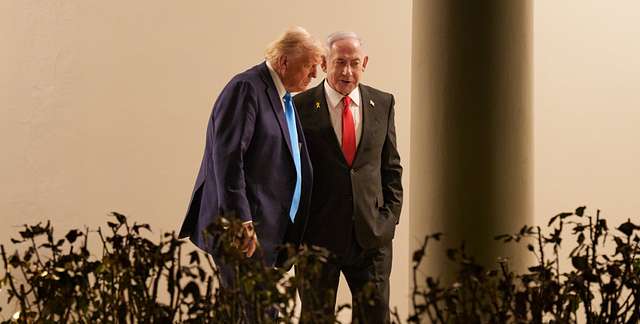
File Photo. On February 4, 2025, President Donald Trump welcomes Israeli Prime Minister Benjamin Netanyahu at the White House.Executive Office of the President. Public Domain. Via Picryl .
None of this is a defense of the Islamic Republic. It is a murderous regime that has killed, imprisoned, and tortured its own people for decades. The Iranian people deserve better. They have been saying so, loudly, at extraordinary personal cost. But to claim, without laughing, that Donald Trump and Benjamin Netanyahu are waging this war out of concern for Iranian lives and freedoms — two leaders with documented contempt for the rule of law in their own countries, two governments that maintain warm relations with dictatorships across the region when it suits them — requires a suspension of judgment that borders on willful blindness.
Caring about Iranian freedom means supporting Iranian civil society. It means not destroying the infrastructure that society needs to survive. It means not handing the regime the gift of external enemies to justify its grip on power.
Every country has the right to defend its sovereignty. Iran included. The international community — what remains of it after years of Trump’s assault on every multilateral institution he could reach — has an obligation not merely to condemn, but to restore diplomacy as a legitimate route. To say that international law is not a suggestion. To insist that there are questions that must be asked before the bombs fall, not after.
What are we trying to achieve? Can it be achieved this way? What would it cost — not in budgets but in lives? Is there another way?
These are not radical questions. They are the minimum that any society owes itself before it agrees to kill and be killed.
We have stopped asking them. That is the crisis underneath the crisis.

 © 2026 All Rights Reserved