
This week I was interviewed by Sahar Aziz, of the Law School at Rutgers, along with my friend Mojtaba Mahdavi, on the Iran War. Here is the video. I also append the transcript. Thatnks to the Rutgers Center for Security, Race & Rights, an indispensable institution standing for civil and human rights for all Americans and combatting anti-Muslim and anti-Arab bigotry.
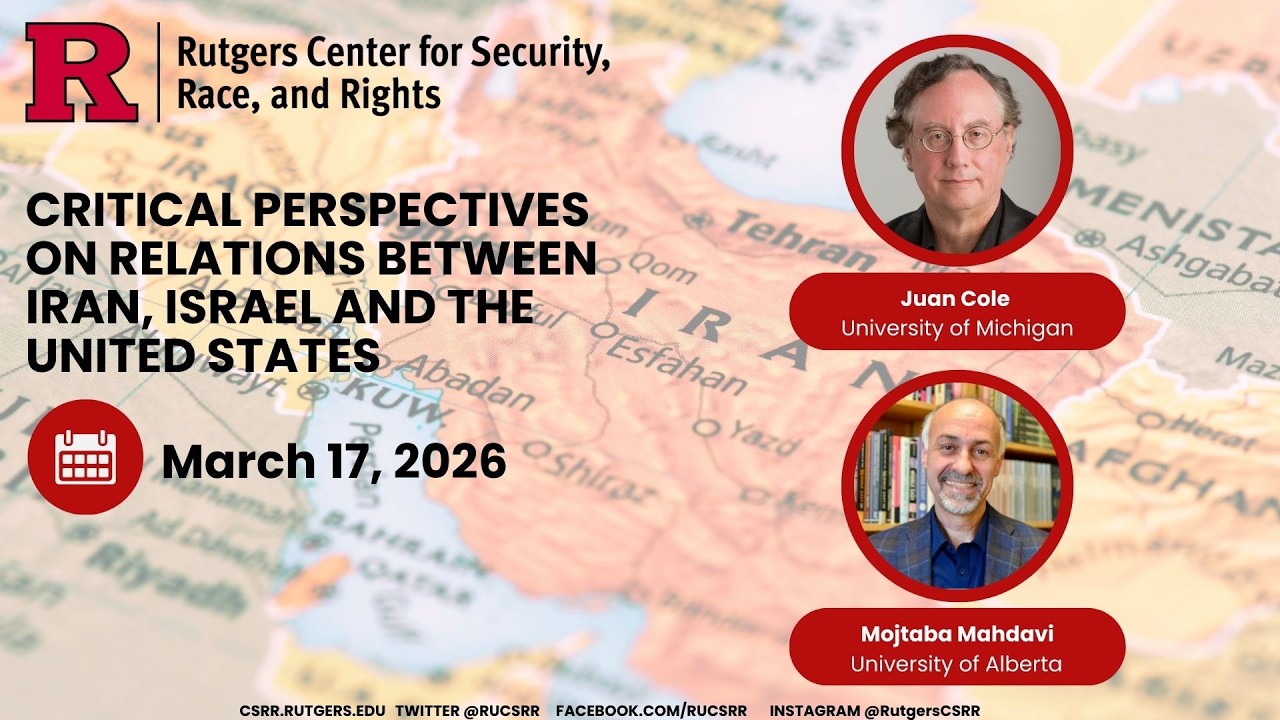
Critical Perspectives on Relations Between Iran, Israel and the United States (3/17/26)
Here is the YouTube computer-generated transcript, which I ran through Anthropic’s Claude to clean it up for publication. I spot checked parts of it, which were accurate. Caveat Emptor.
Rutgers Law School Center for Security, Race and Rights Special Lecture: Critical Perspectives on Relations Between Israel, Iran, and the United States March 17, 2026
SAHAR AZIZ: Welcome everyone to the Rutgers Law School Center for Security, Race and Rights lecture, special lecture entitled “Critical Perspectives on Relations Between Israel, Iran, and the United States.” Today is March 17, 2026. So keep in mind that everything we discuss today is based on what’s happened up until today, and we are in the middle of a war that Israel and the United States started against Iran, and therefore there are a lot of uncertainties and unpredictable events that are yet to happen after today.
But before we start our event, I want to encourage everyone to use the resources available by the Rutgers Law School Center for Security, Race, and Rights by visiting our website at csr.rutgers.edu, by following our YouTube channel, which will include the recording of this lecture as well as other lectures that we’ve held in the past. We have over 105 academic lectures by national and internationally known scholars and seasoned professionals. And to also follow us on social media at Rutgers CSRR or RU CSRR. The Center for Security Race and Rights is the first and only academic center at a US law school that focuses primarily on the civil and human rights of Muslim, Arab, Palestinian, and South Asian communities in the United States and abroad in so far as it also impacts the civil and human rights of those populations.
For that work, we tend to be very unpopular among various parts of United States society and western societies who seek to perpetuate Islamophobia, who seek to deny these diverse communities their rightful and equal place as participants in public discourse, as equal citizens who run for political office or who protest those who are in political office, and who want to live a dignified, peaceful, and safe life. And so if you support the work that we do, if you find it informative, if you find it important for the public conversation, if you believe that these communities do deserve equality and dignity and rights, then I hope and I encourage you to support the Center for Security, Race, and Rights through a donation. Go to csrr.rutgers.edu, press the donate button, and please give generously.
So today it is my distinct pleasure to host two renowned international scholars, historians and political scientists with expertise on the Middle East including on Iran. But before I introduce them I just want to lay out a few key facts.
On February 28th, 2026, the United States and Israel coordinated an unprovoked military attack on the sovereign state of Iran without any credible evidence of an imminent threat posed by Iran. On that same day, February 28, 2026, the first day of that unprovoked war, the Israelis killed Iran’s Supreme Leader Ayatollah Ali Khamenei and other senior figures, immediately transforming a long-running shadow conflict into a full regional war. Also on the first day of the war, the United States bombed a girls’ school in Manab, Iran, killing over 168 Iranian children.
Iran then invoked its right to self-defense by launching missiles, drones, and proxy attacks against the United States and Israeli targets in the Persian Gulf and in Israel. However, some of their targets were civilian targets, which if done intentionally is unlawful under the laws of war, also known as international humanitarian law, which is a topic that we discuss in detail in the latest episode of the Race and Rights Podcast featuring Professor Mariam Jimshidi. I recommend the audience subscribe to the podcast and listen to that episode, which was released on March 11th, 2026.
Now on March 2nd, 2026, Hezbollah entered the war by attacking Israel in retaliation for Khamenei’s killing, which led to a major Israeli air and ground escalation in Lebanon. And since then, Israel has killed at least 880 Lebanese and displaced more than 1 million people in Lebanon. On March 2nd, 2026, the Iranians effectively closed the Strait of Hormuz, which cuts off 20% of the world’s supply of oil and natural gas from the global economy. So since February 28, 2026, the start of this unprovoked war, the cost of oil has increased from approximately $65 per barrel to over $100 per barrel.
And finally, as of today, March 17, 2026, the estimated death toll and number injured from this unprovoked war started by Israel and the United States is as follows. More than 1,300 Iranians have been killed and more than 18,000 Iranians have been injured. More than 880 Lebanese have been killed and over 2,100 Lebanese have been injured. 13 American soldiers have been killed and 150 American soldiers have been injured. 15 Israeli soldiers and civilians have been killed and 3,300 Israelis have been injured. And at least 20 people have been killed in the Gulf countries and over 300 people have been injured in the Gulf countries. These and many other facts should be considered when examining the political and economic implications of the war on Iran.
So joining us today at the Rutgers Law School Center for Security, Race, and Rights are two distinguished experts who will discuss the causes and the consequences of Israel and the US military attacks on Iran. Professor Juan Cole and Professor Mojtaba Mahdavi.
Professor Juan Cole is Richard P. Mitchell Distinguished University Professor of History at the University of Michigan. Professor Cole has devoted his career to understanding the Middle East and the Muslim world more generally and to critically evaluating its relationship with the North Atlantic states. Professor Cole has lived in various parts of the Muslim world for more than a decade and continues to travel widely there. He has written, edited, or translated 21 books and authored over 100 articles and chapters. And among his recent publications are Muhammad: Prophet of Peace Amid the Clash of Empires and The New Arabs: How the Millennial Generation is Changing the Middle East. Professor Cole is also the proprietor of Informed Comment, a news and analysis site which I highly recommend the audience subscribe to.
Our second distinguished speaker and expert is Professor Mojtaba Mahdavi, who is a professor of political science and the ECMC Chair in Islamic Studies at the University of Alberta, Canada. Professor Mahdavi is the author and editor of numerous works on post-revolutionary Iran, contemporary social movements and democratization in the Middle East and North Africa, and post-Islamism and modern Islamic political thought. Professor Mahdavi is editor of the book The Myth of Middle East Exceptionalism: Unfinished Social Movements Towards the Dignity of Difference — Neither End of History nor Clash of Civilizations, and also co-editor of the book Rethinking China, the Middle East and Asia in a Multiplex World. Professor Mahdavi is a guest editor of “The Many Faces of Contemporary Post-Islamism” and “Contemporary Social Movements in the Middle East and Beyond.” This is just part of their impressive resume and accomplishments. And so it goes without saying that we are so fortunate to have both of these experts and senior scholars to illuminate our understanding of the complexity of what is happening today in Iran and in the Middle East that is costing the United States at least $1 billion per day.
So with that, I will moderate a Q&A with our panelists, and I’d like to start with Professor Mahdavi with a broad question. What is in your expert opinion the United States goal in starting this unprovoked war on Iran, and can those goals be achieved? And relatedly, because I think you can’t talk about the US without also talking about Israel, what is the Israeli war goal here? And is it different than the United States? Why or why not? Professor Mahdavi, welcome to the Center for Security, Race, and Rights. The virtual floor is yours.
MOJTABA MAHDAVI: Thank you very much, Professor Sahar Aziz, and thanks to the Center for Security, Race, and Rights for this opportunity.
I mean, there are many misperceptions about what’s happening today in Iran, and I would like to start by saying that unlike the conventional wisdom, I think the overwhelming majority of Iranians inside and outside the country actually go beyond this false dichotomy of supporting the war or supporting theocracy. This is probably one misperception. Many have a principled position basically challenging theocracy and at the same time this illegal, immoral, and unethical imperialist war against Iran. So that’s probably one very important concept.
And I guess to understand the current condition today, unlike what many would like to suggest with respect to the causes of the war, we also need to understand what happened over the past few months, especially in January 2025, when many people actually were killed by state violence. So the January massacre definitely was somehow used to sell this war, and many people out of despair, desperation, and hopelessness were looking for an exit strategy and solution. And we know that Benjamin Netanyahu on the one hand and President Trump had their own agenda long before January, or even a few years ago, to pursue their own goal. So definitely they took advantage of this massacre and managed to sell this war to some people.
Generally speaking, I would say that there have been some arguments about this war — basically that Iran is an imminent threat because it wants to make a nuclear bomb, that Iran is a major threat to its neighbors, that Iran doesn’t respect its own people’s rights and democracy, the violation of human rights, and so many things like that. However, we know that for Israel and particularly Benjamin Netanyahu, none of these are really the main goal for this war. Benjamin Netanyahu at least since 1990 was basically saying that we should go after Iran as an entity to secure its own regional hegemony, and he managed to sell this idea to President Trump twice — once in June 2025 and another since February 28, 2026 — that Iran is a major threat and basically you have to go after Iran. And he managed to sell this idea to President Trump. President Trump actually has been the only president who actually followed this idea by Benjamin Netanyahu. So basically I would like to say that this war’s main rationale for Benjamin Netanyahu is to secure Israeli hegemony in the region. The rest is rhetoric.
And of course for President Trump it is maintaining United States hegemony, challenging China as the major global power in the region, and definitely selling this idea to some part of the opposition.
One really important argument here I would like to make is that we know that the current authority in Iran is not democratic. However, unfortunately, some part of the Iranian opposition were after the war, supported the war in the diaspora, and they tried to create an argument that Iran is an exception to the rest of the Middle East and that with this war Iran could be liberated. Whereas when we actually analyze and understand the complexity of this region and what has happened to many neighboring countries in this region using the argument of the global war on terror, responsibility to protect, humanitarian intervention — we know that what happened to many of these nations after the war was destruction, civil war, and not really democracy and development. So the argument these people actually try to make to normalize and basically moralize this imperialist invasion as a pretext to liberate Iran has many, many problems.
Iran’s long history and civilizational depth doesn’t actually make it immune to civil war or the horrible consequences we see in Syria, in Libya, in Iraq, and in Afghanistan. War, civil war, and destruction don’t come because you are culturally superior or inferior. It comes as a result of war, and definitely sanctions and so many things happen. So all I’m trying to say is that this war is not going to empower Iranian civil society, is not going to bring democracy and development. And those who think that they can bring and use this momentum and opportunity to liberate Iran, I think they are wrong, because they are not sitting in the driver’s seat. The imperialist goals of the United States under Trump and of Israel under Benjamin Netanyahu have their own agenda for this war. That’s probably my introductory remarks and I’ll be more than happy to elaborate on this.
SAHAR AZIZ: Thank you so much, Professor Mahdavi. Professor Cole, would you like to answer the question as well as expound on the broader context as your introductory remarks?
Never miss an issue of Informed Comment: Click here to subscribe to our email newsletter! Social media will pretend to let you subscribe but then use algorithms to suppress the postings and show you their ads instead. And please, if you see an essay you like, paste it into an email and share with friends.
JUAN COLE: Thanks so much, Sahar, for having me and to CSRR. It’s a great honor to be here on the podium with Professor Mahdavi and to hear his insights.
I think the Israelis led the way for this war. It’s not a hard sell in Washington to make war on Iran. But I think the impetus for it came from Benjamin Netanyahu. And from his point of view, I think the war was launched because Israel does have aspirations to be a regional hegemon. I don’t think it’s plausible, because the idea of hegemony implies at least a certain amount of authority, and there’s a distinction between power and authority. I don’t think that the Israeli state can ever get much authority in the Middle East in the sense that people would voluntarily accede to its legitimacy and its demands. But it can have power, and the United States has built it up as among the more powerful militaries in the region. And it’s not afraid to express that power.
It also has territorial designs on its neighbors. It has occupied parts of Syria, has occupied more of Syria in the last two years. It seems to want at least 10% of Lebanon. And it wants to make sure that no opposition is voiced to these plans in regional capitals. So Iran was a real problem for the Israelis because it was a brake on these expansionist and hegemonic designs and gave rockets and missiles and training to the Lebanese Shia in South Lebanon. It propped up for many years the government of Bashar al-Assad in Syria and has developed a network of guerrilla groups in Iraq and at least has some relationship to the Houthis in Yemen. So from Netanyahu’s point of view, if he can take down Iran, provoke a revolution, change the regime in the way that happened in Syria for instance, he can weaken it to the point where it’s unable to stand against these Israeli aspirations to regional hegemony.
And the pretext of the nuclear program is just that. The Iranians had a civilian nuclear enrichment program. It was never assessed by any major intelligence agency to have a military dimension. The Iranians were not making a bomb. The leader of Iran, Ali Khamenei, the late leader, gave numerous fatwas against making, storing, or using nuclear weapons, which I think were quite sincere and frustrated some of the hardliners in Iran. So there wasn’t a military program, but I think they did maintain that civilian nuclear enrichment capacity as a form of what is sometimes called nuclear latency or the Japan option — if a country is close to being able to make a nuclear weapon, perhaps it has a deterrent effect. And that didn’t work in this case. There was no deterrence, and in fact it became a pretext for war.
As for the United States, I think it’s very difficult to analyze the thinking of this administration because President Trump is notoriously erratic and says one thing one time and another thing another time. He says that he was given the impression by Jared Kushner, his son-in-law, and Steve Witkoff, his special envoy to the region, that Iran was about to attack the United States, which is absurd because Iran didn’t have the capability of attacking the United States. And he’s given other pretexts for this war. Some think that he believes that if he could take down Iran it would make his presidency the most glorious of the presidencies of the 21st century and so forth. But I find it very difficult to analyze what his thinking is. Certainly he concurs with Netanyahu that Iran should be weakened. So they’re hitting Iran’s launching capabilities for its missiles, they’re attempting to attack its military capabilities, and I think they originally thought that if they decapitated the government, if they got rid of Ali Khamenei the clerical leader, that it might lead to a coup or revolution and a new government with which they could do business more easily.
SAHAR AZIZ: Thank you. I think those of us who remember the post-9/11 era and the other illegal war of aggression by the United States against Iraq — at least under the Bush administration, they attempted to provide evidence that justified their illegal war, although it was not accurate. The allegation that there were weapons of mass destruction, that Saddam Hussein was on the verge of creating or using them — but at least they went through the motions of trying to justify it. Whereas in this war, Trump can’t be bothered with international law, and neither can Netanyahu. So in many ways they’re very much alike.
So I want to then switch over to the Iranian response and the Iranian strategy. I think there’s been quite a bit of analysis right now in US English-language sources that critique the Trump administration for appearing not to have a war strategy, not to have an exit strategy — that he may in fact just be following Israel. And Israel, as Professor Mahdavi stated, I don’t think hides its objective, which is to eliminate the regime, which is the last regime that is openly opposed to Israel. It was Iraq before then, and Syria, and so Iran is the last government in the Middle East that is openly opposed to Israel.
But the United States again doesn’t seem to have an objective beyond pleasing Israel or wanting to satisfy Netanyahu. So let’s talk a little about Iran. Professor Cole, what do you think is Iran’s strategy that it has had to develop in real time? Or perhaps it’s prepared for this because there was a pretty severe warning shot in June of 2025, when the US again unilaterally bombed Iran, in this case alleging that they were there to destroy their nuclear weapons or what they believed were about to be nuclear weapons facilities. So what do you think Iran has been doing for the last nine months? Did they anticipate that this war was coming? And what do you think is their strategy, or how can we understand their response since February 28, 2026? And I’ll also ask Professor Mahdavi the same question once you’re finished with your analysis.
JUAN COLE: So I have to say that I’m quite critical of the Iranian government’s policies in this regard.
My own analysis — and I’d love to hear what Professor Mahdavi thinks about this — is that the Iranian government has its roots in a popular revolution, in a mass movement. And the Iranian military has two divisions, two separate organizations. One is the Iranian Revolutionary Guards Corps, which developed as a guerrilla movement and fought in the Iran-Iraq War in the 80s. And I think guerrilla thinking dominates this government. If you have a proper state, wouldn’t you want to have an air force? They don’t have, and they never have had very much of an air force. They have money. They had all the oil resources. They could have bought advanced planes. And of course the sanctions regime does hurt them in this regard, but I think they should have been able to get around it in other ways. Or wouldn’t you want a thoroughgoing anti-aircraft capability for your defenses?
It is true that Russia did a deal with them and then didn’t follow through, and there have been problems. But I think the government thought that Iran is a very large country — Americans don’t realize how large it is. It’s as big as Germany, Spain, and France combined, and a population of some 92 million, larger than Germany. They thought that it has a kind of strategic depth of its own and that it would be able to withstand any attack from the outside. And so it simply wasn’t very well prepared to fight conventionally against an attack.
And so what they’ve decided to do, again in the way of a guerrilla movement, is not to fight the United States or Israel conventionally — although they have lobbed missiles and drones at Israel to, as far as I can tell, no great effect — but they have taken their neighbors hostage. So they started attacking the United Arab Emirates, Qatar, Kuwait, even Oman, countries that had at least correct relations with them. We think that Dubai did a lot of money laundering for the Iranians to help them evade sanctions. Qatar has had good relations with Iran. Oman on several occasions put itself on the line to negotiate for Iran. But Iran has attacked these countries and closed the Strait of Hormuz. It has taken the world’s energy hostage. It’s basically taken your and my heating bill and gasoline bill hostage.
I drive electric, but nevertheless most people are suffering from this. And so their main strategy has been a hostage-taking strategy and an attack on near neighbors. It’s been the most effective thing that they have done. Otherwise they have suffered enormous attrition — probably some 4,000 IRGC personnel have been killed, large numbers of popular militia, many senior government officials, and so forth. But they have been able to reply in this way, and it’s an effective response to some extent in the sense that it puts enormous pressure on Israel and the United States to make this a short war, because every $10 increase in the price of petroleum — which is what happens when you cut off 20% of the supply — takes a tenth of a point off world GDP. The United States was only going to grow probably seven-tenths of a point this year, and this could well tip the United States into a recession if it goes on. So that’s my analysis of how the Iranian government has responded to this.
SAHAR AZIZ: Thank you. Professor Mahdavi.
MOJTABA MAHDAVI: Yes, I think Iran’s strategy — and this is what they think, I believe; this is not my position of course — is to actually make this a war of attrition, a long war, and see who is going to actually survive. The analysis is that the United States in particular, and Israel to some extent, cannot actually tolerate this war of attrition. And as Juan said, they definitely targeted US military bases in neighboring countries, and in addition to that, basically targeting the global economy by having some control over the Strait of Hormuz — not necessarily actually doing something extraordinary, just to make sure insurance companies actually do not underwrite any ships. It’s quite risky for them, but their purpose is to put pressure on Trump, because their analysis is that this is the only language Trump can understand. Putting pressure on that, and of course some Arab countries, Arab monarchies in the Persian Gulf, can probably put pressure on Trump to do something about it. This is somehow their strategy.
In addition to that, they might actually consider working with the Houthis in Yemen to do the same things in the Strait of Bab-el-Mandeb. And that would be another strategy for Iran to put pressure on Trump and Israel to end this war. And they want of course to end this war in a way that they do not expect another war in three months, six months later, because they want some sort of guarantees that this is not going to happen again. This is their strategy. I don’t know if they can succeed or not, and many unexpected things could happen in the next week or so.
With respect to their armament, my analysis is that if they do not have a strong air force, it is not by choice — it is because of the sanctions. And Iran doesn’t really have a solid strategic partner. Even Russia and China are not really strategic partners of Iran. So Iran was somehow suffering from a strategic loneliness, if you wish — partly because of geopolitics and partly because of its own foreign policy in post-revolutionary Iran. So it’s a combination of structure and agency at the same time. With this in mind, the only thing they had was to develop their own missile system, which is mostly based on their own knowledge and some knowledge received from other countries.
So at this point we will see to what extent this can be a successful strategy for Iran — putting pressure on the global economy, the only language Trump can understand, making this a war of attrition, and seeing who’s going to actually survive.
SAHAR AZIZ: And before I move on to focusing on the diaspora, which I think is an important stakeholder in this, in your professional opinions — and I realize there’s a lot of uncertainty — do you think it’s going to work? What do you predict? Given what we know as of March 17, 2026, given what we know about the price of oil and the pressures on Trump, and also polls showing that this war is not very popular in the United States, especially among Democratic voters but even among some MAGA voters — the core base of Trump — because they believe that his America First political platform was that we’re not the world’s police force, we’re not going into another endless expensive war abroad, especially in the Middle East, similar to what happened in Iraq and Afghanistan, which ultimately in Afghanistan ended in complete failure. The Taliban are back in power, tens of billions of dollars have been wasted, and hundreds of American soldiers’ lives have been sacrificed.
But also there’s a view even among the most staunch supporters of Trump on the right — why are we in this war? We understand why Israel wants to fight it, but why does the United States want to fight it, especially now in light of the fact that there is no imminent threat? And as we remember from June 2025, Trump’s talking points after he again unilaterally bombed a sovereign state, Iran, was that we have set them back, set their nuclear program back years if not decades. And so if that’s true, that just lends itself to the argument that there is no imminent threat. Like why are we spending a billion dollars a day?
So Professor Mahdavi, what do you predict? And I know it’s a risky question, but what do you see as the future of these two strategies?
MOJTABA MAHDAVI: It’s a risky prediction. We know that unfortunately this war is very popular in Israel — among the left, and there is nothing left of the left in Israel, but whatever center, right-wing, extreme right — because they were successful in manufacturing this enemy, a phantom enemy, and selling it to the public. In the United States, fortunately, it’s not quite popular as far as we know. But unfortunately Trump and this administration don’t really care. They have their own agenda. And of course as long as Netanyahu can convince Trump that this is going to bring some sort of sweet outcome for him, and as someone who actually did something that previous US presidents could not do and thereby became a unique president, he will continue that.
At the same time, we know that President Trump can actually switch his position 180 degrees. So if he can claim some sort of symbolic victory, he probably can stop the war and put some pressure on Netanyahu.
I personally — it’s hard to predict — I’m not sure if this war can bring sort of regime change. So far what we have seen is that they replaced one Khamenei with another Khamenei who is actually more radical, and also pushed the state towards a full-fledged security state. So the state is now more run by the Revolutionary Guard and more securitized, and civil society is weaker. The middle class is weaker. The priority is now no longer democracy — it’s security and order. Unfortunately, people are suffering from not only economic sanctions but also the outcome of the war. And after the war, whatever happens and whoever claims victory, Iran is going to suffer more and more because of, if not a stateless and chaotic situation, then definitely the need to rebuild this country, which will probably create the conditions for more state repression, suppression of civil society. The idea of democracy and democratization becomes marginalized. And the ordinary people suffer more economically and politically.
These are the bad scenarios. It could be even worse — separatist movements, civil war, or similar conditions to what Iraq actually experienced after 1991, when George Bush asked Kurds and Shia to come out and protest against Saddam Hussein, and then when they came out there was no support. After that, Saddam Hussein suppressed the ordinary people — Kurds and Shia — and then after that you had a decade of brutal economic sanctions against the Iraqi people, which was a war crime in my view, killing the middle class, the engine of democratization from within, and then this created the conditions for another illegal war in 2003.
This is probably one of the best scenarios for Benjamin Netanyahu. He definitely doesn’t really care about democracy and indigenous democratization in Iran. He simply is going after his own strategic interests.
But at the same time, if Iranian opposition and civil society forces can put their forces together and create conditions that can actually stop this war, put pressure on the state, and do something about the future of Iran, that would be another scenario we can actually think about. Another unlikely scenario — very unlikely — is that the Iranian state actually starts talking to its own people, surrenders to the people, and after that has a strong base to actually fight this imperialist war of aggression. So there are many different scenarios, but we have to wait and see. These are probably some of the most feasible scenarios.
SAHAR AZIZ: Thank you. Professor Cole, would you like to provide some analysis with the caveat that it’s hard to predict, but maybe some of the scenarios that you think are likely or more likely or less likely based on what you know about the region and the country?
JUAN COLE: Sure. There’s an old saw attributed to Yogi Berra that prediction is very difficult, especially with regard to the future. I’ve discovered, however, that if you give percentages you can’t be wrong.
I would say there’s a 70% likelihood that some form of this government will survive the war. And I agree entirely with Professor Mahdavi that it will be more hardline, more securitized if it does survive. The reason it’s not very likely that you’d have a government overthrow is that there are two ways to get that. One is a coup. And since they’ve put IRGC leadership at the head, the Iranian Revolutionary Guards Corps have no reason to make a coup. That’s their guy. And another way is a popular revolution. Iran is not a country where you can have a Syria-style revolution — guerrillas in the countryside who gradually take over and invade the capital — because of its geography. It’s a country of mountains and deserts. The cities are distant from one another. It’s very hard to have that kind of movement from below.
And the successful revolutions we’ve seen in the last more than a century in Iran have been largely urban, and they have involved a coalition of urban forces including the bazaar — the merchants in the traditional market — intellectuals, students, thinkers, opinion leaders, and the clergy. And only when you’ve gotten all three of them together have you had a big change in government.
I think there was some chance that that was starting to happen in December and January, because for the first time the bazaar was very upset with the government over the collapse of prices and they were demonstrating, they went on strike. And there was substantial youth participation in those big demonstrations on January 8th and January 9th. And the clergy are not all aboard with this government. But I think the Israeli and US attack on the country from the air has blunted that movement. And of course you can’t come into the streets if you’re being bombed. And now if you come into the streets you look like an Israeli agent, which has reputational impact. And so I think the idea of a popular revolution against the government under these conditions has become markedly less likely. And so we’re probably going to get Islamic Republic 2.0, but it’ll be leaner and meaner — the opposite of what the Trump administration said that it wanted.
SAHAR AZIZ: These predictions and this analysis I think confirms what many of us suspect is the case in the White House under Trump, which is that he doesn’t have Iran experts. Everything that he and his administration has done — putting aside the international legal implications and the moral implications — just from a pure geopolitical analysis, he just seems not to have anyone around him who is a country expert and regional expert. Which is not good for American interests in the Middle East. You certainly at least want to have experts in the room even if you don’t agree with them, but at least let them be part of the conversation.
So I want to now focus on the diaspora, the Iranian diaspora, which is substantial in the United States and also in Europe. As we know, a large number of the diaspora fled Iran in 1979 because of the harms it caused to them and their families and their wealth arising from the 1979 Islamic Revolution. Some of them left the same time or later for political reasons or economic reasons. But one sees much evidence of anti-Iranian regime sentiments among the diaspora, and the diaspora is very diverse in its political positions. But there does seem to be a dominant theme that the diaspora is very opposed to the current regime and to some extent — although not all of them — do support regime change.
So I’d like to unpack that. The more that we can understand the complexity and diversity of the Iranian diaspora, including the diaspora monarchists who are now supporting the return of the son of the Shah — and it’s a bit of déjà vu for those who know Iranian history. The CIA in 1953, I believe, orchestrated the coup against the Iranian elected official, and then bringing the Shah in, and even before then his father had been brought in by the British. So that family seems to have a history of being brought in forcibly to rule, or supported, by the great western power of the time.
So Professor Mahdavi, can you give us a little bit more understanding of the complexity of the Iranian diaspora and their role before and after February 28, 2026? And ideally also include an analysis of the diaspora monarchist support for Israel, Trump, and this joint military attack on Iran.
MOJTABA MAHDAVI: Sure. The fact is the Islamic Republic of Iran suffers from a massive legitimacy crisis inside Iran. It has its own social basis of maybe 10 to 15%, but the overwhelming majority of people are not happy and they really want some sort of massive, fundamental change inside the country. And this crisis of legitimacy of course became intensified especially after the January massacre and the failure of the reform movement after suppressing so many social movements over the past few decades. So definitely there is a huge legitimacy crisis, in addition to many many other crises. The estate of course betrayed so many things — I would say betrayed the sacred and secular at the same time, faith and freedom. So there is a serious serious discontentment toward this authority.
However, Iranian society is quite plural. Like many other societies, it has its own religious forces, secular forces, liberal, leftist, and so many divisions within and among them. This is a fact also when it comes to political positions — definitely there are some people who support monarchy, or they simply want to see some sort of change and they don’t really see any other alternative other than Mr. Reza Pahlavi. So they instrumentally use this man to bring some sort of change. However, there are many, many social forces who are categorically against not only monarchy but also against Mr. Pahlavi. Progressive leftists and others are included.
So Iran’s diaspora is somehow representative of this diversity to some extent. The diaspora is also diverse. However, we know that pro-monarchists and pro-Reza Pahlavi voices have louder voices and they get more support from media, financial support, and of course the United States and in particular Israel actually use them and support them to become the only voice among the diaspora.
So all I’m trying to say is that we should not basically homogenize either Iranian society or the diaspora. It’s quite diverse. There are of course pro-monarchists, and there are those who are not necessarily monarchist but they see Reza Pahlavi as a transitional person for a transitional state. But there are many, many others who are categorically opposed to this, especially when they see that Mr. Pahlavi actually supported this war and has a close relationship with Israel and President Trump. So they are actually against both theocracy and this representation of monarchy.
I would say the Zan, Zendegi, Azadi — the “Women, Life, Freedom” movement — which was quite progressive and in many ways a glorious movement, was a much better representation of Iran’s dynamic condition. And to some extent the diaspora at that time was quite progressive and representative of Iran’s condition. After that, because of the suppression of the movement and also after the June war, when the state also did not work with civil society and also created this January massacre, more people actually became disappointed toward the state and definitely showed some sort of sympathy toward that section of the opposition.
At the same time, we know that there are opposition voices inside Iran, but many of them are in jail or under house arrest and we don’t really hear much from them. So this is really important to understand the dynamics and diversity of the Iranian opposition. But what I can say is that definitely people want major substantive change above and beyond this theocracy and the Islamic Republic. But the future of course depends on so many factors — how strong is the leadership of the opposition, whether there is a unifying, inclusive discourse, and of course definitely the role of the state in terms of oppression, global civil society support, and definitely the global structure of power. So many things are involved in this context. I just want to repeat that neither Iranian society nor Iran’s diaspora is homogenized. We should definitely appreciate this diversity and plurality.
SAHAR AZIZ: Thank you. And I do want to reiterate a point you made which is really important for our audience that isn’t familiar with the diversity of the Middle East — which is just as diverse as Europe or North America or any other part of the world. The media here — if you want to be cynical you may say it’s intentional, if you want to be charitable you can say it’s due to ignorance — but the effect is that the media tends to provide disproportionately more coverage to the anti-Iran perspective, which doesn’t do justice to this complexity in terms of just listening and being able to learn from the different categories of critiques or support or somewhere in between.
Professor Cole, you are a historian by trade and so you also have the advantage of seeing the long arc of history. Where can you give us some insights into the role of the diaspora, whether in this current moment of war but also before, especially at least since 1979?
JUAN COLE: There wasn’t much of an Iranian diaspora before 1979. There were a lot of students. There used to be a saying back in the 70s that half the world is full of water and the other half is full of Iranian students. But as for families that moved abroad and lived in large numbers in Europe and the United States, that was rare until the 1978-79 Islamic Revolution, when those families who were close to the Shah, the former government, or who benefited from it, or who were members of minorities who were disliked by the new Khomeini government, fled in very large numbers.
I was at UCLA at the time doing my doctorate and studying Persian when the Iranians showed up. I was living in Santa Monica and all of a sudden we had an Iranian-American community in Santa Monica, and I hung out with the young people — that’s how I learned Persian. So I had a view of that diaspora community, and of course one sympathizes with them. Many of them escaped by the skin of their teeth from being executed. They took long treks through Azerbaijan and Turkey and suffered enormous hardship, or had to go down through Zahedan to Pakistan, to get out. And even at that time it wasn’t so easy to get a US visa. So that many of them have an enormous animus toward this government is entirely understandable.
But it’s very interesting that the National Iranian-American Council did opinion polling recently among a weighted sample of Iranian-Americans. They found that 49% of Iranian-Americans opposed the beginning of this war and 48% supported it. So they were very divided about the war. And in the aftermath, two-thirds of them favor a quick diplomatic off-ramp rather than ongoing war. So just to speak to Professor Mahdavi’s point that the community is not monochrome — it has many voices, many perspectives in it.
But if you watched cable news in the United States, these statistics would come as a surprise, because I think the voices that wanted war and want to continue until the government is overthrown are predominant in what’s presented to the US audience.
Diasporas can sometimes be very important in revolutionary movements, and it should not be forgotten that Lenin himself had to come back to Russia and had been in exile. And they do play a role. But the monarchists, the people who are supporting Reza Pahlavi, I think are actually a minority of Iranian-Americans. They’re not 51%. That’s a voice that gets a lot of attention.
There are reports that during those big demonstrations in the middle of January there were Iranian crowds chanting Reza Pahlavi’s name. I can’t verify this one way or another, but it wouldn’t be completely out of the question. It should be remembered that the Marcoses are back in the Philippines — a family that became very dictatorial and was overthrown by a popular revolution, and now the son is back in power. So in politics, having a name matters.
On the other hand, after the Soviet Union was formed and the Tsar’s family were mostly killed, there was this persistent belief in the Russian diaspora that a young daughter had escaped — Anastasia — and that somehow she would emerge and they’d put her back on the throne. And that was a fantasy. In my view, the likelihood of Reza Pahlavi becoming king of Iran is about the same as Anastasia becoming the ruler of Russia.
SAHAR AZIZ: I appreciate your candor, and unfortunately the media doesn’t seem to understand that and continues to lend credence to this very unlikely and impractical scenario, which I think is also a disservice to the US audience who really should be learning about the context of this issue through experts, not through pundits and propaganda.
It reminds me of when the US invaded Iraq and they wanted to bring in — I’m blanking on the name.
JUAN COLE: Ahmed Chalabi.
SAHAR AZIZ: Yes, Ahmed Chalabi, to just parachute in and suddenly he was going to bring peace and prosperity to a country that, as Professor Cole mentioned, had been sanctioned for 13 years to the extent that humanitarian organizations were sounding the alarm of mass malnutrition of Iraqi children — caused by US-imposed sanctions and obviously exploited by Saddam Hussein to further deny his population the basics that they needed.
But I want, before we move to audience questions, to ask about the role of Islamophobia, the role of perceptions of Muslims and Islam in the West — often times very negative perceptions — in the manufacturing of consent, and whether it is at play and whether it is effective. This is something that we study a lot at the Center for Security Race and Rights, how Islamophobia or anti-Muslim stereotypes and racial tropes inform public opinion about foreign policy decisions. We see it quite a bit on Palestine and Gaza and Israel in terms of the way — and this was very intentional — to justify supporting what in my position is Israel’s genocidal campaign in Gaza. One of the arguments was that all of the Palestinians are terrorists, they’re all Muslims (which we know is untrue, as 15 to 20% of Palestinians worldwide are Christian), that they’re all Hamas supporters, that they all are antisemites, that they all want to kill Jews. And these Islamophobic tropes and anti-Palestinian racist tropes were very powerful in manufacturing consent for the chronic and clearly documented human rights violations in Gaza from 2023 to 2025 and arguably continuing, but at a lesser rate.
So how does that backdrop and reality — and the same thing happened with Iraq, and much of this is a product of the global war on terror — how can we understand the role of Islamophobia, and how does that connect to views of Iran in particular and the Iranian people? I’ll start with Professor Cole.
JUAN COLE: You were talking about Noam Chomsky’s idea of manufacturing consent. It’s always the case in American wars that racism is a very powerful argument for war. If you go back and look at the depictions of the Japanese in World War II — as monkeys and so forth — then it becomes easier to understand how you could drop a nuclear bomb on civilian cities and wipe out tens of thousands of people, including children and housewives and so forth. Dehumanizing people is essential to war and genocide.
And the Iranians have been the objects of this kind of stereotypical bigotry since the Islamic Revolution in 1978-79, because of the hostage crisis, because of Jimmy Carter’s failed attempt to intervene, because of the subsequent events, the Iran-Iraq War, and so forth. The Iranians became bigger-than-life super villains in American popular culture.
Saturday Night Live did a skit years ago about anti-Iranian bigotry in the United States. They depicted a Sikh shopkeeper who was attacked by mobs every time something happened with regard to Iran, because Americans think that because Sikhs wear turbans they’re Muslims. I thought it was a very clever skit and very insightful into the way that American bigotry works.
Opinion polling showed in the 1980s and 1990s that if you ask Americans what people they hate most — and it’s kind of shameful that these opinion polls are so easy to pull off — they listed Iranians above the Russians during the Cold War. That was supposed to be America’s major enemy, but they hated the Iranians more.
And of course all those old stereotypes of Muslims fighting jihad and wearing scimitars and turbans and all those things are deployed against the Iranians, even though no Iranians wear turbans or scimitars to my knowledge. So dehumanizing people, deploying stereotypes, making them a natural enemy, making them evil — you’ll see American politicians talk about the Iranians as evil. All of that makes it much easier to launch a war.
And what’s remarkable is that even though we’ve had 47 years of this kind of institutionalized bigotry against Iranians, the American people on the whole, by and large, don’t like this war and can understand that Iran did not pose a threat to the United States, that it’s an aggressive war of choice that will, I’m sorry to say, certainly harm the lives of many Americans because of the energy costs.
SAHAR AZIZ: And I also want to point out that while we in the United States — and I assume similarly in Canada — are rightfully sensitive to antisemitic racial tropes, we are not sensitive at all to Islamophobic racial tropes. And so I will always recommend to people: if you don’t realize how serious these racist tropes are in terms of endangering real people’s lives in the United States, but also causing our country to again go to war and spend $1 billion and kill people abroad — in this case Iranians — just imagine if we were using antisemitic tropes about Jews to justify a war against Israel. Imagine how that would be rejected, and it should be rejected. And that’s essentially the reality that many people from the Middle East live.
And people from Afghanistan, because there’s the myth that all people from the Middle East and Central Asia are all Muslim and that there are no ethnic differences or religious differences among them. But it’s part of the racialization process — creating this monolithic, monolithically evil, genetically dangerous Other.
Professor Mahdavi, what are your insights or perspectives? And you’re Iranian-Canadian, so I’m sure you’ve also personally experienced it, but also seen it among Iranian diasporic experiences in the West — this Islamophobia and this vilification of Iranians within the Islamophobic discursive umbrella.
MOJTABA MAHDAVI: Sure. Anti-Muslim racism and Iranophobia are two manifestations of Orientalist discourse, to use Edward Said’s argument, which basically creates a fantasy picture of Iranians that ignores their diversity and also their agency.
And I would say that one of the arguments which is somehow related to this Orientalist discourse, Iranophobia, and anti-Muslim racism is that you do not acknowledge that Iranians have their own agency to bring some changes, and that they need some charity-style support from the West as a savior to save them. Whereas that’s not the case. Iranians have their own agency. They don’t need a western white savior to save them from their own culture or civilization. That’s a typical clash-of-civilizations argument. So here it’s not a bad idea to read again Frantz Fanon’s book Black Skin, White Masks or Hamid Dabashi’s Brown Skin, White Masks. This concept of alienation and whiteness is quite problematic.
So these are all part and parcel of this discourse of Iranophobia — ignoring and rejecting Iranian diversity and at the same time pluralism and agency. It’s not that Iranians are a bunch of idiots with no agency, just religious people, typical of a pro-theocratic regime that really needs saving. So this dehumanization and the creation of a very false picture of Iranian society and civilization is quite problematic. And unfortunately some people of course reproduce this argument by supporting the war and ignoring people’s agency and diversity. This is quite problematic and we need to acknowledge it.
SAHAR AZIZ: Well, thank you so much. We could have an entire graduate course on this topic. I want to move to some of the audience questions. I encourage those who haven’t asked to do so.
One question is regarding the motives of this war and the objectives. As we know, whenever a country is oil-rich, that tends to also be a potential motive. So one question is what is the role of oil here? It’s not mutually exclusive with the other objectives or lack thereof that we discussed earlier. But if we look at Venezuela — the abduction, literally the kidnapping of the president of Venezuela by the US military — the stated purpose was to retake Venezuelan oil because it was rightfully the United States’ before the socialist government nationalized their own oil industry. So what’s the role of oil in Israel’s and the United States’ motives in starting the war?
Another question is looking at the broader impact in the region, especially in Lebanon and Syria. Would you say that the war with Iran is also a way for Israel to covertly take more territory in Lebanon and Syria and act in an even more extreme way with regard to Gaza, now that the world’s attention is on Iran? And does Iran have an interest in having more influence in Middle Eastern countries?
Professor Cole, would you like to start?
JUAN COLE: Sure. With regard to petroleum, I don’t think it played a role in Israel’s calculations, but it seems to bulk large in Trump’s imagination. He’s spoken of attempting to take over Kharg Island, which is a major set of Iranian oil terminals.
And I think Trump represents a rear-guard action of big oil — of ExxonMobil and Chevron and the big international oil companies — against the move to green energy to fight climate change. He’s a climate change denialist. He wants to promote oil and fight electric vehicles.
This attempt on his part to do so seems to me quixotic — it’s not very likely to succeed. But it will do a lot of damage to the world environment on the way. And we’ve already seen a fall-off in sales of EVs in the United States. So taking control of Venezuela’s petroleum industry the way the United States has is a stark neocolonial move. Even the attempt to claim Canada is part of this oil resurgence policy. And so I think petroleum certainly is one of the things that drove Trump’s desire to overthrow the Iranian government and maybe get a government that doesn’t have to be sanctioned, so you could put more oil on the market.
Because one of the things that drives the superiority of electric vehicles is that green energy — wind and solar, battery and hydro, in addition to electrified transportation — is much cheaper than petroleum. And, ironically enough, it seems to me that Trump’s war on Iran will give electric vehicles and green energy more advantages in the coming years. And I think China will do very well out of it, since it’s a leader in those industries. But I think that was part of what was driving Trump.
And with regard to Israel, I think we’re just not very well informed about what’s going on anymore. Our media fails us in so many ways. Does everybody know that the Israelis reimposed the blockade on Gaza? They broke the supposed terms of the ceasefire of last October that Trump trumpeted, and they issued this horrible, smarmy statement that there was enough food let in that they’ll be all right. They already weren’t letting in enough food, and children will suffer from this move by the Israelis to reimpose the blockade.
They’ve also taken advantage of the Iran war to pursue a more thoroughgoing policy of ethnic cleansing and annexation in the West Bank. And then under the cover of the Iran war, they launched a war on Lebanon, which ordinarily would consume headlines and be a big issue. Over half a million Lebanese have been displaced. Three and a half million Iranians have been displaced. When we talk about deaths, that’s only one of the costs of war. People losing their homes, becoming homeless, is a big issue.
So Israel is rampaging around. And as a historian I think about it as a Napoleonic strategy — big changes in the governance of an entire region directed from a particular capital. And I think the Iran war works for them in all of these ways.
SAHAR AZIZ: Professor Mahdavi, your perspective.
MOJTABA MAHDAVI: Yes, I agree with Professor Cole. Oil, gas, and minerals are definitely part of Trump’s calculation. And it seems to me he’s going back to the old form of colonialism, not even neocolonialism. He quite frankly talks about mercantilist capitalism — I want this, I want that. So this is definitely part of their calculation.
Broadly speaking, I would say we definitely need to talk about the political economy of war — not only in terms of oil, gas, minerals, and resources, but also the calculation after the war. You know, construction after the war, the blocking of assets as they did in Libya. These are definitely part and parcel of the construction opportunities for many companies. And definitely weapons — Israel is already starting to advertise how effective their weapons are to sell more weapons. So war is definitely a good laboratory to show how weapons work, especially this new generation of war using AI and how sophisticated it is. So dirty money is definitely part and parcel of this political economy of war and resources, which we really need to understand the complexity of. Just look at what happened in Libya, Iraq, Syria, and the rest of the world.
And I agree with Professor Cole that Iran has definitely been used to divert attention from the genocide in Gaza and of course more annexation in the West Bank. And I think Netanyahu and his coalition government are going to take advantage of this.
SAHAR AZIZ: Well, speaking of oil, where does China fit into this? Because I’ve heard some reporting that China relies heavily on Venezuela and Iran, in addition to other sources, and that it tends to be one of the biggest customers of those two countries. And to the extent that the United States can either completely stop that — which I believe it has with Venezuela — and certainly seeks to with Iran, is that also an oil-related analysis?
And I’ll just note that I read today that Trump is extremely upset with China and European countries for not getting involved in this war by using their navy to secure the Strait of Hormuz. And it was very interesting that he’s trying to bring in all of these other countries, and they I think are quite intelligently refraining from that trap. But where does China fit in with the oil connection? Professor Mahdavi.
MOJTABA MAHDAVI: Yeah, definitely China is the biggest part of the calculation, because if the United States doesn’t really need oil for itself, it definitely wants to have a say over who is going to use Iran’s oil. And definitely China is the number one so-called enemy, and they want to stop this cheap oil going to China to compete with the United States. So I would say definitely that’s part and parcel of the calculation.
SAHAR AZIZ: Professor Cole.
JUAN COLE: Yeah, I think that may be what’s in their minds, but they’re wrong. That is to say, if Venezuela was selling something in the order of 300 or 400,000 barrels a day to China, in world terms this is nothing. The world produces over 100 million barrels a day of petroleum. And Iran is more important — on the order of 15% of Chinese petroleum imports were coming from Iran. China imports about 5 million barrels a day of petroleum. And the advantage for China of taking the Iranian petroleum is that they got it at a discount because it was essentially smuggled under sanctions. The Iranians put it on what are called ghost ships with the transponders turned off and shipped it to Malaysia or Indonesia, third countries who then transshipped it to small refineries south of Shanghai that don’t have an international presence. They don’t deal in dollars. They don’t have bank accounts abroad. So they can’t be sanctioned very easily by the Treasury Department.
But because of the skullduggery involved, or the ways in which this has to be done as smuggling, the Chinese get a discount on that petroleum. But so what? If they couldn’t get a discount on Iranian petroleum, they would just increase the amount of petroleum they took from Russia. The world petroleum market is not going to fail China.
Moreover, what’s really important here is that now 53% of new car sales in China are electric. And the International Energy Agency predicted that we could well be at peak oil in China — that is to say, from every year here on in, because of the electrification of transportation in China, they will import less oil. BYD and other Chinese electric auto companies — BYD, by the way, is the biggest in the world, it’s now bigger than Tesla — they just introduced a vehicle that gets on the order of 700 or 800 miles to the charge and can be charged in as little as six to nine minutes. And BYD produces these sedans for $16,000. There are some Chinese EV companies that are making automobiles for $5,000. And the technology in China is improving quickly. Their batteries are becoming less and less expensive.
So my estimation is that China will easily be able to replace whatever petroleum Trump is denying them through these actions in Venezuela and Iran. And to the extent that it can’t, it will just increase its incentives for consumers to buy electric and accelerate its movement away from petroleum for transportation.
SAHAR AZIZ: And I think one of the reasons we are not aware of all these developments is that Chinese cars aren’t imported into the US. And so the rest of the world is quite aware because they are buying these cars and benefiting from them, while we seem to be in the darker ages of trade exclusivism, which is bipartisan on this issue.
And so we have come to the end of our time, but before I formally end, I’d like to give each of you an opportunity to make any closing remarks — anything that you’d like to say that we didn’t cover in today’s talk, so that our audience has a better understanding of the complexities involved in this unprovoked unilateral military attack on Iran by the United States and Israeli governments. Professor Cole, would you like to start?
JUAN COLE: One of the things that we had discussed earlier that didn’t come up so much today is the character of the normative order of the world. After World War II, enormous attempts were made — because 65 million people were slaughtered around the world and it was a horrible thing, economies were destroyed — the nations of the world created the United Nations and put it in the charter that you’re not allowed to launch aggressive wars, you’re not allowed to try to take other people’s territory. And the only two proper reasons for a war, the only two casus belli, were either that you were attacked — and you can always defend yourself — or that the United Nations Security Council could designate a country as a threat to world order, as they did with Iraq in the Gulf War when Iraq had illegally invaded and occupied Kuwait. But in neither the case of the US invasion and occupation of Iraq, nor now in the case of this unprovoked aggressive war on Iran, were any elements of international law considered by the United States.
Israel has been doing whatever it can to undermine international humanitarian law, including all of the Geneva Convention provisions for the treatment of occupied peoples, forbidding aggressive warfare, forbidding the deliberate attack on civilians, which is part of Israeli military doctrine — the Dahiya doctrine — which is to destroy civilian objects and infrastructure as part of the war effort.
All of these things may be nails in the coffin of the post-war order. And it should be remembered that when Britain, France, and Israel got up a war against Egypt in 1956 and attempted to occupy the Suez Canal zone again after Egypt had nationalized it, President Eisenhower threatened to ruin all of their economies if they didn’t get right back out of Egypt. He went on television and gave a speech about how these three countries were in danger of trying to undermine the basic principles of the United Nations by this aggressive war.
That was a US president, and not some namby-pamby liberal. This was the former Supreme Allied Commander of the US Armed Forces who defeated Hitler. He stood against an obviously unprovoked war of aggression and said so, citing the United Nations Charter. And we are so far past that now that it seems like science fiction when I say it.
SAHAR AZIZ: Yes. It’s unfortunate that this is no longer even within the realm of possibility coming out of the White House, regardless of the political party. Professor Mahdavi, your closing remarks.
MOJTABA MAHDAVI: I just want to say that I hope this madness stops. This illegal and immoral war against Iran stops. And I would say I just want to read one quote from Martin Luther King Jr.: “Injustice anywhere is a threat to justice everywhere.” So we have to actually stand up to this injustice committed against the Iranian people.
And Iran is a land of so many great poets, including Saadi of Shiraz, whose very famous cosmopolitan humanist poetry — the poem “Bani Adam” — is quite inspiring. I just want to read the translation: “Human beings are members of a whole, in creation of one essence and soul. If one member is afflicted with pain, other members uneasy will remain. If you have no sympathy for human pain, the name of human you cannot retain.”
So with that, we really need — Iranians definitely have a lot in their own culture and civilization, they don’t really need a foreign savior to save them. They can stand on their own feet. And as a result of this massive cultural, structural, and discursive transformation in Iranian society towards a post-Islamist society, they can definitely create their own democracy.
At this time, I know it’s really hard to talk about hope in the time of despair, but we really need a radical hope in the time of crisis. And I’m sure the people of Iran can do it if they simply rely on themselves.
SAHAR AZIZ: Thank you. Thank you so much, Professor Cole and Professor Mahdavi. And I hope that those who are listening to this, whether during the panel or afterwards — this will be on our YouTube channel, Center for Security, Race, and Rights, please subscribe and watch all of the videos that we have. But I hope that those who listen to this are inspired and encouraged to read more. What we did today is just the small tip of the iceberg. Iran is a remarkable country. It has remarkable civilizations on which it was founded. And one of the ways in which Islamophobia, or anti-Iranian sentiment, or racist sentiments against particular national identities is perpetuated is that the only exposure that western audiences have is through war, through violence. And that is no more their identity than it is the identity of American culture as just the sharp end of the spear of US military imperialist endeavors. There’s a lot more to America than that. So there’s a lot more to Iran than that.
So please do use this as an opportunity to learn more, to read more, and to listen to the diverse perspectives of Iranians and of Iranian-Americans, Iranian-Canadians, or Iranian-British. And through that exposure, I think you will appreciate our common humanism.
So with that, please do subscribe to the Center for Security Race and Rights social media, Rutgers CSRR. Make sure you subscribe to our YouTube channel, subscribe to our Race and Rights podcast, which I have the honor of hosting. And finally, if you find this informative, if you find it impactful, if you want us to continue this kind of work, we need your financial support. Please go to csr.rutgers.edu, press the donate button. Any amount is welcome, but please do give generously.
And thank you so much, Professor Cole. Thank you, Professor Mahdavi. We are so grateful for your generous time and sharing your expertise.
JUAN COLE & MOJTABA MAHDAVI: Thank you. Thank you.

 © 2026 All Rights Reserved