
Ann Arbor (Informed Comment) – The world changed for everyone on Thursday.
The US was only predicted to grow 0.7% this year. It could well be that as of today, we have been tipped into recession.
The day before, the Israeli Air Force bombed Iran’s South Pars gas field.
This action escalated the war to a whole other level. Bombing security-related targets in Iran could affect the government’s stability (though there is little sign of that), but it does not affect the economic future of the country. If Iran’s oil and gas rigs begin being targeted, that attack could reduce the country to fourth-world status. Oil and gas development doesn’t happen overnight, and repairs can take years.
Iran’s leadership, more hard line than ever before, has repeatedly made it clear that if they cannot export gas or oil from the Persian Gulf, then no one will be allowed to. So in retaliation for the Israeli attack, on late Wednesday and into Thursday Iran targeted the Ras Laffan Liquefied Natural Gas complex in Qatar, as well as gas fields in the United Arab Emirates. These assaults have little impact on Israel, but threaten instead the well-being of the entire world, as I warned last week.
Israeli Prime Minister Benjamin Netanyahu and his extremist cabinet, full of the Israeli equivalent of neo-Nazis, knew exactly what they were doing when they bombed South Pars. They were signaling that their goal is the complete destruction of Iran. They also were very well aware that Iran’s response would likely be to hit the Gulf gas giants. They do not care that they thereby plunged billions of the earth’s people, including ordinary Americans, into long term economic pain. Call it the “Netanyahu tax” that we’ll all be paying in our electricity, grocery, electronics and consumer spending, possibly for years to come.
It is impossible to know whether US President Donald Trump was complicit with the South Pars strike, or was, as he represented himself in social media posts, alarmed and dismayed by it. Trump is a notorious and serial liar, so for all we know he green-lit the bombing but then backed off when Qatar called him up to remonstrate and his less loony advisers explained to him about the world economy.
Ras Laffan in Qatar is one of the world’s major energy hubs, the source of a considerable amount of the world’s Liquefied Natural Gas.
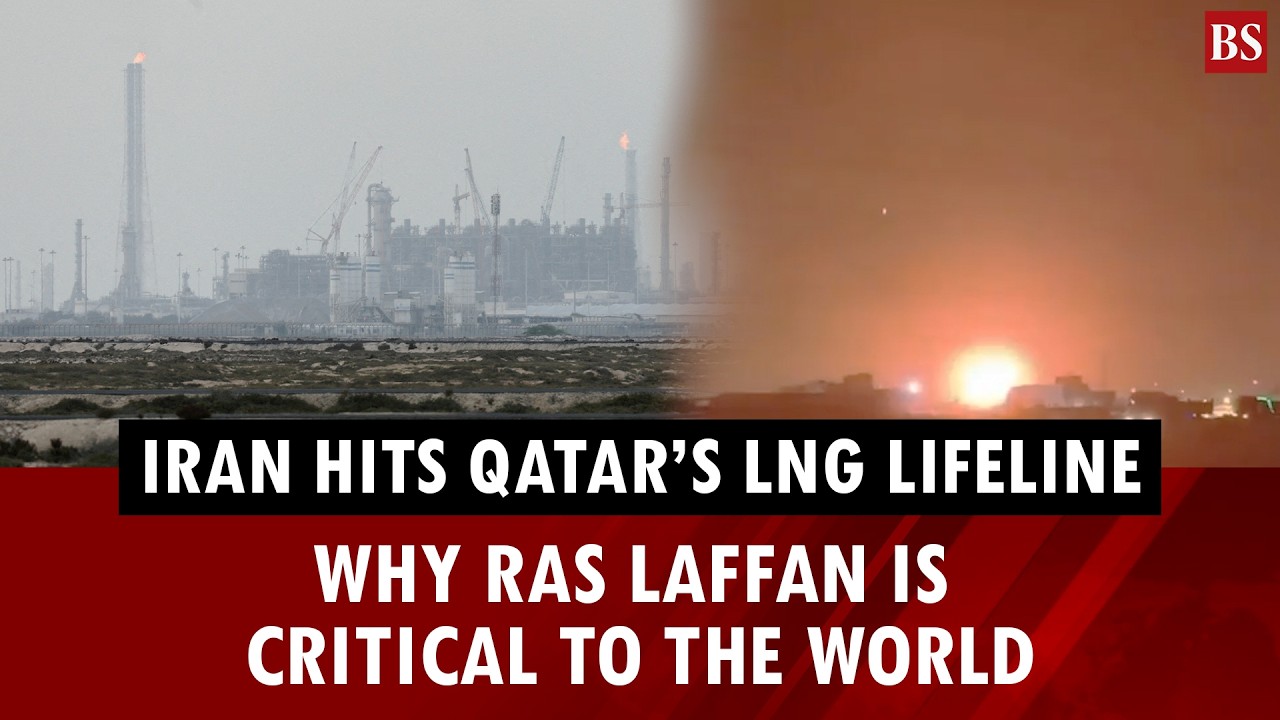
Iran hits Qatar’s LNG lifeline: Why Ras Laffan is critical to the world | West Asia war
QatarEnergy posted to “X,” regarding the “Ras Laffan Industrial City,” quoting Saad Sherida Al-Kaabi, the company’s CEO who also serves as the Minister of State for Energy Affairs. He said that Qatar’s LNG export capacity has been cut by 17% because of the strikes, for a yearly loss of $20 billion.
Qatar is in the top three of global fossil gas exporters, and its Liquefied Natural Gas accounts for one fifth of that market. That is, the world just lost 3.4% of its global LNG supplies. For countries not easily reached by pipelines, LNG, which can be shipped, is a lifeline.
Al-Kaabi lamented, “Extensive damage to our production facilities will take up to five years to repair and will compel us to declare long-term force majeure.”
Five years! that takes us out to 2031, when we’ll be electing the successor to the successor to Trump. The loss of so much international gas supply will have severe inflationary effects. Gas supply is relatively inelastic — there aren’t countries that could quickly step up to replace Qatar’s production. And if your house or factory is locked into gas for heating or your power plant uses gas for electricity generation, it isn’t as though you can just wake up in the morning and switch to something else. The switch takes time. So if both supply and demand are inelastic or inflexible, then a reduction in supply causes prices to spike. The spike in this case will be long term.
It isn’t just fossil gas that is at stake. If the Israeli-US war on Iran continues into late April, Saudi officials believe petroleum could reach $180 a barrel. Brent crude was $63 a barrel last November. Every increase of $10 in crude petroleum prices equals a jump of about 25 cents in the price of gasoline at the pump for Americans. Gasoline is today on average $3.88 per gallon at a little over $100 a barrel. You’d add $2 a gallon to that at $180 a barrel. That would be nearly $6 a gallon, and much more in California where there are fees and taxes and add-ons because of importing from Asia. And imagine the pain in Europe, which does not have its own petroleum and where they are already paying the equivalent $7 or $8 a gallon. Further, Goldman Sachs assesses that if the war goes on very long, the price of petroleum could stay above $100 a barrel for years. Americans, spoiled by low gasoline prices, will have to get used to nearly $4 a gallon gasoline.
Plus, every $10 a barrel increase in the price of petroleum shaves a tenth of a point off global GDP growth. So an $80 increase is a 0.8% loss. If we were only growing 0.7% this year, we would plunge to -0.1 GDP contraction. Do that two quarters, say Q2 and Q3, and it is the textbook definition of a recession.
So, back to fossil gas and Qatar. Al-Kaabi wrote, “The attacks damaged two liquefied natural gas (LNG) producing Trains 4 and 6 totaling 12.8 million tons per annum (MTPA) of production, representing approximately 17% of Qatar’s exports. Train 4 is a joint venture between QatarEnergy (66%) and ExxonMobil (34%), and Train 6 is a joint venture between QatarEnergy (70%) and ExxonMobil (30%).”
He doesn’t mean by “train” a locomotive. Liquefied Natural Gas is produced by a production line along which components compress, purify and cool the gas. And I mean “cool.” They take it down to -260°F (162°C), Mars-style, so that they can ship it in cryogenic containers aboard enormous tankers. There were 14 such production trains at Ras Laffan, and now two are knocked out for years to come.
China, South Korea, Italy and Belgium get their LNG from Qatar. Not only are they not getting any right now, but the supply will be reduced 17% for the next few years. Unlike petroleum, which countries like China stockpile, there are no stockpiles of natural gas. Qatar cancelled its contracts with those countries because of events beyond its control (“force majeure”).
It isn’t just fossil gas for heating or electricity generation that is at stake. Some gas is made into various other liquids or materials. Gas is crucial feedstock for fertilizer. Since Qatar’s gas plants are closed, there is a fertilizer crisis. Even if the war ends and Qatari gas production resumes (albeit at 83% capacity), it is probably too late for the corn planting season in the US, where several million acres won’t be planted this year. That will raise food and livestock prices.
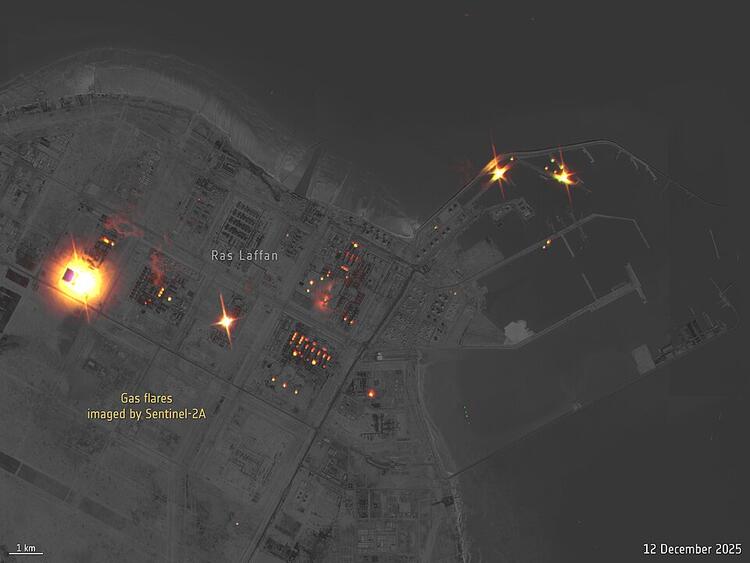
This image shows gas flares from oil production in Qatar, imaged at night on 12 December 2025. The Sentinel-2A signal is overlaid on a greyscale basemap. European Space Agency. Public Domain. Via Wikimedia Commons
The US is a rich country, but in much of the world a fertilizer shortage could mean real hunger. For Sudan alone, the fertilizer shortage will push 45 million people into hunger. Food insecurity in sub-Saharan Africa and some of Asia is expected to jump by 20%.
Shell ran the Pearl GTL plant jointly with QatarEnergy, producing “premium engine oils and lubricants, and paraffins and waxes.” Iran hit that facility, which will be inactive for at least a year.
Al-Kaabi lists the other commodities produced at Ras Laffan that have been knocked out:
-
· Condensates: 18.6 million barrels which is around 24% of Qatar’s exports
· LPG: 1.281 MT which is around 13% of Qatar’s exports
· Naphtha: 0.594 MT which is around 6% of Qatar’s exports
· Sulfur: 0.18 MT which is around 6% of Qatar’s exports
· Helium: 309.54 MCFA which is around 14% of Qatar’s exports
Sulfur is essential to mining and refining metals like copper and nickel. Helium is crucial for microprocessors, including for cooling silicon wafers. South Korea is petrified at this loss of Helium capacity for its chips business. LPG can substitute for petroleum. Naptha is important for gasoline refining and has other uses.

 © 2026 All Rights Reserved