
Dublin (Special to Informed Comment) – While violence in Gaza and the West Bank continues, many argue that firm separation between Palestinians and Jews is necessary to achieve “peaceful co-existence with their neighbors.” However, life in mixed Jewish-Palestinian neighborhoods in Israel tells a different story.
Marked by decades of violence, the Israeli-Palestinian conflict is widely considered intractable, with very little hope for peaceful coexistence.
New research shows that Jewish and Palestinian citizens in mixed Israeli neighborhoods interact often—and usually positively—and that these everyday encounters are linked to stronger support for conflict-resolution proposals. This suggests that even in intractable conflicts like the Israeli-Palestinian case, personal encounters may help bridge divisions.
Mixed neighborhoods in Israel are shared by Jews and a minority of Palestinians who hold Israeli citizenship. Palestinians with Israeli citizenship lead fundamentally different lives from the majority of Palestinians inhabiting this conflict. Therefore, we cannot assume that our findings translate to Palestinians outside of Israel. However, focusing on Palestinians within Israel is the only way to study contact between civilian Jews and Palestinians in a natural setting of the conflict environment—Gaza and the West Bank are walled off, which prevents the mixing of Jewish–Palestinian civilians. As such the new findings provide an important addition to existing understanding of the conflict.
Ma’alot-Tarshiha, one of the locations where our survey was conducted.
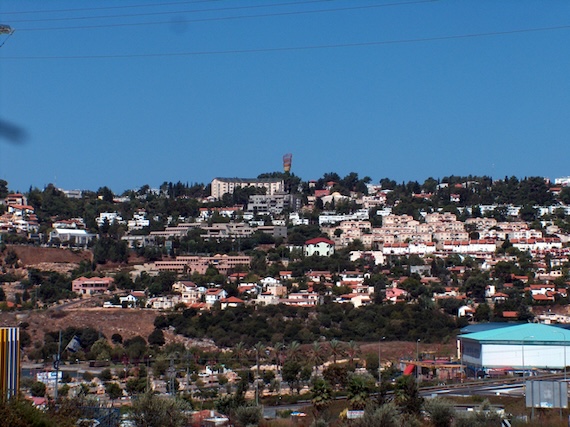
Maalot Tarshiha. Uploaded by מיכאלי at Hebrew Wikipedia. Licensed under the Creative Commons Attribution-Share Alike 2.5 Generic license.. Mirrored at Wikimedia
We carried out our research in 2019 across seven Israeli cities—Lod, Ramle, Acre, Haifa, Jaffa, Upper Nazareth, and Ma’alot-Tarshiha. The study, conducted by the B.I. and Lucille Cohen Institute, surveyed 315 Jewish Israelis and 287 Palestinian Israelis living in 96 mixed neighborhoods. This sample is notably larger than those used in most studies on this difficult topic. Moreover, while existing research tends to focus on mixed cities as a whole, our study centers specifically on mixed neighborhoods, where interactions between the two groups are more likely to take place.
The survey conducted telephone interviews—carried out in Arabic for Palestinian Israelis and in Hebrew for Jewish Israelis. Despite the challenges of reaching residents in mixed neighborhoods, we achieved a response rate of 24 percent for each group. While sampling bias cannot be entirely ruled out, the data offer rare and valuable insights into Jewish–Palestinian relations in these settings.
In total, the questionnaire included around 80 items covering intergroup contact, attitudes, identity, political views, collective action, and demographic characteristics. Findings on the frequency and nature of contact—whether positive, neutral, or negative—are based on descriptive statistics. To examine how contact relates to attitudes, we conducted regression analyses while controlling for demographic factors and neighborhood characteristics.
The results indicate that both Jewish and Palestinian residents of mixed neighborhoods reported frequent and largely positive interactions with one another. Notably, reports of negative contact were minimal. Here, “contact” refers to face-to-face encounters, such as brief conversations or even simple gestures like greeting each other. The survey assessed whether these interactions were positive or negative based on how respondents felt about them.
These findings stand in contrast to communal violence in Israeli neighborhoods which took place in 2021 in the same settings as our study, but after our study was conducted. Rather than revealing underlying animosities, our findings suggest that daily interactions in these settings that later, and briefly, became known for their violence are actually mostly peaceful and positive.
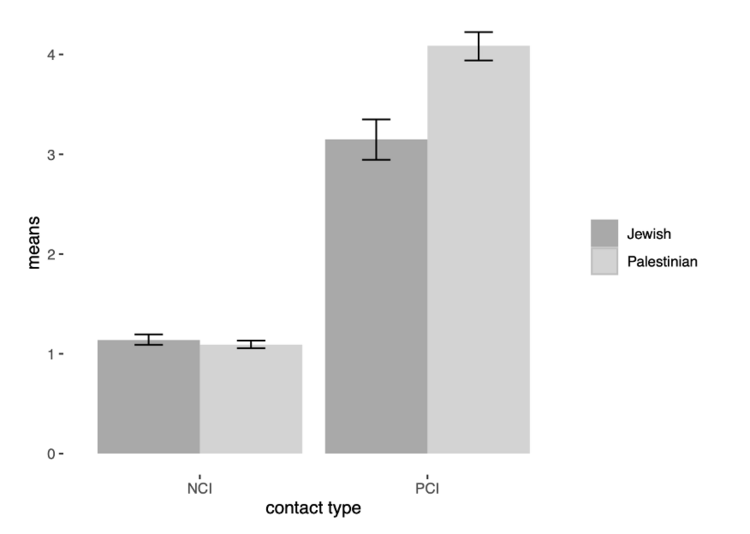
Survey findings: Means and standard errors for negative (NCI) and positive (PCI) contact reported by Jewish versus Palestinian respondents. Answers were provided on a scale from 1-5, with 1 referring to no contact and 5 to contact several times a week. The figure includes 95% confidence intervals based on 2500 bootstrapped samples.
Our findings moreover reveal a strong association between positive intergroup contact and support for contested conflict-resolution proposals. Among Jewish respondents, positive interactions with Palestinians are linked to greater support for Israeli concessions.
Jews reporting positive contact are significantly more likely to endorse a two-state solution that recognizes Palestinian statehood, the dismantling of Jewish settlements in the West Bank, and the return of a limited number of Palestinian refugees. This pattern is striking, as these positions reflect a substantial shift toward the Palestinian perspective—one that is often rejected in official Israeli discourse. Among Palestinians, positive contact with Jews is associated with support for mutual recognition.
Jewish respondents who report negative contact are generally less supportive of Israeli concessions. In particular, they express significantly lower support for the limited return of Palestinian refugees and for the sharing of holy sites.
In contrast, Palestinian respondents who report negative contact are significantly more likely to support a two-state solution, which would improve their current position by granting statehood. At the same time, negative contact does not appear to reduce Palestinians’ overall support for conflict-resolution proposals.
These findings show the importance of contact programs that aim to bring Jewish and Palestinian Israelis together. Such initiatives are intentionally designed to foster improved relations and typically take place in carefully structured settings that incorporate conditions known to promote positive intergroup contact. However, these environments differ fundamentally from the realities of an ongoing conflict, where violence persists. Our research contributes a rare examination of interactions within that real-world conflict context.

 © 2026 All Rights Reserved