
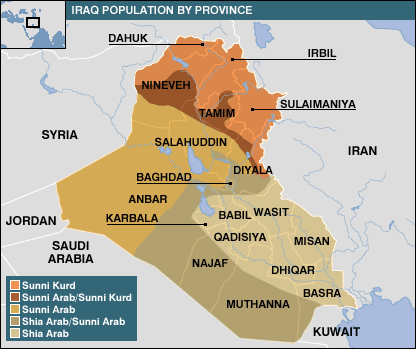
The big news in Iraq this week is the provincial elections due to be held on Saturday. These elections will have little direct impact on the Federal parliament or cabinet, since new parliamentary elections won’t be held until December. But they will bolster or weaken existing parties at the center by acting as bellwethers of public opinion. They will also provide parties with new sources of patronage or cut them off from existing ones, where they lose. The outcome of the elections will tell us something about how realistic Obama’s plans to withdraw from Iraq on a short timetable are.
Iraq has 18 provinces. The three Kurdistan provinces and Kirkuk will not be participating. That leaves 14, four of them largely Sunni Arab and 10 with Shiite majorities. So the two big questions are “Who will win the four Sunni Arab-majority provinces?” and “Who will win the 10 Shiite provinces?
Cont’d (click below or on “comments”)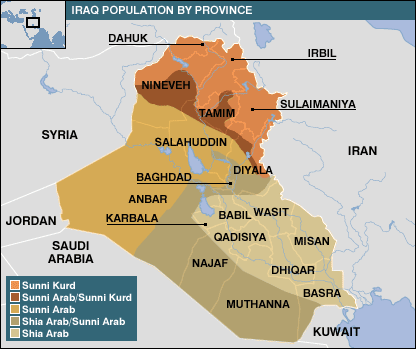
Al-Maliki’s cabinet has participation from the Big Four– the Sunni Arab Iraqi Accord Front, the Kurdistan Alliance, the Shiite Da’wa or Islamic Mission Party, and the Shiite Islamic Supreme Council of Iraq.
The leading party withing the Sunni Arab Iraqi Accord Front is the Iraqi Islamic Party (IIP: descended from the Iraqi Muslim Brotherhood). It performed well in the December, 2005, parliamentary elections, in which the Sunni Arabs took part. But they had boycotted the January 2005 provincial elections. So the IIP has a commanding position in the provincial government of al-Anbar. But only 2% of voters in al-Anbar took part in the January polls, so their victory is meaningless. Now it seems unlikely that the IIP will retain control of al-Anbar, which would diminish its national standing, as well.Anthony Shadid reports on the central role of tribalism in electoral politics in the Sunni Arab province of al-Anbar. (The Iraqi Islamic Party is not tribally based but rather grounded in urban religious fundamentalism).
The NYT observes that Prime Minister Nuri al-Maliki is trying to turn the secretive, cell-based al-Da`wa into a grassroots Shiite political party that will support him. He may succeed. Al-Zaman, Iraq’s leading newspaper, says a new opinion poll (Arabic) shows al-Maliki is the most popular politician in Iraq. In the Shiite south, his set of parties, the “Coalition for a Government of Laws,” is garnering between a fourth and a third of voters in the poll and outstrips all other parties there. (This poll contradicts another that showed dissatisfaction with religious parties; it is likely that the religious parties will win again).
Al-Maliki’s rivals fear, however, that he is gathering too much military might into his hands, and that this step will allow him to fix the lection.


 © 2026 All Rights Reserved