
New York (Special to Informed Comment; Feature) – Supported by U.S. military, political and financial muscle, Israel seeks to demolish the UN Palestinian refugee agency UNRWA in the occupied territories. It reflects the ongoing war against the poorest in the Global South.
Last Friday, the UN Palestinian refugee agency UNRWA said that The Qalandiya Training Center for hundreds of Palestinians in the West Bank could be closed within days by Israeli authorities. The Center is at risk of expropriation by Israeli authorities cooperating with the Messianic far-right Jewish settlers.
That’s why the Knesset has passed legislation banning the group from Israeli territory, barring Israeli officials from having contact with it and shutting it off from Israeli electricity and water.
Qalandiya is a part of a far bigger puzzle, the Netanyahu cabinet’s effort to deport UNRWA along with the Palestinians from the occupied territories, to set the stage for their de jure incorporation in the pre-1967 Israel. This plan was accelerated after October 7, 2023.
From Nakba to UNRWA
In May 2024, after half a year of genocidal atrocities in Gaza, Israeli settlers launched several attacks on the headquarters of the UNRWA, setting fire to the perimeter of the building in East Jerusalem. The attacks came after months of far-right settler protests outside of the building.
The UN General Assembly established the UN Relief and Works Agency for Palestine Refugees in the Near East (UNRWA) in 1949 with a temporary mandate, to provide humanitarian assistance, protection, and education to registered Palestinian refugees (more than 5.9 million today) living in the West Bank, Gaza, Jordan, Lebanon, and Syria.
About 1.4-1.6 million of Gaza’s more than 2.1 million residents are registered Palestinian refugees. With no political resolution on the refugees’ status, the General Assembly has regularly extended UNRWA’s mandate, which is currently set to expire on June 20, 2026.
The agency was created in the aftermath of what Israel calls its Independence War and what the Palestinians call Nakba, the great catastrophe in which 750,000 Palestinian Arabs were displaced and dispossessed in what became Israel.
After achieving an initial truce in the 1948 Arab-Israeli War, Count Folke Bernadotte, a Swedish diplomat, used it to lay the groundwork for the UNRWA.
Just hours after his proposal, Bernadotte was assassinated in Jerusalem by the Jewish paramilitary Stern group, while pursuing his official duties. One of those who planned the killing was Yitzhak Shamir, the future prime minister of Israel, the predecessor and onetime mentor of Benjamin Netanyahu, Israel’s current PM.
From humanitarian lifeline to US/Israeli target
Ever since then, UNRWA has served as a humanitarian lifeline to generations of Palestinians in the West Bank, the Gaza Strip and the adjacent Arab countries.
Created as a temporary measure, UNRWA’s mandate has been subject to renewal every three years. It is funded primarily through voluntary contributions from governments (95%) and the UN regular budget (5%). UNRWA’s 2024 program budget was for $880.2 million; in addition, emergency funding appeals, primarily for Gaza, totaled $1.6 billion.
Prior to October 7, 2023, the U.S. accounted for almost 30% of the total. Historically, the United States has been UNRWA’s largest financial contributor, with more than $7.3 billion since 1950. The Trump administration considers such funding waste. Yet, the U.S. military aid to Israel has amounted to $4 billion annually; and since October 7, 2023, total military aid has soared to $21.7 billion.
From the start, these contributions have been subject to a variety of legislative conditions and oversight measures. Some members of the U.S. Congress have regularly raised concerns about UNRWA’s effectiveness and neutrality.
Decades of U.S. policy toward Israel and the occupied territories, however ambiguous, was reversed almost overnight in 2018. That’s when the first Trump administration executed a set of dramatic policy changes and canceled nearly all U.S. aid to the West Bank and Gaza, plus $360 million in annual aid previously given to the UNRWA.
Subsequently, the Biden administration restored much of the funding, yet continued to provide Israel weapons and financing for the mass atrocities against those the UNRWA funding was supposed to help.
Hollow claims, twisted logic, atrocities of the innocent
After allegations surfaced connecting a few of the 30,000 UNRWA employees with the October 7 Hamas-led attacks against Israel, UNRWA fired nine staff members following a UN investigation, but denied allegations that the agency has widespread links to Hamas. Yet, in March 2024, Congress enacted a year-long prohibition on U.S. funding to UNRWA (P.L. 118-47), which has been effectively extended and strengthened rather than allowed to expire.
To put it all into context: The Empire State Building is said to have 21,000 employees. Imagine what would happen if a handful of them were suspected of terrorism and therefore the entire building would be dismantled and all employees fired? It would seem to represent collective punishment of many for the alleged crimes of a few. Well, that’s the current congressional logic regarding Gaza.
The new U.S. and Israeli legal measures emboldened Jewish settlers, particularly the Messianic far-right, prompting several attacks on the UNRWA headquarters in East Jerusalem in May 2024.
The assaults came after months of far-right settler protests outside of the building, following Israeli claims of UNRWA-Hamas links that lacked verification, according to U.S. intelligence.
Among the protesters was Aryeh King, a deputy mayor of Jerusalem and a prominent advocate for settlements, who described Palestinian Gazans as “Muslim Nazis” and “sub-human,” calling for captured Palestinians to be “buried alive” in December 2023.
Not just Palestinians but UNRWA’s employees have become targets of Israeli military and US arms. As of early January 2026, over 380 UNRWA personnel and staff supporting its activities have been killed in the Gaza Strip since October 7, 2023, making it the highest toll in the UN history.
These figures include over 300 staff members, with many killed while on duty or with their families. Additionally, some 80 individuals have been killed supporting UNRWA activities. These personnel were killed while delivering aid or at home, often in similar conditions to the communities they serve.
The same goes for the targeted agency infrastructure. Beyond personnel, over 300 UNRWA installations have been impacted by the conflict, and more than 800 people have been killed while sheltering in UNRWA buildings.
UNRWA’s last stand against a new catastrophe
On January 20, 2026, Israeli authorities used bulldozers to demolish the UNRWA headquarters in the Sheikh Jarrah neighborhood of East Jerusalem. Moreover, two laws passed in late 2024 took effect in January 2025, banning UNRWA from functioning on “sovereign Israeli territory” and prohibiting any contact between Israeli state officials and the agency.
The UNRWA’s chief, Philippe Lazzarini, said the demolition was the latest in a series of Israeli actions against UNRWA, including shuttering a medical clinic for 30 days earlier this month and its plan to cut power and water to UNRWA facilities in the coming weeks.
UNRWA still employs over 15,000 staff in Gaza and the West Bank and remains the largest provider of health and education services there, despite being “frozen out” of official coordination and denied basic utilities like water and electricity.
As the occupying power, if Israel succeeds in fully dismantling UNRWA, it would legally be required to absorb the annual $1 billion cost of providing services (education, health, social services) to Palestinian refugees, potentially costing Israeli taxpayers billions of dollars.
Of course, Israel, against all realities, has long denied that it is an occupying power.
As the “backbone” of aid for roughly 2 million people, UNRWA is what stands against still another humanitarian crisis. Its restriction has already exacerbated famine risks, with 1.6 million Gazans facing acute food insecurity in early 2026.
Struggling to sustain UNRWA’s position, the UN Secretary-General, on January 13, 2026, warned Prime Minister Netanyahu that he would refer Israel to the International Court of Justice (ICJ) if the anti-UNRWA laws were not repealed.
Multiple Israeli allies, including the EU and individual countries like Ireland and Belgium, have formally condemned the demolitions as “flagrant violations” of international law and UN diplomatic immunities.
But their appeals have little effect as long as the White House condones Israel’s repeated violations of international law. Compounding the humanitarian threats, Israel announced on December 30, 2025, that it would also halt operations for 37 other international NGOs (including Doctors Without Borders and CARE) starting in March 2026.
Washington’s effective war against the Global South
Based on modeling studies published in The Lancet and other research throughout 2025–2026, the withdrawal of the United States from the World Health Organization (WHO) and the cancellation of United States Agency for International Development (USAID) programs is expected to lead to a massive international humanitarian crisis.
In the absence of countervailing forces, it will be one of the largest disruptions to global health in modern history, reversing decades of progress in reducing infectious diseases. Modeling suggests that continued cuts to USAID and associated global health programs could result in over 14.1 million additional all-age deaths globally. Over 4.5 million children under the age of 5 are projected to die due to the loss of health services, nutrition support, and vaccine programs by 2030.
Specific models tracking the 90-day USAID funding pause in early 2025 estimated that roughly 757,000 people died in the first year as a result of these cuts, with the majority being children. Worse, these cuts will virtually ensure weakened pandemic surveillance.
Effectively, it is war against the poorest, youngest and most vulnerable in the Global South. Africa and Asia are expected to bear the brunt of the impact due to heavy reliance on U.S. aid for HIV/AIDS treatment, malaria control, and maternal health.
The suspension of humanitarian aid has impacted food security, leading to increased malnutrition, particularly in areas like Congo, Somalia, and Yemen. And as the cost of health services has shifted to individuals in many developing nations, poverty is on the rise.
Israeli violations of international law<
As of January 2026, Israel is accused of violating several core tenets of international law through its military campaign and the ongoing attempt to dismantle UNRWA.
The Fourth Geneva Convention: According to Duty of Care (Articles 55 & 56), as the occupying power Israel is legally obligated to ensure the food and medical supplies of the civilian population to the “fullest extent of the means available”. According to Facilitation of Relief (Article 59), Israel must facilitate relief schemes for the occupied population. In October 2025, the ICJ ruled that Israel’s ban on UNRWA had already violated this obligation, as the agency is an “indispensable” provider that cannot be replaced on short notice.
The UN Charter: In view of Diplomatic Immunity (Article 105), the demolition of UNRWA’s East Jerusalem headquarters, has been cited as a “blatant violation” of the inviolability of UN premises and assets. Furthermore, Duty of Cooperation (Article 2) deems that member states must give the UN “every assistance” in its actions. The ICJ found Israel is not entitled to unilaterally decide on the presence of UN entities in the Occupied Palestinian Territory.
International Humanitarian Law (IHL): In view of proportionality and distinction, legal experts argue that Israel’s destruction of nearly 78% of Gaza’s structures and 94% of its hospitals is foreseeably excessive and violates the principle of proportionality in self-defense (jus ad bellum). Furthermore, Israel’s use of starvation as a weapon has led the ICJ and UN experts to conclude that blocking UNRWA and other aid has resulted in an “engineered famine,” violating the prohibition of using starvation as a method of warfare.
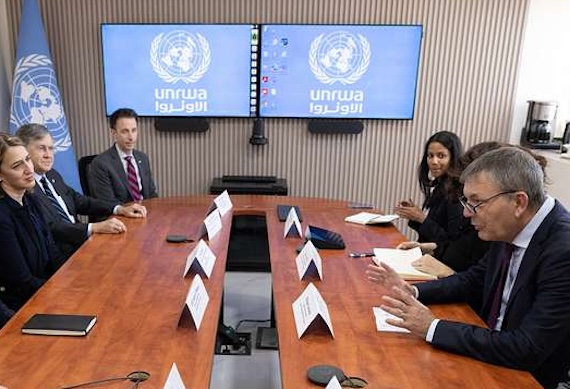
Detail of File Photo. State Department personnel meet with UN Relief and Works Agency for Palestine Refugees in the Near East (UNRWA) Commissioner-General Philippe Lazzarini in Amman, Jordan, November 4, 2023. (Official State Department photo by Chuck Kennedy). Public Domain. Via Picryl
US violations of international law
The United States, as its primary ally, also faces intensifying legal challenges for alleged complicity and failure to prevent these violations of international law.
Complicity and Failure to Prevent Genocide: Under the 1948 Genocide Convention, all signatories have a legal duty to prevent genocide. Recent lawsuits (e.g., Taxpayers Against Genocide) argue that the U.S. has directly contributed to atrocities through unconditional military funding and diplomatic cover.
Duty to “Ensure Respect” for IHL: Common Article 1 of the Geneva Conventions requires states to “ensure respect” for the treaties. Critics argue the U.S. violates this by continuing to supply weapons used in “apparent violations” of IHL.
Violation of Domestic Statutes (US Law): Section 620I of the Foreign Assistance Act: Prohibits aid to countries that restrict the delivery of U.S. humanitarian assistance. Organizations like Human Rights Watch have formally called for the suspension of aid under this law. In turn, the Leahy Law prohibits aid to foreign military units that commit gross violations of human rights (GVHR). The U.S. is accused of continuing aid to Israeli units with documented unremedied abuses.
Even the newly established Board of Peace (BoP), led by President Trump, has already come under fire for potentially violating the right to self-determination. By planning a “Gazan Riviera” without consulting the local population, critics argue the U.S. is entrenching external control in violation of Palestinian sovereignty.
What we are witnessing – from Gaza to Venezuela and Greenland – is a progressive crumbling of the international order consolidated by the U.S. and its Western allies after 1945. It is an effort at “might makes right” hegemony. Masquerading as a “rules-based order,” it seeks to undermine international law.
What happens in Gaza today will happen elsewhere tomorrow.

 © 2026 All Rights Reserved