
Ann Arbor (Informed Comment) – On Saturday the US Embassy in Baghdad was hit by a missile. Video shows black smoke billowing from the compound. There were no reports of casualties. The US says that a helipad was hit, while Iran charges that it took out a radar facility.
It was the second attack on the embassy since the Israelis and the U.S. launched their war on Iran on February 28. The embassy thereafter called on all Americans to flee Iraq.
I visited that embassy in 2013, and I hope everybody there is all right. It is a tough diplomatic station to be in a majority Shiite country when your country just whacked a major ayatollah. American consular offices in Lahore and Karachi in Pakistan have also been attacked by angry crowds.
The strike on the embassy came after a U.S. fighter-jet killed three members of the Brigades of the Party of God, an Iraqi Shiite militia, one of whom was high-ranking.
Iraq in general has been devastated by the US-Israeli war on Iran. This week two tankers were hit by drones off Basra port in the south, leaving them in flames. In response, Iraq closed its oil ports, including Basrah Oil Terminal (BOT) and Khor Al-Amaya Terminal (KAAOT). They had been responsible for the export of 3.3 million barrels of oil a day in 2025, and now it is all off the market.
This episode demonstrates that the near-closure of the Strait of Hormuz is not the only problem. If the Strait was entirely open, Iraq still would not be exporting petroleum, since Basra is very near Iran and can be easily targeted. In fact, during the Iran-Iraq War of 1980-1988, Basra was heavily shelled by the Iranian military, something older Basrans well remember.
Iraq’s economy is being devastated, and al-Sudani’s government is talking about having to take out international loans just to pay government salaries. Trump has turned them into beggars.
The 2003 US invasion of Iraq was intended by its architects to ensure that the 21st would be another “American century.” By miring the country in a fifteen-year fruitless war, first with Sunni and Shiite guerrilla groups and militias, and then with ISIL (which the US invasion helped create), the Iraq War did the opposite. It cost the US trillions of dollars, added dangerously to the national debt, and diverted resources from confronting genuine challengers such as Russia. Moreover, the only way for Washington to overthrow the Baathists was to ally with Iraq’s Shiites, who are for the most part favorable to Iran. So George W. Bush erased the regime that had constained Iran to its west, and replaced it with a Tehran-friendly government in Baghdad.
Washington likes to pretend that at least it transformed Iraq from an enemy under the old secular Baath nationalist government of Saddam Hussein into a friend. But of course there are no friends in politics, only shifting interests. As the old saw has it, if you want a friend, buy a dog.
Iraq is not only not an ally of the US in this war on Iran, it is siding firmly with Iran, at least rhetorically. Iraqi Prime Minister Mohammed Shia’ al-Sudani on Wednesday called up Iranian President Massoud Pezeshkian and condemned Trump’s “unjust war” targeting Iran. He also expressed his condolences on the killing by the US and Israel of Iran’s former clerical Leader Ayatollah Ali Khamenei and members of his family, as well as other Iranian nationals. He wished the wounded a speedy recovery. He also objected to Iranian drone attacks on Iraqi soil, which he said were unacceptable, since Iraq does not allow itself to be used to launch attacks on Iran.
The US is such a media black hole now that I think China’s news service was the only one to report this conversation in English.
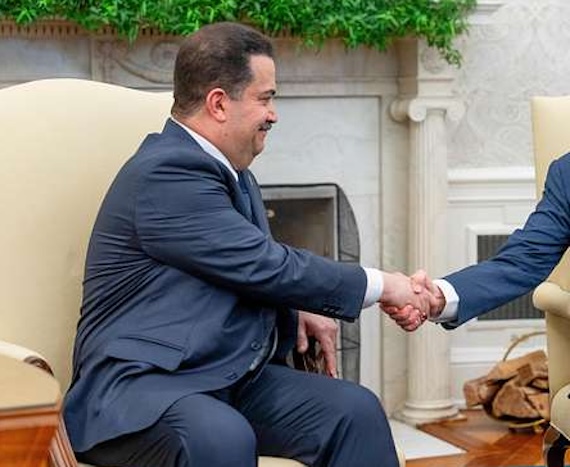
File photo, detail. Iraqi PM Mohammed Shia’ al-Sudani in the White House in 2024. Public Domain. Via Picryl.
There are some US troops in Iraq, remnants of the force sent by President Barack Obama to help defeat and then mop up elements of the ISIL terrorist organization that took 40% of Iraq in 2014. There had been 2500 US troops in Iraq last summer, but some have been withdrawn. In January, all US forces withdrew from Ain al-Assad Base in western Iraq. A few hundred were sent to a base in Iraqi Kurdistan, which is under attack by Iran. The US and Iraq have committed to seeing most US forces leave Iraq, with the exception of about 300 in Kurdistan.
So Iraq offers nothing to a New American Century, which US involvement there actually sank. And it did not turn out to be a strategic asset. Now that the US is again involved in a major war in the region, Iraq tilts to Washington’s enemy, Iran. Pro-Iran militias are targeting US interests. The remaining tiny US facilities are under drone attack. Sleazy press lord Rupert Murdoch boasted in 2003 that invading Iraq would produce $14 a barrel oil. Oil is over $100 a barrel because of this sort of jingoistic militarism.

 © 2026 All Rights Reserved