
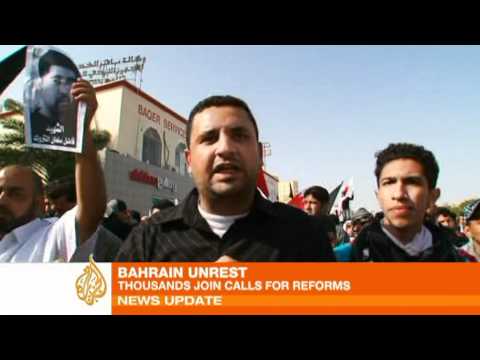
Bahrain’s Agony Continues 2 Years Later

Posted on 02/25/2013 by Juan Cole

Bahrain national dialogue talks began again on Sunday as two small parties came back to the table after a token protest against what they called street violence.

Last week saw the commemoration by the opposition in Bahrain of the second anniversary of its Arab Spring protests, demanding a move toward constitutional monarchy and a better deal for the country’s discriminated-against Shiite majority. Shiites say that they don’t get the good schooling, the good jobs, or political power commensurate with their majority status. The mainstream Shiite political party, al-Wifaq, agreed the previous weak to talks with the Sunni monarchy. Some activists were upset with Wifaq’s Sheikh Ali Salman for this move, worried that it gave too much legitimacy to the government’s hard line position.

The government cleverly demanded last week that all the civil groups involved in the negotiations condemn the use of violence. Wifaq declined to sign the statement unless it also condemned police violence against non-violent protesters. Wifaq’s refusal to sign led two Sunni reformist groups to withdraw from the negotiations.

On Thursday, police fired on protesters, killing a 16-year-old boy, and provoking further protests over his death. Later, a 20-year-old was also killed.

Amnesty International has adopted some 22 Bahrain activists as prisoners of conscience. The Bahrain regime, notorious for its arrest and torture of dissidents, denied that it holds any prisoners of conscience. (In fact, the government even charged physicians who had treated wounded protesters). Amnesty’s report on the past two years is available here in PDF.

Excerpts:

“Scores of people were arrested and sentenced before unfair military courts (National Safety Courts) on freedom of expression-related charges after they participated in peaceful protests in 2011. Many were subsequently released. For those currently serving prison sentences, the government says that charges related to freedom of expression were dropped and only criminal charges were retained for their appeal hearings. Among those still in jail are 13 opposition activists, including Ebrahim Sharif, Hassan Mshaima’ and ‘Abdulhadi Al-Khawaja; a group of medical professionals, including ‘Ali ‘Esa Mansoor al-‘Ekri and Ghassan Ahmed ‘Ali Dhaif (see background); and the head of Bahrain Teacher’s Association (BTA), Mahdi ‘Issa Mahdi Abu Dheeb (see background). All were convicted of serious criminal offences and sentenced to imprisonment. After Amnesty International reviewed legal documents, including court verdicts, and statements made by the prosecution the organization concluded that none of the activists used or advocated violence and that no convincing evidence had been submitted to justify their conviction. It appears that all of them were targeted for their anti-government views and for having participated in peaceful protests.”

and:

“Other prisoners of conscience have been convicted for acts considered to be a crime in Bahrain, but which do not constitute an internationally recognizable criminal offence, such as calling for or participating in an “illegal gathering”, or “criticizing the rulers of the country”. Prominent human rights defender Nabeel Rajab, for example, was sentenced on 16 August 2012 to three years in prison under the Code on Public Meetings, Processions and Gatherings (Law 18 of 1973) and Article 178 of the Penal Code, which criminalize any gathering of more than five people who are assembled “with the intention of committing crimes or acts intended to facilitate the commission of such crimes or aimed at undermining public security”. Article 178 has repeatedly been used to punish peaceful protesters taking part in unauthorized assemblies.”

Some civilian dissidents have been sentenced by military courts, which violates international law.

Abdul Ghani Al Khanjar, human rights and anti-torture activist who was jailed for 2 years, tells the story of how he went underground and is in hiding in the islands rather than risk re-arrest.

The US government has been relatively low-key in condemning Bahrain human rights violations. The government leases the US a naval base at Manama as the HQ of the Fifth Fleet, which provides security to Gulf oil exports (some 20% of the world’s total). Also, Washington worries about expansion of Iranian influence, and the Sunni monarchy’s claims that the Shiite protesters have Iran links may give the Obama administration pause. Finally, the Saudi government is a hawk on the Bahrain crackdown, and is influential with the US.

The regime’s heavy-handed tactics may have pushed some Bahrain Shiites toward radicalism. Last week, the Bahrain government announced that Kuwait had helped it crack a budding terrorist cell, with links to Lebanon’s Hizbullah and to Iraq and Iran. Most Bahrain Shiites are peaceful and the majority belongs to the Akhbari school of jurisprudence that rejects the authority of ayatollahs, so the regime’s attempt to tag all Shiites (some 60% of the population) with the radicalism of a few is pure propaganda.

Democracy Now! reports:

0 Retweet 25 Share 11 Google +1 2 StumbleUpon 1 Printer Friendly Send via email

Posted in Bahrain, Uncategorized | 2 Comments

Bahrain dissidents Commemorate 2 Years of Protest, Condemn Repression

Posted on 02/15/2013 by Juan Cole

The USG Open Source Center translates a report from the Bahrain newspaper al-Wasat for Feb. 14, entitled “Bahraini Opposition Condemns Security Solution, ‘Ill-Treatment’ of Prisoners.” (They mean by ‘security solution’ the regime’s preference for dealing with dissent by violence instead of negotiation.) Bahrain is an ethnically divided society of some 550,000 citizens, mostly Arab, and a similar number of expatriate workers. Some 60% of the Arab citizens are Shiite Muslims, while the monarchy and power elite is mostly Sunni. Shiite activists have been protesting their second class citizenship and lack of access to the better jobs and educational opportunities, which are reserved for Sunnis. They have been joined by some reformist Sunnis who object to the iron fist policy of the monarchy. Dissidents want to see Bahrain move to being a constitutional monarchy where most decision-making is in the hands of parliament and where parliament actually looks like the country. The Sunni monarchy paints the Shiite dissidents as cat’s paws of Iran, which is untrue. The US has a major naval base at Manama and although the Obama administration has urged the king to compromise, Washington has not spoken out forcefully against the repressive tactics of the Bahrain secret police.

Excerpt:

“The police forces fired yesterday tear gas and stun grenades to disperse demonstrators who attempted to reach Pearl Roundabout in the capital Manama, and there were reports of several injuries.

This demonstration followed a mass protest that had been called for by the opposition political societies; namely, Al-Wifaq National Islamic Society, National Democratic Action Society (Wa’d), Nationalist Democratic Assembly, National Democratic Assemblage, and Al-Ikha National Society. The Interior Ministry said on its Twitter account that “after the end of a march on Al-Badi Street, a group of vandals rioted and closed streets, which necessitated taking legal action against them.”

The opposition forces said in a statement that “resorting to the security solution to resolve the crisis in Bahrain has proved sheer failure for over two years,” and that “such a solution should be stopped, especially since the crisis is political and needs a serious and comprehensive political solution that would meet the demands of the political majority of the Bahraini people calling for change and democracy.”

The opposition pointed out that merging the security and political solutions together is not possible, adding that “if the call for dialogue is serious and is meant to come up with positive results, it should be accompanied by the cessation of the security operations and violations, as well as the media provocation practiced by official and semi-official media outlets.”…

The opposition forces expressed their grave concerns over reports about a number of prisoners of conscience and expression have gone on a hunger strike, and some even on a thirst strike, because of the ill-treatment, persecution, poor conditions, and denial of the basic human rights inside the detention centers…

Amy Goodman’s Democracy Now! reports on the commemoration in Bahrain of the beginning of the two-year-old protest movement against government policies there.

0 Retweet 42 Share 9 Google +1 3 StumbleUpon 1 Printer Friendly Send via email

Posted in Bahrain | 3 Comments

Bahrain’s Bloody Crackdown no Bar to Big US Weapons Sales (Elliott)

Posted on 01/16/2013 by Juan Cole

Justin Elliott writes at ProPublica:

Despite Bahrain’s bloody crackdown on pro-democracy protesters, the U.S. has continued to provide weapons and maintenance to the small Mideast nation.

Defense Department documents released to ProPublica give the fullest picture yet of the arms sales: The list includes ammunition, combat vehicle parts, communications equipment, Blackhawk helicopters, and an unidentified missile system. (Read the documents.)

The documents, which were provided in response to a Freedom of Information Act request and cover a yearlong period ending in February 2012, still leave many questions unanswered. It’s not clear whether in each case the arms listed have been delivered. And some entries that only cite the names of weapons may in fact refer to maintenance or spare parts.

Defense Department spokesman Paul Ebner declined to offer any more detail. “We won’t get into specifics in any of these because of the security of Bahrain,” said Ebner.

While the U.S. has maintained it is selling Bahrain arms only for external defense, human rights advocates say the documents raise questions about items that could be used against civilian protesters.

“The U.S. government should not be providing additional military equipment that could make matters worse,” said Sunjeev Bery, Middle East advocacy director for Amnesty International USA.

There have been reports that Bahrain used American-made helicopters to fire on protesters in the most intense period of the crackdown. Time magazine reported in mid-March 2011 that Cobra helicopters had conducted “live ammunition air strikes” on protesters.

The new Defense Department list of arms sales has two entries related to “AH-1F Cobra Helicopters” in March and April 2011. Neither the exact equipment or services being sold nor the delivery timetable are specified.

The U.S. is also playing a training role: In April 2012, for example, the Army News Service reported that an American team specializing in training foreign militaries to use equipment purchased from the U.S. was in Bahrain to help with Blackhawk helicopters.

Bahrain’s ambassador to the U.S., Houda Nonoo, said the country’s military has not targeted protestors. Bahrain’s military “exists to combat external threats,” Nonoo told ProPublica. “[T]he potential for U.S. foreign arms sales to be used against protestors in the future is remote.”

The Obama administration has stood by Bahrain’s ruling family, who are Sunni, during nearly two years of protests by the country’s majority Shia population. Bahrain is a longtime ally and the home to a large American naval base, which is considered particularly important amid the current tensions with nearby Iran.

The itemized arms sales list does not include dollar values but a separate document says military equipment worth $51 million was delivered to Bahrain in the year starting in October 2010. (That period includes several months before the protests began.)

The U.S. has long sold weapons to Bahrain, totaling $1.4 billion since 2000, according to the State Department. The sales didn’t come under scrutiny until security forces killed at least 19 people in the early months of the crackdown in 2011. (Dozens have died since then.) 

The administration put a hold on one proposed sale of Humvees and missiles in Fall 2011 following congressional criticism. But Foreign Policy reported that other unspecified equipment was still being sold without any public notification.

The new documents offer more details on what was sold during that period — including entries related to a “Blackhawk helicopter armament” in November 2011 and a missile system in January 2012.

In May 2012, the administration announced it was releasing some unspecified items to Bahrain’s military that “are not used for crowd control” while maintaining a hold on the Humvees and TOW missiles.

State Department spokesman Noel Clay told ProPublica, “We continue to withhold the export of lethal and crowd-control items intended predominately for internal security purposes, and have resumed on a case-by-case basis items related exclusively to external defense, counter-terrorism, and the protection of U.S. forces.”

The U.S. has also sold Bahrain a helicopter fit for the royal family.

In September, Missouri-based aviation services firm Sabreliner reported that, as part of an official government arms sale, it delivered to Bahrain a fully customized UH-60 Blackhawk Helicopter for “a variety of missions including transporting heads of state.” The aircraft was outfitted with a “clam shell door” for ease of entry, a “new VIP interior,” and a “custom Royal Bahraini” paintjob.

In other recent developments in Bahrain, the country’s highest court this month upheld lengthy prison sentences for 13 high-profile activists accused of plotting to overthrow the government.

In a rare occurrence in November, a series of homemade bombs were set off in the capital of Manama, killing two and leading some observers to argue that the opposition is growing more militant. Also in November, an Amnesty International report found that despite government promises, “the reform process has been shelved and repression unleashed.”

Follow @elliottjustin


0 Retweet 58 Share 20 Google +1 5 StumbleUpon 0 Printer Friendly Send via email

Posted in Bahrain | 9 Comments

US must Pressure Bahrain on Human Rights (Strindberg)

Posted on 10/23/2012 by Juan Cole

Anders Strindberg writes in a guest column for Informed Comment

All is not what it seems: Bahrain and U.S. strategic interests

On the last Friday night of September, Bahraini police shot seventeen-year old Ali Ne’amah in the back with bird shot, in the village of Sadad. He died on site. Ali’s family insists that he was engaged in peaceful pro-democracy protest – the now almost daily demonstrations in the Shi’a villages surrounding the capital Manama. The Ministry of Interior, meanwhile, claimed that he had been part of a “domestic terror attack” and that the “policemen defended themselves according to legal procedure.” During the massive protests that followed, crowds blamed Ali’s death on King Hamad bin ‘Issa Al Khalifah personally, and on the political system over which he presides. The slogan “may God burn your heart, oh Hamad, as you have burned the heart of a martyr’s family” gave a sense of the frustration and desperation.

Indeed, Ali Ne’amah was only one of over eighty individuals who have been killed as a result of the ongoing repression of Bahrain’s pro-democracy movement, which began with the assault on peaceful demonstrators at Pearl Roundabout in mid-February 2011. The government’s abuses of human rights and civil liberties in the course of these nineteen months have been carefully documented by foreign governments, journalists, and human rights watchdogs. Arbitrary arrests, false charges, torture, forced confessions, draconian jail sentences, denial of medical care to prisoners, intimidation, use of live ammunition against unarmed demonstrators, tear gas “flooding” of entire villages, collective punishment and individual harassment – the use of these practices is beyond empirical dispute. “The problem is not that no one knows about this,” I was told by one grassroots activist during a visit to Bahrain in July, “the problem is that Al Khalifah excel at stalling and making excuses.”

Indeed, the Al Khalifah government has been masterful in its implementation of a reformist “bait-and-switch” aimed at maintaining the status quo at any cost. Holding out the prospect of reform while repressing critics and tarnishing them as malcontents, foreign agents, or even terrorists, the Bahraini government has shown no signs of serious intent to implement reform. The purpose is to buy time in the international arena while systematically and decisively breaking the back of the pro-democracy movement on the ground.

Since the beginning of September, Bahraini courts have upheld lengthy prison sentences against nine medics whose crime had been to treat wounded protestors, and against thirteen leading opposition activists, who had simply called for democratic reform; seventeen-year old Ali Ne’amah was killed, Muhammad Mushaima (age 23) died due to denial of appropriate care in prison, and Hassan Abdul Ali (age 59), Haj Mahdi Ali Marhoun (age 65 plus) and baby Huda Sayyed Nima Sayyed Hassan (age 11 months) died from inhaling tear gas; Sadiq Rabe’a, a member of the Central Municipal Council, was one of at least a dozen individuals injured by police firing birdshot at unarmed demonstrators, and human rights activist Zeinab al-Khawaja was sentenced to two months in prison – for tearing up a picture of the king. This in addition to the several dozen peaceful demonstrators, including children, who have been attacked or detained by security forces for merely chanting slogans in the street. All within the past month and a half.

On October 14, at an open meeting in Ma’ameer, Shaykh Ali Salman, Secretary General of Bahrain’s largest legally chartered opposition party, the National Islamic Society (al-Wefaq), stated plainly what has been obvious for quite some time: “The national struggle in Bahrain has gone beyond the phase where it is possible to stop or retreat. The situation in Bahrain will not be restored to the pre-revolution situation. The choice to subjugate the people is no longer available.” In this he is absolutely right, and there is an urgent need for Washington to understand the relationship between the abuses of the Al Khalifah government, on the one hand, and the strategic value of Bahrain to the United States, on the other. If the abrupt end to U.S. relationships with Ben Ali in Tunisia, Mubarak in Egypt and Saleh in Yemen taught us anything, it was that reliance on repressive regimes for political tranquility is not only morally deficient, but strategically unwise. By opting for sustained repression rather than reform and dialogue, the Al Khalifah government is actively and systematically undermining the country’s stability, which constitutes a direct threat to U.S. strategic interests. This state of affairs has reached a point where Washington needs to put its foot down, informing Al Khalifah that Bahrain may no longer meet the standards for a safe port for the U.S. navy.

Bahrain has hosted an ever-expanding U.S. naval presence for over six decades, and is currently the site of Naval Support Activity Bahrain (NSA Bahrain), a naval base in Juffair, Manama, that is home to the U.S. Naval Forces Central Command (NAVCENT) as well as the U.S. Navy’s Fifth fleet. The strategic importance of the naval facilities hosted by Bahrain cannot be exaggerated. For Bahrain’s rulers, the U.S. naval presence brings investments, status and, above all, political protection. However, it cannot be enough to simply lease out fortified realty: there have to be guarantees that the neighborhood is sustainably safe – which Bahrain no longer is.

Speaking at a recent meeting of the UN Human Rights Council in Geneva, Michael Posner, U.S. Assistant Secretary of State for Democracy, Human Rights and Labor, noted that “Bahrain is at a crossroads” and that “a stable, democratic healthy Bahrain, one where human rights issues are dealt with appropriately, is a country that’s going to be a strong ally and we need that.” Indeed. It is the historic stability and tranquility of Bahrain, not the bloodline of its rulers, that has been the island’s primary selling point as the host of the U.S. Navy. “The Bahrainis give us anything we want” is a phrase that has been heard on more than one occasion off the record, from U.S. diplomats and military personnel. True enough, but they are not giving the United States what is actually needed, and repeatedly (if all too gingerly) requested: sustainable domestic stability through robust political reform.

Conversely, there is nothing threatening to the United States, either in terms of geopolitics or domestic stability, about the clearly stated demands of Bahrain’s legally chartered opposition parties. Their demands center on a representative elected parliament under an Al Khalifah constitutional monarchy. In fact, in a show of extraordinary steadfastness and patience, this has been the opposition demand ever since the current ruler’s father, Amir ‘Issa, abolished the country’s fledgling, yet functioning and democratic National Assembly in 1975. Moreover, Bahrain’s legal opposition parties, including the Islamists, are known democratic entities. Their leaders (some of whom are currently in prison) are known to be among the most long-standing and consistent pro-democracy activists in the region – including the Islamists.

The only thing threatened by the opposition agenda is the privilege of unaccountability and impunity currently enjoyed by the ruling elite in all areas of public life. In the struggle to cling on to that privilege, the Al Khalifah rulers depend entirely on the alignment with Washington, and this is well understood at all levels of opposition politics in Bahrain. This is why the legal opposition parties, as well as human rights groups, have repeatedly reached out to the United States for help only to be gently rebuffed.

A democratic Bahrain will certainly be more complex to deal with, for the purposes of long-term security arrangements, than a king who guarantees security by riding roughshod over political rights. There are two things to say about this. First, anyone who paid even the slightest attention to last year’s popular uprisings in the region would know that the supposed stability of Arab dictatorships has already been exposed as utter fiction. For the United States to continue to rely on such relationships is strategic folly (in addition to being profoundly unethical). Second, even if there was something defensible about such arrangements, the Al Khalifah regime specifically is pursuing policies that are actively undermining Bahrain’s stability rather than guaranteeing it, and negatively impacting U.S. strategic interests rather than safeguarding them.

The tenor of the popular protest movement has changed rapidly over the past year. Frustration with the absolute lack of progress in the opposition parties’ negotiations with the government, coupled with the burden of state repressive measures, is fueling frustration and fury on the grass-roots level. As the legal opposition parties continue unsuccessfully to demand constitutional reform in line with the so-called Manama Document , some of the underground activists – the groups within the February 14 Movement – are growing increasingly vocal in their calls for revolution and regime change. Demonstrations in the villages are now a daily occurrence, leading to a spiral of tear gas versus molotov cocktails that is repeated almost every night. Some voices, although still isolated, have begun to call for the removal of the Fifth fleet. As more activists connect the dots of culpability, that demand is likely to spread. Absent an imminent shift in policy, the United States must expect to pay the price for inaction.

It has been absolutely clear from my conversations with leaders and activists from across the opposition spectrum, that robust political reform is the only thing that can prevent the country’s descent into bloody chaos. “It is a race against time” said Radhi al-Musawi, Deputy Secretary General of the secular al-Wa’id Party, when we met in July. Similarly, Jalil Abdulkhalil, head of the parliamentary group of al-Wefaq, argued that “we need to produce results in our negotiations with the government, or the people will stop listening to our calls for patience.” When I spoke with Radhi al-Musawi a few days after the death of Ali Ne’amah, he stated unequivocally that, “the situation is very bad now… if there is no real hard talk from the Americans and the British, the friends of the government, the ones who are able to influence them, there will be a very dangerous situation ahead. Not just in Bahrain but in the entire region. You see it already in the East Bank of Saudi Arabia with the uprising there. The entire region is affected by what happens here.” No one from the legal opposition groups believes that, absent real and robust reform, the “final showdown” lies more than two years into the future. Some underground activists claim that it is more likely a matter of months.

Why is the United States sitting on its hands? A common view in Washington is that the Saudi rulers will not allow for any change in Bahrain, and U.S. deference toward Al Khalifah is based in large measure on a fear of angering Saudi Arabia. On the face of it, this seems to make sense: Saudi Arabia and its Gulf Cooperation Council allies deployed its Peninsula Shield Force to help the Bahraini regime quell the pro-democracy movement in mid-March 2011 (its first deployment ever since it was stood up in 1984). The Saudis were instrumental in removing Bahrain’s reform-minded crown prince, Salman bin Hamad bin ‘Issa Al Khalifah, from his duties in March 2011, and bringing the king’s stalwart anti-reformist uncle, Prime Minister Khalifah bin Salman Al Khalifah back into active politics after several years of relative inactivity. More subtly, since the military intervention, an increasing number of Saudi-sponsored Wahhabi missionaries have turned up in Bahrain, injecting that particular Riyadh-approved brand of religious bigotry into an already volatile Sunni-Shi’a dynamic.

The Saudis have spoken, the case is closed. But they have spoken against regime change, not reform. The Saudis have made clear that no gulf monarchy will be allowed to fall due to popular pro-democracy sentiments, but that does not mean that they do not understand the need for reform in Bahrain. The very public repression of a Shi’a majority uprising in Bahrain, with Saudi complicity, has directly fueled a somewhat less publicized Shi’a uprising also in Saudi Arabia. It is inviting unwelcome global attention to the true cost of maintaining the peninsula’s monarchical status quo. It is handing archenemy Tehran an open invitation to point fingers and condemn – with accuracy, if also hypocrisy – the abuses that underpin these monarchies. It is quite simply in the Saudi interest that the Bahraini problem is resolved – which can only be accomplished by implementation of political and human rights reform.

The legal opposition parties demand precisely that: reform of the existing regime, not its downfall. According to al-Wefaq’s leadership, which is not naturally inclined to put any stock in the good offices of the Saudi regime, Riyadh is prepared to countenance such reform, and could be a constructive party to charting the road ahead. That would require U.S. involvement. There is a real possibility that U.S. policy makers are toeing a non-existent Saudi red line when instead they could be working with the Saudis to put pressure on Al Khalifah.

The fact that Iran is Bahrain’s other next-door neighbor seems to complicate matters, but simply calls for some discernment. For the past three decades, the Bahraini government and the public relations firms it employs have repeatedly suggested that oppositionists are doing the bidding of Iran, that there is evidence connecting leading dissidents to the regime in Tehran, and that the Lebanese Hezbollah has infiltrated the island. Yet in all that time, they have failed to supply a single shred of evidence to support these claims. The singular exception is an “Iranian-inspired coup” in 1982 by the Islamic Front for the Liberation of Bahrain, but it is worth mentioning that the Islamic Front (reconstituted since 2001 as the Islamic Action Society–Amal) were followers of Ayatollah Muhammed al-Husayni al-Shirazi, who not only refused government positions in the Islamic Republic, but openly rejected Khomeinist doctrine and was eventually placed under house arrest in Qom, while his followers in Iran have experienced systematic repression. The reality is that Khomeinism has never enjoyed politically significant support in Bahrain, while clerics who have opposed Khomeini’s political theories – such as the late Grand Ayatollah Muhammad Husayn Fadhlallah in Lebanon and Iraqi Grand Ayatollah Ali al-Sistani – have enjoyed widespread popularity. Moreover, no known opposition party – neither the legally chartered, nor those that have been outlawed – supports Iranian territorial claims to Bahrain or the Iranian system of theocratic government.

As for the Lebanese Hezbollah, they are not only absent from the island, but have made clear that they would consider an attempted revolution in Bahrain as foolhardy and futile. Hassan Mushaima, who broke with al-Wefaq in 2005 in order found al-Haq Movement, which promotes a regime change agenda, met with Hezbollah leaders in Lebanon in February 2012, hoping for an endorsement. Mushaima was told – as Hezbollah leaders have told other Bahraini leaders – that they do not support regime change activism in Bahrain. “They told Mushaima that the geopolitics of Bahrain is very different from Lebanon, and that being located between Iran and Saudi Arabia makes calls for a republic virtual suicide,” I was told by a friend of Mushaima. “They reiterated their support for the mainstream opposition’s demands for democratization of the current system.” So much for the Iranian and Hezbollah threat. Still, the Al Khalifah rulers know that almost nothing causes such severe and immediate fits of judgment clouding paranoia in Washington as the Iranian specter – and they have used this insight deftly.

The Al Khalifa rulers have been brazen in abusing their ties to the United States in ways that directly undermine their utility as an ally and their value as a friend. In the process, they are making the United States an object of increasing popular resentment in a country where none of the political parties, including the Islamist groups, have been “anti-American” – quite the contrary. This makes the Bahraini government unfit as a strategic partner – and Washington needs to make this clear. A mere whisper from the White House that it might consider relocating NSA Bahrain to some other Persian Gulf port due to the detrimental effects of Al Khalifah’s domestic policies would send shivers down their spine. This is not playing politics with U.S. strategic assets: it is simply not sound policy to maintain an alignment that is used by the other party to destabilize the very foundation of the alignment. Without NSA Bahrain, the associated infrastructure, investment, expat presence, and most importantly the U.S. guarantee of regime stability would go away. Bahrain would find itself entirely dependent on its suffocating neighbor Saudi Arabia. Nor would the Saudis wish to weaken the Al Khalifah monarchy given that the preservation of the Arabian Peninsula as an “Arab Spring Free Zone” remains a primary objective in Riyadh.

What can be done? The United States needs to put pressure on the Bahraini government to implement the recommendations of the Bahrain Independent Commission of Inquiry (BICI) report, which included an extensive list of political and human rights abuses, as well as recommendations for action. King Hamad solicited the report, attended the presentation of its findings, and then accepted those findings. Pressure to implement the BICI recommendations is nothing more than ensuring that the Bahraini government actually embark on a path of reform that it has already committed itself to, and is in no way subversive. It does not violate Saudi interests by threatening regime continuity in Bahrain. Importantly, it would mean sorely needed progress for the legally chartered opposition’s work for peaceful reform, giving them an opportunity to stave off the underground activists’ increasingly vocal demands for revolution. In fact, it may be the only remaining way of ensuring the legitimacy of the legal opposition, the continuity of the Al Khalifah monarchy, and the preservation of U.S. strategic interests in the Persian Gulf – but the window of opportunity is closing rapidly.
__________

“Anders Strindberg teaches at the Center for Homeland Defense and Security (CHDS), Naval Postgraduate School, and is the author, with Mats Warn, of Islamism: Religion, Radicalization, Resistance. The opinions expressed in this article are solely those of the author, and do not represent the views of CHDS or any other institution with which he is affiliated.”

0 Retweet 176 Share 14 Google +1 0 StumbleUpon 1 Printer Friendly Send via email

Posted in Bahrain | 17 Comments

Plot to Provoke war with Iran thwarted by Navy analyst

Posted on 08/26/2012 by Juan Cole

Shorter WaPo: In spring of 2007, someone in the Bush administration (unindicted co-conspirator Richard Bruce Cheney? Neocons?) Sends uber hawk Vice Admiral Kevin J. Cosgriff to Oil Gulf with instructions to provoke a war with Iran. He allegedly toys with challenging Iran’s claim to half of the Shatt al-Arab. He certainly decided abruptly to bring two aircraft carriers to the Gulf, in hopes of provoking Iran into doing something stupid, and without telling the State Department or the White House.

He also pushes analysis alleging that Bahrain Shiites intend anti-American terrorism on behalf of Iran.

Adviser to the Navy Gwenyth Todd (former National Security Council staffer) rightly challenges this stupid conspiracy theory (Bahrain Shiites are mostly Arab Akhbaris who reject ayatollahs, and would not slavishly obey Persian, Usuli Iran!).

I.e. Cosgriff was allegedly nearly making a coup in order to get up a war. Failing something so drastic, he may have (or his Neocon superiors may have) hoped to forestall direct talks with Iran that month.

Todd blows the whistle on Cosgriff, letting State know about his intended insubordination. Word gets back to Neocons or whoever was behind the provocation and Cosgriff that Todd was the leak. She is abruptly deprived of her base pass and security clearance, a trumped up case is made against her with the FBI that she received money from a former boyfriend who did illegal consulting with Sudan (she says she returned the small sum he sent her). Todd’s career is ruined, her inquiries and grievances are ignored, she marries an Austrlian naval officer and goes into exile in Perth. FBI harasses her even there.

Todd’s account is corroborated by Navy sources speaking off the record, according to the Washington Post.

But there are lots of reasons to believe there is something to her charges.

What happened to her was typical of Neoconservative ways of operating. Paul Wolfowitz, Douglas Feith, Richard Perle, Scooter Libby, and other Israel partisans inside the Pentagon or in Cheney’s office repeatedly played dirty tricks, held meetings and did not invite principals, contolled meeting agendas, and spied on and tried to discredit foeign service officers at the State Department, according to FSOs who have privately talked to me. The Neocons did these things in order to get up the Iraq War, which they thought would protect Israel. According to Wesley Clark, they hoped for a series of wars. In 2007 Cheney was clearly pushing for a war on Iran. Many of the Neoconservatives had left government by 2007, but the network remained powerful, especially in Cheney’s office.

Among the victims/ witnesses was Karen Kwiatkowsky, who served in Feith’s Office of Special Plans, which cherry-picked raw intelligence, stove-piped it to the White House, illegally and inaccurately pbriefed Congress on intelligence, and generally behaved like a seedy third world secret police cell. She was appalled at what she saw.

A similar dirty trick was played on Joe Wilson and his wife, Valerie Plame, when Wilson blew the whistle on the Bush administration’s falsehoods about alleged Iraqi ‘weapons of masss destruction.’ Plame was investigated by Karl Rove and Scooter Libby, who discovered she was CIA undercover, and they tried to spead the information around to the press in hopes of weakening Wilson’s credibility.

And, since I consulted in DC with government analysts about how to uproot al-Qaeda, and elements in the Bush White House minded my having influence with the analysts, someone in the WH in late 2005 ordered the CIA to spy on me and attempt to destroy my reputation (very illegal).

If Gwenyth Todd’s story is true, she is owed thanks by her country for thwarting a plot to get up a war on Iran. Given the things we know about how the Neocons operated, it is entirely plausible.

A dark thought: the Neocons have glommed onto Mitt Romney and will come to power if he does, and they still desperately want a war on Iran.

9 Retweet 314 Share 116 Google +1 9 StumbleUpon 0 Printer Friendly Send via email

Posted in Bahrain, Iran, Uncategorized | 47 Comments

Syria and the New Great Divide in the Greater Middle East

Posted on 08/17/2012 by Juan Cole

With news of a series of bombings and attacks in Iraq, of kidnappings and reprisals in Lebanon, and an ongoing Civil War in Syria, anyone who looks at the map of the Greater Middle East cannot fail to see a new Great Divide.

The Great Divide has three dimensions.

1. First, it pits the Shanghai Cooperation Council (Russia, China and the Central Asian states, along with Iran as an observer) against the North Atlantic Treaty Organization. NATO wants Bashar al-Assad to step down and is attempting to strangle Iran via financial and trade sanctions. Russia and China are supporting the Baath government of al-Assad and are opposed to increased sanctions on Iran.

2. Regionally, the Great Divide ranges on the one side: Iran, Iraq, Syria and Lebanon, and on the other Turkey, Saudi Arabia, Qatar and the Gulf Cooperation Council more generally, along with Libya and Egypt. This regional conflict is not exactly along sectarian lines, but sectarianism is an element in it. Saudi Arabia and Turkey are Sunni-ruled, whereas Iran and Iraq are Shiite-ruled. Saudi Arabia and Qatar are providing RPGs and other weapons to the Syrian rebels. Iran is charged with training and equipping not only the Syrian army but also the Alawite shabiha or ‘Ghost Squads’ that carry out massacres of Sunnis in places like Houla (yes, that was a regime massacre). Syria’s Alawite minority, a branch of Shi’ism, predominates at the upper levels of the Baath Party, but the Baath is secular. Lebanon’s Miqati government depends heavily of the country’s Shiites and on their Christian allies, and leans toward al-Assad.

3. Locally and nternally, within each of the regional powers, a conflict is going on between supporters of al-Assad and those who want to see the Baath fall. Again, there is a sectarian dimension here, though it is not the only thing going on. On the whole Iraq’s Sunni Arabs support the Syrian rebels, as do Lebanese Sunnis. Lebanese Shiites largely support al-Assad.

This local conflict is hot today.

In Lebanon, kidnappings and clan reprisals have spiked as the Syria conflict spills over on its small neighbor to the west.

In Iraq: Radical Sunni insurgents deployed bombings and shootings to kill nearly 60 people. The Iraq Sunni-Shiite conflict appears to have been reinvigorated by the events next door in Syria, where some radical Sunni Iraqis have gone to fight the al-Assad regime.

In Bahrain harsh repression by the Sunni monarchy of dissidents, especially those of Shi’ite heritage, continues,
with a twitter micro-blogger getting a 3-year sentence for his critique of the regime.

In Syria itself, the civil war continued on Thursday, and Friday morning. Syrian oppositionists decried the government air strike on Izaz that killed dozens of civilian non-combatants, including children. A UN inquiry concluded that regime elements and death squads were responsible for the Houla massacre in June — not, as regime loyalists whispered– the Free Syrian Army.

Fighting continued between insurgents and the state in the suburbs of Damascus and in Aleppo and other cities and towns around the country.

France24 reporters in the Damascus area describe how the rebels are getting secret help from regime insiders, and how they continue to gather forces for confrontations with loyalist troops:

The Great Divide in the Greater Middle East continues to devour its partisans on both sides and to introduce new forms of instability into the region. That it has three levels makes it intractable. In Libya, where one of the levels, the international, avoided deadlock and international actors could act decisively, they certainly shortened the conflict– a development that is unlikely to occur with regard to Syria, at least for the rest of this calendar year. In Libya, moreover, there were no sectarian divides. Only when al-Assad falls will there be hope for a return to relative peace in the region, and that event could be a ways off.

14 Retweet 96 Share 93 Google +1 1 StumbleUpon 0 Printer Friendly Send via email

Posted in Bahrain, Iraq, Syria | 33 Comments

US arms Sales to Bahrain Undercut Criticism of Russia, Iran on Syria

Posted on 05/13/2012 by Juan Cole

You wouldn’t think Bahrain and Syria were much linked. Both are Arabic-speaking countries, though about half of Bahrain’s residents are non-citizen guest workers who speak anything but Arabic. One is a geographically fairly large country of some 23 million abutting the eastern Mediterranean. The other is a set of tiny islands in the Mideast’s Gulf.

But Bahrain and Syria are tied in destiny, since they are numbers 5 and 6 of the series of Arab Spring countries that staged major rallies against their government. (The successful such movements were Tunisia, Egypt, Libya and Yemen). Bahrain and Syria are in some ways mirror images of one another. Syria has a Shiite, secular ruling elite and a Sunni majority that is treated like a minority. Bahrain has a Sunni ruling elite and a Shiite majority that is treated like a minority. Syria is backed by Russia and Iran, and has given the Russians a naval base on the Mediterranean at Tartous. Bahrain is backed by the United States and Saudi Arabia; it has given the US a naval base as HQ for the Fifth Fleet at Manama, and has garrisoned 1,000 Saudi troops on its soil.

Both governments have brutally repressed their popular revolts. In Bahrain a little less than a hundred have been killed, whereas in Syria it is something like 9,000. But Bahrain is so small that proportionally the death toll there per capita is in the same league with Syria’s.

The United States government has blasted Syria over its repression of its popular movement for democracy, placing a series of sanctions on Syrian leaders.

The US has been virtually silent about the dirty little police state that is Bahrain and its outrageous tactics, such as trying physicians for so much as treating wounded street protesters. The US has not placed sanctions on Bahrain and has done no more than tut-tut the government violence.

It is now worse. The US is now selling Bahrain Coast Guard and F-16 jet equipment.

Just ask yourself if the US would sell coast guard and F-16 equipment to Syria today.

This unnecessary and pernicious arms sale has only one purpose, and it isn’t to beef up Bahrain’s defenses. It is to reassure the Sunni king and his uncle, the prime minister, that the US forgives them for their jack boot tactics and will continue to support them.

There is no difference between the US acting this way and Russia running interference for Syria. Each is following its geopolitical interest. Neither has any morality. They are great powers.

So US ambassador to the UN Susan Rice has just had her legs cut out from under her. When she goes to the UN and argues that Syria should be sanctioned, and she is blocked by Russia and China, you can be assured that Bahrain will be thrown in her face. The US is trying to make a case to other countries for the principled character of its stand. The Obama administration has just made itself a laughingstock in that regard, and I should think its Syria position will be a cause for snickering given that it is selling arms (albeit not crowd control supplies) to Bahrain.

The US and Saudi Arabia are afraid that the Bahrain Shiite majority leans toward Iran and that if it succeeds, that victory will benefit Iran. But most Bahrainis are Akhbaris and don’t even believe in ayatollahs, and they are Arabs and wouldn’t want Persian dominance. Bahrain Shiites are distinctive and have their reasons not to act as Iran’s cat’s paws.

The arms sale to Saudi Arabia is therefore bad for the Syrian opposition, since it announces the hypocrisy of American support for it.

Bahrain’s bloodthirsty government, long accused of using torture and jailing people for thought crimes, doesn’t need US coast guard cutters to protect it from Iran. That is the job of the fifth fleet. And since the US is doing that job for the king, Washington should expect a little cooperation on the human rights front, not to be further taken advantage of.

Meanwhile, the US statements on Bahrain sound just like those of Iran on Syria. It is all about fifth columns and hooligans and outside agents. It is a crock.

Aljazeera English has a video news report on the sale:

0 Retweet 136 Share 94 Google +1 5 StumbleUpon 1 Printer Friendly Send via email

Posted in Bahrain, Syria, Uncategorized | 9 Comments