
Ann Arbor (Informed Comment) – In Islam, God is thought of as sending a succession of human Messengers, each with his own dispensation. I say “his” because most Muslim thinkers believed that the Messengers (such as Abraham, Joseph, Moses, David, Solomon, John the Baptist, Jesus) were men. A minority opinion held that Mary the mother of Jesus was a prophet in her own right.
I have spoken before about how Muslims depicted the Nativity in their paintings — especially at the Mughal court in India, but not only there. Muslim mystics such as Jalal al-Din Rumi, Farid al-Din Attar and other Sufi writers often referred to Jesus as a symbol of spirituality and love.
One surprising use of the figure of Jesus is in romantic poetry, for instance that of Hafez of Shiraz (d. 1391). Qur’an 3:49 retells a story also found in apocryphal works like the Infancy Gospel of Thomas about an infant Jesus breathing life into clay birds, which miraculously take flight. But of course Jesus was also known in the New Testament for bringing Lazarus back to life. John 11:43-44 has: “When he had said this, he cried with a loud voice, ‘Lazarus, come out!’ The dead man came out, his hands and feet bound with strips of cloth and his face wrapped in a cloth. Jesus said to them, ‘Unbind him, and let him go.'” This is likely referred to in Qur’an 5:110 where God addresses Jesus and mentions how He gave him the ability to “bring out the dead.”
So in Persian poetry, whether spiritual or romantic, there are references to Jesus’ life-giving breath. It may seem sacrilegious, but sometimes the life-giving beloved is compared to Jesus in this regard.
Hafez, for instance, laments that his beloved is determined to set out on a journey and leave him behind, even though it will break his heart to be apart.
For God’s sake, friends, my soulmate has decided to make a journey,
How can I treat my wounded heart, since she is my salve?To whom can I speak of it, that she, hard-hearted,
has slain me, but she is herself the life-giving breath of Jesus?
The beloved’s absence wounds his soul, and since she is the only medicine that can heal him, he must remain injured until she returns (if she does). Her departure is killing him, and she is the only one who, Jesus-like, can bring him back to life.
A similar use of Jesus’ breath of revivification is found in another of Hafez’s love poems:
My heart is hungry for your face, my soulmate
the way the dirt misses its road when a gale carries it off.In the same way, my clay body cannot rise up
from your road, which is far too grand.The shadow of your body across my form, you Jesus-breath
is the very picture of a soul that falls across a corpse.
Here, the lover is abased, compared to dirt on the beloved’s street and compared to a carcass, across which her soulful shadow falls. He is helpless and like dust blowing in the wind. Only the beloved has agency, and her love is spiritual and exalted, like the revivifying breath of Jesus. This sort of chivalric poetry that puts the beloved on such an elevated pedestal was paralleled in European ballads of the same era.
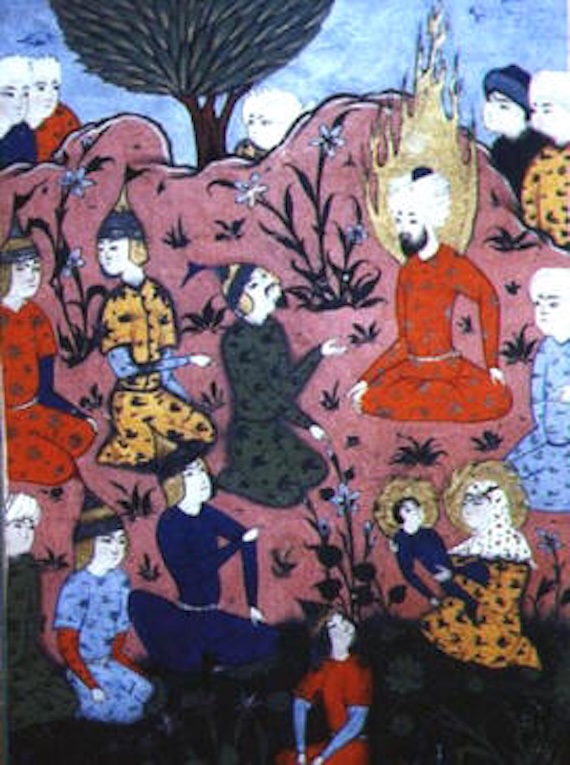
“Jesus giving the Sermon on the Mount.” Persian miniature in a Russian collection. n.d. Public Domain. Via Wikimedia Commons .
And here is a celebratory poem attributed to Omar Khayym about people having a good time when winter ends and they can party in the wilderness, which invokes both Jesus and Moses
اکنونکه جهانرا بخوشی دسترسیست
هر زنده دلی را سوی صحرا هوسیست
بر هر شاخی طلوع موسی دستیست
در هر قفسی خروش عیسی نفسیست
Now that the world verges on being happy,
the high-spirited plan to make merry outside.
Each branch is putting out shoots as white as the hand of Moses,
and every breeze wafts the life-giving breath of Jesus.
(This is from my translation of the Rubáiyát of Omar Khayyam, available at: Bloomsbury (IB Tauris) or Barnes and Noble or for $16 at Amazon Kindle)
We could look at it another way, that these Muslim poets lived in a sacralized world, with the prophets and saints as an everyday matter, and so worked references to them even into secular love poetry. They were in this way ever-present, and not figures only thought about on holy days like Easter and Christmas.

 © 2026 All Rights Reserved