
Ibrahim al-Marashi and Tanya Goudsouzian
( The New Arab ) – Dystopian images emerged from Iran in mid-January: families searching body bags for loved ones, smoke-choked streets and unverified footage of unarmed guards beaten or protesters cut down. On January 17, US President Donald Trump seized on the moment, publicly calling for an end to Ayatollah Ali Khamenei’s 37-year reign.
“It’s time to look for new leadership in Iran,” Trump told POLITICO, even as reports suggested that widespread protests were already losing momentum.
The same day, Iran’s supreme leader fired back. “We find the U.S. President guilty due to the casualties, damages and slander he inflicted upon the Iranian nation,” Khamenei wrote on social media, casting the unrest as yet another chapter in foreign aggression. Then, just one day later, Trump abruptly changed course, saying he had been informed that the killings had stopped.
The whiplash between escalation and retreat exacerbated an already pervasive confusion. Facts blurred into rumor and truth dissolved into competing narratives, as misinformation and AI-fueled disinformation once again merge with lived reality, just six months after Israeli airstrikes on Iranian nuclear and military sites killed and injured scores of civilians.
Social media statements from Trump urging Iranians to keep protesting, with promises that “HELP IS ON THE WAY,” fed the maelstrom. Yet beneath the fog of images and counterclaims, the unrest signaled an unmistakable fracture in the Islamic Republic’s claim to legitimacy, unfolding alongside an intensifying scramble for power.
Clerical factions, the IRGC, reformists, monarchists, ethnic movements including Azeris, Kurds and Balochis, along with exile groups and foreign powers, are positioning themselves for a future that no longer feels hypothetical. What happens when a system built on moral authority begins to lose its hold?
Plato’s “Republic” offers a lens for this moment, and a warning about how such systems unravel.
Was The Republic ever meant to exist beyond the page? Many scholars argue it was not a political blueprint but a philosophical thought experiment, designed to expose the limits of human nature. Plato never described his ideal republic emerging from revolutionary chaos, violence, fear and improvisation. Nor did he imagine philosopher-kings ruling under constant existential threat, or in an interconnected world where information flows instantly, AI-generated falsehoods distort reality, the son of an exiled king claims his calls for mass rebellion are being heeded, and foreign leaders issue regime-change rhetoric one day only to walk it back the next.
Implicit in Plato’s work is a core skepticism: absolute wisdom cannot coexist with absolute power. Revolutionary regimes from Lenin’s Soviet Union to Mao’s China to Khomeini’s Iran have pursued moral or ideological utopias, only to find that survival requires force, and ideals, once weaponised, become tools of domination.
Ayatollah Ruhollah Khomeini’s revolution was as one of the 20th century’s last great attempts to turn moral theory into political reality. Khomeini sought to fuse moral authority, revolutionary legitimacy and state power into a single governing principle.
As Iran scholar Vali Nasr noted, the very concept of clerical rule in the Islamic Republic drew heavily on Plato’s “Republic”, particularly its vision of a “specially educated guardian class led by a philosopher king”. This experiment, however, collided almost immediately with history. The new Islamic Republic was plunged into the longest conventional war of the century, subjected to economic isolation and forced to navigate Cold War geopolitics by playing Washington and Moscow against one another.
Scholars have pointed to “the vast gulf between Khomeini’s pre-revolutionary statements and his actions once in control of Iran”. Promises of liberty and an end to repression gave way, after consolidation, to the systematic rejection of democratic practices as incompatible with the regime’s ideological vision. In such conditions, there was no room for a philosopher-king ruling by wisdom alone. Survival demanded Machiavellian calculation; that is, strategic ruthlessness, institutional consolidation and coercion.
Plato’s philosopher-king was imagined for a world that rarely exists: a stable, insulated city-state, free from existential threats and able to let wisdom guide governance. The Islamic Republic inherited no such conditions. From the start, Iran’s leadership operated in a state of permanent emergency, defined by war, isolation and relentless regional hostility.
Under these pressures, religion ceased to function primarily as moral philosophy and instead became political glue, binding society in the face of danger. Authority depended on guarding sovereignty, enforcing cohesion and deterring enemies. In Platonic terms, this was the decisive turn, when wisdom yielded to power, marking the first step in a republic’s inevitable decay.
In 1989, Supreme Leader Ali Khamenei assumed control of a securitised revolutionary state forged by years of conflict and isolation, hardly a Platonic republic of wisdom. By then, the critical Platonic turning point had already passed. The guardians no longer ruled by reason; they relied on force.
Once defenders of revolutionary ideals, the Islamic Revolutionary Guard Corps (IRGC) had become enforcers of regime survival, with ideology serving secular power politics. Today, Iran resembles the later stages of Plato’s cycle, i.e. timocracy or oligarchy, where honor, loyalty and power eclipse the aristocracy of wisdom.
Plato argued that unrest arises when rulers lose touch with the society they govern. Iran’s protests reflect this disillusionment. Many demonstrators do not reject the Islamic Republic’s founding ideals, but its persistent failure to live up to them. This crisis is quintessentially Platonic: the ruling class still claims moral authority, yet the public no longer recognises it.
When outside actors alternately encourage revolt, this gap between rulers and ruled widens further, breeding cynicism. The erosion of this social contract threatens the regime’s survival and signals the decay that Plato warned would befall republics built on moral foundations that cannot be sustained in practice.
Plato also warned that in the republic’s final stages, opportunists rush to fill the power vacuum left by fading moral authority. Iran illustrates this vividly. Internally, IRGC factions, clerical elites, reformists and ethnic movements are jostling for influence. Externally, regional rivals, global powers and diaspora-backed groups maneuver to exploit any potential collapse.
Yet, as Bobby Ghosh put it, when authoritarian regimes are decapitated, “the guys with guns take over.” In Iran, the most organised and armed force is not the protesters or democratic movements. It is the IRGC, with roughly 190,000 personnel across all branches.
Once moral legitimacy crumbles, power becomes the primary currency, driven by survival and ambition. Such moments seldom bring freedom or justice. Instead, they produce consolidation, where authority is justified by the necessity of order and control.
Plato’s final warning? The fate of a decaying republic is not chaos, but tyranny. He outlined three paths: genuine reform, managed stagnation or authoritarian consolidation. Iran appears to be moving steadily toward the third, a predictable outcome of entwined ideology and absolute power, and regardless of whether foreign leaders signal encouragement or condemnation.
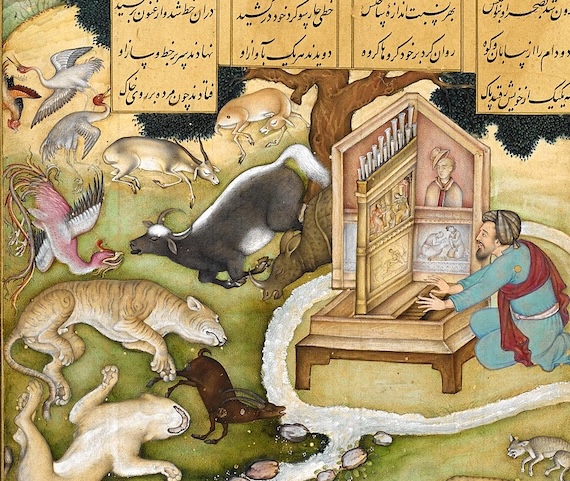
Detail of Madhu Khanazad (attr.) Plato charming the wild animals with music, Khamsa of Nizami, Mughal, 1595 -6, f.208, British Library. Public Domain. Via Wikimedia Commons
Iran may not disprove Plato’s skepticism. The philosopher-king was never meant to navigate the messy realities of power. Attempts to fuse utopia, ideology and unchecked authority inevitably replace wisdom with force. Iran’s tragedy is not a moral failure but a philosophical impossibility. Plato’s enduring lesson is that the most dangerous states are those convinced that virtue can govern without limits—even when those convinced include the world’s self-proclaimed exemplars of freedom and democracy.
Reprinted from The New Arab with the authors’ permission.
Ibrahim al-Marashi is associate professor of Middle East history, visiting faculty at The American College of the Mediterranean, and the Department of International Relations at Central European University. His publications include Iraq’s Armed Forces: An Analytical History (2008), The Modern History of Iraq (2017), and A Concise History of the Middle East (2024).
Tanya Goudsouzian is a Canadian journalist who has covered Afghanistan and the Middle East for over two decades. She has held senior editorial roles at major international media outlets, including serving as Opinion Editor at Al Jazeera English.


 © 2026 All Rights Reserved
_Plato_charming_the_wild_animals_with_music,_Khamsa_of_Nizami,_Mughal,_1595_-6,_f.208,_British_Library.jpg)