
Ann Arbor (Informed Comment) – Israeli military forces made a raid into Syria on Friday that from what I can gather turned into a disaster for them. Israeli troops mounted an assault on the hamlet of Beit Jinn southeast of Damascus, where they maintained that three members of the Lebanon-based Islamic Group (al-Jama`ah al-Islamiyyah) constituted a danger to Israel.
After the Israeli troops and troop carriers came into the small town, they came under heavy fire and six servicemen and officers were wounded, three seriously. The Israelis then bombarded the village with artillery and called in air strikes on it, killing 13 Syrian townspeople and wounding 24. Syria’s foreign minister denounced the Israeli killing of innocent women and children after, he said, the town predictably put up resistance to being invaded.
He has a point. If a foreign country sent troops into a small town in Alabama or Kentucky to kidnap some Americans it felt were hostile to it, I can only imagine they would take heavy shotgun fire to say the least.
The Israelis say they succeeded in kidnapping two Islamic Group members. It isn’t clear to me whether the Lebanese Islamic Group party had established a constituency among Syrian Sunnis near the border with Lebanon, so that they were local Syrians, or whether the Dawn paramilitary had sent over Lebanese cadres to Beit Jinn.
Lebanon’s Islamic Group is a small Sunni fundamentalist party based mainly in Tripoli and Beirut. Its origins go back to an organization called Servants of the All-Merciful active in the 1950s and early 1960s. The Islamic Group has a civil wing as a political party and participates in Lebanese civil life and politics, even getting a representative elected to the 130-member Lebanese parliament.
Although it is typically characterized by Israeli, European and American reporters as an offshoot of the Egyptian Muslim Brotherhood, I do not believe that is an accurate characterization. It was heavily influenced by the Brotherhood’s pamphleteers, but it never had a reporting line back to Cairo and was always a tub on its own bottom. Its actual origins go back to Sunni Muslim organizing and reformist thinking in 20th century Lebanon. That is, it is local.

Or by check:
Juan Cole
P. O. Box 4218,
Ann Arbor, MI 48104-2548
USA
(Remember, make the checks out to “Juan Cole” or they can’t be cashed)
Moreover, the Egyptian Muslim Brotherhood formally gave up political violence in the early 1970s when President Anwar El Sadat let its leadership out of jail and allied with them against the Arab left cultivated by his predecessor, Gamal Abdel Nasser. The Lebanese Islamic Group has a small militia, called Dawn. Presumably the Israelis were targeting Dawn commandos who oppose the Israeli genocide in Gaza and have sympathies with Hamas, also a Sunni fundamentalist organization.
The Konrad Adenauer Stiftung and the Center for Lebanese Studies published an interesting paper by scholars Nader Ahmad and Nada Al Maghlouth in 2016 on the possibilities of Lebanese political and administrative reform, in which they surveyed the country’s political parties. Here is some of what they say about the small Islamic Group:
“The study reveals that the majority of political parties’ internal administrations and control agencies, with the exception of Al-jama’ah, can be described as highly centralised and dependent on the authority and vision of the president and his often appointed executive board.”
That is, the Islamic Group is the most internally democratic of the Lebanese political parties. The authors add, “perhaps due to its religious character and the absence of a national political founder, Al-jama’ah appeared to be more democratic compared to other political parties when it comes to their internal administration as well as human resources management. A higher value was placed on abstract rules and regulations when it comes to their organisational behavior within the administrative configurations of the party, and which to a large extent reflected the party’s dedication to work with parliamentary committees on administrative development.”
They found Lebanese political parties opaque and unwilling to share their internal thinking on electoral strategy and reform, with the exception of the Islamic Group, which was open and transparent. It was one of a handful of parties that sought decentralization of Lebanese politics as a key reform. Both the right wing Phalangist Party, which had been modeled on Spanish and Italian fascism and which appeals to a minority of Lebanese Christians, and the right wing Sunni Muslim fundamentalist Islamic Group saw decentralization “as an opportunity to achieve a higher level of administrative accountability and equal development by freeing administrative decision-making from the influence of the Council of Ministers as well as its Secretary General and will circumvent the need for sectarian quotas on administrative posts.”
Never miss an issue of Informed Comment: Click here to subscribe to our email newsletter! Social media will pretend to let you subscribe but then use algorithms to suppress the postings and show you their ads instead. And please, if you see an essay you like, paste it into an email and share with friends.
The Islamic Group “also promoted administrative decentralization as a means to facilitate accountability. According to Al-jama’ah, when local affairs are administered by an elected local body, through the Municipal Council or otherwise, these people can be held accountable by those who elected them . . . They also argued that centralized decision-making facilitates unequal development – particularly in instances when particular ministers are biased towards their regions. Decentralization means that each region can develop itself independently as per a shared centralized mechanism . . .”
To some extent, they are promoting the interests of Sunni-majority Tripoli in the north of Lebanon, versus the central government in Beirut.
One reads in the secondary literature that the Islamic Group wants to impose Sunni canon law on all Lebanon, and they are being called “militants.” But it isn’t what the party told these researchers. The Islamic Group “argued that the biggest barrier to reform is sectarian politics. They asserted that religions in Lebanon are meant to enrich it and not to create barriers in communication between the Lebanese people, and they believe that the problem lies in using those religions for political ends. They also argued that sectarian politics is more similar to feudalism than it it to sectarian representation. Under the banner of sectarian representation, sectarian leaders transform into feudal lords who ‘realistically end up neglecting their sects” . . . [they] claimed that this is why their main focus is creating the largest possible dialogue between the Lebanese people to reach the abolishment of the sectarian system.”
Finally, the party’s internal governance appears to be among the more democratic of any political party in the Middle East: “Elections are held for most of the positions in the party, so each sector concerned elects its own representative, whether at the administrative level – at the level of regional offices . . . There are two types of positions in the party, the first, which is larger and voluntary, is not compensated. The second type of position is filled by full-time members, and Al-jama’ah relies on an employment system involving job descriptions and specifications based on which members are employed to particular positions. High-ranking executive members are all volunteers and are elected.”
The Islamic Group isn’t well studied, but I found these few research findings from a decade ago interesting because they contradict the glib image purveyed in the Western press about them. None of this is to say that the party’s paramilitary wing consists of nice guys or that they have been uninvolved in planning violence toward Israel. But then Christian fundamentalists in the US Republican Party have been planning violence on other countries for decades.
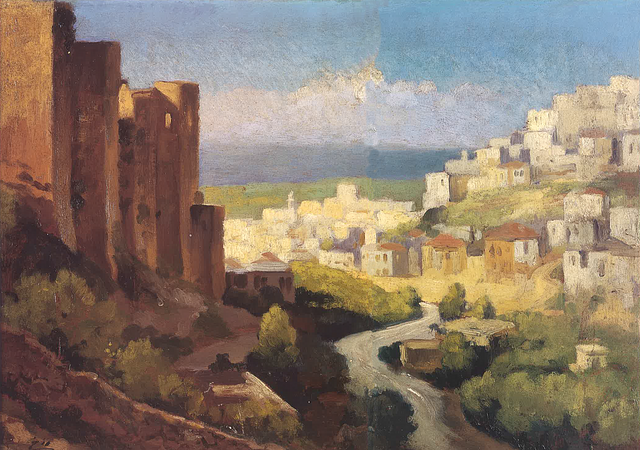
Painting of Tripoli, Lebanon. Via Picryl. Public Domain.
Israeli military forces have been attacking Syria since last December’s Muslim fundamentalist revolution, attempting to degrade the country’s military capacities by bombing naval vessels, port facilities, and military bases. This constant barrage of Israeli bombings has been pursued even though the new government in Damascus has been recognized by the United States and says it wants correct relations with Israel. That is, Israeli attacks on Syria are not a response to a clear and immediate danger emanating from that country but are an opportunistic attempt to weaken a neighbor so as to dominate it geopolitically.
The attack on Beit Jinn, however, was the largest Israeli troop incursion of the past year.
The Israelis have also taken on the old role of the British Empire in the 19th century, which declared itself the protector of the Druze and Jewish minorities in the Middle East as a way of interfering in the domestic affairs of the Ottoman Empire. Thus, Israeli forces invaded southern Syria, ostensibly to protect Druze villages from ascendant Sunni fundamentalist militias. Since Israel’s own small Druze minority serves in the Israeli military and saw action in Gaza against Hamas, Prime Minister Benjamin Netanyahu’s incursion on behalf of the Druze played well in Israeli domestic politics.

 © 2026 All Rights Reserved