
Ann Arbor (Informed Comment) – Earlier this month, Jonathan Crickx, the State of Palestine Chief of Communication for UNICEF (the UN International Children’s Emergency Fund), revealed that his agency “estimates that at least 17,000 children in the Gaza Strip are unaccompanied or separated. Each one, a heartbreaking story of loss and grief. This corresponds to 1% of the overall displaced population – 1.7 million people.”
These 17,000 children are alone and on their own. An estimated 39,000 children have lost one or both parents to Israeli bombardment, but about half of them have been taken in by relatives or strangers. Al Jazeera calls it the world’s largest orphan crisis, proportionally.
The reason Gaza has this monstrous number of orphans is that the Israeli government killed their parents, including their mothers. The majority of the more than 70,000 people the Israeli air force and army have killed in Gaza are innocent civilians, often evaporated by one ton bombs dropped on inhabited family apartment buildings with no military purpose.
Crickx said at a press conference in Geneva, “In a center where unaccompanied children are hosted and cared for, I also saw two very young children aged 6 and 4. They are cousins and their entire respective families were killed in the first half of December. The four year old girl – in particular – is still very much in shock.”
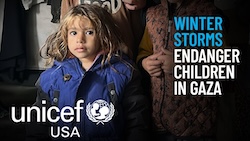
Donate to UNICEF’s Gaza work by clicking here.
One of the children UNICEF worked with wrote this poem (translated from Arabic):
- I am a child from Gaza, dreaming of tomorrow,
After nights of darkness and bitter pain
I dream of a home where fear has no place,
Of my mother’s voice, of the children’s laughter
I dream of my school, my notebook, and my poems,
Of a toy that thunder cannot snatch away
I am tired of a war that has stolen my innocence
And taken my little dreams away
Tell the world: Here is a child with hope,
And with dreams that grow, despite cruelty and despair.
Alaa Ziad Kashta
Never miss an issue of Informed Comment: Click here to subscribe to our email newsletter! Social media will pretend to let you subscribe but then use algorithms to suppress the postings and show you their ads instead. And please, if you see an essay you like, paste it into an email and share with friends via a newsletter or cc list. Please link back to the Informed Comment site.
I looked around and discovered that Slovenia, which has a population similar to that of Gaza, has 769 children in foster care. While another 547 are in residential care because of emotional or behavioral disorders, and more orphans may be with uncles and aunts or other relatives, it seems clear that there are only a couple thousand orphans in the country of 2.13 million people. Slovenia used to be part of Yugoslavia, and is the birthplace of Melania Trump.
Or, take Croatia, which has a little less than twice Gaza’s population. It has 4,000 orphans. That would be like Gaza having 2,279 orphans, given the difference in population.
But Gaza has about 7 1/2 times as many orphans as we might expect from these comparisons. That is horrific.
Unlike the orphans in Slovenia or Croatia, moreover, many of these Palestinian children are not in residential or foster care. They are wandering amid rubble and flooded dirt paths in the cold rainy winter trying to find food.
Crickx explained, “Of 12 children I met or interviewed, more than half of them had lost a family member in this war. Three had lost a parent, of which, two had lost both their mother and their father. Behind each of these statistics is a child who is coming to terms with this horrible new reality.
“11 year old Razan was with her family in her uncle’s house when it was bombed in the first weeks of the war. She lost almost all her family members. Her mother, father, brother, and two sisters were killed. Razan’s leg was also injured and had to be amputated. Following the surgery, her wound got infected. Razan is now being taken care of by her aunt and uncle, all of whom have been displaced to Rafah.”
Razan isn’t even among the 17,000 unaccompanied orphans, since despite her horror story she at least is living with an aunt and uncle — who are themselves internally displaced refugees without resources.
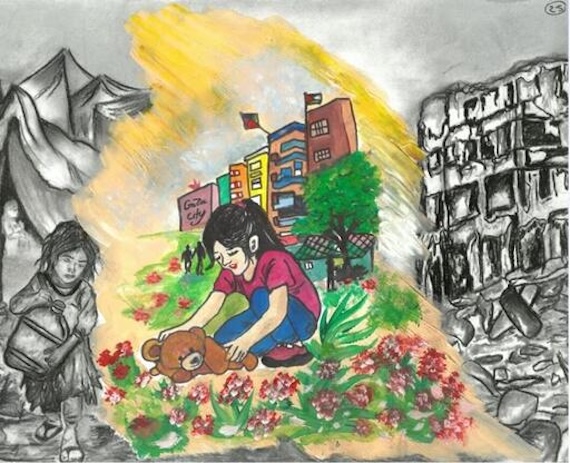
Palestinian child’s art. “The Gaza We Want” UNICEF . Permissions are granted for one-time use in a context that accurately represents the real situation and identity of all human beings depicted. UNICEF multimedia assets are documents of real people and situations.
Just this week, Crickx spoke of UNICEF’s “The Gaza We Want” program, where they asked Palestinian children about their own desires for the future of the Strip. It reminded me that President Donald Trump’s so-called “Board of Peace” for Gaza doesn’t have a single Palestinian voice in it.
Crickx said, “Three weeks ago in the Gaza Strip, I met Hala, a 15-year-old girl in a UNICEF Temporary Learning Centre in Deir El Balah. She told me:
- “missing school affected my learning a lot. Education matters for my future, so I dream of a safe life—having a secure home, my own room, and a good school where I can learn and grow.”
“In one sentence, Hala summarized what I heard so many times in Gaza: children want a proper home, they want safety, and they want to be back on school benches. And all decision makers should hear their call and consider it the utmost priority. These are not extraordinary demands. They are the fundamentals of childhood.”
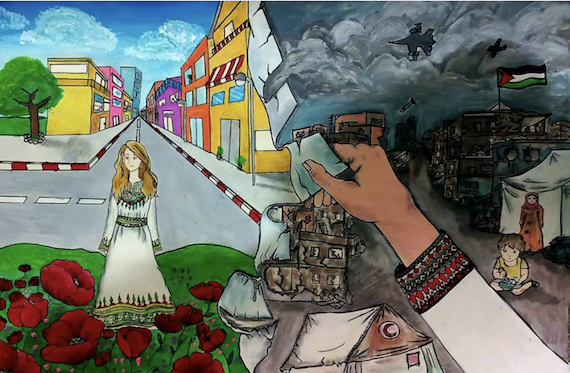
Palestinian child’s art. “The Gaza We Want” UNICEF . Permissions are granted for one-time use in a context that accurately represents the real situation and identity of all human beings depicted. UNICEF multimedia assets are documents of real people and situations.
He added, “I also want to share the voice of 14-year-old Mayar. During the Gaza We Want discussions, she told us,
- “Life has been so difficult, no child should ever have to live through this. The Gaza I want is a beautiful place with hospitals, schools, and safe buildings. I was injured in the war and it affected me a lot. Whenever I hear an airstrike, I get scared. But during the Gaza We Want activity, I felt so much better in my head.”

 © 2026 All Rights Reserved