
Ann Arbor (Informed Comment) – The World Meteorological Organization has issued its annual report on the 22 countries of the Arab world, covering last year, and presents alarming conclusions about human-driven climate change in that region.
2024 was the hottest year on record in the Middle East, around 1º Celsius (1.8º F.) hotter than the average for 1990-2020, which was already on the hot side. Since the previous 122,000 years have been cool, the hottest year on record probably means the hottest year in 122,000 years.
The rate at which heating is increasing, moreover, has doubled in recent years compared to the rate observed 1961-1990. The rate of heating in the Arab world 1990-2024 was 0.4º C. per year, which is twice the global average of 0.2º C. The Levant and the Arabian Peninsula saw the fastest heating.
These findings are especially alarming, since parts of the Middle East are already hitting 50º C. (122º F.). Where, as in some regions along the Persian Gulf littoral, humidity rises to 80%, that combination of high temperatures and humidity produces a combined “wet bulb” temperature that is fatal to human beings, who need to sweat and have the sweat evaporate from their skin in order to keep cool. The brain is especially vulnerable to high temperatures.
Over the past 40 years, the duration of heatwaves has increased. They last longer than they did before 1980.

Or by check:
Juan Cole
P. O. Box 4218,
Ann Arbor, MI 48104-2548
USA
(Remember, make the checks out to “Juan Cole” or they can’t be cashed)
North Africa has not only seen heatwaves extend, it has experienced a prolonged drought, with six rainy seasons having passed without significant rainfall, affecting Tunisia, Algeria and Morocco.
The report says,
- “In the Maghreb, wheat yields were well below average due to prolonged seasonal drought. In Iraq, approximately half of households in Anbar, Kirkuk, Ninewa, and Salahaddin governorates reduced either the area under cultivation or their irrigation water use due to drought during the 2024 season.”
In contrast, in 2024 Sudan and parts of the Arabian Peninsula have experienced rains that were 100% to 150% above normal. The report’s authors observe:
- “In the Near East, several major flood events occurred in early 2024, primarily affecting Iraq and Syria. On 17 January, nearly 10,000 people were affected by flooding in northwest Syria. In Iraq, flash floods on 18 February resulted in three deaths and affected approximately 18,000 people. In northern Lebanon, extreme precipitation in January led to widespread flooding, affecting over 10,000 people, submerging 3,000 houses, and destroying 8,000 hectares [19,768 hectares] of agricultural land.”
Across the Arabian Peninsula, major flood events occurred in the United Arab Emirates (UAE), Oman, Yemen, and parts of Saudi Arabia.
Never miss an issue of Informed Comment: Click here to subscribe to our email newsletter! Social media will pretend to let you subscribe but then use algorithms to suppress the postings and show you their ads instead. And please, if you see an essay you like, paste it into an email and share with friends.
Sea level rise is also unevenly distributed around the world’s coasts. On the Red Sea littoral the water is rising 4.1 millimeters [0.16 inches] a year.
Extreme weather events such as floods and heatwaves killed over 300 people last year and had a negative impact on 3.7 million people in this region of some 500 million people, or 0.7%.
These events included 22 floods, 6 of them flash floods.
Extreme weather events also included 5 multi-country heatwaves. Heatwaves especially harmed Syria, Iraq, Jordan, Egypt, Libya, and eastern Algeria, not to mention southern Sudan.
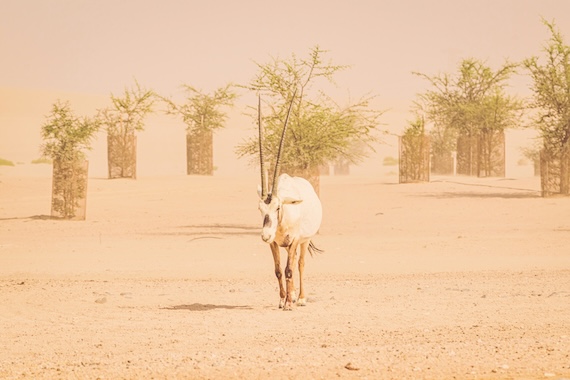
Photo of oryx in Saudi Arabia by Stanislav Ferrao on Unsplash
They note, “The frequency and severity of extreme weather and climate events have increased significantly, with an 83% rise in recorded disasters between 1980–1999 and 2000–2019.” (Emphasis added.)
These climate disasters destroyed needed infrastructure and interfered with supply chains. They also caused other countries and organizations to reduce their Direct Foreign Investments in the areas affected, which will slow economic development.
The report paints a picture of an Arab world becoming increasingly fragile as human-driven climate change accelerates twice as fast in this region as the global average.

 © 2026 All Rights Reserved