
By Joan Taylor, King’s College London
(The Conversation) – Every year, millions of people sing the beautiful carol Silent Night, with its line “all is calm, all is bright”.
We all know the Christmas story is one in which peace and joy are proclaimed, and this permeates our festivities, family gatherings and present-giving. Countless Christmas cards depict the Holy Family – starlit, in a quaint stable, nestled comfortably in a sleepy little village.
However, when I began to research my book on the childhood of Jesus, Boy Jesus: Growing up Judaean in Turbulent Times, that carol started to sound jarringly wrong in terms of his family’s actual circumstances at the time he was born.
The Gospel stories themselves tell of dislocation and danger. For example, a “manger” was, in fact, a foul-smelling feeding trough for donkeys. A newborn baby laid in one is a profound sign given to the shepherds, who were guarding their flocks at night from dangerous wild animals (Luke 2:12).
When these stories are unpacked for their core elements and placed in a wider historical context, the dangers become even more glaring.
Take King Herod, for example. He enters the scene in the nativity stories without any introduction at all, and readers are supposed to know he was bad news. But Herod was appointed by the Romans as their trusted client ruler of the province of Judaea. He stayed long in his post because he was – in Roman terms – doing a reasonable job.
Jesus’ family claimed to be of the lineage of Judaean kings, descended from David and expected to bring forth a future ruler. The Gospel of Matthew begins with Jesus’ entire genealogy, it was that important to his identity.
But a few years before Jesus’ birth, Herod had violated the tomb of David and looted it. How did that affect the family and the stories they would tell Jesus? How did they feel about the Romans?
A time of fear and revolt
As for Herod’s attitude to Bethlehem, remembered as David’s home, things get yet more dangerous and complex.
When Herod was first appointed, he was evicted by a rival ruler supported by the Parthians (Rome’s enemy) who was loved by many local people. Herod was attacked by those people just near Bethlehem.
He and his forces fought back and massacred the attackers. When Rome vanquished the rival and brought Herod back, he built a memorial to his victorious massacre on a nearby site he called Herodium, overlooking Bethlehem. How did that make the local people feel?

Matson Collection via Wikimedia Commons
And far from being a sleepy village, Bethlehem was so significant as a town that a major aqueduct construction brought water to its centre. Fearing Herod, Jesus’ family fled from their home there, but they were on the wrong side of Rome from the start.
They were not alone in their fears or their attitude to the colonisers. The events that unfolded, as told by the first-century historian Josephus, show a nation in open revolt against Rome shortly after Jesus was born.
When Herod died, thousands of people took over the Jerusalem temple and demanded liberation. Herod’s son Archelaus massacred them. A number of Judaean revolutionary would-be kings and rulers seized control of parts of the country, including Galilee.
It was at this time, in the Gospel of Matthew, that Joseph brought his family back from refuge in Egypt – to this independent Galilee and a village there, Nazareth.
But independence in Galilee didn’t last long. Roman forces, under the general Varus, marched down from Syria with allied forces, destroyed the nearby city of Sepphoris, torched countless villages and crucified huge numbers of Judaean rebels, eventually putting down the revolts.
Archelaus – once he was installed officially as ruler – followed this up with a continuing reign of terror.
A nativity story for today
As a historian, I’d like to see a film that shows Jesus and his family embedded in this chaotic, unstable and traumatic social world, in a nation under Roman rule.
Instead, viewers have now been offered The Carpenter’s Son, a film starring Nicholas Cage. It’s partly inspired by an apocryphal (not biblical) text named the Paidika Iesou – the Childhood of Jesus – later called The Infancy Gospel of Thomas.
You might think the Paidika would be something like an ancient version of the hit TV show Smallville from the 2000s, which followed the boy Clark Kent before he became Superman.
But no, rather than being about Jesus grappling with his amazing powers and destiny, it is a short and quite disturbing piece of literature made up of bits and pieces, assembled more than 100 years after the life of Jesus.
The Paidika presents the young Jesus as a kind of demigod no one should mess with, including his playmates and teachers. It was very popular with non-Jewish, pagan-turned-Christian audiences who sat in an uneasy place within wider society.
The miracle-working Jesus zaps all his enemies – and even innocents. At one point, a child runs into Jesus and hurts his shoulder, so Jesus strikes him dead. Joseph says to Mary, “Do not let him out of the house so that those who make him angry may not die.”
Such stories rest on a problematic idea that one must never kindle a god’s wrath. And this young Jesus shows instant, deadly wrath. He also lacks much of a moral compass.
But this text also rests on the idea that Jesus’ boyhood actions against his playmates and teachers were justified because they were “the Jews”. “A Jew” turns up as an accuser just a few lines in. There should be a content warning.
The nativity scene from The Carpenter’s Son is certainly not peaceful. There is a lot of screaming and horrific images of Roman soldiers throwing babies into a fire. But, like so many films, the violence is somehow just evil and arbitrary, not really about Judaea and Rome.
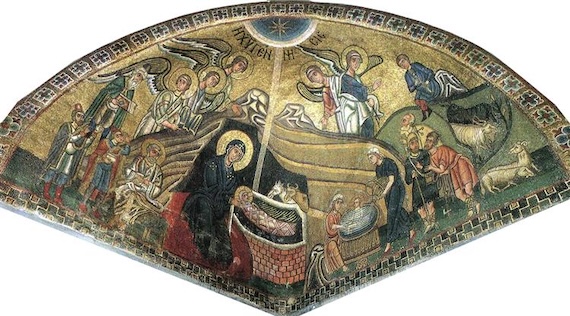
Name:Series Hosios Loukas Monastery Distomo Greece. Type: Masonry. Public Domain. Via WikiArt
It is surely the contextual, bigger story of the nativity and Jesus’ childhood that is so relevant today, in our times of fracturing and “othering”, where so many feel under the thumb of the unyielding powers of this world.
In fact, some churches in the United States are now reflecting this contemporary relevance as they adapt nativity scenes to depict ICE detentions and deportations of immigrants and refugees.
In many ways, the real nativity is indeed not a simple one of peace and joy, but rather one of struggle – and yet mystifying hope.
Joan Taylor, Professor Emerita of Christian Origins and Second Temple Judaism, King’s College London
This article is republished from The Conversation under a Creative Commons license. Read the original article.

 © 2026 All Rights Reserved