
Ann Arbor (Informed Comment) – The Trump administration’s strike on Sokoto State in the far northwest of Nigeria had no legal basis in U.S. law. The United States is not at war with Nigeria, and Congress hasn’t authorized any such actions, as is required by Article I, Section 8, Clause 11 of the US Constitution and the 1973 War Powers Resolution.
Ironically, the strike was fully supported by the Muslim president of Nigeria, President Bola Ahmed Tinubu, and coordinated with the federal military. Nigeria’s Daily Post is more positive about the operation than most US newspapers. It says that US naval vessels in the Gulf of Guinea launched 16 guided MQ-9 Reaper missiles at “two major Islamic State ISIS terrorist enclaves located within the Bauni Forest axis of Tangaza Local Government Area, Sokoto State.”
So Trump’s attempt to configure the action as a Christian strike in defense of Christians (for his Evangelical base) is a stretch. He seems actually to have worked hand in glove with Tinibu and the Nigerian Muslim elite to hit a mutual problem. Although parts of Nigeria, especially the northeast, are poor and conflict-ridden, there is no evidence that Christians suffer worse from this violence than Muslims — people from both communities have been kidnapped, brutalized, and killed by forces such as Boko Haram.
The increasing dryness in the Sahel region because of human-driven climate breakdown is at the root of some of the accelerated competition for resources that produces this violence.
The group that was struck at only actually has tenuous links to ISIL, the so-called Islamic State group. It is likely Lakurawa , who are part of a northwestern Nigerian Pied Piper of Hamlet story. I’ll explain below.
It is not clear whether some missiles went astray or what, but it wasn’t only the Bauni Forest area that received fire. Some rockets landed in the fields of farmers outside the town of Jabo, which confused them no end since they don’t have a history of ISIL presence, according to interviews done by Nimi Princewell at CNN.
Help us reach our goal — only one week left. $150 donation gets a signed copy of Juan Cole’s “Gaza Yet Stands.

Or by check:
Juan Cole
P. O. Box 4218,
Ann Arbor, MI 48104-2548
USA
(Remember, make the checks out to “Juan Cole” or they can’t be cashed)
In any case, you can’t actually fight a pastoral group like the Lakurawa by raining missiles down on them. They will run away from a conventional army ground attack, but you can’t reliably hit them from the air. The US in the late 1990s used to try things like that against al-Qaeda in Afghanistan, which was so little effective that al-Qaeda went on to stage the 9/11 attacks. If you see someone bombing guerrilla groups, you should understand that it is just for show, not for military victory.
Sokoto is savannah, and has marginal land that can be used to pasture livestock, because occasional rains cause pasturage to pop up even though there isn’t enough rain in those areas to farm consistently. Pastoralists wander around with their cattle, sheep and goats in search of that pasturage, and they don’t pay any attention to national borders, Lakurawa was founded in 2010 by herdsmen from Mali and Niger who wandered into Nigeria’s Sokoto State, which is dominated by Hausa Muslims with a minority of Fulani. Pastoralists carry rifles and can hunt wild game from horseback, so they are a natural cavalry.
Settled farmers in Sokoto are occasionally raided by pastoralists or “nomads.” They also trade with each other, since farmers need dairy and meat products and pastoralists need grain. But sometimes the armed pastoralists decide to raid rather than trade. Some farming groups in 2017 hired the Lakurawa to fight off other pastoralists for them, which they did.
But as in the tale of the Pied Piper of Hamelin, if you bring in someone to get rid of the rats, you had better pay them well, because otherwise they will come back for your children.
Never miss an issue of Informed Comment: Click here to subscribe to our email newsletter! Social media will pretend to let you subscribe but then use algorithms to suppress the postings and show you their ads instead. And please, if you see an essay you like, paste it into an email and share with friends.
The Lakurawa, having chased off other pastoralists, saw an opportunity to dominate an area of Sokoto, taxing the farmers and regimenting them with what they represented as “shariah law.” Despite the fetish among the American Right about shariah, it just means the practice of Muslim law, which has many interpretations. It is akin to Jewish halakha or Roman Catholic canon law (though far less institutionalized). It forbids murder, theft, adultery, etc. There is a rigid and authoritarian version favored until recently in Saudi Arabia, but there are also more flexible approaches like that of the Hanafis (who in Turkey permit beer drinking). The Lakurawa adopted a Salafi, Saudi-inspired approach, much harsher than what the Muslim farmers of Sokoto were used to.
So then in 2022 the farmers called in the Nigerian army to get rid of Lakurawa, who were chased back over the border into Niger.
In 2024 some of them began trickling back in, apparently to that Bauni Forest area, and terrorizing the farmers again.
Sokoto is 90% Muslim and 10% Christian. Lakurawa and other pastoralists have bothered farmers of both religions, but Ted Cruz only cares when he gets a report about a Christian village being raided. Characterizing the Lakurawa as ISIL is probably a stretch, but ISIL is after all just a franchise, so maybe some fighters have advertised themselves that way to seem like big men locally.
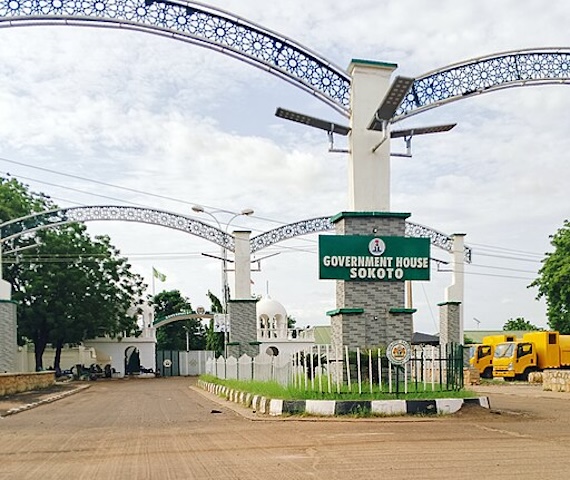
Government House, Sokoto. Public Domain. Wikimedia Commons.
Sokoto was the site of the modern Sokoto Caliphate in the nineteenth century, which was gradually subordinated to the British Empire.
Nigeria, a former British colony, is about 56% Muslim and 43% Christian according to the Pew Research Center. Among adults, Christians may be a slight majority, but Muslims have larger families, so if you count the children, the Muslims form a solid majority. Less than 1% still practice traditional Nigerian religion, worshiping the gods and goddesses that still survive in Brazil’s Candomblé hybrid of Catholicism and African spirituality.

 © 2026 All Rights Reserved