
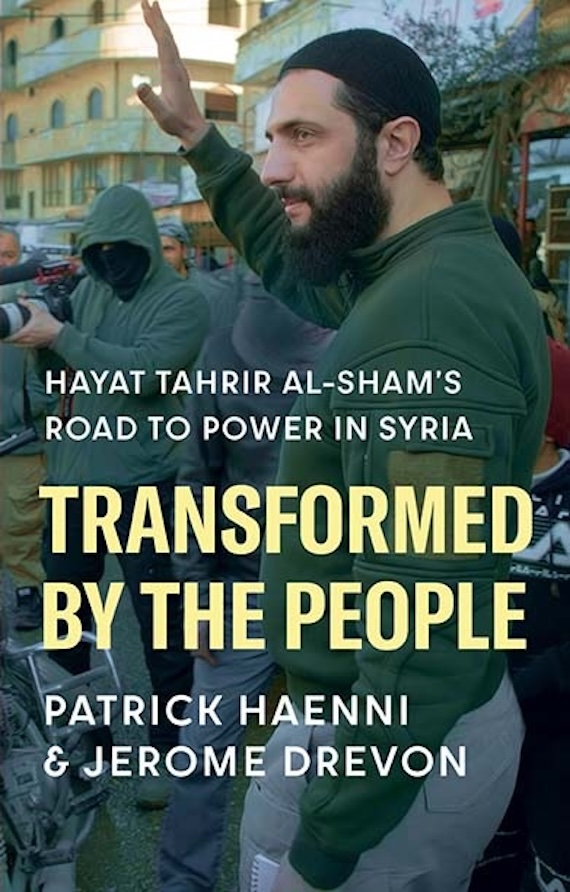
( Middle East Monitor ) – Ahmed Al-Sharaa has been in power in Syria for nearly 1-year. The lightening rebel offensive that brought down five decades of the dictatorial rule of the Assad family, was a shock to many. In Al-Sharaa, Syrian’s were greeted with a new kind of leader, but debates about Syria’s future continue to rage. For Patrick Haenni and Jerome Drevon, Al-Sharaa won’t turn Syria into a democracy, but Syria’s civil society might turn the Mediterranean country into one. Their new book Transformed By The People: Hayat Tahrir Al-Sham’s Road To Power In Syria tells the story of Hayat Tahrir Al-Sham or HTS and Ahmed Al-Sharaa’s rise to power. The research was years in the making and included interviews with Al-Sharaa himself, HTS members, diplomats and opponents of the group; it paints a fascinating picture of the evolution of the movement.
They argue HTS, which was founded in 2016, has undergone four key evolutions. The first is rejection of transnational Jihadism, opposing fighting the West and against imposing a version of Islamic law found in the ideologies of groups like Daesh. The second is rejecting Salafism altogether and reorientating their religious views to fit Syria’s cultural and religious landscape. Thirdly, they outmaneuvered other rebel groups by building alliances with civil society and broader populations at large. Fourthly, the rejection of global Jihadism allowed them to relocalise their politics to fit Syrian society.
The fighting of more extreme groups and moderating religious politics while believing in the values of the 2011 Arab Spring, the authors view HTS as akin to the Thermidorian Reaction against the Jacobin’s Reign of Terror regime in 18th century revolutionary France. What’s interesting about these transformative steps is that some of them emerged as pragmatic accommodations to situations unfolding. Overtime, these accommodations accumulated and changed into a deeper strategic transformation. However, while there is much talk of pragmatism or opportunism, the book cautions us against reducing our view to this, ‘an opportunist navigates tactically, shifting direction at will. HTS, however, did not simply adapt on a whim.’ The authors point out that despite HTS not issuing a formal doctrinal revision, their political trajectory has followed a very clear path and irreversibly so.
A core contention about HTS’s leader is that he is a former Daesh and Al-Qaeda commander, but Haenni and Drevon argue that this is not so straightforward. After the 2003 US-led invasion and occupation of Iraq, Ahmed Al-Sharaa travelled to Iraq to join a group that was a precursor to Daesh, known as the Islamic State in Iraq or ISI. Not long after arriving in Iraq in 2005, he was arrested and held in both Abu Ghraib and Bucca prisons, run by the Americans, for five years. The significance of this is that the extreme sectarian violence and mass killings carried out by ISI occurred after Al-Sharaa was jailed. While being motivated to fight the foreign occupying forces, Al-Sharaa’s views at the time didn’t totally align with ISI.
Al-Sharaa claims that at the time, he was motivated to fight the US invasion, but didn’t fully understand the ideology of ISI and was shocked to learn how extreme their views were. While this would be a convenient thing for him to say now, a letter sent by one of the main leaders of Daesh, Muhammad Al-Adnani, to the Al-Qaeda leadership in Afghanistan in 2011, adds credence to this claim. Al-Adnani was complaining about Al-Sharaa notably his opposition to key beliefs of the group. He was given permission to go back to Syria by ISI and form a new organisation Jabhat Al-Nusra. But soon after Al-Nusra’s establishment, complaints by Al-Qaeda about Al-Sharaa escalated, alleging that he was trying to sideline them.
Although breaking with ISIS in 2013 and Al-Qaeda in 2016 transformed Ahmed Al-Sharaa’s group and led to the creation of HTS, ultimately it was governance that changed the orientation of the group. After HTS came to dominate the Syrian province of Idlib in 2017, they built alliances with educated and conservative elites, ‘HTS’s dominance over its competitors paradoxically created space for this urban elite to operate, albeit under control.’ These elites included academics, activists, NGO workers and businessmen, all of whom helped build governmental institutions. ‘Businessmen were more interested in rebuilding order and security than driven by ideological affinities. They believed that unifying governance would improve security and limit factional intrusions in their work.’
Transformed By The People is an important intervention into ongoing debates about Syria’s future. It assesses the political trajectory HTS has been on and how changes have unfolded. Crucially, it also shows how susceptible the group can be to popular pressure and the role civil society can play in changing the direction of the group. Although HTS is formally disbanded, the group is the main source of governance in Syria today, alongside other factions, which makes this book an urgent read. It offers detailed, well-thought-out and nuanced analysis of HTS.
Usman Butt is a broadcast and digital journalist and researcher.
 Unless otherwise stated in the article above, this work by Middle East Monitor is licensed under a Creative Commons Attribution-NonCommercial-ShareAlike 4.0 International License.
 © 2026 All Rights Reserved