
Ann Arbor (Informed Comment) – Back in 2004, in an interview with one of our foremost journalists of the Middle East, Robin Wright, Jordan’s King Abdullah II complained as a Sunni Muslim monarch that he now saw a “Shiite Crescent” in the Middle East. The Bush administration’s overthrow of the Baath government of Saddam Hussein, which was secular but dominated by Sunni Arabs, was allowing the Iraqi Shiite majority to mobilize. King Abdullah also coded the secular Baath nationalist government of Syria under Bashar al-Assad as “Shiite” because the Alawite Shiite denomination dominated its upper reaches, though many Sunni Syrians also supported it, in Damascus and Aleppo. And Lebanon was then polarized between the Shiite Hezbollah and its Christian allies and the Sunni-led March 14 coalition, which was supported by most Christians and by the Druze community. The Iraqi Shiites, the Baath government of Syria, and Hezbollah all had Shiite Iranian backing. So King Abdullah was actually worried about the spread into the Arab world of the influence of the Islamic Republic of Iran; both elements, the Shiism and the republic, were scary to a Sunni monarch.
The Syrian elite was not actually “Shiite” in a religious sense, being devoted to secular nationalism, though it did ally with Iran for geopolitical reasons. And Lebanon has all along been multicultural. So it wasn’t much of a crescent and did not threaten Jordan in any obvious way. In fact, it was the hard-line Muslim fundamentalist movements that grew up among Sunni Iraqis, such as al-Qaeda in Mesopotamia and then the Islamic State of Iraq, that tried to blow up things in Jordan.
Help us reach our goal — only one week left. $150 donation gets a signed copy of Juan Cole’s “Gaza Yet Stands.
Or by check:
Juan Cole
P. O. Box 4218,
Ann Arbor, MI 48104-2548
USA
(Remember, make the checks out to “Juan Cole” or they can’t be cashed)
Then in 2014-2015 the Zaydi Shiite Houthi movement took over North Yemen and attracted some Iranian support, though it was very much a North Yemeni local movement.
Not only to Jordan but also to the Sunni Arab Gulf monarchies, it looked as though they were losing the Middle East. The Saudis in particular were furious with George W. Bush for having, in their view, given Iraq away to Iran, and expressed puzzlement, confusion and outrage as to why he would have done such a thing. Looking out from Riyadh, you now had Iran-aligned Hezbollah in Lebanon, an Iran-friendly government in Iraq, an Iran ally in Syria, and a Hezbollah-dominated Lebanon.
From 2015 the new Saudi King, Salman, and his son Mohammed Bin Salman, took a new hard-line against Iran and its regional allies, launching a war on the Houthis in Yemen and trying to use their influence to diminish Hezbollah influence in Lebanon in favor of the Sunnis (who did not want this outside interference). The Saudis under King Salman also helped blow things up in Syria and backed the fundamentalist Army of Islam in the outskirts of Damascus in hopes of overthrowing the government of Bashar al-Assad.
None of these Saudi initiatives had much success in the succeeding 7 years, though they were for the most part backed by the other Sunni Gulf monarchies in the Gulf Cooperation Council (Saudi Arabia, the United Arab Emirates, Kuwait, Qatar, Oman and Bahrain). After Iran or one of its allies bombed the major Saudi oil refinery at Abqaiq in 2019, the Saudis began realizing their vulnerability if they continued an aggressive policy toward Iran, and they began being more conciliatory. By 2022, the Saudis made a truce with the Houthis in Yemen. Russian and Iranian backing had appeared to shore up the Bashar al-Assad government in Syria. And Hezbollah was still a major player in Lebanon.
It looked as though Iran had won.
Then in 2024-2025 it all came unstuck.
In September 2024 Israeli intelligence carried out a pager attack on Hezbollah in Lebanon, killing many top commanders and throwing the organization into disarray. On September 27, 2024, the Israelis bombed the underground bunker of Hassan Nasrullah, the organization’s general-secretary, killing him. Israeli intelligence had clearly been able to recruit top Hezbollah officials, otherwise they would not have been able to place exploding pagers in the hands of the cadres, and would not have known where Nasrullah was in real time.
On 9 January, 2025, the Lebanese parliament broke a two-year deadlock and elected the Maronite Christian General Joseph Aoun as president. Aoun agreed with Washington to make an effort to disarm Hezbollah. Anti-Hezbollah Sunni Nawaf Salam became the prime minister, with Shiite power much reduced. By custom, the president is always Christian and the prime minister is always Sunni in Lebanon. But in 2016-2022 the president was Michel Aoun (no relation to Joseph), a political ally of Hezbollah. While Prime Minister Saad Hariri had been complaisant toward Hezbollah in the teens, current Prime Minister Salam has a fraught relationship with the organization, which he wants to see disarmed. Lebanon’s many sectarian militias of the 1970s and 1980s Civil War had disarmed in the 1990s after the Taif Accords of 1989, which brought peace back to the country. But Hezbollah was allowed to retain its arms to fight the Israeli occupation of south Lebanon. Since then Lebanese politics has been unbalanced, since only the Shiites have an armed militia and the other groups — Sunnis, Christians and Druze — went back to recognizing the national army as having a monopoly on force.
In December 2024 the al-Assad government abruptly collapsed, since the Russian Federation had put its resources into its Ukraine War instead. Sunni fundamentalists, some of them former al-Qaeda, swept into Damascus with CIA and Turkish backing.
Iran itself was bombed by Israel and the United States in the June 13-24 “12-Day War,” in which Tehran’s civilian nuclear enrichment program was set back, and many high military commanders were killed. Israeli sources boasted that they could have killed the clerical Leader of Iran, Ayatollah Ali Khamenei, and President Massoud Pezeshkian, if they had liked. Israeli intelligence had succeeded in penetrating Iran as thoroughly as it had Hezbollah, likely in coordination with an Iranian fifth column that infiltrated high offices. Or maybe some ayatollahs and Revolutionary Guards Corps commanders were bribed or blackmailed.
Shiite-dominated Iraq and the Houthis in Yemen, both geopolitically weak, are all that is left of Iran’s old Alliance of Resistance, the so-called Shiite Crescent. Iran itself has been taken down a peg and looms less large in regional geopolitical calculations.
The big victors in the rise of a Lebanon-Syria-Jordan Sunni Crescent are Turkiye and the Sunni Arab Gulf monarchies, who are now the power centers in the region other than Israel. Unlike Israel, which has power but not regional authority, Turkiye’s Erdogan and some of the Gulf monarchs are widely popular and can exercise soft power.
Turkiye and the GCC have enlisted the Trump administration in the effort to rebuild Syria. Trump brought Ahmad al-Sharaa, a former al-Qaeda commander once imprisoned by the US army in Iraq, to the White House, and removed US sanctions on Syria.
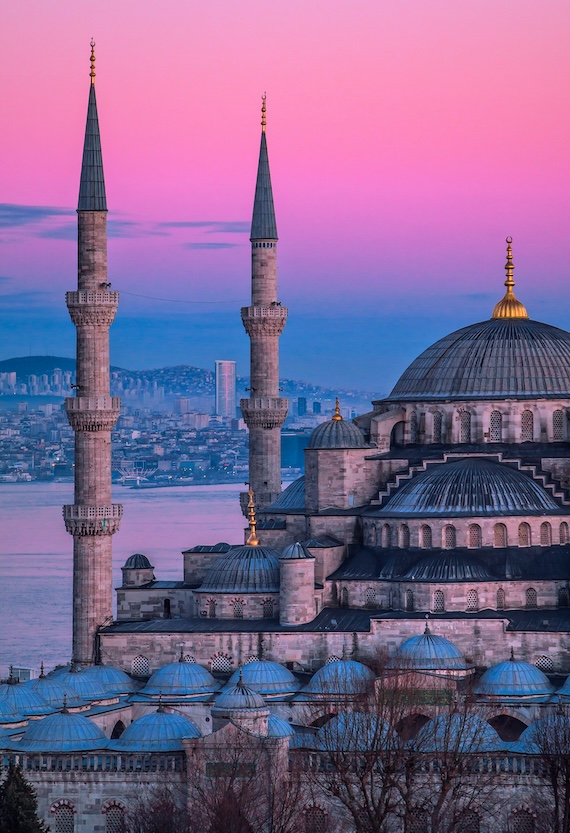
Photo of Sultanahmet, Istanbul, Turkiye by Fatih Yürür on Unsplash
Of course, the Sunni Crescent as a concept is as rickety as the Shiite crescent had been. Lebanon is still multicultural and not dominated by Sunnis, though they have power. Many mainstream Sunnis are nervous about the hard-right Salafis who have taken Damascus. And even though Turkiye under Erdogan gives rhetorical support to groups such as Hamas and the Syrian Liberation Council that took Damascus, Turkiye has a secular constitution. The Saudis, being Wahhabi-ruled, are not accepted as Sunnis by some in the region. Turkiye has newly warm relations with Iran, as does Qatar. Geopolitics follows interests not culture; but culture can be part of interests.
Afraid of the new bloc, as well, Israel’s government has swung into action, attempting to keep the new Syria weak by bombing its weapons depots and military bases, and invading to occupy further territory. The Sunni crescent is in some ways more dangerous politically to Tel Aviv than the Shiite crescent had been, since it has more legitimacy in the West. President Trump even made Prime Minister Benjamin Netanyahu apologize from the White House to Qatar for bombing it on September 9. Israel, aware of Trump’s good relations with Turkish President Tayyip Erdogan, has aimed a barrage of negative propaganda at him, accusing him of aspiring to revive the Ottoman Empire, which ruled much of the Middle East before WW I.
That is the big story of 2025 — the military victory of Israel over Iran and its alliance of resistance, and the emergence of a new Sunni bloc centered on Turkiye, Syria and Qatar.

 © 2026 All Rights Reserved