
Informed Comment Homepage

Thoughts on the Middle East, History and Religion

Header Right

  • Featured
  • US politics
  • Middle East
  • Environment
  • US Foreign Policy
  • Energy
  • Economy
  • Politics
  • About
  • Archives
  • Submissions

© 2026 Informed Comment

  • Skip to content
  • Skip to primary sidebar
Donald Trump

With Maduro Abduction, the US Addiction to Regime Change is now farcical

Ibrahim Al-Marashi 01/07/2026

Tweet
Share
Reddit
Email

By Ibrahim al-Marashi and Tanya Goudsouzian | –

( The New Arab ) –

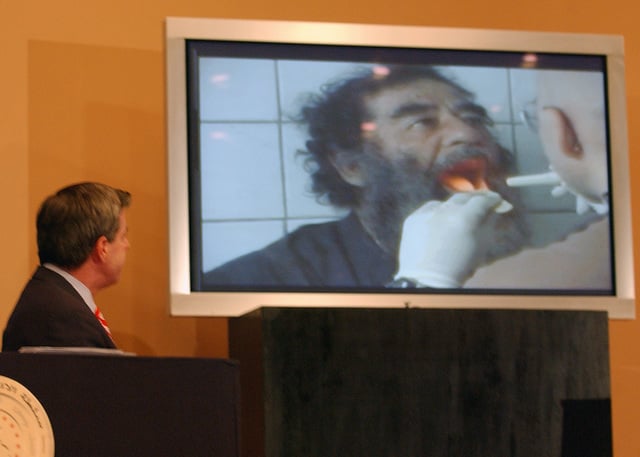
Images of Nicolás Maduro taken into US custody early on 3 January were greeted in some quarters with celebration, in others with criticism, and in many with a familiar sense of déjà vu. They recall earlier moments once framed as turning points: Saddam Hussein pulled from a hole in the ground, Manuel Noriega photographed under arrest, and Salvador Allende, clutching a weapon shortly before his alleged suicide.

Then, as now, the images seemed to promise resolution. Remove the strongman, cut off the head of the snake and a nation’s problems would finally unravel.

That same confidence resurfaced when President Donald Trump suggested that the US would effectively “run” Venezuela following Maduro’s capture, not unlike the post-2003 assumption that Washington could manage Iraq after Saddam’s ouster.

In Iraq, military success was quickly mistaken for political victory. The fall of Baghdad was followed by civil war and an insurgency led in part by Saddam loyalists and Al-Qaeda affiliates, creating the conditions for the rise of ISIS after U.S. forces withdrew.

Supporters of the Venezuelan intervention have pointed to its efficiency – not a single American life was lost. Yet bloodless intervention offers little reassurance that rebuilding a society hollowed out by two decades of authoritarian rule will be any easier. Trump’s promise of a “safe, proper and judicious transition” rings familiar.


 

From Cold War coups to Iraq, Afghanistan and Syria, regime change has rarely delivered orderly political outcomes. More often, it has laid the groundwork for long-term instability. There is little reason to believe Venezuela will be different.

An old imperial pattern

This instinct to equate the removal of a ruler with the resolution of a society’s problems long predates the US. In 1839, Britain seized the port of Aden in southern Yemen, displacing the local authority of the Lahej Sultanate and imposing an external political order designed to serve imperial interests. The immediate objective of gaining control of a strategic chokepoint was achieved with relative ease.

The long-term consequences were far messier: fragmented governance, weakened local legitimacy and a political landscape shaped by outsiders rather than rooted institutions.

The pattern hardened in the early Cold War. In Egypt in 1952, the CIA backed the Free Officers’ coup against King Farouk I, viewing Britain as an overextended colonial power whose presence was fuelling Arab nationalism and opening the door to Soviet influence.

By overthrowing Farouk, British influence was curtailed and Washington convinced itself it had nudged history in the right direction. What followed instead was decades of entrenched military rule and a political system hollowed of meaningful civilian life.

The 1956 nationalisation of the Suez Canal and the subsequent Suez Crisis, followed by the 1967 war, underscored how regional and international conflicts were inseparable from the instability created by externally influenced regime change. The lesson went unlearned.

A blueprint that backfired

A year later in Iran, the US helped overthrow Mohammad Mossadegh, a democratically elected prime minister who had nationalised the Anglo-Persian Oil Company. Whether Mossadegh in 1953 or Maduro decades later, leaders who sought to wrest control of national resources from foreign corporations faced the wrath of the US.

The short-term payoff came at the cost of long-term legitimacy, paving the way for authoritarian repression by a pro-American shah and, eventually, the 1979 Islamic Revolution.

The same arc would later unfold in Iraq and Afghanistan: initial control, followed by insurgency, radicalisation and collapse. Regime change did not eliminate instability; it postponed it (some would say created it) and allowed grievances to accumulate until they erupted.

Afghanistan stands as perhaps the most comprehensive refutation of the logic of regime change. In 1979, the Soviet Union toppled the existing government and installed a friendly regime, only to trigger a prolonged war that eventually collapsed under its own weight.


Decades later, the US repeated the formula: in 2001, the Taliban were removed swiftly, and a new political order was imposed with foreign backing and vast resources. Yet the outcome was strikingly similar to the Soviet experience: twenty years of conflict, dependence on external support and a rapid collapse once that support was withdrawn.

Two superpowers, opposing ideologies, identical failure. Afghanistan demonstrates that regime change does not fail because of insufficient time or effort; it fails because legitimacy cannot be imported and authority imposed from outside cannot substitute for local political foundations.

Instant coffee, instant democracy?

Closer to home, the US’ record in Latin America offers an unflattering prelude to its later adventures in the Middle East. From Guatemala to Chile, Nicaragua to Panama in 1989, Washington repeatedly engineered swift victories followed by shallow reforms and fragile institutions. Across continents and decades, US-backed regime change has often destroyed what little order existed, leaving behind chaos under the guise of triumph.

Emboldened by Iran, Washington treated Guatemala in 1954 as a low-risk rehearsal. Operation PBSUCCESS removed President Jacobo Árbenz under the assumption that once a troublesome leader who tried to wrest control of the banana industry from the U.S. United Fruit Company (the precursor to Dole Fruit) was gone, and democracy would naturally reassert itself.

Instead, the coup ushered in decades of military dictatorship, civil war and mass repression against the native Mayan population that claimed hundreds of thousands of lives, giving us the term “banana republic.”

A government elected at the ballot box was replaced in the name of freedom, only to extinguish it. Democracy was treated as a deliverable, something that could be installed after the fact, rather than a fragile process requiring legitimacy, institutions and time.

In Panama, US forces removed Manuel Noriega quickly, on the same charges levelled against Maduro: drug trafficking. Yet, the political order remained brittle and dependent on outside support, as well as vulnerable to corruption.

This pattern resurfaced in Iraq in 2003, when Saddam Hussein was toppled with ease, only for institutions to collapse and militias and extremist groups to fill the vacuum.


Saddam Hussein Medical Inspection. Scene Camera Operator: SSGT Steven Pearsall, USAF Release Status: Released to Public. Combined Military Service Digital Photographic Files. Public Domain. Via Picryl

“Anyone but the dictator”

The central irony is that removing or weakening a dictator did not produce security or stability. In many areas, it made conditions far worse.

Maduro is in custody and Donald Trump is now in charge. If there is a plan for the days and weeks ahead, it seems to be a closely held secret. It is an understatement to say this is dangerous, if not existential, especially for the people of Venezuela who woke up without lights, without a governing authority and only vague promises of a better life proclaimed from Mar-a-Lago.


A worse-case scenario envisions that banks will not open, ATMs will not work, shops will not accept Venezuelan currency and hard-line security forces and local paramilitaries will brutally insert themselves into the vacuum. If so, expect US boots on the ground to follow.

From Aden to Cairo, Tehran to Kabul, Baghdad to Damascus, and now Caracas, the same enduring fantasy that uprooting a leader is equivalent to creating legitimacy is repeating itself in the vague promises of the US policy for a post-Maduro Venezuela.

When President Trump was asked who would execute the policy of a democratic transition, he made a vague reference to “these guys”. It is certainly the case that these guys have their work cut out for them, and history is not on their side.

Ibrahim al-Marashi is associate professor of Middle East history, visiting faculty at The American College of the Mediterranean, and the Department of International Relations at Central European University. His publications include Iraq’s Armed Forces: An Analytical History (2008), The Modern History of Iraq (2017), and A Concise History of the Middle East (2024).

Tanya Goudsouzian is a Canadian journalist who has covered Afghanistan and the Middle East for over two decades. She has held senior editorial roles at major international media outlets, including serving as Opinion Editor at Al Jazeera English.

Follow Ibrahim on X: @ialmarashi

Follow Tanya on X: @tgoudsouzian

Reprinted from The New Arab with the authors’ permission.

Filed Under: Donald Trump, Iraq, Iraq War, US Foreign Policy, Venezuela

About the Author

Ibrahim Al-Marashi is Associate Professor of History at Cal State San Marcos. He co-authored with Arthur Goldschmidt Jr., A Concise History of the Middle East (Routledge, 2018) and with Phebe Marr, The Modern History of Iraq (Routledge, 2017) .

Primary Sidebar

Support Independent Journalism

Click here to donate via PayPal.

Personal checks should be made out to Juan Cole and sent to me at:

Juan Cole
P. O. Box 4218,
Ann Arbor, MI 48104-2548
USA
(Remember, make the checks out to “Juan Cole” or they can’t be cashed)

STAY INFORMED

Join our newsletter to have sharp analysis delivered to your inbox every day.
Warning! Social media will not reliably deliver Informed Comment to you. They are shadowbanning news sites, especially if "controversial."
To see new IC posts, please sign up for our email Newsletter.

Social Media

Bluesky | Instagram

Popular

  • Top 5 Mistakes Bush made in Iraq that Trump is making in Venezuela
  • Regime Change in Venezuela: American "Justice" as the "Supreme International Crime"
  • Taking an Oath on the Qur'an, like Mamdani, attests its Long History in America
  • Vietnam on the Nile? With Chinese investment, Egypt turns to Solar Panel Manufacturing
  • The Gulf's Cold War: Saudi-UAE Rivalry spills into Africa

Gaza Yet Stands


Juan Cole's New Ebook at Amazon. Click Here to Buy
__________________________

Muhammad: Prophet of Peace amid the Clash of Empires


Click here to Buy Muhammad: Prophet of Peace amid the Clash of Empires.

The Rubaiyat of Omar Khayyam


Click here to Buy The Rubaiyat.
Sign up for our newsletter

Informed Comment © 2026 All Rights Reserved