
Quincy, CA (Special to Informed Comment; Feature) – Political analysis aims at understanding events that are only partially knowable by comparing them with conceptual frameworks that have been useful before. Mr. Trump’s actions in Venezuela appear chaotic by the standards of policy consistency or national interest. Viewed through the lens of contemporary autocratic practice, his recent moves fit well, eliciting new streams of tribute, bargaining with fellow autocrats, and making progress toward criminalizing the US military.
By ordinary political standards, Mr. Trump once again appears to be erratic. He campaigned on keeping the US out of war, bid for the Nobel Peace Prize, then began bombing international waters and a foreign country. He punished Brazil with heavy sanctions for arresting an autocratic traitor, then postured as savior of democracy in Venezuela, only to shun the opposition and embrace the oppressive regime anew. He kills purported drug runners and accuses their country’s president of being a narcotics kingpin, but pardons the former president of Honduras, who is a convicted narcotics kingpin serving time in a US jail.
As for national interest, one dimension might be expansion of US oil interests, but experts point to a massive need for infrastructure in pursuit of a category and quantity of oil that is not that attractive. Moreover, US oil does not trust the regime that Mr. Trump has preserved, the CEO of Exxon being widely quoted as declaring Venezuela is “uninvestable.”
The other claimed interest is interdicting drug traffic at sea. Mr. Trump’s use of force in no way resembled a serious attempt to lend teeth to international anti-drug efforts. Compare the anti-piracy fleet in the waters of the Middle East to see how legitimate naval protection works. There, despite very complex obstacles, a small international flotilla was able to whittle down the pirate threat with minimal bloodshed, and do so within international law and norms.
By contrast, Mr. Trump’s unilateral, lethal action, unsupported by actual evidence of drugs endangered the legal status of the sailors who were ordered to do it. Care was taken to assure that no wreckage, survivors, or cargo were recovered, lest any target prove to be innocent. What this does do is undermine the US Navy’s role as global enforcer of free navigation, lending legitimacy to Chinese assertions of dominance over international waters near its shore.
All these actions and words make a great deal more sense when examined through the politics of 21st Century autocracy. In the growing fraternity of authoritarians, economics exists for the sake of political extraction, and private wealth is only permitted on condition of complicity. Cooperation among the new model dictators is problematic, but they emulate one another’s practices, assist one another at times, but will gain at the expense of another if the incentive is sufficient. The forces of order enforce orders not restrained by law.
However, the charge of inconsistency only holds if one expects a leader to establish a stable, systemic outcome. Measured by the standards of contemporary autocratic practice, Mr. Trump’s actions are characterized by continuity, not surprise. Demonstrating that he is willing to commit crimes to hurt some drug traffickers, and also willing to spare even the worst of them is the classic opening move for setting up a protection racket. Drug corruption is not just bribery, it is selective enforcement. Compare his approach to that of the two relevant drug kingpins.
A US DoJ Press Release on Hernandez, updated 2/6/25 says, “During his time in office, Hernández publicly promoted legislation and the efforts he purported to undertake in support of anti-narcotics measures in Honduras…while at the same time promising drug traffickers who bribed him and followed his instructions that they would remain safe in Honduras.”
Page 12 of the indictment against abducted Venezuelan leader, Nicolas Maduro Moros alleges that he and his wife, “…worked together to traffic cocaine, much of which had been previously seized by Venezuelan law enforcement, with the assistance of armed military escorts. At the same time they, “…maintained their own groups of state- sponsored gangs known as colectivos to facilitate and protect their drug trafficking operation.”
Mr. Trump has publicly taken his tribute in promises of oil, and there is no record, or even serious suspicion, that Mr. Trump has ever dabbled in the drug traffic. If he ever does, the “dark money” US political system will hide it better than conventional money laundering.
One may still note that Mr. Trump’s pardons are consonant with his record of recruiting a certain sort of talented advisors (Paul Manafort, Michael Cohen, Steve Bannon, all convicted of crimes after serving him). His pardons have made available a stellar panel of potential consultants for someone, even if not for himself. Hernandez, convicted of abetting the import of over 400 tons of drugs into the US, is expert in running the top tier of drug corrupted politics. Ross Ulbricht, pardoned from a life sentence, ran the dark web operation Silk Road, covering the digital dimension of addiction servicing. Larry Hoover, pardoned from multiple life sentences, was so adept at street level distribution that he ran the Gangster Disciples and their allies from behind bars. Cesar Humberto Lopez-Larios, pardoned while under indictment, led MS-13 from cartel to international terrorist group.
There is a big question for the autocratic perspective, though. What happened to the Russians in Venezuela? For years, various outlets have reported that the Caracas regime was secured against domestic or international attack by a tripwire force of 150 Russians from the mercenary Wagner Group. The tripwire was made more effective when Wagner contractors were absorbed into the Russian army. Something above 1,000 allied Cuban troops added heft to the contingent, and Cuba says 32 of their troops were killed in the US raid. If the Russians were technical advisors they might have been out of harm’s way, but in 2024 they were spotted on the streets, helping with frontline repression of democracy protests.
One potential answer is available. Several aviation and defense websites reported that, on October 26, 2025, a Russian heavy air transport plane landed in Caracas, Venezuela after a flight that originated in Moscow. The plane is operated by a Russian company included in US sanctions against Wagner. At the time, this was interpreted as evidence of Russia reinforcing its support for Mr. Maduro. In retrospect, and until any new information emerges, the stronger assessment would be that the plane extracted the Russians, avoiding a clash with the US raiders. Online flight trackers show that it left with no recorded destination, but it seems to have turned off its transponder twice as it traveled to Cuba and Nicaragua, then back to Caracas before departing the hemisphere.
The flight was almost simultaneous with a Russian proposal to the US on Ukraine. That proposal became the 28-point, Russian victory formula offered by the US as if it were an American idea. At the time, Secretary of State Rubio stumbled, admitting that the document was handed to the US. He quickly reversed himself, apparently realizing that a truth protecting Mr. Trump was less important than a falsehood protecting Mr. Putin.
Barring a coincidence, it appears that Mr. Putin and Mr. Trump may have arranged a trade. Mr. Trump betrayed President Zelensky in exchange for Mr. Putin’s betrayal of Mr. Maduro. Cuba’s troops seem not to have been in on the deal.
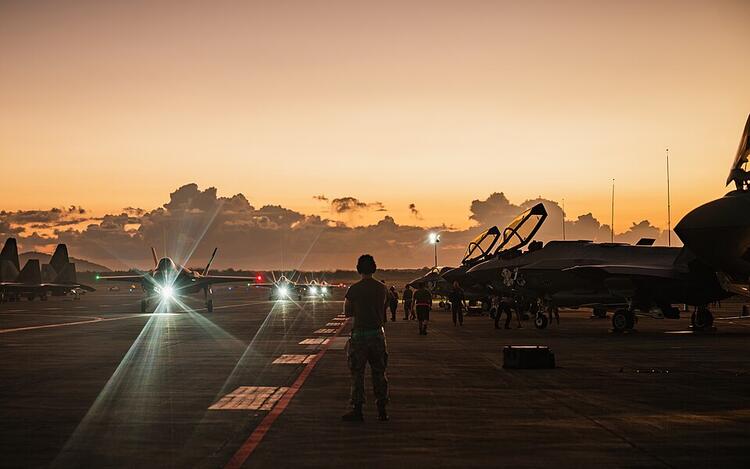
U.S. Air Force crew chiefs watch as F-35A Lightning II’s taxi following military actions in Venezuela in support of Operation Absolute Resolve, Jan. 3, 2026. U.S. military forces are deployed to the Caribbean in support of the U.S. Southern Command mission, Department of War-directed operations, and the president’s priorities to disrupt illicit drug trafficking and protect the homeland. (U.S. Air Force Photo by Senior Airman Katelynn Jackson). Public Domain. Via Wikimedia Commons .
Most important to the mutual satisfaction of Mr. Trump and Mr. Putin is that the Venezuelan regime remain undisturbed. Russia’s primary weapon in its war with the West is refugees. Its interventions in Syria, Libya, and Venezuela generated oceans of refugees to besiege the West, and the Kremlin has had great success promoting political division out of the resulting social strain. Mr. Trump is the primary beneficiary of that program in the Western Hemisphere. Any change that resulted in a serious reversal of the Venezuelan exodus would be bad for both autocrats, so the legitimate winner of last year’s election has little hope.
Last, but not least, this intervention nudges along the criminalization of the US military and law enforcement. They must be ready to block the election in major US cities this November, and there is much to do before then.
Again, it is not possible to be completely confident of any insight into a political gesture for which there is a shortage of direct evidence. Nevertheless, what is known about how 21st Century autocracies operate seems a strong guide to understanding the recent episode, while competing approaches are left with confusion that is helpful only to the autocrats.

 © 2026 All Rights Reserved