
Ann Arbor (Informed Comment) – Iraq is seeking custody of the captured ISIL (ISIS, Daesh) fighters who had been imprisoned by the Syrian Kurdish YPG forces. Some of these prisoners escaped recently when the fundamentalist Salafi Arab government in Damascus made a Blitzkrieg into eastern Syria, pushing out the YPG and seizing oil fields, towns, a dam, and vast territory. The Shiite-dominated government in Iraq does not like the new Syrian government of hard line (“Salafi”) Sunni fundamentalists one little bit. Baghdad is petrified that instability in Syria will spill over into Iraq. And ISIL fighters escaping en masse is a nightmare for Iraqis.
Secretary of State Marco Rubio announced Thursday that Iraq had launched an initiative to take custody of the ISIL fighters held in Syria. Of the estimated 10,000 or more detainees, some 3,000 are Iraqis. The Iraqis among them would be dealt with by the Iraqi justice system. About 5,000 are Syrian and 2,000 are foreign nationals. Since Iraq is said to be taking 7,000, it seems to be willing to take charge of about 2,000 of the Syrians (those held in Kurdish detention centers) along with the 2,000 foreign fighters. The foreigners will be held “temporarily,” presumably until arrangements can be made for their home countries to take them.
Obviously, neither Baghdad nor Washington trusts the al-Sharaa government in Syria to do due diligence in keeping their fellow fundamentalists behind bars.
The thousands of ISIL fighters imprisoned by the Kurds in 14 or so major detention centers had terrorized western and northern Iraq and eastern Syria throughout the teens of the past decade, until they were finally defeated in 2017-2018. Their Syrian capital of al-Raqqa was captured by the YPG, with Arab tribal and American support, in October 2017.
The escape of ISIL fighters deeply alarmed the Iraqi government as well as the US. Although the new Syrian government is headed by fundamentalists, some of them former al-Qaeda, their leader Ahmad al-Sharaa had broken with ISIL in April, 2013. The core of the present government in Damascus had belonged to the Jabhat al-Nusra (the Succor Front), which rejected ISIL leader Abu Bakr al-Baghdadi’s attempt to merge the two groups. Jabhat al-Nusra remained loyal to Ayman al-Zawahiri, the al-Qaeda leader, who excommunicated al-Baghdadi and his group. Jabhat al-Nusra merged with other parties later on to become the Syrian Liberation Council, which took over Damascus last December. So there is no love lost between the current government and ISIL, sort of the way Bolsheviks hated Trotskyites. But neither Jabhat al-Nusra nor the Syrian Liberation Council ever fought ISIL in a significant way on the battlefield, ceding to them their control of eastern Syria.
The only force then President Barack Obama could find to take on ISIL on the ground and defeat it was the YPG Kurds, who were backed by the US Department of Defense, to Türkiye’s outrage. The Kurds stepped up and did the whole world a favor in defeating the horrid ISIL who ruled by terrorizing people, killing large numbers, blowing things (including Paris) up, beheading them, enslaving them and occasionally snacking on their livers.
In the past week, the Kurdish YPG was pushed out of Raqqa province by Syrian Army forces from Damascus.
The new fundamentalist Salafi Arab government in Syria has some unfinished business. The religious minorities — the Druze and the Alawis, both offshoots of folk Shiism — are one. Neither will be easy to incorporate into the Salafi state. The Kurds are the other, being non-Arabs and leftists and so ethnically and ideologically opposed to the fundamentalist, right-wing project of the al-Sharaa government.
Further, the YPG (Peoples’ Protection Units) paramilitary of the Kurdish Democratic Union Party is considered a branch of the Kurdistan Workers Party (PKK) by Türkiye — though the Syrian Kurds deny this charge. Ankara has been involved in a dirty war with the PKK in southeast Türkiye for over 40 years and views it as a severe threat to Turkish national integrity that advocates Kurdish secession from Türkiye. Kurds make up about 20% of the population of Turkiye and predominate in the southeast. Political scientists do not find that secessionist sentiment is strong among Turkish Kurds.
About 10% of Syria’s population is made up of Kurds, mainly in the northeast of the country.
The YPG had hoped to link up the three main enclaves of Kurdish populations in Syria, in Afrin, Kobane and the Jazira and create a new state, Rojava. Since it would stretch along the Syrian border with Türkiye, this development was absolutely unacceptable to Ankara, which got permission from Trump in 2019 to push into Syria and disrupt this plan.
The main patron of the fundamentalists in Damascus is Türkiye, and so Ahmad al-Sharaa’s government has every reason to curb the YPG.
On January 16, al-Sharaa had appeared to offer the Kurds an olive branch. He made Kurdish an official language of Syria, recognized Now-Ruz as an official national holiday, and restored to the Kurds of Hasaka the Syrian citizenship that had been stripped from them in 1963 by an Arab nationalist government. Kurds, like Iranians and some Central and South Asians, celebrate the spring equinox, typically March 21, as New Year’s Day. These steps contradicted the exclusivist Arab nationalist policies that had predominated in Syria since the 1960s.
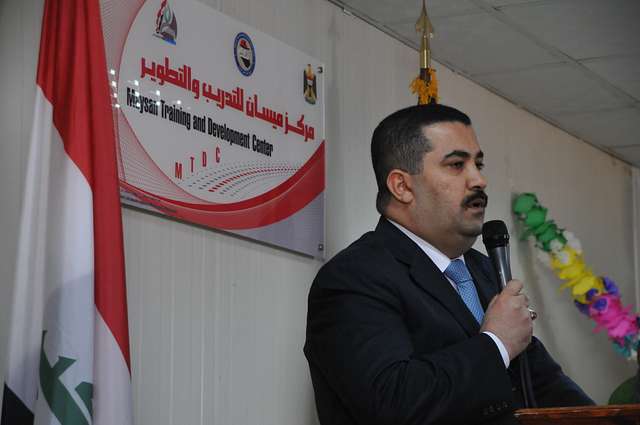
File Photo of Iraqi PM Mohammad Shia al-Soudani. Public Domain. Via Picryl
But tensions over YPG control of parts of Damascus and its hinterland boiled over, and the Syrian Army expelled the YPG from the city, and then went after them in Raqqa province January 17-19. There, the YPG had ruled in partnership (as the “Syrian Defense Forces”) with Arab tribal levies, who defected to the Damascus government, which forced the YPG to retreat to Kurdish-majority regions in the northeast. During this round of fighting, some 1,500 ISIL fighters were said to have escaped from prison, though the number may have been smaller and some were recaptured.
On January 20 a ceasefire was brokered, in part by the US. But it wasn’t much of a ceasefire, with fighting continuing at Hasakah and elsewhere. Moreover, it was accompanied by an ultimatum from al-Sharaa that the YPG integrate into the Syrian Army, giving up its independent command structure, by January 24, i.e. Saturday. First of all, that integration is unlikely to happen, certainly on this time scale. Second, ultimatums typically start wars.
On Wednesday, 150 of the 7,000 ISIL fighters held in Hasakah Province were transferred to Iraqi custody by the US CENTCOM, with an expectation that all of them would be sent to Iraq.
Iraqi officials expressed their relief at the transfer, since they are petrified that thousands of ISIL fighters will escape amid the chaos in eastern Syria, and will go back to blowing things up in western and northern Iraq and fomenting Sunni Arab secessionism again.

 © 2026 All Rights Reserved