
This analysis draws on extensive discussions with Chinese security, military, and political experts based in Beijing and reflects analytical assessments rather than the official position of the Chinese government on Iran’s recent protests.
Florence, Italy (Special to Informed Comment, Feature) – When President Trump announced in January that the United States would impose a sweeping 25 percent tariff on any country trading with Iran, the move was framed in Washington as economic pressure on Tehran. In Beijing, it was read very differently: not as an Iran policy, but as another chapter in America’s expanding use of economic coercion, and another test of China’s strategic patience.
The timing was not lost on Chinese analysts. Iran is facing internal unrest, external military threats, and unresolved questions over its nuclear program. To Beijing’s security circles, the protests that erupted across Iranian cities earlier this year were already understood as the domestic continuation of the 12-day war, a pressure campaign that merely shifted arenas. The tariff announcement, in this view, added a financial front to the same conflict architecture.
China’s response has been characteristically calm, almost austere. There has been no dramatic counter-threat, no theatrical denunciation. Instead, Chinese officials reiterated familiar principles: opposition to unilateral sanctions, rejection of extraterritorial enforcement, and support for sovereignty and stability. These phrases may sound formulaic, but they are rooted in a consistent strategic worldview. Beijing does not see Iran as a revolutionary cause or an ideological ally. It sees Iran as a state under pressure, and pressure, in Chinese strategic thinking, rarely produces order.
Within Chinese policy and security circles, the tariff threat is interpreted less as a genuine attempt to alter Iran’s behavior than as a signal to third parties. The logic is familiar: punish intermediaries, force isolation, and hope internal strain does the rest. But Chinese experts remain skeptical of this approach. Their assessment of Iran’s protests, “widespread but thin, noisy but not overwhelming,” leads them to conclude that economic strangulation will not produce regime collapse. It will produce endurance, adaptation, and escalation.
From Beijing’s perspective, abandoning Iran under U.S. pressure would validate precisely the model of coercion China seeks to resist. The concern is not Iranian oil alone, though China remains Iran’s largest customer, but precedent. If Washington can impose punitive tariffs on any country trading with a sanctioned state, then the architecture of global trade becomes contingent on U.S. political approval. That is a structure China fundamentally rejects.
Beijing views recent U.S. military actions in Venezuela, where Washington ousted President Nicolás Maduro and assumed control of Venezuelan oil resources, not as a liberation of the Venezuelan people but as a strategic blow against China’s access to cheap crude. Chinese officials and analysts have publicly condemned the U.S. strike as a violation of international law and a “hegemonic act,” signaling they see such interventions less as regional policy and more as attempts to choke China’s energy supply chain and contain Beijing’s influence.
Chinese analysts also frame the tariff move as inseparable from the broader U.S.–China economic rivalry. After years of trade wars, technology restrictions, and supply-chain decoupling, Beijing no longer interprets such measures as isolated policy tools. The tariff threat fits a familiar pattern: weaponizing access to the American market to discipline rivals. In this sense, Iran is not the target so much as the terrain.
This is why Chinese officials privately dismiss the idea that the tariffs will fundamentally alter Sino-Iranian relations. Trade may become more opaque, routes more indirect, mechanisms more creative, but the relationship will persist. China has already spent years learning how to operate under sanction-heavy environments, diversifying markets, expanding yuan-based trade, and deepening South–South economic corridors. The assumption in Beijing is not that tariffs can be avoided entirely, but that they can be absorbed, redistributed, and eventually diluted.
There is also a strategic symmetry at work. Just as Chinese security experts view Iran’s domestic unrest as inseparable from military pressure, they see economic warfare as another destabilizing force that increases the likelihood of conflict rather than preventing it. In their assessment, a weakened but cornered Iran is more dangerous than a stable, constrained one. Tariffs, like bombs, do not exist in isolation.
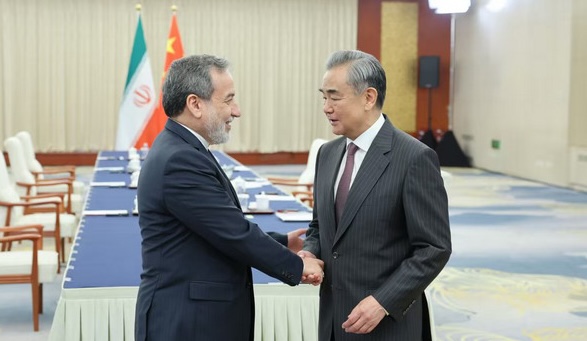
On July 16, 2025, Member of the Political Bureau of the CPC Central Committee and Foreign Minister Wang Yi met with Iranian Foreign Minister Seyed Abbas Araghchi in Tianjin. Ministry of Foreign Affairs, People’s Republic of China. Government Work. Public Domain.
Yet China’s stance has clear limits. Beijing has no intention of militarily backing Iran or confronting the United States head-on. Its support remains political, diplomatic, and economic, calibrated to avoid escalation while resisting compliance. This reflects the same logic Chinese experts apply to the prospect of another war: China opposes it, expects it may happen, but will not intervene to stop it at great cost to itself.
What emerges is a distinct Chinese posture, one that neither aligns with Tehran’s rhetoric nor Washington’s tactics. Beijing will continue to call for stability, oppose regime change, and criticize foreign interference, while quietly adjusting trade patterns and financial mechanisms to blunt U.S. pressure. It is not defiance for its own sake, nor solidarity out of sentiment. It is strategic continuity.
Trump’s tariff gambit may yet reshape parts of the global economy. But in Beijing, there is little sense of panic. The belief remains that pressure campaigns exhaust their authors faster than their targets. China’s answer is not to blink, but to endure, confident that in a fragmented world, patience is a form of power.

 © 2026 All Rights Reserved