
( Foreign Policy in Focus ) – In this interview, international relations scholar Stephen Zunes and Middle East historian Lawrence Davidson help to unpack the Iranian protests and explain their relevance within the context of U.S. and Israeli national interests.
Daniel Falcone: Jeffrey St. Clair of CounterPunch, recently cited filmmaker Jafar Panahi’s insistence that change in Iran must come from the will of the people, not from outside intervention. As U.S. and Israeli involvement tends to strengthen hardliners, how do you explain the balance between international solidarity and the risk of external actors undermining Iran’s sovereignty and social movement?
Lawrence Davidson: One has to ask what these terms, international solidarity, and risk from external actors, mean in today’s international environment. If international solidarity means, for instance, the solidarity of reactionary countries that have somehow made an alliance to change the internal behavior of a third nation, that is obviously problematic. In this case, international solidarity is the manifestation of just these external actors. If the United States intervenes in Iran at this time, it would not be to the benefit of the Iranian people, it would be for the suppression of anti-Zionist sentiment in the country through the introduction of the Shah’s adult son. This would probably lead to something like a civil war in Iran. If, however, international solidarity means the sentiment of people rather than governments, this has not proved very effective, as we can see in the case of Gaza.
The Arab and Muslim peoples have either chosen not to or could not in any practical way act to support the Palestinians. I’m afraid that the conclusion here is that in the present circumstances, there is no balance between international solidarity and external actors. The power of institutionalized external actors overwhelms practical terms, the power of popular solidarity.
Stephen Zunes: While the United States and Israel have tried to take advantage of the unrest, the protests this round, as well as previously, have been homegrown and not the result of imperialist machinations. Iran has had a long history of widespread civil resistance going back to the late nineteenth century with the tobacco strike against imperialist economic domination, through the Constitutional Revolution the following decade, through the revolution in the late 1970s that brought down the U.S.-backed Shah. The outspoken support for the protests by the U.S. and Israeli governments have probably been counter-productive, feeding the regime’s false narrative that they are a result of foreign backing. Israel and the United States have a lot of power in terms of blowing things up and killing people.
They do not have the power to get hundreds of thousands of angry Iranians into the streets or even to steer the direction of their protests. The people who have given their lives on the streets were fighting for their freedom, not for foreign powers. Threats of military action by the United States and Israel have also likely strengthened the regime, since people tend to rally around the flag in case of outside threats and most Iranians across the political spectrum do not trust either country.
Given the U.S. support for even more repressive regimes in the Middle East, don’t think the Trump administration cares about the Iranian people. Bombing Iran to ostensibly support the uprising would be a tragedy. People would certainly be reluctant to go out onto the streets while they are being bombed. Most of those calling for U.S. military intervention appear to have been from the Iranian diaspora, not those on the streets. Although some Iranians within the country may have been desperate enough to want to risk it as well, let’s remember that it was not the eleven weeks of NATO bombing that brought down Milosevic in Serbia. It was the massive nonviolent resistance of the Serbian people that took place more than a year later.
It is possible that the United States and Israel might prefer the current reactionary, autocratic Iranian regime to a democratic one, which would still be anti-hegemonic and anti-Zionist but have a lot more credibility. A democratic Iran would still be nationalistic and sympathetic to the Palestinian cause, but less likely to engage in the kinds of repression and provocative foreign policies that would give the United States and Israel an excuse for some of their militarism. Solidarity from global civil society, by contrast, is important and appropriate. Despite claims by some to the contrary, many prominent pro-Palestinian voices from Bernie Sanders to Peter Beinart to Greta Thunberg have been outspoken in their support for the Iranian popular struggle as well. People will certainly tend to protest more when their own governments are actively supporting repression and mass killing, as with Israeli violence in Gaza and the West Bank, than when their governments are opposing the repression and mass killing.
Same as during the Cold War—it is quite natural for Americans to be less involved in protesting Communist repression we could do little about than repressive rightwing governments backed by Washington, where we might have more impact. As a result, this line about “where are all the protests on U.S. campuses?” has been unfair (particularly since most were still on winter break). And although some sectarian leftists really have become apologists for the reactionary Iranian regime or have exaggerated the Israeli role in the uprising, they are fortunately a small minority.
Ultimately, international solidarity is important, but it must be from sources that genuinely support the principles for which a popular movement is struggling. The movement in Iran, as with similar movements against autocratic regimes elsewhere, is fighting for freedom, democracy, and social and economic justice. Since neither the U.S. nor the Israeli government supports those principles, the Iranian regime—quite accurately in this case—can observe that U.S. and Israeli backing of the resistance is about advancing U.S. and Israeli strategic objectives, since these right-wing governments support regimes with even worse human rights records and they themselves are undermining democratic principles in their own countries. Indeed, some statements of support have played right into the regime’s hands.
Daniel Falcone: It seems that the participation of bazaaris and the poor and working class makes these protests distinct from earlier movements dominated by students and the middle class. How does this class composition alter legitimacy and the political stakes for the regime?
Lawrence Davidson: Their participation reflects the economic circumstances now. Those circumstances are, in turn, the product of externally imposed economic sanctions and incompetent internal management. Certainly, the participation of the bazaar keepers and the poor and working class in the protests is significant. No matter who comes out on top here, you’re going to see some sort of reform take place. The probability that it is the government that comes out on top is a function of the remaining loyalty of various contingents of the military. And a lot of this has to do with the economic stake of the Revolutionary Guard Corps in the status quo. As long as the military components of the regime stay loyal, the addition of bazaar keepers and the lower classes in the demonstrations cannot change the government.
Stephen Zunes: I find it rather significant that the bazaaris, traditionally a backbone of support for the regime, have been in the leadership of the resistance, as is the fact that there has been significant poor and working-class participation in the protests, unlike some previous movements, which have been disproportionately students and those from the educated middle class. The Iranian military, like the military in Egypt and some other autocratic systems, has their fingers in all sorts of economic enterprises at the expense of the common people. As a result, their brutal response to the protests was not just ideological, but from a desire to protect their vested interests.
It is also striking how quickly the protests went beyond economic issues. Most Iranians want at minimum much greater democratization/accountability within the current system and an increasing number clearly want regime change, not just because of economic hardship, but because they are simply tired of the repression.
Daniel Falcone: Although U.S. led sanctions have crippled Iran, there are also problems of systemic corruption and mismanagement by the Iranian state. Protesters increasingly reject both. Do you see this moment as one in which economic grievances lead to demands for democratization?
Lawrence Davidson: The economic problems come from both factors you mention. The Iranian theologians did not understand the intricacies of modern economic institutions or the importance of international trade. Thus, they could not manage a national economy, particularly one under outside stress. At the same time, American sanctions were designed to destroy that economy and impoverish the Iranian people. The two factors, working simultaneously, opened the way for corruption. And then there is the Revolutionary Guard capturing control of important parts of the economy. It is a mess. Democracy? I think we are a long way from that. We are probably closer to a military coup with the mullahs kept as front men.
Stephen Zunes: U.S.-led sanctions are unjustifiable (since Iran was honoring the nuclear agreement when Trump reimposed them) and they are hurting the economy. But my sense is that both the regime and Washington, for different reasons, are exaggerating the importance of the sanctions in sparking the rebellion. It is the regime’s corruption, mismanagement, and lack of accountability that are the bigger problems. The sanctions have provided the government with an excuse to deflect attention from their lousy economic policies, but that justification is now wearing thin. The economic problems are systemic, so changes at the Central Bank and minor adjustments in fiscal policies will not satisfy most protesters. The regime’s crony capitalism is being seen increasingly as beyond repair under the current system.
Daniel Falcone: UBC Professor Jaleh Mansoor eloquently defended the circulation of protest images as a form of democratic solidarity, while also warning about reactionary diaspora fantasies that reduce Iran’s future to either the Islamic Republic or a restored monarchy. How do you see media circulation distorting an understanding of the protests?
Lawrence Davidson: I do believe that the images should be shown as widely as possible, just as should the ones from Gaza. However, the problem is that they are often shown with either few or misleading explanations. Western commentators do not understand much of the context of happenings in Iran, much less the history. This is the price of a corporate press. The ignorance and biases of editors, if not reporters, are shown over and over. In our lifetime the best example is during Vietnam.
Unless one is motivated to go to an alternate, more accurate source one will get a distorted picture. It is a curse that has always been with us. The wealthy Iranians in California can be as delusional as they wish but there will be no restored monarchy short of an American invasion and occupation of Iran. That is not going to happen. Thus, the Shah’s son will stay in LA.
Stephen Zunes: The greater the circulation of imagery of the people’s resistance and the regime’s repression the better. Care should be given as to how they are presented, however. Like protest coverage elsewhere, the media tends to disproportionately show dramatic photos of vandalism and arson even though overall the protests have been overwhelmingly nonviolent. Indeed, violence is used by the regime to increase its already horrific repression even more.
Similarly, the monarchists are certainly a small minority of the protesters, though both the regime and the Western media (for different reasons) like to highlight them. Although there is something of a nostalgia among better-off Iranians from the pre-revolutionary days—like there is by some Russians for the Soviet era—it is more of a sign of how bad things are now than how good things were then. The Shah was one of the most repressive dictators in the world, and the inequality and corruption under his rule was terrible. Despite some protesters with signs or chants calling for a return of the Shah, the reality is that most Iranians on the streets in recent weeks have been fighting for democracy. In addition to the small number of monarchists, there have also been communists, moderate Islamists, secular liberals, and lots of other folks. People are fed up. Based on my time in Iran a few years ago and my following the situation in that country for decades, I can say with confidence that most of the Iranian people are both anti-regime and anti-monarchist.
Daniel Falcone: Masoud Pezeshkian has taken a conciliatory tone. Are hardliners likely to prevail if the protests intensify? And do you see any viable path for change within the current system?
Lawrence Davidson: There is a story going around that some government people went to the University of Tehran. They asked the protesting students what they wanted. The answer was “we want you to leave.” This was a mistake on the part of the protesters. They gave those with more power than themselves, no way to retreat. I see no path to meaningful change. I do think that once the government retakes the streets, there will be minor positive alterations in their behavior.
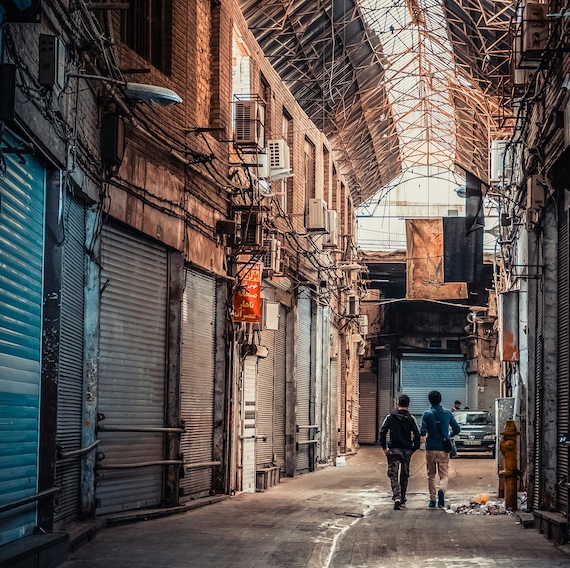
Photo by omid armin on Unsplash
Stephen Zunes: Pezeshkian is a relative moderate, but he is not nearly as powerful as the mullahs or the military. Iran’s authoritarian system is a series of complex overlapping loci of power which represent varying interests, unlike some authoritarian regimes centered around a single autocrat, whose social base is thinner. As a result, I am not surprised, though quite disappointed, that the regime appears to have successfully and violently suppressed another round of protests.
Another problem is that the Iranian regime is the first government to face a massive civil insurrection that initially came to power themselves through a massive civil insurrection. Just as regimes that have come to power through guerrilla warfare are better at engaging in counterinsurgency, the Islamic Republic has unfortunately developed better mechanisms than did the Shah (or Mubarak, Ben Ali, Milosevic, Marcos, Suharto, etc.) to suppress civil resistance. I do believe the regime’s days are numbered, however. I just can’t say when or predict what will replace it.

 © 2026 All Rights Reserved