
Ann Arbor (Informed Comment) – The China Daily reported in late December that the 1 gigawatt “offshore photovoltaic project in Kenli district of Dongying, Shandong province, achieved full-capacity grid connection . . . marking a breakthrough in China’s development of clean energy.” Not only does China now have a major floating solar panel array, but it doubles as an aquaculture project or fish farm. And the solar farm has a megabattery attached so that some of the electricity it generates from sunlight can be stored for release at times of peak usage or at night.
I love Americans, but we are a big, insular island and typically don’t know much about the rest of the world, and only about half of us have a passport. Despite its vast size and economic prominence, China remains a mystery to most of us. You know how people sometimes say that California, population 39 million, would be a major country if it were independent, the world’s fifth largest economy? What would you say about Shandong Province just southeast of Beijing, with a population of 100 million and a GDP the size of Mexico’s or Spain’s at $1.3 trillion? If independent, it would be the world’s 15th largest economy.
Some beer afficionados may know the Tsingtao brand. That is named for the old spelling of the city of Qingdao in Shandong Province, which was ruled by Germany from 1898 until 1914, when, with the outbreak of WW I, Japan took it. Germany left behind a pretty good brewery, which uses pure spring water from Mount Lao.
And you probably have heard of Confucianism, China’s classical philosophical system. It comes from Shandong Province, where there were also important Buddhist temples.
The massive Yellow River, the 6th largest in the world, flows west through Shandong Province, emptying into the Bohai Sea. And there at the mouth of the Yellow River on that sea is a kind of Chinese New Orleans, the city of Dongying, population 260,000.
And five miles off Dongying is where China Energy Investment Corp. (CHN Energy) has located its $1.2 billion fixed-pile offshore solar panel array, the largest in the world. It is connected via high density transmission wires to a substation on land. It is made up of nearly 3,000 photovoltaic platforms and will generate enough electricity to cover the needs of 2.67 million urban residents. Qingdao, where they make the beer, has about 6.2 million people, so this one floating solar farm would supply 43% of the city’s electricity. Maybe they will be making the beer with sunshine.
Moreover, it turns out that fish like floating solar arrays, because they are like coral reefs, offering places to hide from predators. Their vicinity is therefore ideal for aquaculture.
The project in the Kenli District of the Dongying metropolitan area is important not only for China but also for other countries, many of which lack the terrain on which bulky solar panels can be sited.
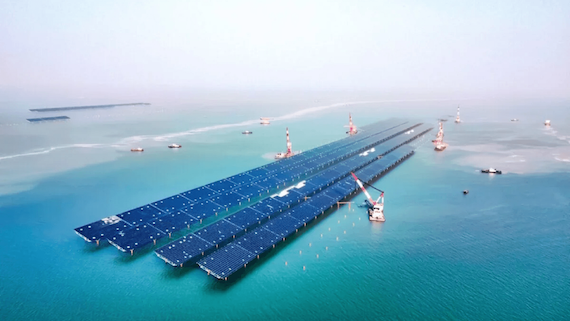
Floating Solar Array, Kenli District, Dongying, courtesy CHN Energy
Because of my specialization in the modern Middle East, I was led to an interest in energy markets and they way they work. While initially I concentrated on petroleum and its impact on modern social history, when renewables began burgeoning in this century I could see their relevance for the fossil fuels on which the Middle East ran. So I tried to get up to speed on them, too, from a social science point of view. When I became a prominent commenter on the Iraq Wars (1990-2018) and their implications for energy markets, I sometimes was asked to consult on the subject by governments. One time the Japanese Institute for Middle East Economies kindly had me over to speak, and they sent me over to the Ministry of Economics, Trade and Industry (METI) to talk to some young government economists about the future of energy. This was after the Fukushima disaster when many of Japan’s nuclear plants had been closed and they were importing Liquefied Natural Gas from the Gulf Arab states. They were worried about Gulf security, since oil tankers had sometimes been attacked.
So I told them they should go big into solar. I pointed out that Japan had made early breakthroughs in solar technology, and that Japanese scientists and engineers are world-class, but then they had departed the field. The young bureaucrats were not convinced. They pointed out that solar panels are bulky and that Japan is a set of small islands, and they didn’t see where you could put a lot of solar farms. It is not like they are California, with its San Bernardino County and its Mojave desert. They also said that Japan is cloudy a lot of the time. They made good points, but I still think that they were overly pessimistic. Rooftop solar and balcony solar could flourish in Japan, just as they do in Germany. In fact, Japan has more hours of sunshine annually (1,935 hrs) than Germany (1,716 hrs.). Yet solar provides 18% of German electricity.
But floating solar panels are as practical for Japan as for China. In fact, the Japanese government points out that Sumitomo Mitsui Construction Co., Ltd. already has a small floating array in Tokyo Bay.
The U.S., by the way, is backward in this technology, as it is increasingly in so much else under Trump. It only has little dinky floating solar arrays on lakes, like 4-9 megawatts.
Floatovoltaics are only one of the renewables solutions the planet needs to slash its carbon emissions and avoid ever larger climate disasters, but China has demonstrated that they are one powerful arrow in our quiver.

 © 2026 All Rights Reserved