
Ann Arbor (Informed Comment) – A Dutch court in the Hague has ordered the government to take steps to protect the Caribbean island of Bonaire from the effects of human-caused climate change, according to Dutchnews.com. Actually, they ordered the entire Dutch government to get its act together on fighting climate change, including in Europe. The ruling has implications far beyond Bonaire or the Netherlands, since it could influence the Court of Justice of the European Union and the International Court of Justice of the United Nations.
One of the plaintiffs, Jackie Bernabela, said at a press conference, “For us, this means so much.”
In 2019 the Dutch Supreme Court ordered the government to reduce greenhouse emissions in order to carry out its duty of protecting its citizens, a requirement of European Union law.
The Netherlands gets only a medium ranking for the adoption of green energy and is unlikely to meet its Paris Climate Treaty obligations.
The judges were particularly upset that the Netherlands is not doing anything for climate resiliency in Bonaire, though it is taking such steps for the European part of the Netherlands. Judge Jerzy Luiten said that his country “is pursuing a climate policy that does not comply, in a binding and transparent manner, with the measures that must be taken worldwide to limit global warming.” Judges may yet help save us all.
The judges said in their ruling that the “residents of Bonaire were wrongly treated differently from residents of the European Netherlands.”
The Netherlands chapter of Greenpeace writes, “Bonaire, Saba and Sint Eustatius have been special municipalities of the Netherlands since 2010, but the Dutch government has almost no plans to protect the islands against flooding caused by the rising sea level. This is in stark contrast to the extensive coastal protection in the European part of the Netherlands.”
Greenpeace was a co-plaintiff with 8 Bonaire residents, and they prevailed in part because of this invidious set of policies. The Netherlands has done almost nothing for climate resilience in its Caribbean territories. Some of them are special municipal areas, like Bonaire, while others, like Sint Maarten are “countries” of the Kingdom of the Netherlands.
A study by scientists at the Amsterdam Free University (Vrije Universiteit) found that Bonaire is especially vulnerable. First, some of the island is low-lying, and so those parts could be under water as soon as 2050. Second, Bonaire is protected from storm surges by coral reefs. But coral reefs don’t do well with heated water and acidic water, which is what climate change is producing.
I’ve been to Sint Maarten a couple of times, which is also a Dutch territory in the Caribbean (on an island shared with the French territory of St. Martin). I even wrote an article for The Nation on the climate change challenges it faces, which are similar to those of Bonaire.
I explained, “Coral reefs attract and protect fish, helping fishermen, and are a favorite tourist feature for snorkelers and divers. A Nature Foundation report noted of Sint Maarten’s reefs, ‘They are also a very important ecosystem for the local and global biodiversity.” [Environmentalist Tadzio] Bervoets said, ‘We have seen coral bleaching because of heat stress.'”
I continued,
“Corals are symbiotic, cohabiting with a kind of algae that live in the coral’s tissue, and are capable of photosynthesis, turning light into energy. These single-celled algae also promote calcium formation, extending the coral reef. Unfortunately, they do not deal well with extra-warm water. And the industrialized world’s addiction to burning gasoline in automobiles and coal and natural gas for electricity is heating up the earth, including its oceans. The high temperatures interfere in the algae’s ability to carry out photosynthesis, thus damaging the coral.”
As for Bonaire, Greenpeace writes, “If global emissions are not significantly reduced, a fifth of Bonaire is in danger of being lost to the sea by the end of this century. If emissions are not reduced fast enough, even the capital Kralendijk is at risk of flooding.”
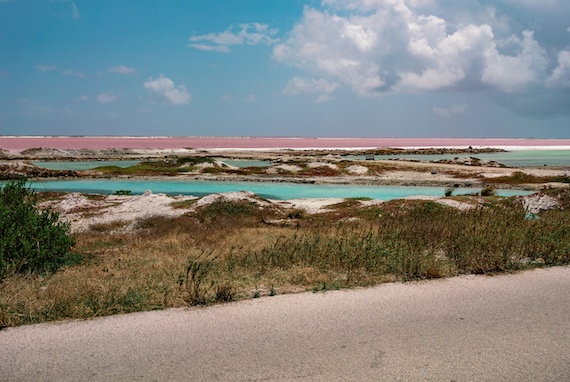
Photo of Bonaire by Israel Gil on Unsplash
Greenpeace warns that under the worst climate impacts, Bonaire’s coral reefs, which attract divers, will be reduced to only 13 diving spots out of the present 86 by 2050. If humanity doesn’t stop burning so much gasoline, fossil gas and coal, all of the island’s corals could be gone by 2100. Tourism brings in a quarter of a billion dollars a year to Bonaire, accounting for 40% to 50% of the economy, and the loss of the corals will reduce reasons for divers to visit. Worse, the corals won’t be there to blunt storm surges during increasingly violent hurricanes.
Residents face increasing risks from heat stress and from tropical diseases such as Zika and dengue fever as temperatures rise.
When I was researching Sint Maarten, I discovered why the Netherlands has these Caribbean islands. As usual, it is all about economics. The Netherlands had been a territory of the Spanish Empire but they rebelled 1568 to 1648. It was an odd, long-running rebellion of 80 years, and until the end of it the Habsburgs in Spain claimed the low countries, while the northern provinces around Utrecht insisted they were independent. That independence was finally recognized in 1648.
The Netherlands was a major source of fish protein for early modern Europe. And they had refined their technique of preserving the fish in barrels of brine or salt water. They supplied a third of Europe’s fish in the late 1500s. But Europe’s major salt beds were in Portugal, which was under the Spanish crown. So when the Dutch rebelled, the Spanish cut off their access to salt. The move could have crashed the Netherlands economy because of its dependence on fish exports. They didn’t have salt to make brine to store the fish and keep them from spoiling.
But the Dutch discovered that Caribbean islands like Sint Maarten and Bonaire had impressive salt beds, and they seized them for that reason. They kidnapped people in Africa and brought them to work in the salt mines. There was a labor shortage because European diseases had killed off much of the indigenous population, but then the Europeans accidentally imported malaria and yellow fever when they enslaved West Africans and brought them to the islands. So Europeans got sick and died in the Caribbean until mosquitoes were discovered to be the carriers and began being sprayed around 1900. That is why 95% of the Caribbean population is African — they had some immunity to those tropical diseases.
The Dutch were then a powerful maritime empire They governed Manhattan or New Amsterdam 1624 to 1664, and they had northern Brazil 1630 to 1654, and of course parts of what is now Indonesia. So holding a few islands off the coast of Venezuela was not a big challenge for them at that time. They had big sturdy ships on which they could mount state of the art cannon and blow enemies out of the water.
Since the islands saved the early modern Dutch economy with their salt, the least the Netherlands can do for their people now, who are Dutch citizens, is to keep them from being drowned and boiled to death.

 © 2026 All Rights Reserved