
Oxford (Special to Informed Comment; Feature) – The 1979 Islamic revolution caused a major earthquake in international geopolitics, when it toppled the strongly pro-US government of the late Mohammad Reza Shah and replaced it with an intensely anti-Western clerical government led by Ayatollah Ruhollah Khomeini. Are we now witnessing the collapse of the Islamic Republic and the return of a pro-US regime?
Massive demonstrations have continued for over two weeks all over Iran and, by all accounts, they are intensifying. In recent days, they have turned violent with protestors attacking security forces and setting fire to many government buildings, and the security forces have responded with their usual brutality, killing hundreds and wounding and arresting thousands of demonstrators.
Government officials claim that more than 100 members of the police and security forces have been killed, and the BBC reports have verified that only one hospital in Tehran has received more than 70 corpses of demonstrators shot in the head and chest by security guards.[1]
These demonstrations started with protests in the Tehran bazaar, which played a major role during the Islamic Revolution, and it has been constantly loyal to the clerical regime. The fact that the bazaar has turned against the regime is significant as it will paralyze the economic life of the country. The scale of protests and the level of brutality of the regime, combined with foreign backing for the protests, mean that they have gone beyond the point of no return.
Former US Secretary of State Mike Pompeo, in a post on X, alluded to Israeli collusion with the protestors. He wrote: “Happy New Year to every Iranian in the streets. Also, to every Mossad agent walking beside them.” Pompeo has always had a profound antipathy towards the Iranian government and has worked closely with Mossad to bring about its demise. In March 2022, after being awarded the ‘Crown of Israel’ Award, Pompeo promised that the CIA and Mossad would topple the Iranian regime, “I don’t know what day, I don’t know what week, I couldn’t tell you how or when but we need to be prepared to do that.” He boasted: “To this day, when something blows up in Tehran, [Mossad director] calls me – we don’t say where, we just smile and hang up the phone.[2]
In fact, some Israeli officials have openly spoken about the Israeli involvement in the current protests. Israel’s Heritage Minister Amochai Eliyahu, speaking to Israel’s Army Radio on 9 January 2025, claimed that Israeli agents are active on the ground in Iran’s current crisis. He said: “When we attacked in Iran during ‘Rising Lion’ we were on its soil and knew how to lay the groundwork for a strike. I can assure you that we have some of our people operating there right now.”[3]
The current Iranian protests are very complex and multifaceted. On the one hand, they reveal a split between the more moderate reformist officials in Iran, led by President Masoud Pezeshkian, and the hardline clerical elements, led by Ayatollah Ali Khamenei. While Pezeshkian adopted a conciliatory stance towards the protestors and promised economic reforms, Khamenei, the Revolutionary Guards and judicial authorities have threatened a harsh response and even death sentences against the protestors.
On the international stage, the protests represent the continuation of Israeli and US efforts to topple the Iranian regime. There have been repeated statements by both US and Israeli leaders about a second round of fighting against Iran, not only to finish its nuclear program, but also to destroy its missile capabilities.
The attack on Venezuela and the kidnapping of President Maduro and his wife on 3rd January, only five days after President Trump met with Netanyahu, when Iran was the main topic of discussion, might have contained a message to Iran. First, it demonstrated the extent to which the US administration was prepared to go, and secondly, it was a preemptive attempt to gain control of Venezuelan oil in case the operation in Iran would lead to the closure of the Persian Gulf and its impact on oil prices.
In July 2023, Iran became a full member of the Shanghai Cooperation Organization (SCO), and in January 2024, it became a full member of BRICS. Consequently, Iran has greatly increased the level of its cooperation with China and Russia. In view of its strategic position, Iran plays a critical role in China’s Belt and Road Initiative and in Russia’s International North-South Transport Corridor. Iran is also a large country of 92 million people with the second largest gas and the third largest oil reserves in the world. Toppling the Iranian government would deliver a major blow to both Russia and China, much more than the toppling of President Maduro has done. But it may also lead to a major response by them.
The situation which the clerical regime is facing now is very similar to the last days of the 1978-9 revolution that ended Mohammad Reza Shah’s 37-year rule and more than 2,500 years of Iranian monarchy. After a short period of political opening by the Shah’s government, mainly to satisfy President Jimmy Carter’s human rights advocacy, the protests soon got out of hand, and the revolutionaries found an opportunity to unite against the government. Domestic factors, such as a massive rise in inflation, suppression of political activities, and unnecessary brutality by SAVAK, combined with President Carter’s influence on the course of affairs, resulted in the success of the revolution.
As the protests intensified and a state of chaos continued, the US administration sent General Robert Huyser, Deputy Commander of U.S. Forces in Europe, to Iran on 7th January 1979 to gauge the level of the Iranian military’s loyalty to the Shah and their readiness to cooperate with the United States. In the crucial days leading to the revolution, Huyser, who had arrived in Iran without the Shah’s knowledge, encouraged the Iranian armed forces to maintain a position of neutrality between Shapur Bakhtiar, the last prime minister appointed by the Shah before he left the country, and the revolutionaries. He summoned more than 40 leading generals in the Iranian armed forces and ordered them to maintain their unity and be ready to stage a coup against the revolution in case it was needed.[4]
General Abbas Gharabaghi, the last Commander-in-Chief of the Imperial Iranian Army, in two important books, Haghayegh Darbareye Bohran-e Iran (“Facts About the Iran Crisis”),[5] and Che Shod Ke Chonan Shod? (translated as “Why did it happen?”)[6] described the stunned silence and the shock of the generals who were present at that meeting, most of whom had remained loyal to the Shah right to the end, and all of whom except two were later executed by the revolutionary regime.
General Amir Hossein Rabi’i, the last commander of the Iranian Air Force under the Shah, who had also attended that meeting, during his trial after the revolution, which resulted in his execution, said, “General Huyser threw the Shah out of the country like a dead mouse.”[7]
I was in Iran during the years leading up to the revolution, serving as the dean of the Faculty of Languages at the University of Isfahan, and I witnessed how uncertainty and mismanagement at home, combined with foreign interference, made the revolution inevitable. Shortly before the success of the revolution, a group of what seemed to be senior US officials, presumably from the CIA or other government agencies, came to Iran on a fact-finding mission. To this day, I have not been able to find out who they were.
The American consul in Isfahan asked me to meet with them as they wanted to find out how I saw the revolution progressing. After the initial pleasantries, I was shocked by the remarks of a member of the group who, out of the blue, said: “We believe the Shah’s time is up and he has to go.” When I asked why he had reached that conclusion, he responded that the Shah had become “too big for his boots”. In those days, the Shah was in the middle of intense negotiations with the oil consortium, and according to them, the Shah was making excessive demands.
I asked: “If he goes, who do you want to replace him with?” He shot back, “his wife”. I explained to him that although the Shah had jointly crowned himself and the Empress Farah, Iranian society was still very traditional, and I would find it hard to believe that, assuming that the Shah left, most people would automatically accept his wife as their monarch. He then responded, “Maybe his son, the crown prince.” I pointed out that he was only 17 years old and was receiving military training in the United States. They had clearly thought of removing the Shah, but they had not thought of the day after.
By referring to that conversation, I do not intend to insult the intelligence, expertise and political wisdom of all American officials or the way that they would normally treat an ally. Many exceptional US officials act with great skill and integrity. The problem is that when we speak of US officials, it covers a wide range of people, some with their own distinct loyalties and ambitions.
The Carter administration was a good example of the multiplicity of voices. On the one hand, we had Secretary of State Cyrus Vance who emphatically advised the Shah to refrain from the use of force, and then there was the National Security Advisor Zbigniew Brzezinski, who kept asking the Shah what he was waiting for and why he did not use massive force to suppress the demonstrations. This led to heated discussions between him and the US ambassador in Iran, who knew that it was not easy to crush millions of demonstrators in the streets. Then, there was Andrew Young, U.S. Ambassador to the United Nations, who famously said that Ayatollah Khomeini was another Mahatma Gandhi. This multiplicity of contradictory views made President Carter, and even more so the Shah, unable to decide which path to follow.
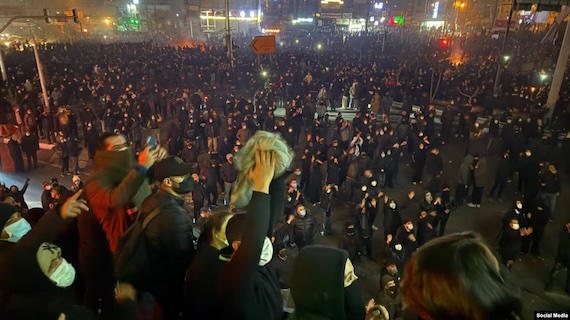
Iran protest. Social Media. Public Domain.
In the case of the Shah, his indecisiveness, partly due to the magnitude of problems that he faced and partly due to the cancer from which he suffered, resulted in total paralysis and inaction. Both the US Ambassador William Sullivan in his book Mission to Iran,[8] and the British Ambassador Sir Anthony Parsons in his book The Pride and the Fall: Iran 1974–1979[9] have written that the Shah had lost any appetite to fight and kept asking them “When do you want me to leave?”.
The current Iranian government is facing a similar dilemma. The 86-year-old Khamenei, who has held power for exactly the same number of years as the late Shah, continues with his usual threats, but the young generation has moved beyond him. Years of despotism and ignoring the wishes of the people have alienated even his closest allies. Various calls for moderate reforms by former officials of the regime, such as former President Mohammad Khatami and former Prime Minister Mir-Hoseyn Mousavi, have fallen on deaf ears.
Mousavi called for a free and “healthy” referendum on the necessity of making changes to the current constitution or drafting a new constitution, which would eliminate the post of Velayat-e Faqih or the chief jurisconsult. Khatami put forward 15 proposals, including, free and competitive elections, reforming the judicial process, releasing political prisoners, lifting media restrictions, combating government corruption, reviewing the role and composition of the Assembly of Experts, the Guardian Council, and the Expediency Council, reducing the role of the military in politics and the economy, and a foreign policy based on dialog rather than isolationism.
The response to those proposals was to isolate the reformers and even put them under house arrest. Now, it may be too late to implement any of those proposals, but even now if, for the good of the country, Khamenei agrees to step down and convene a council to draw a new constitution based on the above proposals and move the country away from a clerical dictatorship to an elected form of democracy, it may be possible to avoid further bloodshed and chaos and maybe Iran’s disintegration.
President Donald Trump should also remember that the vacuums created in Iraq, Afghanistan, Libya and many other countries in the Middle East did not result in stability or the establishment of pro-American governments. He can push for a change of the regime based on peaceful transition and orderly transfer of power, which would safeguard Iran’s stability and the progress of democracy.
The Iranian people have been fighting for democracy ever since the 1906 Constitutional Revolution. Iran’s large educated population, its cultural and scientific achievements, its vast gas and oil reserves, and above all, its human capital are fully capable of establishing a flourishing democracy and a prosperous society.
Notes
[1] “Iran says over 100 officers killed as protesters defy government crackdown”, Al Jazeera, 11 January 2025, https://www.aljazeera.com/news/2026/1/11/iran-says-dozens-of-officers-killed-as-protesters-defy-government-crackdown
[2] Mike Pompeo: “Former Mossad Chief calls me after every explosion in Iran”, Israel National News, Mar 28, 2022, https://www.israelnationalnews.com/news/324786
[3] “Israeli minister says agents ‘operating in Iran’ amid protests”, The Arab News, 9 January 2026. https://www.newarab.com/news/israeli-minister-says-agents-operating-iran-amid-protests
4 Declassified diplomacy: “Washington’s hesitant plans for a military coup in pre-revolution Iran”, The Guardian, 11 February 2015.
[5] Haghayegh Darbareye Bohran-e Iran (“Facts About the Iran Crisis”),1983 (in Persian), Paris: Sāzmān-i Chāp va Intishārāt-i Suhayl
[6] Che Shod Ke Chonan Shod? (Why did it happen?), 1999. ISBN 0967019915.
[7] Jahangir Amuzegar, Dynamics of the Iranian Revolution: The Pahlavis’ Triumph and Tragedy. Albany, NY: State University of New York Press. (1991). p. 88. ISBN 978-0-7914-0731-8.
[8] William Sullivan, Mission to Iran, W. W. Norton & Co., 1982
[9] Anthony Parsons, The Pride and the Fall: Iran 1974–1979; Jonathan Cape, London, 1984

 © 2026 All Rights Reserved