
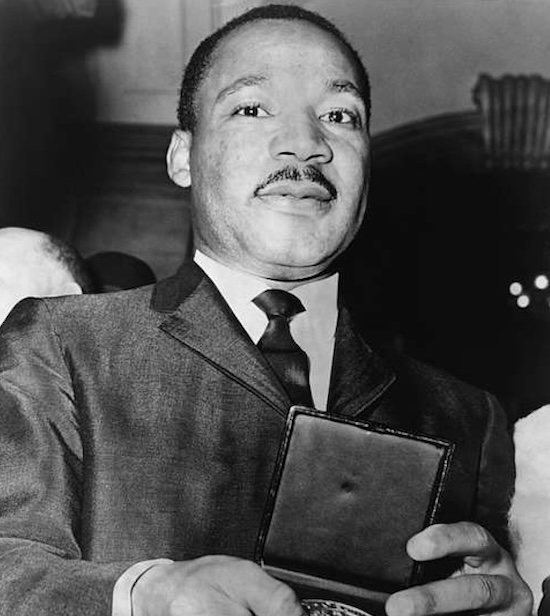
Mitchell Zimmerman recalls his days in the Freedom Movement:
In the mid-1960s, I joined the freedom movement in the South as a member of the Student Nonviolent Coordinating Committee (SNCC) in Georgia, Mississippi and Arkansas. Those were heady years, and I am proud of my small role in the great achievements of that time.

(Here I am in Little Rock, Arkansas in 1966, probably writing an urgent appeal for something.)
Our movement breathed new life into American democracy, inspiring and teaching people who led many of the other liberation movements of the 1960s and 70s. It opened up schools and education and jobs and public accommodations and voting power and electoral office and judgeships to people of color in the South and throughout the country.
But there is also a fight for history. Those who rule our society have a miserly notion of democracy, and they have re-told the story of our movement, to try to make it fit into the way they want most people to act – as passive observers of government and society, who do nothing other than vote every few years.
A giant part of Martin Luther King’s leadership was inspiring others to be leaders
The distorted history they tell of the civil rights movement fits into that stingy vision. Their version of our history says that the movement was about a handful of great leaders, like Dr. Martin Luther King, and their followers.
Dr. King was an extraordinary leader, a moral giant, a radical thinker, a gifted tactician, a great teacher of the power of nonviolence, and one of the most eloquent and inspiring speakers in American history. His memory and his teachings remain a threat to those who seek to empower white supremacy and debase our democracy, which is why the Trumpians denigrate Dr. King and try to obscure his teachings.
But a giant part of Martin Luther King’s leadership was inspiring others to be leaders. The freedom movement was about thousands upon thousands of leaders, all across America, sometimes acting in planned ways, sometimes acting spontaneously.
The movement was about millions of people who took to the streets, the courthouses, the schools, who were jailed and beaten, fired and abused for standing up for themselves, people who nonetheless protested and organized and went to meetings and voted and demanded justice – demanded freedom. Each of them was a leader, too, leading other Americans to understand the flaws of our nation, and the urgency of curing them.
Persisting – not surrendering to despair – is part of the struggle
One other important lesson to understand about the movement was that, with hindsight, its victories appeared inevitable. But they did not seem inevitable at the time. People had to persist in struggle over years and decades, understanding that to grow discouraged would be a kind of surrender, that defeats might not be permanent, nor would victories, and that it might take a long time to finally smash the Jim Crow system.
Those lessons apply to today’s struggle against fascist authoritarianism in the United States. I keep hearing people ask, “What can we do?” and “Can anything we do make any difference?”
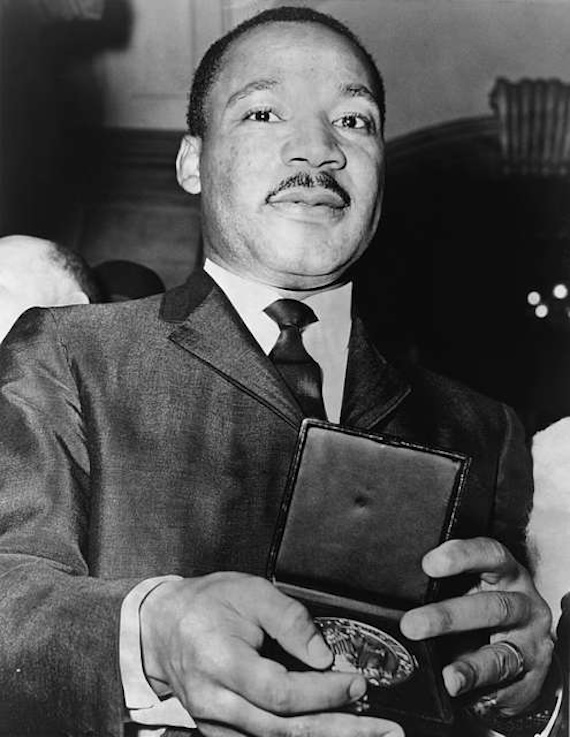
Martin Luther King, Jr. showing his medallion received from Mayor Wagner. Library of Congress. Public Domain. Via Picryl
Persisting – not surrendering to despair – is part of the struggle. Victory over fascism may not be inevitable, but neither is defeat. We must keep demonstrating on the streets – peacefully, no matter what violence ICE wreaks – monitoring ICE activities, recording their abuses and exposing them, disrupting when we can at acceptable risk, writing to our representatives and to newspapers, voting, canvassing, contributing money and time, joining with others, and above all reaching out.
We must all become leaders in small or large ways, attempting to persuade and remind others of the dangers and of the injustices that we are fighting against, and urging them to act.
Dr. King would have recognized the urgency of this moment, as the Trump regime seeks to reverse the gains of the past and to eviscerate American constitutional democracy. And he would have been proud of those who stand up – peacefully, insistently, loudly – and say No, we’re not going to go backward.
Reprinted with permission from Reasoning together with Mitchell Zimmerman

 © 2026 All Rights Reserved