
I’ve been doing a lot of media on the Iran War. See my interview over at Bradblog with Brad Friedman.
And here is my appearance along with Khalil Jahshan of the Arab Center on Turkiye’s TRT World Now on March 4 to discuss the US-Israeli War on Iran.
TRT World Now: “US says it has struck or sunk more than 20 Iranian ships”
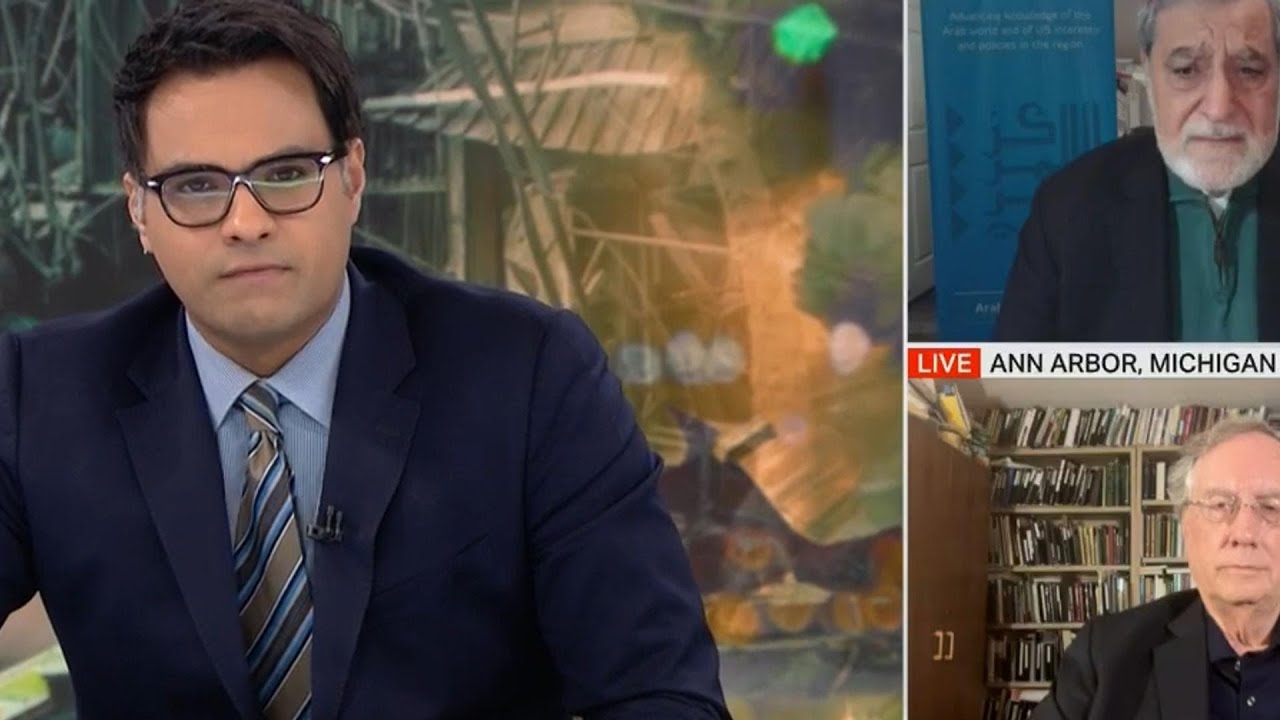
US says it has struck or sunk more than 20 Iranian ships
I asked Anthropic’s Claude to clean up the computer-generated audio transcript for the TRT interview. Caveat emptor.
Transcript:
Host: For more on this, let’s bring in Juan Cole, professor of history at Michigan University. Thanks very much for joining us here on TRT World. You heard the language used by Pete Hegseth there. For example, he said, and I’m quoting him, “death and destruction from the sky all day long.” Obviously, he’s talking about Iran here. I don’t remember any previous US administration using such language to describe US operations.
Juan Cole: Well, actually, it’s similar to the kinds of things that were said about Iraq in 2003. In fact, Hegseth reached back for that slogan of “shock and awe.” And the thing is that shock and awe didn’t work. The next thing that happened was the United States was drawn into a 20-year quagmire.
Host: Professor, stay with us. I’m also joined by Khalil Jahshan. He’s the executive director at the Arab Center and he joins us from Washington. Khalil, I was basically discussing the language that was used by Pete Hegseth to describe the operation, and obviously when you look at the language, it’s not hard to tell that the rhetoric coming from the Trump administration is very strong. What do you make of it?
Khalil Jahshan: Not much. Knowing where the secretary of defense — or secretary of war, as he likes to be called — comes from in terms of his political background, that’s not necessarily very impressive. He never met a war he didn’t like. He sounds tough to cover up for his weakness, and his statements were not only not reflective of realities on the ground, but as a matter of fact they were not reflective of realities at the White House. He doesn’t seem to have coordinated his language with that of his boss. So it wasn’t really that impressive.
Never miss an issue of Informed Comment: Click here to subscribe to our email newsletter! Social media will pretend to let you subscribe but then use algorithms to suppress the postings and show you their ads instead. And please, if you see an essay you like, paste it into an email and share with friends.
Host: Professor Cole, when it comes to the objectives that the Trump administration has outlined for this combat operation, it seems to me that there’s a lot of ambiguity. In the wake of this operation being announced, the listed objectives were regime change in Iran. But now, as days have passed, the objective appears to be shifting. What do you make of this shifting stance of the Trump administration?
Juan Cole: It was never clear what the goal of this war was. The likelihood that you could achieve regime change by bombarding people from the air was always very low. It has very seldom happened in history, and it hasn’t happened this time. To the extent that a popular opposition was building against this government in the streets in January, by bombarding the country, that movement has had the steam taken out of it. You can’t go into the streets if you’re afraid of being bombed, and moreover you look like a traitor if you’re demonstrating against the government when it’s under bombardment. So the idea of regime change in this way was always foolish, and it hasn’t happened. It’s not likely to happen. The goals of this bombardment have been to weaken Iran’s ballistic missile and drone capabilities. It may well be that many of the launchers have been taken out, but Iran still seems to be able to put large numbers of drones out there. The Shahed drones are striking all over the region. So even that goal, so far, seems distant.
Host: That’s a great point, because no one really knows the strength of Iran’s missile arsenal. Even according to US intelligence, they’re not sure of the exact number Iran has. That brings me to the question, Khalil — we heard President Donald Trump say very recently, in today’s press conference, that if the US had not launched this operation, Iran would have a nuclear weapon. But I recall that last year in June, President Trump claimed that the United States had obliterated Iran’s nuclear program. So how can Iran be on the verge of a nuclear weapon now?
Khalil Jahshan: Look, this whole story about Iran’s nuclear weapons is an old one. We have seen it a hundred times in so many different fashions. The secretary of state said, just a couple weeks ago, that Iran is about a week away from developing a nuclear weapon — and they’ve been saying that for years. So, number one, what is the United States attacking? An existing, or a non-existing, a phantom nuclear program? Number two, back in June, the president made it very clear that the program had been destroyed, and when the media objected to that, he started calling people in the media names and questioning their professional ability to judge what happened, claiming that the whole program had been obliterated. Now all of a sudden it’s alive and well and threatening. This is the problem with this whole campaign. The rationale for it doesn’t make sense. That’s the reason most experts call it illegal, in terms of both international law and domestic US law — in the sense that Iran did not, at least last Saturday or Friday, the day before, constitute a mortal threat to the United States justifying its action. The US got involved in this war because Trump was dragged by Netanyahu, for his own reasons, into a war that Netanyahu has been advocating for more than 42 years. It has nothing to do with any threat, nuclear or otherwise, to the United States.
Host: Professor Cole, right now there is a growing consensus among experts that the US got involved in this war largely because of Israel. In fact, this was something that was acknowledged by Marco Rubio as well. Historically speaking, to what extent has this dynamic influenced US foreign policy?
Juan Cole: The United States is very close to Israel, and most Washington politicians see Israeli interests and US interests as the same. In this case, I agree with my colleague that there was no threat to the United States from Iran. And indeed it doesn’t seem to me that there was much of a threat to Israel from Iran either. After the 12-day war last summer, Iran’s capabilities had been much reduced. It lacks anti-aircraft batteries and can’t defend itself very well. It has those missiles and drones, but they haven’t been used except in a defensive posture until now. The US political establishment, however, sees Israel as a kind of aircraft carrier on land for the United States in the Middle East — a tool with which the US can achieve its objectives. Among those objectives are dominating the energy resources of the region and ensuring that there are no challenges to US predominance of the sort that Iran represents. To that extent, I think Trump is somewhat unusual in being willing to be led by Netanyahu. But we saw in Gaza how Biden declined to tell the Israeli government to cease its genocide. I think that the two governments have been joined at the hip for some time.
Host: Professor Cole, let me add one more question. Is it Israel that’s acting as a tool for the United States to achieve its objectives, or is it the other way around? Because from all indications right now, it seems that the US is acting as an extension of the Israeli army in the Middle East.
Juan Cole: I think the Israeli government took the lead on pushing for this war at this time. But I maintain that it wasn’t a hard sell in Washington. The political elite in Washington has hated the Iranian government for 47 years. It has been a thorn in the side of US interests in the region. The US petroleum companies, I think, bear as much blame as anybody else for this war, because they want to get into Iran and develop its petroleum, and they can’t do it as long as that government is there — there are sanctions on that government. There is every reason to think that they were pressuring Trump to do this as well. There is also a Christian white nationalist constituency in the United States which is very wedded to an alliance with Israel and which hates Iran — they’re hoping to turn the Iranians into evangelical Christians. There are a lot of ill-considered reasons for which the US is involved in this, but I don’t think it should be forgotten that oil is predominant. There’s a reason the dictatorship in Burma hasn’t been attacked by the United States.
Host: Now, Khalil, let me come to you. Obviously, there are many questions on people’s minds right now, and perhaps the biggest one — and I’m sure many watching us must be wondering as well — are we heading towards world war?
Khalil Jahshan: I’m not sure we’re heading towards world war. But once you enter into an aimless war that is not justified, that has no exit ramp and no clear objectives, you always put yourself in a predicament that could lead to a much larger conflict. Frankly, what we have seen over the past five days has been an expansion of the war theater. Unfortunately, the people who have been damaged so far are basically US allies. If there is a winner at all so far, it’s essentially Israel, in the sense that Netanyahu got his political objective — short-term, long-term, who knows. As far as the United States is concerned, I don’t think it has gained anything. Its credibility is at stake, and I’m not sure that public support for the administration is increasing. It remains very low compared to other foreign conflicts in the past, where American citizens tend to rally around the flag. That hasn’t happened this time. The president has not been able — or has been unwilling — to explain this war to the people, or to involve the US Congress in the decision to authorize it. Therefore the danger of this war expanding is very real. I’m not sure about the whole world, but it has definitely become a regional war.
Host: Talking about the US Congress — we just got results from a Senate vote, and it seems that the Senate basically backs President Donald Trump’s war against Iran. It was a vote that took place along party lines, but the Senate is backing Donald Trump right now.
Khalil Jahshan: That’s what Trump bet on, definitely. He knew the makeup of Congress, and otherwise he wouldn’t have gambled the way he has by proceeding with this war without authorization from Congress and without public support. But the lesson is not where Congress stands. We know that Congress at this time is totally paralyzed and morally bankrupt — it is entirely a tool in the hand of the administration because of the Republican majorities in both the Senate and the House. The danger lies in entering into, again, an endless war that doesn’t seem to have a clear objective and that gets the United States into all kinds of internal and external problems. And it’s very costly. Sending all these aircraft carriers and dozens of warships to the region is already in the billions of dollars. We are reminded, as the professor said earlier, of the Iraq war, which was supposed to take a few days or a few weeks and ended up lasting a whole decade and costing the United States taxpayers more than a trillion dollars. I think we are heading in that direction right now.
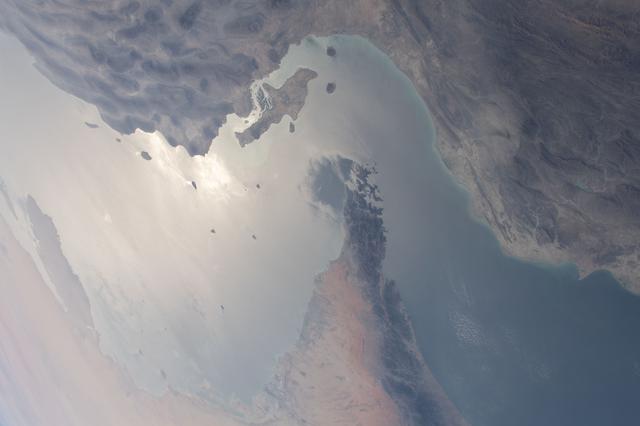
NASA ID: iss064e046338 (March 24, 2021) — The strategically important shipping route of the Strait of Hormuz is pictured separating the nations of the United Arab Emirates and Iran. It also separates the main water bodies of the Persian Gulf and the Gulf of Oman.
Date Created:2021-03-24
Host: You both mentioned the Iraq war. Professor Cole, let me come to you. Many are trying to draw parallels between what’s happening now and 2003, when the US invaded Iraq, but it seems to me the scale of confrontation we are witnessing this time around is much larger. The obvious question is: is this the biggest risk an American president has ever taken in the Middle East?
Juan Cole: Well, certainly among the biggest risks. The important thing to underline is not only that this has become a regional war — because the Iranians are deliberately attempting to punish US allies — but it has also become a war over energy resources. The Strait of Hormuz has effectively been closed, more because of spiking insurance prices than because of kinetic action on the part of the Iranians, but nevertheless Qatari liquefied natural gas is not being exported. Qatar has closed down. It is the third largest producer of natural gas in the world. Twenty percent of petroleum on the world market comes through the Strait of Hormuz, and it is not coming out. If this goes on very long, it could throw the world into an economic recession, and we could see big spikes in energy prices. This is going to affect Europe very badly — it has already tried to wean itself off of Russian gas and doesn’t have much petroleum of its own. It’s going to affect India, and now we see an Iranian warship that had been engaged in joint naval exercises with India [in the coastal city of Vishakapatnamat at the 2026 International Fleet Review] has been sunk by an American submarine. What does that say to India about US-Indian relations? This is becoming — it has the hallmarks of a world crisis. Even though “world war” is too strong a term, it is certainly a world crisis, and the longer it goes on, the bigger the crisis will be.
Host: We’ll have to leave it there for now. Professor Juan Cole and Khalil Jahshan, thanks very much for joining us here on TRT World.

 © 2026 All Rights Reserved