
( OpenDemocracy.net ) – Donald Trump’s plan to raise US military spending to $1.5trn at best signals a plan to put military force at the centre of his presidency, and at worst, an administration planning for all-out war.
The president this week unveiled his proposal to increase the defence budget by almost 60% by the 2027 fiscal year, after three weeks of lethal US operations in Nigeria, Syria, Venezuela and the Caribbean and Pacific littorals.
An increase of this kind, up from $901bn this year, suggests a White House making preparations for major war – a scenario that Trump has said the world must be prepared for.
Announcing the plan on his Truth Social platform after the US military’s kidnapping of Venezuelan President Nicolás Maduro, Trump said we are in “very troubled and dangerous times”.
Trump added that the spending increase “will allow us to build the ‘Dream Military’ that we have long been entitled to and, more importantly, will keep us SAFE and SECURE, regardless of foe.”
What the US president intends needs to be put in the context of what the Pentagon has been doing over the past three weeks.
The seizure of Maduro, as well as the assault on the Venezuelan capital, Caracas, and three other Venezuelan states, was a huge operation involving 150 US military aircraft and a large Special Forces contingent.
Damage on the ground was considerable, with 32 Cubans and 24 Venezuelans reported to have been killed, according to officials in both countries, although Venezuelan interior minister Diosdado Cabello put the losses much higher, at more than 100 people.
The attacks also did substantial damage to the country’s communications and power supplies. Since then, Trump has made clear that Venezuela’s role now is to supply the United States with oil and to buy US goods in return. Either it becomes a client state of the US, or it will be subject to further attack.
Trump’s attempted regime termination in Venezuela may have taken the US to a new level of militarism, but it also tells us how the ten months to the mid-term elections will likely pan out.
Media attention has focused on Venezuela over the past three weeks, but it has been far from the US’s only target. The US military has used lethal air power in at least four other conflicts across three continents, including a series of airstrikes against Islamist paramilitaries in northern Nigeria on Christmas Day.
Trump has said the attack was in response to the persecution of Christians in Nigeria, even telling The New York Times this week that more attacks will follow “if they continue to kill Christians”.
While there is little evidence to support this claim, it is a message likely to play well among US evangelicals, especially Christian Zionists, on whom Trump depends for votes. In practice, the security impact was minimal, and a week later, paramilitaries attacked Kasuwan Daji market in Niger Province, killing at least 30 people and abducting many more.
Meanwhile, US Southern Command forces continued a four-month campaign of attacks on small boats in the Caribbean and Pacific littorals, claimed to be transporting drugs from Venezuela to the United States. Attacks on 31 December killed five people, bringing the total since early September to 114 deaths across 35 attacks.
Still within the same three-week window, US Central Command carried out what it described as a “massive strike” against ISIS in Syria, attacking over 70 targets using strike aircraft, attack helicopters and artillery.
US forces were also involved in attacks against al-Shabaab Islamist paramilitaries near Jilib in central Somalia, the latest in a series of US operations across the country.
Furthermore, the Pentagon is expanding its operations to track and board oil tankers, particularly those transporting oil from Iran and Venezuela to Russia.
Beyond all this, Trump is allowing Netanyahu in Israel to act with impunity in Gaza, while pushing ahead with a huge new settlement construction programme in the Occupied West Bank and East Jerusalem.
This renewed emphasis on foreign interventions gives the lie to claims of a presidency seeking to avoid foreign wars. The reverse is true, and Trump appears utterly convinced that he can act with impunity in his efforts to make the US the world’s most powerful state.
Moreover, the scale of the Venezuela attack sends a clear message to Latin American countries about what Trump is willing to do. It also fits into a wider strategy of signalling power to China, a particular target of the Venezuela operation.
China is currently involved in some 600 joint projects with the Caracas government and has around $70bn invested in the country.
Within the depths of the Trump administration, there will be recognition that the US is in economic decline relative to the rise of China, particularly in its relations with the Global South. Where it is not in decline, however, is military power, with a burgeoning defence budget and a worldwide network of more than 750 military bases across eighty countries.
Partly because of this, Trump’s success in Venezuela gives him the confidence to go further, making him more willing to threaten regime change in Cuba, Mexico, Colombia and, of course, Greenland.
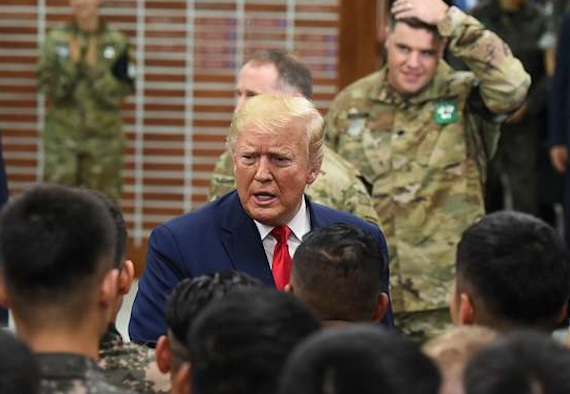
File Photo: President of the United States, Donald J. Trump shakes hands with Soldiers stationed at the Joint Security Area, Panmunjon, June 30, 2019 as part of his two-day state visit to South Korea (U.S. Army photo by Staff Sgt. Joel Salgado, Eighth Army Public Affairs). Public Domain. Via Picryl
There is a further factor over the next ten months. For Trump’s MAGA movement to stay on track, Republicans must retain control of both Houses of Congress. Yet they already face serious problems in the Lower House, where all 435 seats are up for election in November, and polling suggests a potential loss of control.
Trump also faces deep domestic tensions in an increasingly polarised country, with the angry reaction to the killing of Renee Nicole Good by ICE agents in Minneapolis being only the latest example.
More generally, for most Americans, the state of the economy is making life worse, not better, unless they are among the minority benefiting from recent tax changes. At the same time, cuts to federally funded programmes in social security, health and other areas are becoming increasingly visible.
In such circumstances, selected foreign wars over the coming months would serve as powerful demonstrations of the supposed greatness of Trump’s America and could help MAGA in its moment of need. That is an added reason for political leaders in Cuba, Mexico, Greenland, Denmark and elsewhere to view the months ahead with trepidation.
This article is published under a Creative Commons Attribution-NonCommercial 4.0 International licence.

 © 2026 All Rights Reserved