
( Tomdispatch.com ) – Some tales can cross cultures, continents, and even centuries to arrive in our own era with their timeless truths pretty much intact. That’s particularly so for the immortal story of “an appointment in Samarra.” It first appeared in the fifth century in the Babylonian Talmud, that ancient repository of Jewish rabbinical wisdom. Then it crossed over into Islamic literature for reiterations in a thirteenth-century Persian version and a fifteenth-century Egyptian text, before popping up on the London stage in Act III of William Somerset Maugham’s 1933 play Sheppy.
In Maugham’s retelling, the tale is rich in irony. Once long ago, he wrote, there was a merchant in Baghdad who sent his servant to shop in the market. But the servant soon returned home in a panic and told his master about a woman in the crowd there who stared at him angrily. “It was Death that jostled me,” the servant announced, pleading with his master for a horse to flee to the town of Samarra. There, said the servant, “Death will not find me.”
Riding hard and spurring the horse’s flanks, the servant raced across the desert and made it to Samarra by nightfall. That evening, the master himself went to the market and spotted the woman, demanding to know why she had threatened his servant. “That was not a threatening gesture,” said Death. “It was only a start of surprise. I was astonished to see him in Baghdad, for I had an appointment with him tonight in Samarra.”
More than anything else, that ancient tale testifies to the eternal human folly of trying to outrun fate. And if that’s true for individuals, it’s doubly true for one of their most ancient collective creations, the phenomenon we call “empire.” Ever since Sargon the Great of Assyria founded history’s first trans-regional empire in 2300 BCE, the world has witnessed a succession of some 200 empires, of which 70 were large or lasting. Over the span of those 4,000 years, each empire rose, reached a peak so powerful that it seemed eternal, only to fade and finally fall, giving way to the next imperial reality.
Until January 2025 when President Donald J. Trump took office a second time, the United States seemed to be following that fateful journey. After nearly a century as the largest, most powerful empire in history, the country seemed to be on a gradual downward trajectory from the peak of power it reached around 1991 (when that other imperial power of the time, the Soviet Union, collapsed). But from the first day he took office the second time around in January 2025, President Trump assured us that his bold plans to “Make America Great Again” would save this country from that sad fate. To understand how and why our master, our president, is, in fact, leading America to its own appointment in Samarra at a remarkably rapid pace, we need to understand the way this country has exercised its global power and the dynamics underlying its long-term decline.
The Cold War Legacy
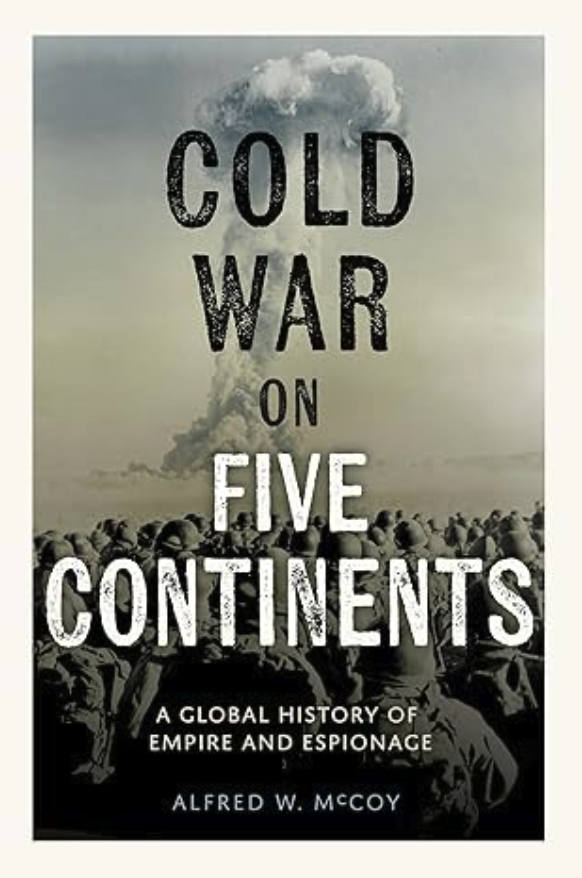
Throughout the 44 long years of the Cold War (1947 to 1991), Washington pursued an effective geopolitical strategy for containing its chief global rival, the Soviet Union, behind an “Iron Curtain” guarded by a chain of U.S. military bases and alliances that stretched for 5,000 miles across the broad Eurasian land mass. Whenever Moscow tried to break out of its geopolitical isolation by arming surrogates in Asia or Africa for war or revolution, Washington, as I explain in my latest book Cold War on Five Continents, sometimes sent troops, as in South Korea in 1950. Usually, however, it dispatched individual CIA officers to organize covert interventions to beat back any Soviet advance, as it did so effectively in Afghanistan in 1980. In the end, exhausted by one foreign adventure too many, Moscow was forced to acquiesce as its satellite states in Eastern Europe broke away and the Soviet Union shattered. By 1991, Washington had won the Cold War, emerging from that monumental conflict as the world’s sole superpower.

At that hour of seemingly ultimate triumph, the signs of America’s military omnipotence and its overweening imperial hubris were both amply evident.
Let’s start with Washington’s imperial hubris. At the close of the Cold War, political scientist Francis Fukuyama published an article that became a veritable manifesto for Washington’s power elites. Not only were we witnessing the end of the Cold War, he argued, but we were also seeing — yes! — “the end of history” through the “universalization of Western liberal democracy as the final form of human government.” Not only was there a “total exhaustion of viable systemic alternatives to Western liberalism,” but there was also, he claimed, an “ineluctable spread of consumerist Western culture” to the most remote corners of the globe, even into the shopping malls of our former enemies, China and Russia.
And his viewpoint did indeed reflect a certain reality: Our nation’s leaders were fully convinced that their Pax Americana would become the final form of global governance for all of humanity for all time. While that unapologetic imperial hubris may now seem almost quaint, in the aftermath of the Cold War it became gospel. It guided Washington’s leaders who indeed seemed to wield ample enough power, both military and economic, to fulfill that bold vision for remaking the world in America’s image.
Next, as for U.S. military omnipotence, while the Russian military was ravaged by the collapse of the Soviet Union and China still couldn’t project power beyond its own borders, America’s armed forces emerged from the Cold War as a global behemoth. By the mid-1990s, the U.S. had more military forces than all the other major powers combined — with more than 700 overseas bases, an air force of 1,760 jet fighters, more than 1,000 ballistic missiles, and a navy of 600 ships, including 15 nuclear aircraft carrier battle groups — all linked by the world’s only global system of communications satellites.
When Iraq’s military dictator Saddam Hussein occupied the small petro-state of Kuwait in 1990, Washington mobilized a coalition of 42 nations to obliterate the Iraqi army in the Gulf War with a show of overwhelming force evident in that conflict’s glaring disparity in casualties. The U.S.-led coalition killed an estimated 50,000 Iraqi troops and destroyed more than 5,000 of that country’s armored vehicles at a cost of just 292 of their own soldiers.
A few years later, in 2002, imperial historian Paul Kennedy reviewed the relative strength of rival empires over the past 500 years, concluding: “Nothing has ever existed like this disparity of power; nothing.” Given America’s “mind-boggling” dominance in finance, scientific research, and, above all, military strength, there was, he added, “no point in the Europeans or Chinese wringing their hands about U.S. predominance and wishing it would go away.” In sum, he concluded, any chance for a serious erosion of Washington’s global power “seems a long way off for now.” But to give Professor Kennedy his due, he did warn that China was “perhaps the only country that — should its recent growth rates continue for the next 30 years and internal strife be avoided — might be a serious challenger to U.S. predominance.”
Seeds of Decline
Yet even at a peak of military supremacy not seen since ancient Rome, America’s asymmetric power was already starting to slip silently, slowly, but inexorably away. Part of that power loss was a tribute to the dynamic world order that Washington had created in 1945 at the end of World War II. Under its innovative system of free trade, low-cost development loans, and stable exchange rates (based on the U.S. dollar), the world dug itself out of the rubble of global war and enjoyed a half-century of unprecedented prosperity.
As the rest of the world experienced a rapid economic recovery exemplified by Germany’s solid 6% annual growth rate and Japan’s sizzling 10%, America’s share of the global economy would, in fact, decline steadily from a formidable 50% in 1945 to 40% in 1960 to just 25% in 1995, and there it would essentially remain for several decades. Using an index called PPP (Purchasing Power Parity) that measures the real value of economic output, the International Monetary Fund calculates that, in 2026, China now leads the world with 20% of global economic output, the U.S. comes in second at just 15%, and the European Union places a close third at 14%. In effect, over the past 80 years, the United States has gone from a towering economic Titan, capable of dictating the terms of trade to the rest of the world, to just one among several major players that must bargain with its peer rivals, China and Europe.
As this country’s economic superiority, the foundation for its global hegemony, slowly began to ebb, Washington’s leaders made some dubious decisions about the Middle East and also China that contributed to the erosion of their international influence. In 2001, in the wake of the 9/11 attacks, the U.S. invaded Afghanistan and Iraq, seeking to bring the Pax Americana with its “universalization of Western liberal democracy” to the oil-rich Middle East (and beyond). As President George W. Bush told the nation in 2004: “America is pursuing a forward strategy of freedom in the greater Middle East” through “the development of free elections, and free markets, free press, and free labor unions… in Afghanistan and Iraq, so those nations can light the way for others, and help transform a troubled part of the world.”
While the U.S. was pouring its blood and treasure (an estimated $4.7 trillion worth) into those desert sands, China was enjoying a decade of warless economic growth. By June 2014, in fact, it had accumulated $4 trillion in foreign currency reserves — and in a major strategic miscalculation, Washington had even lent a hand. In deciding to admit Beijing into the World Trade Organization in 2001, Washington’s leaders proved bizarrely confident that China, home to a fifth of humanity, would somehow join the world economy without changing the global balance of power in any significant way.
In 2013, as Beijing’s annual exports to the U.S. grew nearly fivefold to $462 billion and its foreign currency reserves approached that $4 trillion mark, President Xi Jinping announced his historic “Belt and Road Initiative.” Thanks to that initiative and the lending of a trillion dollars to developing nations, within a decade China would become the dominant economic player on three continents — Asia, Africa, and, yes, even Latin America.
Trump’s Grand Strategy for Making America Great Again
In 2021, at a delicate juncture in the history of U.S. global power, President Joseph Biden took office with a reasonable strategy for managing Washington’s position in a changing world. Above all, he tried to maintain the longstanding U.S. geopolitical position astride the Eurasian landmass by strengthening the NATO alliance in response to Russia’s 2022 invasion of Ukraine and by expanding the country’s Asia-Pacific alliances to contain China.
To complement that geopolitical strategy, the Biden White House pursued traditional U.S. free-trade policies, while working through the international organizations that were the hallmark of Washington’s world order. In response to the globe’s rapidly accelerating green-energy transformation, the Biden administration also launched a trillion-dollar program to modernize the nation’s electrical grid and support Detroit’s transition to electric vehicles. Had Washington continued such policies long enough to realize their promise, the U.S. might indeed have remained a primus inter pares, a first among relatively equal world powers, while protecting its global economic strength and promoting its international influence.
But in January 2025, Donald J. Trump took office (again!) with a seemingly bold vision for nothing less than a new world order. If you sort through all the static and superficial chaos that emanates from official Washington these days, it’s possible to identify three intertwined strands in Trump’s grand strategy for U.S. foreign relations — a tricontinental division of global power, the continued use of traditional oil-powered energy, and a transactional international trade.
Instead of maintaining alliances like NATO, the foundation of the U.S. position in Eurasia (long the epicenter of global power), President Trump has pursued a tricontinental strategy for a world divided into three great-power blocs — with Russia resurgent in the old Soviet sphere, China ascendant in Asia, and the U.S. dominant in the Western Hemisphere. All of his seemingly erratic statements in his first months back in the White House about claiming Greenland, reclaiming the Panama Canal, and making Canada the 51st state were, in fact, expressions of his underlying geostrategic vision. Indeed, he became so insistent in his attempt to grab Greenland — the sovereign territory of NATO ally Denmark — that it threatened to rupture that alliance, long central to U.S. global power.
Last November, the Trump White House imposed an overarching logic on the president’s seemingly erratic eruptions by releasing its National Security Strategy. Reflecting the president’s longstanding aversion to the NATO alliance, the document predicted that Europe faced a “stark process of civilizational erasure” though a mix of multiracial migration and “cratering birthrates” that raised the question of whether its nations would stay “strong enough to remain reliable allies.”
Instead of relying on an unreliable Europe, that strategy document insisted that Washington must “be preeminent in the Western Hemisphere as a condition of our security and prosperity.” To that end, the U.S. should refocus its “global military presence to address urgent threats in our Hemisphere,” while redeploying the U.S. Navy to “control sea lanes” closer to home. By using “tariffs and reciprocal trade agreements as powerful tools,” the Western Hemisphere would become, the document claimed, “an increasingly attractive market for American commerce” and that ever-rising power China would be pushed out of the region.
All those puffy abstractions gained a physical reality in January when a U.S. naval armada, amassed off the coast of Venezuela, sent Special Forces shooting their way into its capital, Caracas, seizing President Nicolás Maduro and taking control of his country’s oil reserves, the world’s largest. While the U.S. might have only 4.7% of the globe’s proven oil reserves, by adding Venezuela’s (17.2%) and possibly Canada’s (9.2%), Washington would suddenly control 32% of the planet’s total oil supply — more than enough to fuel Trump’s contrarian vision of America as a petroleum-fueled superpower and defying what he believed was a disastrous global turn toward green energy.
With Caracas now allowing Washington to control access to its oil and billions of dollars of its oil revenues already sequestered in a Persian Gulf bank that would be under his sole control, Trump is well on his way to achieving the second strand in his grand strategy by returning the United States to its traditional full-scale reliance on oil-powered energy. By trying to bar the completion of coastal wind farms, cancelling tax credits for electric vehicle purchases, opening a billion acres of federal lands to oil exploration, and preventing the planned shut-down of aging coal-fired power plants, after just one year in office, Trump has essentially smothered America’s infant green-energy economy in its cradle (and ceded a future green-powered global economy to China).
With his escalating, ever-changing tariffs on imported goods — the third strand in his strategy — the president has roiled the global economy sufficiently to achieve his objective of replacing rules-based free trade with a transactional system that makes access to the U.S. market contingent on his caprice. When he first imposed a roster of high tariffs on what he called “Liberation Day” in April 2025, he claimed that jobs and factories would “come roaring back into our country.” But by zapping allies and enemies alike with his rat-a-tat-tat burst of tariffs, he raised the average U.S. tariff on imports from 2.5% in January 2025 to a hefty 16.6% just six months later, the highest since 1932, while not faintly stopping the ongoing loss of jobs in the manufacturing sector.
That Appointment in Samarra
Setting aside President Trump’s celebratory claims of miraculous success, there are ample grounds to argue that each strand of his grand strategy is rapidly accelerating the decline of U.S. global power.
His ongoing retreat from Europe into the Western Hemisphere — the first strand — is already eroding Washington’s position in Eurasia, the cornerstone of its geopolitical power for nearly 80 years. Such a withdrawal is tantamount to a full-scale surrender in the great-power struggle between Beijing, Moscow, and Washington for Eurasia that scholars have dubbed “the new Cold War.”
Moreover, the president’s heavy-handed policy toward the Americas is already alienating this hemisphere’s major nations — sending Canada’s prime minister to Beijing in search of a major trade deal to offset punitive U.S. tariffs, and prompting Brazil to lead the Mercosur bloc of South American nations in signing a landmark trade pact with the European Union. Over the past 25 years, moreover, Brazil has led its region in making China its top trading partner and a key source of capital for auto manufacturing, major infrastructure building, communications, and computer technology. If such trends continue, Trump’s strategy could not only reduce the U.S. from a global hegemon to a regional power, but also leave it remarkably isolated diplomatically and otherwise in its own hemisphere.
In the second strand of his strategy, Trump’s aggressive anti-climate-change advocacy of fossil fuels is delaying, at an incalculable cost, this country’s participation in the global shift to renewable energy — a change so profound and pervasive that it’s nothing less than a new industrial revolution, one whose leadership the president is handing to China. In less than a decade, solar-powered electrical generation has already cut costs and increased efficiency, becoming 41% less expensive than the cheapest fossil fuels. And engineering innovations in panel design and battery storage are likely to make any future use of carbon-fueled electricity economically infeasible. In 2025, while the U.S. was blocking wind farms and straining its grid by building ever more data centers, China increased its total power generation by 16%, with solar and wind energy now accounting for half of that country’s total installed electrical capacity.
Just as China already produces 80% of the global supply of solar panels and their components, so its recent innovations in electric vehicle (EV) design, including five-minute charging for a 320-mile range, have allowed it to capture 70% of global EV production. In the past five years alone, China’s share of worldwide auto manufacturing has surged to 24%, while Detroit’s share fell to only 16%, driven in part by a costly retreat from EV production since Trump took office a second time. Import duties of 100% might continue to keep Chinese electric cars out of the U.S., but Detroit’s big three (Ford, GM, and Stellantis) do the bulk of their business overseas where their lack of competitive EV models threatens their profitability and even, ultimately, their survival. “I have 10,000 dealers around the world,” said Ford’s CEO Jim Farley recently. “Only 2,800 are in the U.S. So, you do the math.”
And while Trump’s ambitious tariff policy — the final strand in his grand strategy — is producing some short-term gains in revenue, it carries some serious long-term costs. When the U.S. accounted for 50% of the global economy in the 1940s, Washington could play any tune and the world had to dance. Now, however, with just 15% of global output, Washington might well find itself ever more economically isolated as major players choose other commercial partners. Trade represents about 57% of gross domestic product in countries worldwide, so no nation can long prosper in commercial isolation.
With his seemingly bold moves to avert American decline, President Trump is, in fact, adopting ill-considered policies that will, in the end, serve to accelerate that very decline. Like the merchant in that tale who sent his servant to Samarra to avoid Death, President Trump is sending the United States down a path that is leading to its own appointment in Samarra.
Copyright 2026 Alfred McCoy
Via Tomdispatch.com

 © 2026 All Rights Reserved