
Ann Arbor (Informed Comment) – The Wall Street Journal reports from three US government officials that the some 1000 remaining American troops in Syria will be completely withdrawn from the country over the next two months.
Al Jazeera did follow-on reporting on this story, though it could not confirm from Trump administration officials the report of a quick and total withdrawal.
The move is impelled by strategic considerations, but reflects President Donald J. Trump’s longstanding antipathy to keeping US troops in theaters of war abroad. He put a great deal of effort in 2020 into withdrawing from Afghanistan, and agreed with the Taliban to do so in ways that tied the hands of the Biden administration. Thus ended America’s longest war, 2001-2021.
Trump expressed a desire to withdraw from Syria in his first term, in December 2018. He was apparently encouraged in this course of action by Turkish President Tayyip Erdogan.
Following a phone call with Erdoğan that December, Trump tweeted that “We have defeated ISIS in Syria, my only reason for being there during the Trump Presidency.” Secretary of Defense James Mattis and officers in the Pentagon disagreed with the decision, apparently feeling that US troops were still needed to ensure that ISIL did not regroup and come back. Someone had the bright idea of telling Trump that there is a bit of petroleum production in southeast Syria, and that if US troops left it would be seized by the Bashar al-Assad government in Damascus. As it was, a bit was pumped and exported by the Kurdish forces that had defeated ISIL with US help. Trump has a mania about grabbing other countries’ petroleum, and the argument was enough to convince him to leave a small force at Tanf.
It is widely thought that the US troops at the Tanf base in southeast Syria also worked against the smuggling of arms by Iran and Iraqi Shiites through Syria to Hezbollah in south Lebanon, on behalf of Israel.
The various missions of the small US force in Syria — making sure there was no ISIL resurgence, giving support to the Kurdish-led Syrian Democratic Forces and ensuring they were supported by some oil revenues, and blocking Iran from supporting Hezbollah — no longer make any sense in the current environment in Syria.
The current Syrian government, which came to power in December 2024, sprang from fundamentalist groups that had once been allied with ISIL but which broke with it in 2012 and which have an enmity with it. They are happy to ensure that there is no ISIL revival. The government of Ahmad al-Sharaa seized Deir al-Zor and Raqqa Provinces in the east from the Kurdish-led SDF in mid-January, as the Arab levies in the SDF deserted their Kurdish comrades for al-Sharaa.
Al-Sharaa then insisted that the Kurdish units of the SDF be incorporated into the Syrian national army. Although the Kurds had no choice but to agree in principle to this demand, everyone understands that such integration will be a slow process and that forms of semi-autonomy would continue in the northeastern Kurdish regions.
When the Syrian army took Deir al-Zor and Raqqa, and Kurdish forces withdrew north, it left some 6,000 hardened ISIL POWs without prison guards. The US forces quickly intervened to see them transferred to Iraq, where they will be tried.
The al-Hol, held some 24,000 people, both fighters and civilian family members. When it was taken on January 21 by the Syrian government forces, chaos reigned thereafter and 20,000 people seem to have fled, many to Idlib Province, which had been the base of the Syrian Liberation Council that took Damascus late in 2024. So far, the Syrian government does not report problems with these escapees in Idlib.
The remaining few thousand people at al-Hol are now being resettled on the outskirts of Aleppo, essentially permitted to form villages and to be reintegrated into society. Al-Hol has been closed as of today.
In any case, ISIL is now the problem of the fundamentalist Syrian government, which is in charge of curbing it.
Since Sunni fundamentalists have taken over Syria, it is no longer being used as a smuggling route for Shiite Iran to resupply Hezbollah, and so the US forces no longer need to play the role of spoiler there.
The Trump administration wants the fundamentalist government to get the oil revenue from the small fields in Deir al-Zor, and so US troops are not needed to help divert it instead to the Kurds in the northeast, whom Trump has repeatedly thrown under the bus.
Last December, two US service personnel were killed in an ISIL ambush, pointing to a problem with keeping such a small force in a still-revolutionary country: they become targets themselves.
So we have Trump’s antipathy to long-term boots on the ground as well as the evaporation of all the reasons initially given for a US troop presence.
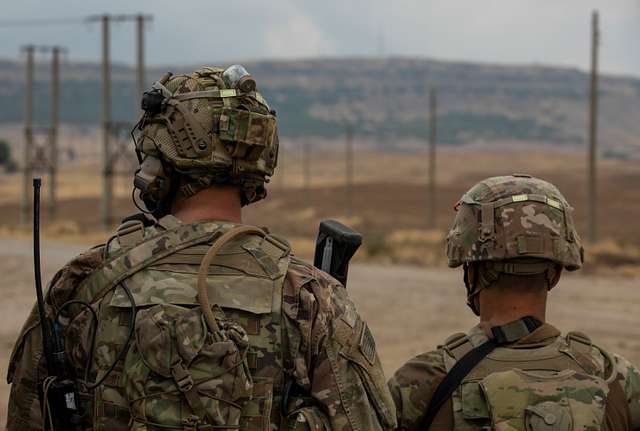
File photo, U.S. Soldiers, with Alpha Troop, 1st Battalion, 6th Infantry Regiment, 2nd Armored Brigade Combat Team, 1st Armored Division, Nov. 16, 2020, in Syria to support the Combined Joint Task Force-Operation Inherent Resolve (CJTF-OIR) mission. (U.S. Army photo by Spc. Jensen Guillory). Public Domain. Via Picryl
The WSJ story may or may not be true, but if it is true, it would hardly be surprising. Trump positions himself as having been an opponent of George W. Bush’s wars, which were unpopular among Trump’s base because of the useless expenditure of blood and treasure. The Bush-era Neoconservatives dreamed of reviving the British Empire in an American guise, with large troop presences and forms of colonialism. Trump instead appears to favor Teddy Roosevelt-style gunboat diplomacy. Hence, Roosevelt used the US Navy to force Colombia to give Panama its independence, so that the US could dominate the Panama Canal.
Trump’s kidnapping of Venezuela’s president typified this gunboat diplomacy. It was not really a regime change operation but a collaboration in a coup. Although the remnants of the Neoconservatives, or their hawkish heirs, hope that Trump will give them colonialism in Iran, it is much more likely that Trump will intervene in a targeted and limited way, if he uses military force at all.
After all, the US troops had to be committed to fight in Syria because ISIL had taken over Raqqa and Deir al-Zor and was using those provinces as a base to attack Paris and to partition Iraq. ISIL would not have arisen or been in such a position if it had not been for Bush’s fiasco of an invasion and occupation of Iraq. Trump now has a similar choice, of whether he wants to spend trillions of dollars on a Napoleonic gamble in Iran that is sure to make him deeply unpopular and to unleash new forms of instability on the world.

 © 2026 All Rights Reserved