
Ann Arbor (Informed Comment) – With the decline of ISIL and the drawdown of US troops in Syria and Iraq, the US military is not actively fighting a kinetic military action in the Middle East for the first time since 2003. The US military is intimately involved in Israel’s ongoing genocide in Gaza, but without boots on the ground. Trump’s contretemps with the Iranian government may or may not eventuate in military action against Iran, which is technically a much more difficult and complicated matter than going in to kidnap a leader from Venezuela.
The major US military action in the region doesn’t often hit the headlines. It is Somalia, a country of about 19 million in the Horn of Africa, which is about as populous as New York state.
Joshua Keating at Vox reports that the US Air Force bombed Somalia 125 times and the US Army conducted one ground raid in 2025, and the Trump administration has already raided the place 28 times this year. In Trump’s second term he has killed hundreds of Somalis, in bombings aimed at the so-called Islamic State group and the roughly 8,000-strong Muslim fundamentalist al-Shabaab al-Qaeda affiliate. With the help of the African Union the Somali government claims to have made some headway against the group last year. The organization kills several hundred people a year in guerrilla attacks and bombings.
Trump characterized the Somali immigrant community in Minnesota as “garbage,” and it seems likely that his concentration on this struggling country of the global south is impelled in large part by racism, not a new development in American political science or foreign relations, as Robert Vitalis has argued.
Although most Somalis are Sunni Muslims with a strong mystical Sufi heritage modern fundamentalist groups have proliferated, funded by Saudi Arabia and other actors. Some of the fundamentalists have turned to extremism.
Frederick Appiah Afriyie argues that al-Shabaab has appeal
- “because of factors that can be categorized under ‘push and pull forces’. The push forces are conditions that drive people to embrace the ideology of violent jihad by examining local conditions within which they live. These include: Poverty and Economic Deprivation, Weak Governance, Social Marginalization, Conflict and Insecurity, Human Rights Abuses, and Systematic Rape as a Radicalization Tool. The pull factors are the advantages terrorist/jihadi movements have that attract people to their cause. Many of these terrorist organizations provide the following as an enticement for recruitment: Ideological Appeal, Sense of Belonging, Economic Incentives, Effective Propaganda, and Control Over Territory.”
Climate change is at least somewhat implicated in the social dislocations that fuel terrorism in Somalia. Southern Somalia and northern Kenya are in the grip of a long-term drought in which large numbers of livestock have died. Livestock exports account for 9% of the country’s GDP and 60% of Somali export revenue.
Stephen Harley cites David Kilcullen as arguing, “that the collapse of the Siad Barre regime in the late 1980s/early 1990s and the subsequent descent of Somalia as a whole into chaos for a quarter of a century was the result of mass migration from rural areas towards the urban littoral in response to a climatic catastrophe which essentially overwhelmed the state.” That is, the Black Hawk Down incident in Mogadishu in which the George H. W. Bush and then Clinton administrations sent in Marines to help with food distribution, who then were attacked by al-Qaeda, was wrought up with dessication worsened by human-caused climate change.
Chris Parenti made this argument from his experiences on the ground in Somalia in his 2011 Tropic of Chaos. Drought drives rural populations into conflict over water resources.
In this decade, as in Morocco, unusually long periods of drought are alternating in the Anthropocene — the era of human-caused climate change — with unusually heavy rains and flash floods.
Climate attribution studies have found climate change effects in Somali extreme weather in this decade, according to the London-based Active Learning Network for Accountability and Performance (ALNAP):
- “Drought: Five consecutive deficient rainy seasons from Gu 2021 through Gu 2023: — Yes – climate change contributed to lower rainfall, warmer air temperatures and higher evapotranspiration (Kimutai et al., 2023a)
Flood: heavy rainfall, October–December 2023: — Yes – climate change intensified the positive phase IOD (Kimutai et al., 2023b)”
In the very extensive flooding in south-central Somalia in 2024, al-Shabaab doubled as social workers in some affected areas, helping build levies and dams. In countries with low government presence and efficiency, such interventions by guerrilla groups help build organic connections with the population.
Just to the south of Somalia, Kenya has likewise been hit by extreme and prolonged droughts and by unusual downpours and flash floods, especially in the north. Such climate-change-driven extreme weather disasters have cost the country 3-5% of its annual GDP. It seems likely that the toll in Somalia has been even greater. The country earned $1 billion from livestock exports, primarily to the Middle East, in 2025. Without the extreme droughts and flooding, the livestock industry would have been more robust, so climate change is functioning as an opportunity cost.
The Trump administration is not only fueling a massive increase in atmospheric carbon, which is exacerbating Somalia’s extreme-weather events but it has also axed US food aid by destroying and defunding US AID under Elon Musk’s DOGE massacre.
Better World Campaign reports,
- “In Somalia, funding cuts and resulting pipeline breaks will force emergency food assistance to be cut by more than 80%. Currently, 4.4 million people face high levels of food insecurity in Somalia.
Prior to U.S. funding cuts, 2.2 million Somalis received emergency food assistance. In April 2025, this number was reduced to 1.1 million, and is expected to be cut to just 350,000 following pipeline breaks caused by funding gaps.”
To repeat: 4.4 million Somalis out of 19 million — nearly a fourth of the population — are food insecure.
The US had been helping about half of them with direct food aid before Trump’s second advent. This step wasn’t taken only as philanthropy but because it helped stabilize the elected Somali government of President Hassan Sheikh Mohamud, a US ally against the extremist groups.
Now, food aid is reaching only 350,000 of them, meeting less than 8% of the need rather than, as before Trump, about 50% of it.
I’d say this change has significant radicalization potential, of which al-Shabaab and ISIL will take advantage.
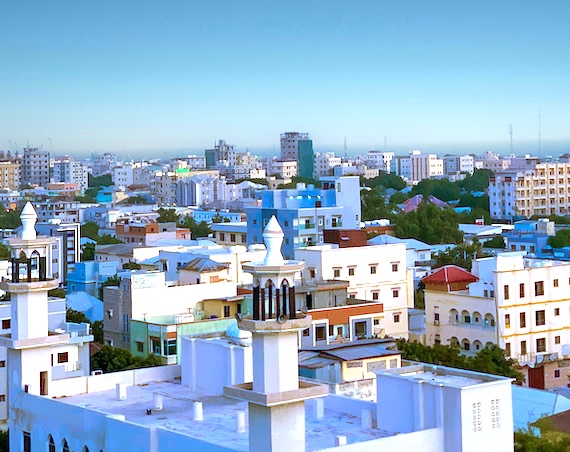
File photo of Mogadishu, August 8, 2024, by Abdullahi Maxamed ✪ on Unsplash
Bombing Somalia from the air is useless from a military history perspective. No guerrilla group in history has been defeated that way, and the bombing creates enormous resentments in the countryside because it kills innocent villagers and attendees at weddings. This tactic is how the US lost both Vietnam and Afghanistan. It is being done just to feed Trump’s inexhaustible narcissism.
In the meantime, the social and economic problems Somalia faces are being turbocharged by climate change, which Trump is promoting. If you don’t think these policies will create an anti-US backlash, you haven’t been paying attention.

 © 2026 All Rights Reserved