
Informed Comment (Ann Arbor) – Massive and unusual floods have inundated Morocco since late January.
Morocco had seven years of drought, and rainfall has declined 20% on average since 1980, so in theory the rains were welcome. But in several areas, they were so torrential that they caused heavy flooding, crop damage and some loss of life. The country has had to evacuate some 154,000 people. One dam is at 156% of its capacity, an extremely dangerous situation. The province of Larache has been especially hard hit.
Drought hardens the topsoil, making it less able to absorb the rains and so producing a heightened threat of run-off and flooding.
Middle East Monitor reports, “The [Interior] ministry said about 81,709 people were evacuated in Larache province, mainly in the city of Ksar el-Kebir, while 9,728 were evacuated in Sidi Kacem province, 2,853 in Sidi Slimane province and 14,133 in Kenitra province.”
The Moroccan government is having to distribute food for livestock to farmers because the floods swept away stored grain.
More heavy rain is expected today, Monday.
A study of similar torrential rains and flooding in South Africa this month found that “a 40% increase in the intensity of the rains would be impossible to explain without human-caused climate change.” That is, humans are burning coal, gas and petroleum, emitting potent greenhouse gases that are putting vast amounts of energy into the atmosphere and changing the way it works.
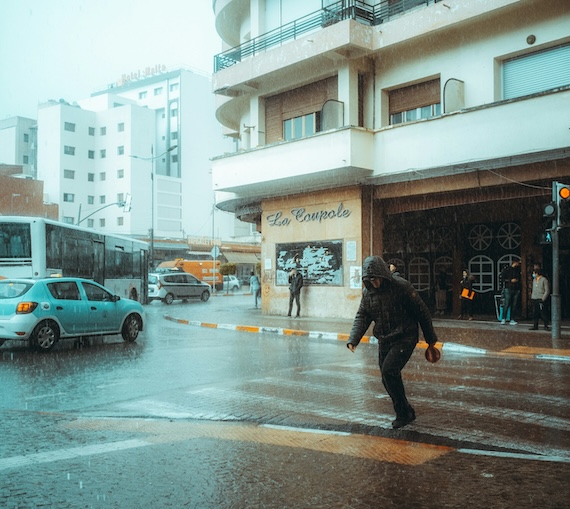
File photo of Meknes, Morocco, by othmane ferrah on Unsplash
Climate scientist François Gemenne, professor at the prestigious School of Higher Studies in Commerce (HEC) in Paris and director of the Hugo Observatory at Liège University in Belgium, explained to Africa Radio that these events are not simply bad weather but derive from a durable change in the climate of North Africa. He said that the whole Mediterranean region will be hit especially hard by climate change and that extreme weather, both intense and prolonged droughts and occasional downpours and flooding, are part of this change. They are two sides of the same coin, he said. He added that we are passing from a relatively stable climate system to an unstable one, where extreme weather events will multiply.
Gemenne estimated that migration from North Africa will rise by 15% to 30%. Moreover, Europe and the Mediterranean will see some areas become depopulated because of climate change while others will be more desirable. He seems to be hinting at massive internal migrations inside Europe. It isn’t just a matter of an influx of Africans.
Radio Africa’s commentator said that these enormous floods are a signal that governments need to increase their efforts toward resilience.

 © 2026 All Rights Reserved