
Ann Arbor (Informed Comment) – Russian Foreign Minister Sergei Lavrov said Monday, “If they [the Americans] thought they could subjugate [Iran] in a day or a few hours, they probably realise now just how seriously they miscalculated, how wrong they were.”
Last month Russian President Vladimir Putin sent condolences to his opposite number in Tehran over the Israeli-US assassination of Ayatollah Ali Khamenei, branding it a “cynical violation of all norms of human morality and international law.”
Russian officials, having been lambasted for four years over their mistakes in the Ukraine War and their failure to win a short, easy victory, and having suffered global stigmatization and sanctions as an aggressor, are clearly taking delight in the way in which Iran is turning into a quagmire for Washington. Their glee is underpinned by the significant wins that the Iran debacle is handing them.
Since February 2022, the major foreign policy priority of the United States had been to roll back the Russian invasion of Ukraine and its occupation of part of that country. Since the U.S. is a superpower, it has several big foreign policy goals, but Ukraine had been front and center. The US pressured Europe to step up to help Ukraine meet the challenge, and to wean itself off Russian petroleum and fossil gas.
Although the Trump administration is considerably less invested in pushing Russia out of Ukraine, even it has pressured Russia with continued sanctions, and last fall the Office of Foreign Asset Control in the Department of the Treasury was strong-arming India to reduce its oil imports from Russia.
Another important US foreign policy goal has been to support the Likud-led Israeli government’s genocide against the Palestinians in Gaza, the ethnic cleansing of indigenous people from the Palestinian West Bank, and the establishment of Israel’s hegemony over neighbors such as Syria, Lebanon and Iran. Tel Aviv has territorial designs on Syria and Lebanon. U.S. spokesmen typically deny that these are US goals. The US, however, tsupports them with billions of dollars in aid and active military cooperation. Sometimes you have to pay attention to what people do, not what they say.
Washington views Israel as the equivalent of a huge aircraft carrier in the Middle East, ensuring US domination of the region’s oil and gas and ensuring US trade through corridors such as the Suez Canal and the Strait of Hormuz. The US therefore grants Israel impunity for its war crimes and wars of aggression in the region, sort of the way the FBI protected gangster James “Whitey” Bulger in Boston from prosecution because, as a secret informant, he made himself useful in the pursuit of Italian and other organized crime figures.
Despite the vast wealth and military power of the United States, it is not omnipotent, and it does not have infinite resources. Prime Minister Benjamin Netanyahu’s insistence on launching a war on Iran, and the Trump administration’s acquiescence in its partner’s priorities, means that Washington does not have the same bandwidth in confronting Russian expansionism in Ukraine.
Given that Iran has closed the Strait of Hormuz to most petroleum and fossil gas exports, throttling the world’s energy and provoking energy crises and inflation globally, the US now desperately needs to reduce Iranian leverage. The only way to take the sting out of the impact of Iran’s scorched earth tactics in the Gulf is to find swing producers outside the region who can and will increase their exports.
Hence, the Trump administration suddenly issued a waiver on sanctions on Russian petroleum purchases to India, which has bought 20% of Russian oil since 2022. Other countries, including China and even the Philippines are lining up for Russian petroleum. China and India are two of the bigger customers for Russian petroleum.
Since Western Europe was never very interested in the Iran issue and they have invested a great deal in containing Russia, leaders such as German Chancellor Friedrich Merz and French President Emmanuel Macron slammed the US easing of sanctions on Russia. Macron said that the move was “in no way justified.”
So, American allies recognize very well the cost to the Ukraine issue of Trump’s budding quagmire in Iran.
Russia gains from the Israel-American war on Iran in other ways, as well. The struggle with Iran is depleting the American arsenal of some weapons and ammunition, which therefore will not be available to Ukraine.
Reuters quotes Maxim Petronevich from Rosselkhozbank as saying that “the closure of the Strait of Hormuz will have a positive impact on global prices for a wide range of Russian export goods, including oil, gas, coal, aluminium, fertilizers and wheat.”
This windfall will allow the Russian Central Bank to cut interest rates by 50 basis points to 15%, nearing the 12% level many observers feel is necessary to get the Russian economy growing more vigorously. Oil last fall at one point fell to under $50 a barrel, deeply hurting the Russian economy, which also suffers from severe US and European sanctions. Now, oil is more than twice that, and the longer the war on Iran continues, the higher oil prices will go and the longer they will stay at those highs. If the war begins damaging Gulf oil facilities, that will ensure that even once it ends they will not be able quickly to ramp back up production. Russia is the chief beneficiary of these developments.
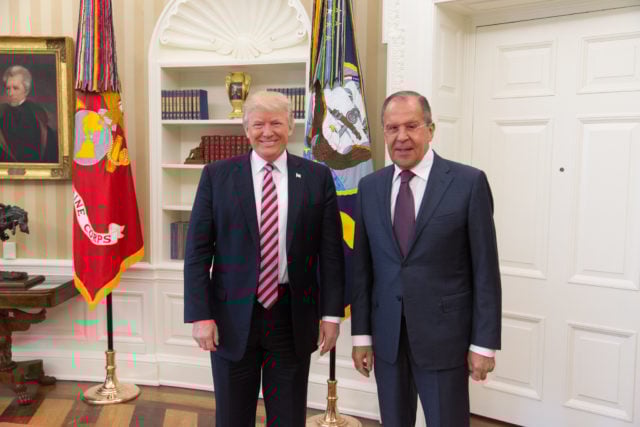
File photo: President Donald Trump speaks with Russian Foreign Minister Sergey Lavrov in the Oval Office, Wednesday, May 10, 2017, at the White House in Washington, D.C. (Official White House Photo by Shealah Craighead). Public Domain. Via Picryl
Likewise, Iran has ceased food exports to Central Asia for fear it may need the nutrition for its own population. Some Central Asian countries like Kyrgyzstan were trying to diversify away from heavy dependence on Russia for staples. Now, they will have no choice but to return to Moscow for some crops, making them dependent on it.
The US has sacrificed its interests in Europe for the sake of Israeli interests in Iran, interests that are in any case fanciful, since Iran posed no aggressive threat to Israel but only acted as a brake on expanding Israeli hegemony over other countries and peoples in the region. Future historians may see this moment as the beginning of the end of American superpower status.

 © 2026 All Rights Reserved