
Greenfield, Mass. (Special to Informed Comment; Feature) – Jane Goodall, the renowned primatologist and impassioned advocate for nature, founded in her later years an institute through which she launched Roots and Shoots. Young people in more than 60 countries were taught about preserving nature and how to work for environmental good in their communities. Because of her passionate mission to protect from the twin threats of the loss of biodiversity and climate change and her goal to “inspire hope and spark action in others,” especially young people, she was honored as a United Nations Messenger for Peace. Like Goodall, many young women’s groups across the United States have emerged as beacons of hope and are sparking action in others.
In Amherst, Massachusetts, a teen feminist group called Generation Ratify was launched to help endorse the Equal Rights Amendment and advance gender equality. They organized many rallies, three school walkouts, banner drops, film and art shops and lobbied at the state house. In July 2025, they joined with Young Climate Action Now to host Little Leader Convention for 10-to-13 -year-olds with the goal of empowering a new generation of ecofeminists. Recently they partnered with a national youth-led organization Feminist Front to form Feminist Generation. Their generation has lost the secure right to bodily autonomy; they inherit an Earth in climate failure and a country enroute to fascism. In 2026 the Amherst chapter of Feminist Generation will launch an initiative to promote youth voter engagement in the 2026 elections, research gender-based wage gaps in local government, and work with Planned Parenthood to implement a comprehensive sex education curriculum at Amherst Regional High School.
Behind the 2025 progressive wins in the states of Virginia and Pennsylvania were hundreds of young feminist organizers, mobilized and trained by Vote for Equality, the political arm of Feminist Majority. They organized on campuses in both states. Abigail Spanberger, a strong advocate for reproductive freedom, won as Virginia’s first woman governor, with 65% women voting for her and an unprecedented shift in the House of Delegates to a large majority of Democrats. In Pennsylvania, 3 progressive Supreme Court Justices who were instrumental in “safeguarding reproductive rights for Medicaid recipients through Pennsylvania’s Equal Rights Amendment” retained their seats. These young feminists are ready to build on their 2025 victories in 2026.
One of the newest young feminist groups is HerStory at Deerfield Academy in Deerfield, Massachusetts. Katie Kim a junior at the academy, re-named her women’s empowerment group of which she is president HerStory because she “can’t really think of a story in history where there’s no her in it.” All of the HerStory group concur that “a lot of social media influence the branding of feminism” as merely groups of women meeting to express “hatred of men” when that’s “totally not what we do,” they said. It’s more about supporting each other in our community and trying to have local impact. HerStory members see the true history of humankind, as one of partnership, gender partnership.
Bright Yang, a sophomore from China, explained his reasons for joining HerStory, namely that he “recognized how powerful women are.” He gave a “shout out to his mom” who has “played a great, great role” in developing his personality, guiding him through the isolation one can feel in boarding school, giving him ideas and “just happiness in general.” Drawn to Middle Eastern Studies and religion, he noted a similarity in Islam as practiced in Afghanistan and Christianity as practiced by Catholicism, the 2,000 year-old religion “that has so much difficulty merely recognizing women as equals” to make them priests, bishops, and ultimately Pope, though he stated, Afghanistan is much worse.
I asked Herstory members to explain their convictions about the statement, “Feminism is the route to peace” with which they ended my last meeting with them. They responded that at its core, feminism is about equality, dignity, and shared power–not just for women, but for everyone. The link to peace comes from a few main ideas. Equality reduces violence. Societies built on strict hierarchies (men over women, some groups over others) often normalize domination and force. Without embracing feminism, “our rights and voices remain disparaged, creating challenges and disputes,” responded Peggy Huang. Feminism promotes cooperation instead of control, dialogue instead of coercion, and respect instead of fear. These values are strongly associated with lower levels of violence—at home, in communities, and between nations.
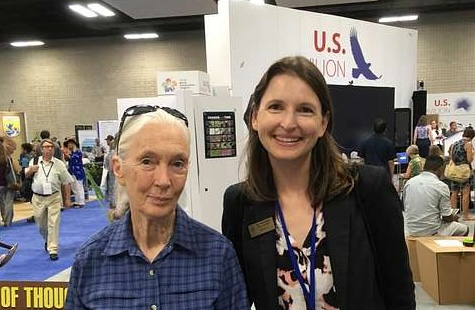
Jane Goodall and FS McArthur, 2016. US Department of Agriculture. Public Domain. Via Picryl
Research consistently shows that countries with higher gender inequality tend to have more internal conflict, more authoritarian leadership, and higher rates of violence overall, explained Katie Kim. Inclusive leadership leads to more peaceful outcomes. When women and marginalized groups are included in decision-making, peace agreements last longer, policies focus more on social well-being (health, education, stability), and conflict resolution emphasizes compromise rather than escalation. This isn’t because women are “naturally peaceful,” she added, but because diverse perspectives improve problem-solving.
Currently, Katie is organizing a poetry anthology project with local women empowerment organizations in Amherst. Through poetry–a simple, accessible literary form–she hopes to bring the current youth activists together fighting for the same cause and to foster tighter bonds with one another.
HerStory members are true Messengers for Peace.

 © 2026 All Rights Reserved