
Newark, Del. (Special to Informed Comment; Feature) – Since the brutal repression of the January 8-9 protests in Iran, those of us who live abroad have been numb. Witnessing an atrocity such as the one that took place is not even comprehensible.*
What we witnessed on videos that came out of Iran was horrific. People were gunned down in a systematic way during these protests on a scale unseen since the 1980s.
Scores of innocent people, most of them young, took to the streets and were gunned down mercilessly. To this day, the number of casualties remained unclear. Most observers have put the number of killed close to 6,000.
It is not just the numbers that are disturbing but the way in which the demonstrators were ambushed. No one knows who set fire to the bazaar in Rasht, killing hundreds and destroying the livelihood of so many people.
One eyewitness said,
- “A friend and I were on the street on Dey 18/ January 8th. Words can’t describe the horrors of that night in Khorramabad. The city was literally on fire. I know there are videos out there, but I don’t think videos can convey things the way they were.
“As for the numbers, I can’t take a guess but among the ones killed there’s one in our neighborhood. The family couldn’t collect the money they had been asked in exchange for the body so many people including me donated a small sum to help the family.”
Within the diaspora, on social media, we are also witnessing sharp and at times ugly disputes taking place. Supporters of the monarchy, many of them without any historical memory, blame the left and liberals for the Revolution that took place forty-seven years ago.
I remember anxiously waiting to go back to Iran in early 1979, ready to land at Tehran’s Mehrabad airport. The atmosphere was jubilant. Iran was being transformed. There were daily manifestations at the university, speeches by nationalists, leftists, Mojahedin and many others. People were cleaning their alleys and streets voluntarily.
In March of that year, I recall attending Dr. Mossadegh’s memorial in Ahmadabad alongside hundreds of thousands of people who had come by buses and by foot to honor him. Such a gathering had been banned since he was exiled by the Shah. An unforgettable day it was.
In every corner of Tehran, people held lively discussions. They called it Bahar-e Azadi (The spring of freedom), but before long it dissolved in a summer of terror. Most of the organizations which had supported the revolution, even the National Front, a moderate entity, were banned and called illegal. Many of their members were arrested and jailed.
It was now the rule of the clergy. Khomeini was surrounded by sycophants and at times by insane people like the hanging judge Khalkhali. Instead of going to Qom and becoming a religious mentor as he had promised, he watched the millions who came to greet him and decided to be the sole leader of a popular revolution. His supporters who believed in his anti-imperialist rhetoric soon became his enemies. Thus, they had to be eliminated.
When my father, who had become governor of Fars Province shortly after the Revolution, took his resignation to Khomeini, he told him, Mr. Khomeini you are taking this revolution towards a Na Koja Abad (nowhere land). In response he said, Mr. Amini, are you snubbing me? If I had snubbed the people, this revolution would not have happened.
So yes, it had gone to his head as they say.
That was the last meeting between the two men who had known each other from the small city of Khomein, the birthplace of Khomeini where my grandfather, a physician, had treated him some seventy years earlier.
The rest is history. We watched, bewildered, as Iran became an Islamic Republic, soon enforcing the hejab and soon instituting Islamic laws.
Over the years, many were arrested, tortured and executed.
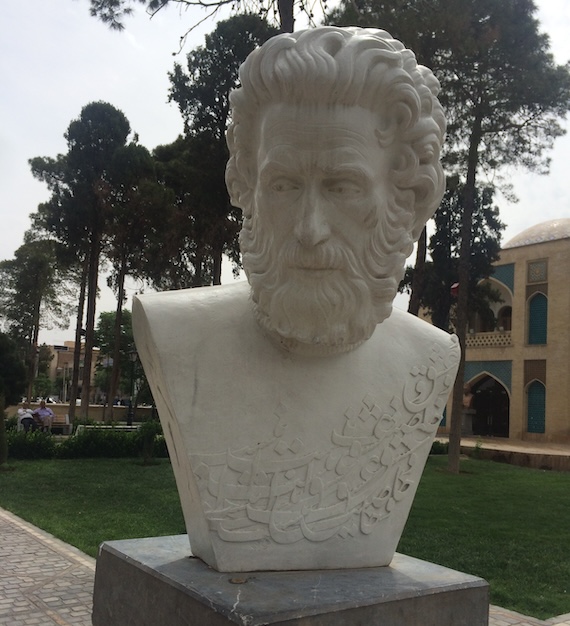
Poet Sohrab Sepehri’s statue in Kashan. © Fariba Amini.
The people who took to the streets last month, all over Iran, were not asking for much. They were unhappy with the status quo, with the devastating inflation, with the soaring food prices.
The US sanctions had crippled the economy, but it was not just the sanctions.
Why did Khamenei and his henchmen order such brutality vis-a-vis the Iranian people, just to stay in power? I just ask myself every day, how can Iranians kill other Iranians so viciously.
Many monarchists and their leader, Reza Pahlavi, have been supportive of an Israeli or American attack. Those who oppose such a move are now depicted by the Iranian Right as traitors to the cause.
The social media are now filled with cursing and name calling. There is now a clear and abhorrent division within the Iranian diaspora.
But inside Iran, the ones who have any wisdom and know the situation from within have vehemently objected to any outside interference, among them the Nobel Laureate, Narges Mohammadi.
If we look around, just in that corner of the world, that is the Middle East, democracy and the rule of law have not been achieved Chaos, anarchy, more killings, refugees, lawlessness have replaced autocratic regimes that fell.
Even if Iran is a nation state with an enormous wealth of educated people, a solid civil society, democracy will not rise from the ashes of war.
In Sohrab Sepehri’s words, the famous poet from Kashan, “Life is not empty, there is kindness, there is apple and there is faith.”
*This essay was slightly revised by the author for style from its initial posting.

 © 2026 All Rights Reserved